Russian Orthodox Convent of Saint Mary Magdalene
Seven gilded domes above Gethsemane, holding the Romanov martyrs' relics
Understand sacred places, explore living traditions, and learn how to engage respectfully with Pilgrim Map.
Access has not been verified. Check current local guidance before planning a visit.
Jerusalem, Jerusalem District, Israel
Read the sources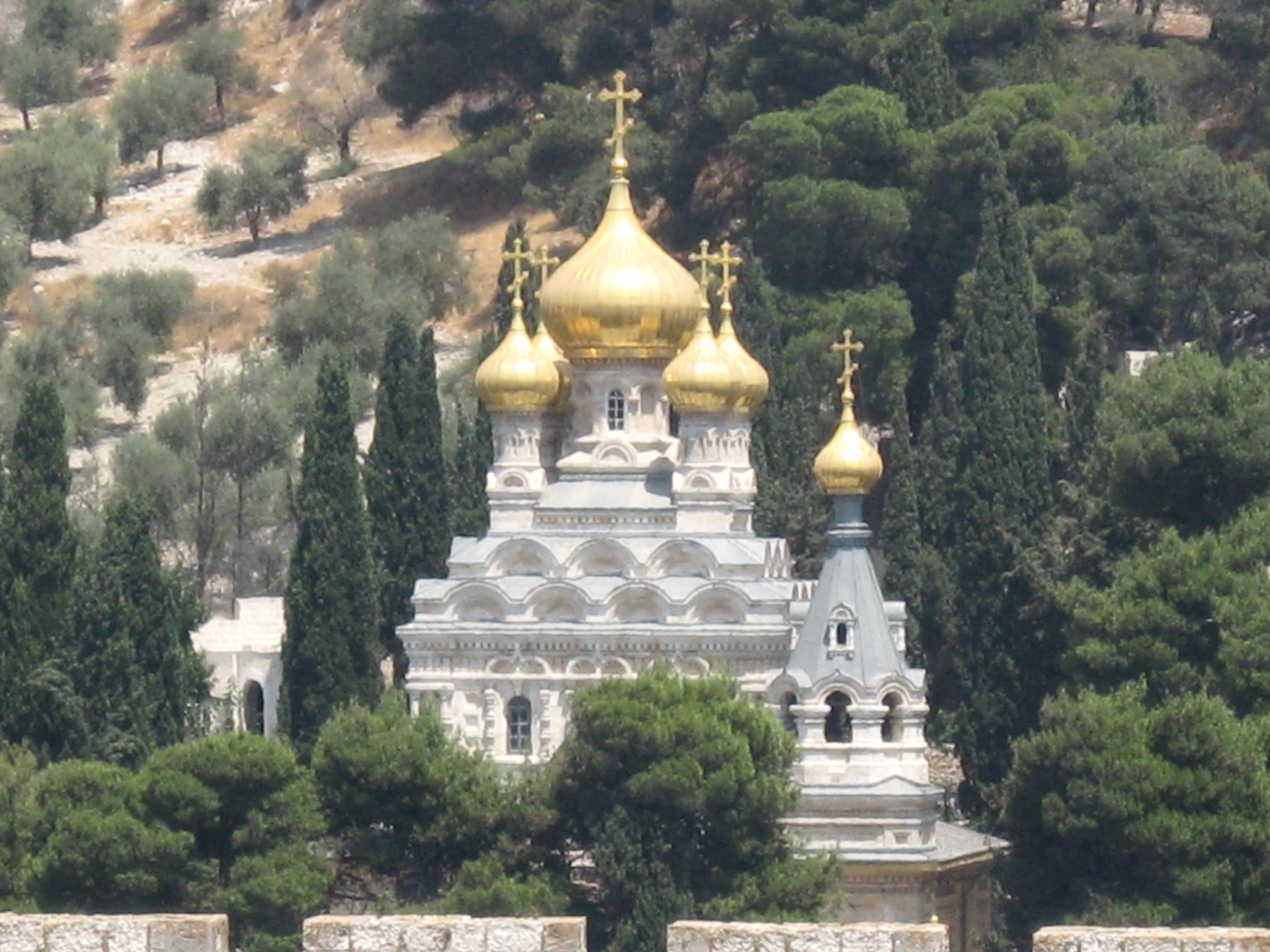
Image of Russian Orthodox Convent of Saint Mary Magdalene. Image source · CC-BY-3.0
Visit essentials
A quick read before you go
- Duration
- 30–45 minutes for the church and shrine.
- Access
- Western slope of the Mount of Olives in East Jerusalem, just above the Church of All Nations and…
Overview
The Convent of Saint Mary Magdalene rises on the western slope of the Mount of Olives, directly above the Garden of Gethsemane. Its seven gilded onion domes in 16th-century Muscovite revival style — a distinctly Russian profile in a city of domes — catch the late afternoon light from the Old City walls opposite.
Tsar Alexander III commissioned the church in 1885 as an act of filial piety, dedicating it to Saint Mary Magdalene, the heavenly patroness of his mother Empress Maria Alexandrovna. It was consecrated in 1888 in the presence of Grand Duke Sergei Alexandrovich and his wife Grand Duchess Elizabeth Feodorovna. Elizabeth, according to convent tradition, is said to have remarked at the consecration that she would like to be buried here.
After her own martyrdom at Alapaevsk in 1918, and the long journey of her relics through Russia, China, and Egypt, she was finally laid to rest in this church in 1921 — a wish fulfilled across three continents and a revolution. Today the convent is a working women's monastic community of around twenty nuns under the Russian Orthodox Church Outside Russia, with daily Divine Liturgy and the full cycle of the Hours.
Public visiting is limited; most groups are admitted only on Tuesday and Thursday mornings.
Why this place is sacred
The thinness of the Mary Magdalene convent has several layers. The Mount of Olives itself is one of the most densely venerated landscapes in Christianity — Gethsemane lies directly below, the Church of All Nations beside it, Dominus Flevit and the Pater Noster church above, the Tomb of the Virgin a short walk down.
The convent stands within that web, with a view across the Kidron Valley to the Old City and the Temple Mount that pilgrims have stood on for two millennia. Inside, the church holds the relics of two of the 20th century's most venerated Russian Orthodox saints: New Martyrs Elizabeth Feodorovna and Barbara, murdered together with other Romanovs in 1918 and brought to Jerusalem three years later.
For Russian Orthodox pilgrims this is both a Magdalene shrine and a sanctuary of the Romanov martyrology — a place where the wound of the 20th century is liturgically held. The monastic prayer that has continued in this church since the 1930s, through Mandate, Jordanian, and Israeli administrations, gives the building a particular kind of quietness.
Experience and orientation
Most pilgrims approach the convent either by walking down from the Mount of Olives summit past Dominus Flevit, or by climbing up from the Kidron Valley road past the Garden of Gethsemane. The grades are steep; allow time. The convent entrance opens onto a garden descending toward Gethsemane, with views across the Kidron to the Old City walls.
The church itself is small but luminous, with the iconostasis painted by Vasily Vereshchagin and the wall scenes by Sergei Ivanov — restrained Russian academic style of the 1880s rather than the abstracted forms of older Byzantine work. The shrine of Sts. Elizabeth and Barbara is the devotional focus; many Russian Orthodox pilgrims linger long here, often praying the akathist. The sisters keep the church in a stillness that is striking after the noise of the Kidron road below.
Stay in the public area; the monastic enclosure is not for visitors. After the church, the convent gardens reward an unhurried walk down toward the Gethsemane wall.
Western slope of the Mount of Olives, just above the Church of All Nations and the Garden of Gethsemane. Entrance through the convent gate; church interior accessible during public hours only; gardens descend toward Gethsemane.
Context and lineage
The church was built as an act of filial piety. Tsar Alexander III dedicated it to Saint Mary Magdalene, the heavenly patroness of his mother Empress Maria Alexandrovna, who had died in 1880. Construction was funded and administered through the Imperial Orthodox Palestine Society (IPPO), founded in 1882 as the principal vehicle for Russian Orthodox presence in the Holy Land.
The architect David Grimm worked in conscious revival of 16th-century Muscovite forms — seven gilded onion domes, kokoshniki, a distinctly Russian profile against the Jerusalem skyline. Consecration came on 1 October 1888 in the presence of Grand Duke Sergei Alexandrovich and his wife Grand Duchess Elizabeth Feodorovna. After the 1917 Revolution the Russian Orthodox presence in the Holy Land fractured. From 1921 the convent was administered by the Russian Orthodox Church Outside Russia (ROCOR), independent of the Moscow Patriarchate.
A women's monastic community grew on the site through the 1920s and 30s and was formally established as a convent in 1934. The 2007 Act of Canonical Communion returned ROCOR to communion with Moscow, and the convent continues under ROCOR jurisdiction today.
Eastern Orthodox Christianity, Russian Orthodox tradition. Administered by the Russian Orthodox Church Outside Russia (ROCOR), in communion with the Moscow Patriarchate since 2007. Distinct from the Moscow Patriarchate's properties in Jerusalem (Gornenskoye Convent at Ein Karem, Trinity Cathedral).
Tsar Alexander III
Imperial patron of the church (1885–1888), commissioned in memory of his mother Empress Maria Alexandrovna
Saint Elizabeth Feodorovna (Elisaveta Feodorovna)
Romanov grand duchess, founder of the Martha and Mary Convent in Moscow, martyred at Alapaevsk in 1918; her relics translated to this church in 1921; canonised by ROCOR (1981) and the Moscow Patriarchate (1992)
Nun Barbara (Varvara)
Elizabeth's companion-nun, martyred with her in 1918; relics enshrined alongside in this church
David Grimm
Russian architect of the church, working in 16th-century Muscovite revival style
Vasily Vereshchagin and Sergei Ivanov
Painters of the iconostasis (Vereshchagin) and interior wall paintings (Ivanov)
Traditions and practice
Divine Liturgy in Church Slavonic on Sundays and feasts; the daily Office in the catholicon; akathist to Sts. Elizabeth and Barbara; reading of the Psalter at the relics. The convent has maintained these rhythms uninterrupted since the 1930s, through Mandate, Jordanian, and Israeli administrations of East Jerusalem.
Around twenty sisters live the monastic life on the site, with stewardship of the gardens descending toward Gethsemane and reception of pilgrim groups during the limited public hours. The convent has historically kept a deliberately low public profile, both for monastic reasons and because of the security situation in East Jerusalem.
Visit during the regular public hours (traditionally Tuesday and Thursday mornings; always reconfirm). Enter the church quietly; women should cover their heads (scarves are provided). Move toward the shrine of Sts. Elizabeth and Barbara without crowding others praying there. Leave time for the gardens. If you are not Orthodox, you are welcome to pray and observe; do not enter the sanctuary behind the iconostasis.
For Orthodox pilgrims, the convent will accept a zapiska (a written request for prayer) for nominal donation; the sisters add these to the daily commemorations.
Eastern Orthodox Christianity (Russian Orthodox — ROCOR)
ActiveOne of the principal Russian Orthodox holy places in Jerusalem. Built as a memorial church by Tsar Alexander III for his mother; now both a working women's monastery and a martyr-shrine of the Romanov family, holding the relics of Sts. Elizabeth and Barbara, murdered at Alapaevsk in 1918 and translated to Jerusalem in 1921.
Daily Divine Liturgy and the full cycle of the Hours in Church Slavonic. Veneration of the relics of Sts. Elizabeth and Barbara. Feasts of Mary Magdalene (22 July / 4 August Old Style) and of Sts. Elizabeth and Barbara (5 / 18 July). Hospitality to Russian and pan-Orthodox pilgrims during limited public hours.
Perspectives and open questions
The convent sits within several distinct and sometimes overlapping ecclesial frameworks. Clarity about jurisdictional realities helps pilgrims navigate the layered Russian Orthodox presence in the Holy Land.
Scholarly perspective
The construction history is well-documented: Alexander III's commission in 1885, consecration in 1888, architect David Grimm working in 16th-century Muscovite revival. The translation of St. Elizabeth's relics from Alapaevsk via Beijing and Egypt to Jerusalem in 1920–21 is similarly secure in the historical record. The convent's ROCOR jurisdiction has been uncontested within Orthodoxy since the 2007 Act of Canonical Communion.
Living and traditional perspectives
Russian Orthodox tradition holds the convent as one of the foremost Russian holy places of the Holy Land, alongside the Trinity Cathedral compound (Moscow Patriarchate), Gornenskoye Convent at Ein Karem (Moscow Patriarchate), and Mamre. Sts. Elizabeth and Barbara are venerated as paradigmatic 20th-century martyrs, a witness to Christian endurance through the Russian catastrophe.
Alternative interpretations
Some Romanov-restorationist literature treats Elizabeth Feodorovna's tomb as a focus for monarchist devotion. This is a political-pious overlay rather than mainstream Orthodox teaching; the convent itself is careful to keep the saint's veneration focused on her witness rather than her dynastic position.
Open questions
The convent has often kept a deliberately low public profile. Some details of its 20th-century history — relations with British Mandate authorities, internal community life under Jordanian and then Israeli rule — are documented mainly in monastic memoirs rather than independent scholarship. Some interior icons and the precise inventory of the Elizabeth Feodorovna reliquary are described primarily in Russian-language monastic publications.
Plan your visit
Access and arrival
Western slope of the Mount of Olives in East Jerusalem, just above the Church of All Nations and the Garden of Gethsemane. Most pilgrims walk down from the Mount of Olives summit (Pater Noster / Ascension) past Dominus Flevit, or climb up from the Kidron Valley. Steep grades. No on-site parking; reach by walking, taxi, or organised tour. Mobile phone signal is generally available on the Mount of Olives slope but coverage can be patchy in the church grounds.
Check current access and security advisories with the convent or your tour operator before visiting.
No on-site accommodation. Pilgrim houses near the Old City (Christian Quarter) and on the Mount of Olives offer lodging; Russian Orthodox pilgrim accommodation is also available through the Russian Ecclesiastical Mission's properties (Moscow Patriarchate).
Respectful visit
Women: long skirt below the knee, head covering (scarves provided), no bare shoulders. Men: long trousers, no shorts, hats removed inside.
Forbidden inside the church without explicit permission from the abbess. Permitted outside in the gardens with discretion.
Candles, icon offerings, and donations to the convent for prayers (zapiski) accepted at the entrance.
Silence inside the church. No food or drink. Respect the monastic enclosure — only designated areas are open to visitors. The sanctuary behind the iconostasis is closed to all but clergy.
The Eucharist is reserved to Orthodox in good standing. Photography inside the church requires explicit permission from the abbess. Tour-group volume is not appropriate; pilgrims should arrange visits in advance for larger groups. Check the convent's status before visiting; closures occur with short notice during security tensions or major liturgical seasons.
Current practical details
Address
Jerusalem
Phone
Hours, fees, and access can change — verify on the official source before you travel. Practical details last checked Jun 2026.
Location
Map loads as you approach this section.
Pilgrim reflections
A portrait of encounter, not a score
Pilgrims describe what they felt, how present they could become, and whether the place would shape a journey. There are no stars and no ranking of traditions.
No reviewed reflections yet
The first pilgrims can help describe the character of being here.
Share a reflection
Available after an account-backed “Been there.” Every reflection is reviewed before publication.
Nearby sacred places
Explore other sacred places in the region. Proximity does not establish access or travel time; check each place’s guidance.


References
Sources consulted for this page. Source categories describe the publication, not a guarantee that every claim is verified. Traditional accounts and outside interpretations may differ.
- 01Convent of St. Mary Magdalene in Gethsemane — Russian Orthodox Church Outside Russia — ROCOR / Jerusalem MissionofficialOfficial ROCOR pages describing the convent's foundation, dependencies, and liturgical life.
- 02Imperial Orthodox Palestine Society — Historical Holdings — Imperial Orthodox Palestine Society (IPPO)officialFounded 1882; the IPPO funded Russian church-building in the Holy Land including Alexander III's commission for the Mary Magdalene church.
- 03Church of Mary Magdalene (Jerusalem) — Wikipedia — Wikipedia contributorsencyclopediaBuilt 1885–1888 by Tsar Alexander III in memory of his mother, Empress Maria Alexandrovna. Architect David Grimm. Seven gilded onion domes in 16th-c. Muscovite revival style.
- 04Grand Duchess Elizabeth Feodorovna of Russia — Wikipedia — Wikipedia contributorsencyclopediaRomanov grand duchess, founder of Martha and Mary Convent in Moscow, martyred at Alapaevsk (1918), canonised by ROCOR (1981) and by the Moscow Patriarchate (1992). Her relics and those of nun-martyr Barbara are enshrined in the Mary Magdalene church.
- 05Russian Ecclesiastical Mission in Jerusalem — Wikipedia — Wikipedia contributorsencyclopediaBackground on Russian Orthodox presence in the Holy Land from 1847; helps distinguish ROCOR vs Moscow Patriarchate properties.
- 06Mount of Olives — Encyclopædia Britannica — Encyclopædia Britannica editorsencyclopediaGeographic and historical context for the cluster of churches on the western slope (Gethsemane, Dominus Flevit, Pater Noster, Russian Mary Magdalene, Ascension).
- 07Russian Pilgrimage to the Holy Land — Library of Congress / academic surveys — Theofanis G. Stavrou; Elena Astafieva; et al.academicStandard scholarly literature on 19th-c. Russian pilgrimage networks, IPPO funding, and Romanov imperial patronage in Palestine.
- 08Church of Saint Mary Magdalene — See the Holy Land — Pat McCarthy, See the Holy LandguideReputable ecumenical pilgrim guide; accurate summary of architecture, history, current liturgical schedule (limited Tuesday/Thursday access).
- 09Church of Saint Mary Magdalene (Gethsemane) — OrthodoxWiki — OrthodoxWiki contributorsencyclopediaOrthodox-internal encyclopedia; jurisdiction history, feast days, current sisterhood.
Photo gallery
3 curated photos
Share a photo
Help visitors recognize Russian Orthodox Convent of Saint Mary Magdalene. Every submission is reviewed before publication.