Tomb of the Virgin
Where Mary's empty tomb draws Christians and Muslims into shared reverence across two millennia
Jerusalem, Jerusalem District, Israel
Plan this visit
Practical context before you go
Thirty to sixty minutes for the tomb itself. Add fifteen minutes for the walk from Lion's Gate through the Kidron Valley. If combining with adjacent sites—Garden of Gethsemane, Church of All Nations, Grotto of Gethsemane—allow two to three hours. A full pilgrimage circuit including the Mount of Olives sites (Church of Mary Magdalene, Dominus Flevit, Chapel of the Ascension) requires half a day.
The church entrance is located in the Kidron Valley at the foot of the Mount of Olives, immediately north of the Garden of Gethsemane. From the Old City, walk through Lion's Gate (St. Stephen's Gate) and descend into the valley—about ten minutes. From the Mount of Olives, descend the western slope toward Gethsemane. Taxis can drop visitors nearby. Public buses serve the Mount of Olives area but not the immediate site. There is no parking at the entrance. The church is generally open from 6:00 AM to 5:00 PM daily. Some sources indicate limited hours on certain days, particularly Tuesday afternoons. Verify current hours before planning your visit, especially if traveling specifically for this site. The church closes during certain liturgical services. There is no entrance fee. The site is an active place of worship, not a ticketed attraction. Accessibility is severely limited. The only entrance requires descending forty-seven Crusader-era stone steps with no elevator alternative. The steps are worn by centuries of foot traffic. The underground church has uneven stone floors. The edicule entrance requires bowing through a low doorway. This site cannot accommodate wheelchairs or mobility devices. Visitors with difficulty climbing stairs should consider this carefully.
The Tomb of Mary is an active multi-faith sanctuary requiring modest dress, quiet demeanor, and respect for ongoing worship. Shoulders and knees must be covered. Hats should be removed inside. Photography is permitted but should be discreet and never intrusive to worshippers.
At a glance
- Coordinates
- 31.7801, 35.2394
- Suggested duration
- Thirty to sixty minutes for the tomb itself. Add fifteen minutes for the walk from Lion's Gate through the Kidron Valley. If combining with adjacent sites—Garden of Gethsemane, Church of All Nations, Grotto of Gethsemane—allow two to three hours. A full pilgrimage circuit including the Mount of Olives sites (Church of Mary Magdalene, Dominus Flevit, Chapel of the Ascension) requires half a day.
- Access
- The church entrance is located in the Kidron Valley at the foot of the Mount of Olives, immediately north of the Garden of Gethsemane. From the Old City, walk through Lion's Gate (St. Stephen's Gate) and descend into the valley—about ten minutes. From the Mount of Olives, descend the western slope toward Gethsemane. Taxis can drop visitors nearby. Public buses serve the Mount of Olives area but not the immediate site. There is no parking at the entrance. The church is generally open from 6:00 AM to 5:00 PM daily. Some sources indicate limited hours on certain days, particularly Tuesday afternoons. Verify current hours before planning your visit, especially if traveling specifically for this site. The church closes during certain liturgical services. There is no entrance fee. The site is an active place of worship, not a ticketed attraction. Accessibility is severely limited. The only entrance requires descending forty-seven Crusader-era stone steps with no elevator alternative. The steps are worn by centuries of foot traffic. The underground church has uneven stone floors. The edicule entrance requires bowing through a low doorway. This site cannot accommodate wheelchairs or mobility devices. Visitors with difficulty climbing stairs should consider this carefully.
Pilgrim tips
- Shoulders and knees must be covered. Long pants or skirts below the knee for both men and women. Sleeves covering at least the shoulders—ideally short sleeves rather than sleeveless. Remove hats inside. Comfortable shoes are essential for the forty-seven stone steps and uneven surfaces within. Dress in layers; the underground temperature differs significantly from the Jerusalem heat above.
- Personal photography is permitted in most circumstances. Restrictions may apply during liturgical services—look for signs or follow the lead of regular visitors. No flash photography anywhere in the church, and particularly not in the edicule. Tripods and professional equipment may require permission. Photographing worshippers without consent is inappropriate regardless of regulations.
- Photography is generally permitted but may be restricted during services. Follow the lead of other visitors and any posted signs. Never use flash near icons or in the edicule itself. The site is an active place of worship, not a museum. Behavior that would be inappropriate in any sacred space—loud conversation, casual dress, disrespectful postures—is especially so here where actual devotion is occurring around you. Be aware that the Status Quo governs precise rights among denominations. Certain areas, certain times, and certain liturgical functions belong to specific churches. Visitors are guests in a carefully balanced arrangement; observation rather than intrusion is appropriate.
Overview
Descending forty-seven ancient steps into the rock beneath Jerusalem, pilgrims enter one of Christianity's most venerated spaces: the tomb where tradition holds the Virgin Mary was laid to rest before her assumption into heaven. This underground church in the Kidron Valley, also sacred to Muslims, pulses with the accumulated devotion of nearly two thousand years.
Beneath the Kidron Valley, where ancient stone steps descend into darkness, lies a tomb that has drawn the faithful for nearly two millennia. Not because a body remains, but precisely because one does not.
According to Eastern Christian tradition, the Virgin Mary died in the presence of the Apostles and was buried in this rock-cut chamber. When the tomb was opened three days later for the Apostle Thomas, it held only her burial shroud and the fragrance of flowers. Her body, like her son's, had been taken up.
The Church of the Sepulchre of Saint Mary wraps around this mystery. Gold and silver lamps hang in such profusion that the ceiling disappears into their glow. Icons crowd every surface, their painted faces reflecting centuries of candlelight. Incense hangs perpetually in air that has absorbed the prayers of countless pilgrims—Orthodox Christians and Armenian faithful, Syriacs and Copts, and Muslims who honor Maryam as the only woman named in the Quran.
This is not a museum. Daily liturgies still consecrate the space. Each August, thousands of Orthodox Christians process through Jerusalem's narrow streets at dawn, carrying the icon of the Dormition to this tomb. They come not to visit the past but to participate in a living mystery—the place where, in their understanding, heaven and earth touched.
Context and lineage
The canonical Gospels say nothing of Mary's death. This silence has allowed tradition to elaborate. According to accounts that crystallized by the fifth century, Mary spent her final years in Jerusalem, in a house on Mount Zion or possibly near the Garden of Gethsemane itself. When she sensed her death approaching, she summoned the Apostles, who were miraculously transported from their scattered missions to be with her.
Mary died peacefully in their presence—not a death of suffering but a 'falling asleep,' the Dormition. The Apostles carried her body to a tomb in Gethsemane, the garden where her son had begun his passion. They sealed the tomb and kept vigil.
Thomas arrived late. The Apostle who had needed to touch Christ's wounds needed also to see Mary one final time. When the other Apostles opened the tomb for him on the third day, they found it empty. Her burial cloths remained, suffused with the fragrance of flowers, but the body had been taken up. Christ had assumed his mother into heaven, body and soul.
This narrative carries the authority of antiquity without the verification of scripture. Patriarch Juvenal reported it to the Council of Chalcedon in 451 CE, and Emperor Marcian and Empress Pulcheria requested Mary's relics—only to learn that her body was no longer available. The burial shroud was sent to Constantinople, where it was venerated at the Church of Our Lady of Blachernae.
A competing tradition places Mary's final years in Ephesus, where John the Evangelist traveled and where she may have accompanied him. The House of the Virgin Mary near Ephesus claims to be where she lived and died, based partly on visions of Blessed Anne Catherine Emmerich. However, the Jerusalem tradition appears in earlier sources and has been more widely accepted in both Eastern and Western churches.
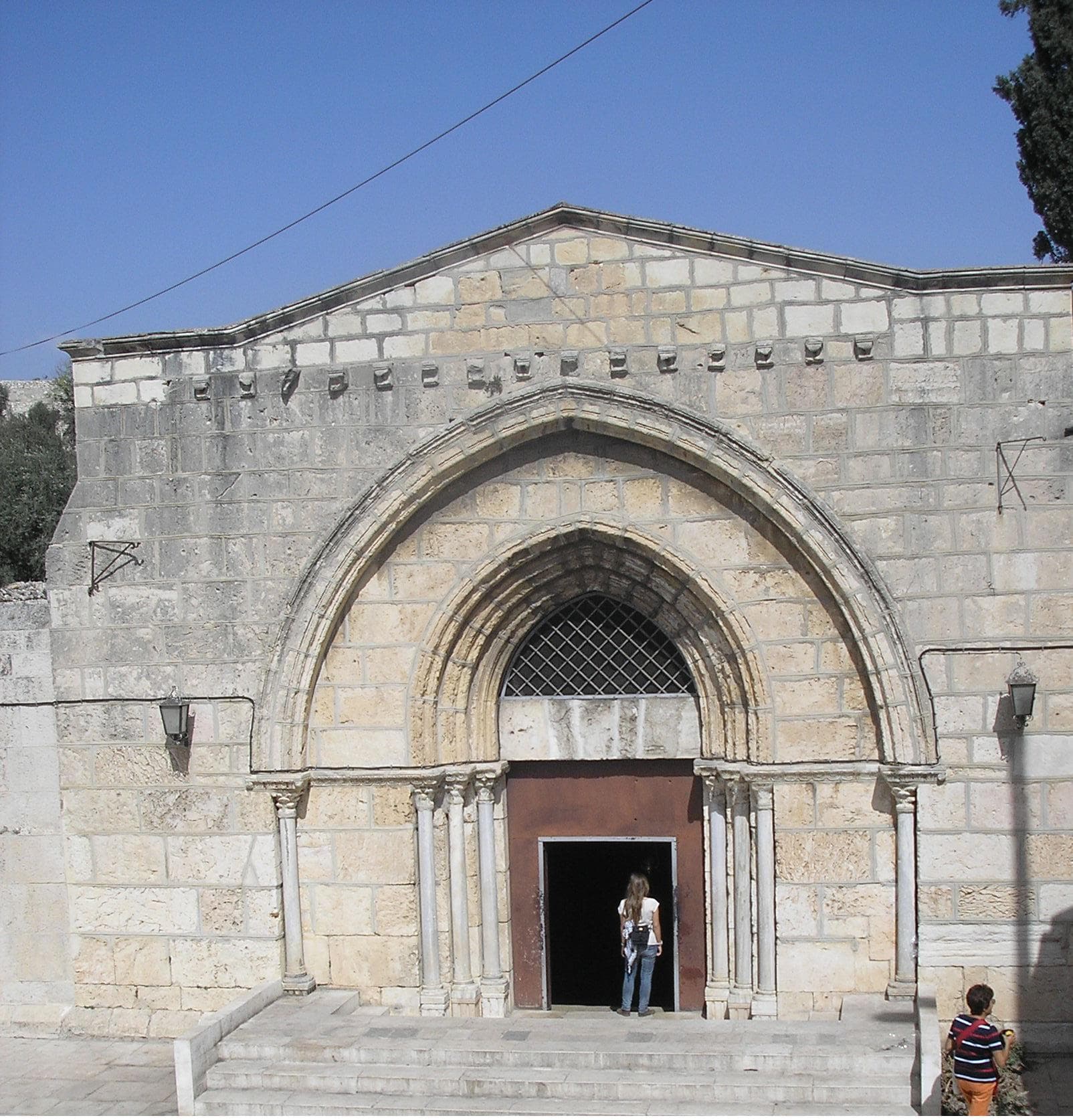
The physical site descends through a series of transformations. A first-century Jewish tomb became a place of Christian veneration—when exactly remains unclear. Patriarch Juvenal formalized this veneration with a church in the mid-fifth century. That church fell to the Persians in 614 CE, was rebuilt, and fell again to Caliph al-Hakim in 1009. The Crusaders constructed the present structure in 1130, establishing a Benedictine abbey that endured until Saladin's conquest.
After 1187, the site passed through Muslim, then Franciscan (from 1363), then Orthodox administration. The Greek Orthodox and Armenian Orthodox churches assumed joint control in 1757 under the Status Quo arrangement that still governs Jerusalem's holy sites. Syriac, Coptic, and Ethiopian Orthodox churches hold minor rights.
Through every transition, pilgrimage continued. The physical custodians changed; the practice of veneration did not. Today's pilgrim descends the same rock-cut stairs that pilgrims have walked for nine centuries, entering a space whose fundamental purpose has remained constant: to honor the place where Mary was buried and from which she was assumed into heaven.
Virgin Mary
holy_figure
The mother of Jesus Christ (in Christian understanding) or the Prophet Isa (in Islamic understanding). According to tradition, she was buried in this tomb before her bodily assumption into heaven. She holds unique significance as the only woman named in the Quran, where an entire surah bears her name.
Patriarch Juvenal of Jerusalem
historical
The patriarch who built the first church over Mary's tomb between 450 and 458 CE. His testimony at the Council of Chalcedon (451 CE) provides the earliest official church confirmation of the site, including the account of the empty tomb discovered on the third day.
Queen Melisende of Jerusalem
historical
Crusader queen who ruled Jerusalem from 1131 to 1153. Under her patronage, the Benedictines rebuilt the church and established the Abbey of St. Mary of the Valley of Jehoshaphat in 1130. She herself was buried at the site in 1161.
Saladin
historical
The sultan who conquered Jerusalem in 1187, destroying the upper Crusader church but deliberately preserving the lower tomb out of respect for Mary's place in Islam. He installed the mihrab that remains today, enabling Muslim worship at the site.
Why this place is sacred
In the vocabulary of Celtic spirituality, thin places are locations where the distance between earth and heaven seems diminished—where something transcendent becomes accessible. The Tomb of Mary embodies this thinness in literal geography: a descent into the earth that leads, tradition holds, to an ascent into heaven.
The Apostles who carried Mary's body here expected burial. What they found three days later defied expectation. According to the account given by Patriarch Juvenal to the Council of Chalcedon in 451 CE, the tomb held only her burial garments. The body had been taken up—assumed into the heaven her son had entered before her.
This narrative gives the site its power. Here is not merely where Mary was buried but where the resurrection promised to all believers was demonstrated in her. Eastern Orthodox theology calls this the Dormition—the 'falling asleep'—emphasizing that Mary's death was not ending but transition. Her body's disappearance from this tomb prefigures what Christians hope awaits every faithful person.
The thinness is amplified by the site's location. Gethsemane surrounds it—the garden where Jesus prayed before his arrest, where the weight of what was coming pressed so heavily that sweat fell like blood. To pass from Gethsemane to Mary's tomb is to trace a path from agony to hope, from an unfulfilled prayer to a completed promise.
Archaeological investigation in 1972 by Bellarmino Bagatti found evidence of a first-century Jewish cemetery here. The tomb itself conforms to burial practices of that period. Whether or not one accepts the traditional identification, the physical space dates to the time tradition assigns to it.
Islamc veneration adds another layer to the site's thin quality. According to tradition, the Prophet Muhammad saw a light illuminating this tomb during his Night Journey to Jerusalem. The mihrab installed after Saladin's conquest in 1187 indicates Mecca's direction, allowing Muslim prayer at a Christian shrine. Mary transcends the boundaries between traditions, and so does this place where she was buried.
The tomb itself originated as a first-century Jewish rock-cut burial cave, one of many in a necropolis on the hillside above the Kidron Valley. At some point—tradition does not specify exactly when—Christians identified this particular chamber as the burial place of Mary. By the fifth century, Patriarch Juvenal had constructed a church above it, creating a space specifically designed to honor Mary's departure from earth and arrival in heaven. The architectural form—a descent into darkness that leads to an empty tomb—mirrors the theological content: death as doorway rather than destination.
The church's physical form has been shaped by conquest and devotion in roughly equal measure. The Byzantine church built by Patriarch Juvenal fell to Persian invasion in 614 CE. Rebuilt, it fell again to Caliph al-Hakim in 1009. The Crusaders constructed the current structure in 1130, including the forty-seven-step staircase and the abbey above. When Saladin conquered Jerusalem in 1187, he destroyed the upper church but deliberately preserved the lower tomb—recognizing its sanctity in Islam even as he defeated its Christian defenders.
The Franciscans administered the site from 1363 until 1757, when Greek Orthodox and Armenian Orthodox churches assumed joint control under the Status Quo that still governs Jerusalem's holy sites. Each transition has left its mark. Icons from multiple centuries crowd the walls. The ceiling is blackened by the candle smoke of ages. The edicule surrounding the tomb resembles that at the Church of the Holy Sepulchre—both were fashioned by cutting away surrounding rock to isolate the sacred chamber within.
What persists through every change is the practice of veneration. Pilgrims descend the same steps. They bow to enter the same low door. They pray at the same stone bench where Mary's body is believed to have lain. The physical form has varied; the devotion has not.
Traditions and practice
The Feast of the Dormition represents the liturgical culmination of devotion at this site. Beginning August 1, Orthodox Christians observe a fourteen-day fast preparing for the feast. On the morning of August 15 (or August 28 in churches following the Julian calendar), a solemn procession departs at dawn from the Metochion of Gethsemane—a small monastery opposite the Church of the Holy Sepulchre. Nuns from Orthodox communities throughout Jerusalem walk with candles and flowers, accompanying the icon of the Dormition through the narrow streets of the Old City.
The icon remains at the tomb throughout the feast period. On the Leave-taking (Apodosis) of the Dormition eight days later, another procession returns it to its home. Divine Liturgy celebrates both the arrival and departure.
Regular Orthodox services continue throughout the year according to the Jerusalem Typikon. The Greek Orthodox Church maintains primary liturgical responsibility, with Armenian Orthodox sharing governance rights. Services occur in Greek, Arabic, and Armenian. The liturgical cycle incorporates this specific tomb into the broader commemoration of Mary's dormition and assumption.
For most visitors, engagement takes simpler forms than formal liturgy. Pilgrims descend the stairs, venerate the icons, light candles, and pray. Entry to the edicule itself involves bowing through the low doorway and spending a few moments at the stone bench where Mary's body is believed to have lain. Many touch the stone or lay objects against it—rosaries, icons, photographs—seeking blessing by contact.
Muslim visitors pray at the mihrab in the southwestern wall. The direction toward Mecca allows them to honor Maryam while fulfilling Islamic prayer requirements. This dual use of the space—simultaneous Christian and Muslim veneration of the same figure—creates an atmosphere of interfaith presence unusual among Jerusalem's holy sites.
Pilgrimage groups often incorporate the tomb into broader Mount of Olives circuits that include the Garden of Gethsemane, Church of All Nations, and other sites associated with Jesus's final days. For many, the Tomb of Mary completes a narrative: from agony in the garden to burial and resurrection nearby, and here the promise of that resurrection extended to one who believed.
Enter slowly. The sensory saturation can overwhelm; let it settle before trying to interpret. Pause on the stairs to mark the transition from ordinary time.
If you light a candle—which the site encourages—let it carry genuine intention rather than habitual gesture. Traditional Orthodox practice involves silent prayer while placing the candle and crossing oneself. If this form feels foreign, simply let the flame represent something you carry.
Waiting in the queue for the edicule offers time for inner preparation. When you enter, the instinct may be to photograph or to rush. Resist both. A few moments of stillness in that small space, with the stone bench before you, offers something no photograph can capture.
If you come from outside the traditions that venerate Mary—or outside any religious tradition—you can still engage meaningfully. Mary represents something that transcends doctrine: a figure of faith under impossible circumstances, a mother's grief and a mother's hope, the possibility that death is not final. Bring whatever aspect of that resonates with your own life.
Eastern Orthodox Christianity
ActiveThe Tomb of Mary ranks among Eastern Orthodoxy's most sacred Marian sites. Orthodox theology teaches that Mary died a natural death—the Dormition or 'falling asleep'—her soul was received by Christ, and her body was resurrected on the third day and assumed into heaven. The empty tomb discovered by the Apostles confirms this understanding. The Greek Orthodox Church holds primary custody alongside the Armenian Orthodox Church.
The Greek Orthodox Church conducts regular liturgical services following the Jerusalem Typikon. The Feast of the Dormition (August 15/28) is the liturgical climax, preceded by fourteen days of fasting. At dawn on the feast day, a procession carries the icon of the Dormition from the Old City to the tomb, where it remains throughout the feast period. Another procession returns it on the Apodosis eight days later. Pilgrims venerate the tomb, light candles, and pray for Mary's intercession throughout the year.
Armenian Apostolic Christianity
ActiveThe Armenian Orthodox Church shares joint ownership of the Tomb of Mary with the Greek Orthodox Church since 1757. The site represents a precious connection to Christianity's origins for a people who consider themselves the first Christian nation. The throne of St. Joseph within the church holds particular Armenian significance.
Armenian clergy participate in the governance and liturgical life of the shrine. Armenian altars and icons occupy designated spaces within the church. Armenian Orthodox pilgrims venerate the tomb according to their liturgical calendar and traditions.
Islam
ActiveMary (Maryam) holds unique status in Islam as the only woman named in the Quran, with Surah 19 bearing her name. She represents the ideal of piety and submission to God. The tomb is sacred because, according to tradition, the Prophet Muhammad saw a light illuminating it during his Night Journey to Jerusalem. Even during the bloodiest Crusader conflicts, Muslim soldiers honored Maryam by not desecrating her tomb.
A mihrab indicating the direction of Mecca was installed in the southwestern wall after Saladin's conquest in 1187, enabling Muslim prayer at the site. While Muslims no longer hold formal ownership rights, they continue to venerate and pray at the tomb. Maryam serves as an exemplar of chastity, purity, and complete devotion to God.
Roman Catholicism
HistoricalCatholics hold that Mary was 'assumed' into heaven in bodily form—a dogma defined by Pope Pius XII in 1950. While the tradition shares much with Orthodox teaching, the Franciscans who administered this site from 1363 were expelled in 1757. Today, the Dormition Abbey on Mount Zion serves as the primary Catholic Marian shrine in Jerusalem. Catholic pilgrims visit the tomb but formal Catholic liturgies do not occur here.
Catholic pilgrims venerate the site as an ancient tradition of Mary's burial, though their formal liturgical connection is now to Dormition Abbey. The Feast of the Assumption on August 15 is a holy day of obligation for Catholics worldwide, connecting global celebration to this site's narrative even if liturgically centered elsewhere.
Syriac Orthodox Christianity
ActiveThe Syriac Orthodox Church holds minor rights at the Tomb of Mary, maintaining an altar on the west side. This reflects their ancient Christian heritage in the Middle East, predating the divisions that separated Eastern and Western Christianity.
Syriac Orthodox clergy conduct services at their designated altar. Pilgrims from the Syriac tradition—concentrated in the Middle East and diaspora communities—venerate the tomb as part of their Holy Land pilgrimage.
Coptic Orthodox Christianity
ActiveThe Coptic Orthodox Church of Alexandria holds minor rights at the tomb, reflecting Egyptian Christianity's ancient Marian devotion. Coptic tradition includes accounts of the Holy Family's flight to Egypt, creating a distinct connection between Egypt and Mary's story.
Coptic Orthodox pilgrims visit and venerate the tomb as part of Holy Land pilgrimage. The Copts participate in the shared governance of minor rights alongside Syriac and Ethiopian Orthodox churches.
Ethiopian Orthodox Christianity
ActiveThe Ethiopian Orthodox Church holds minor rights, maintaining an altar and cistern in the west apse. Ethiopia's Christian tradition dates to the fourth century, with strong Marian devotion central to its spirituality.
Ethiopian Orthodox clergy maintain their altar space. Ethiopian pilgrims—many traveling great distances from one of Africa's oldest Christian nations—venerate the tomb as a culmination of Holy Land pilgrimage.
Experience and perspectives
The first experience is descent. Forty-seven Crusader-era steps carry you down into the hillside, leaving Jerusalem's noise and light behind. Sealed windows line the stairway—blocked against the floods that periodically sweep the Kidron Valley. Two small chapels punctuate the journey: one honoring Mary's parents Anne and Joachim, another her husband Joseph. Then the stairs end and you enter darkness.
But not emptiness. The underground church is saturated with presence. Gold and silver oil lamps hang by chains from the blackened ceiling—hundreds of them, some bearing eggshells atop their frames to deter rats from climbing down. Their light multiplies in the icons that cover every wall: Eastern Orthodox images with their gold leaf and penetrating gazes, accumulated over centuries of devotion. Incense hangs perpetually in the air, mixing with the smoke of candles lit by generations of pilgrims.
The edicule housing Mary's tomb stands at the eastern end. It is small—perhaps ten feet in circumference and eight feet high. You must bow to enter through the low doorway. Inside, the space is intimate, almost cramped. A stone bench marks where Mary's body is believed to have lain. The decoration is simpler here than in the church beyond: bare rock, candlelight, the silence of the tomb.
Visitors describe the experience in varied language. Some speak of peace—not passive calm but something alert, focused, attentive. Others report a sense of presence that transcends the visible crowd of pilgrims and tourists. The darkness, the sensory saturation, the knowledge of what is believed to have happened here—these combine into something greater than their sum.
Those who remain still long enough often notice the multi-layered quality of the devotion surrounding them. Orthodox pilgrims crossing themselves and kissing icons. Muslims praying toward the mihrab in the southwestern wall. The murmur of different languages offering prayers to the same figure—or perhaps not quite the same figure, but overlapping understandings of a woman who transcends the categories that divide traditions.
The most common note in visitor accounts is a sense of profound antiquity. To stand here is to stand where fifth-century Christians stood, where Crusaders stood, where pilgrims have stood continuously through conquests and earthquakes and wars. The stones have absorbed centuries of prayer. Something of that accumulated intention seems to remain.
Approach the Tomb of Mary as you would any living sanctuary—which it is. This is not a heritage site waiting to be documented but an active place of worship where devotion occurs daily.
If possible, arrive early morning when the space holds fewer tourists and the possibility of witnessing liturgical services is greater. The walk from Lion's Gate through the Kidron Valley takes only ten minutes but offers essential transition time. Let the descent down the steps be deliberate rather than rushed. Each step carries you further from ordinary time.
Consider what you bring to this encounter. A question, perhaps—something genuinely unsettled in your life that might benefit from Mary's reputed intercession, or simply from contemplation in sacred space. You need not hold any particular belief about the tomb's authenticity or Mary's assumption; you only need to be present to what arises.
The edicule will likely have a queue. Use the waiting time not for impatience but for preparation. When your turn comes and you bow through that low doorway, let the posture mean something. The humility the architecture requires is not accidental.
The Tomb of Mary invites interpretation from multiple frameworks—scholarly, traditional, and alternative—each offering genuine insight while holding genuine limitations. To engage honestly with this site means holding these perspectives together without forcing premature resolution.
Archaeological excavation by Franciscan friar Bellarmino Bagatti in 1972 found evidence of a first-century Jewish cemetery at the site. The tomb itself conforms to burial practices of that period—rock-cut chambers with stone benches for laying out bodies. However, Bagatti's findings have not been subject to peer review by the broader archaeological community, and his conclusions about the specific identification with Mary's burial remain matters of interpretation rather than proof.
Historians note that documented sources for the Jerusalem tradition begin in the fourth to fifth centuries CE. The earliest substantial text is the apocryphal Book of John about the Dormition of Mary. Patriarch Juvenal's testimony at Chalcedon (451 CE) provides the earliest official church confirmation. Whether an authentic tradition was transmitted orally during the intervening centuries, or the tradition developed later and was projected backward, scholarly opinion divides.
The competing Ephesus tradition—which places Mary's final years and death in what is now Turkey—also has ancient roots but appears in later sources. John the Evangelist did travel to Ephesus, and the House of the Virgin Mary there attracts its own pilgrims. Most scholars consider both traditions plausible without decisive evidence for either.
For Eastern Orthodox Christians, the Tomb of Mary is not merely an ancient site but a place where heaven touched earth. The Theotokos—the 'God-bearer'—completed her earthly life here and was received into the glory her son had prepared. The empty tomb prefigures the resurrection promised to all believers. To pray here is to participate in that hope.
The Armenian Apostolic Church shares this understanding and joint custody of the site. For Armenian Christians, often described as the first Christian nation, Jerusalem's holy sites represent precious connections to Christianity's origins—preserved through centuries of exile and genocide.
For Muslims, Maryam holds unique status. She is the only woman named in the Quran, with an entire surah (Chapter 19) devoted to her story. She represents chastity, piety, and absolute submission to God's will. The Prophet's vision of light over her tomb during the Night Journey (Isra and Mi'raj) sanctified this place for Islam. Saladin's preservation of the tomb—even as he destroyed the Crusader structures above—reflects this reverence.
For Palestinian Christians, many of whom trace their presence in this land to the earliest church, the Tomb of Mary represents ancestral faith made tangible. They are not visitors to these sites but inheritors of a continuous tradition stretching back two millennia.
Some visitors approach the Tomb of Mary through the framework of 'energy' or 'earth mysteries'—understanding sacred sites as locations where geomagnetic or spiritual forces concentrate. The site's position near geological fault lines and water sources (the Kidron Valley functions as a watershed) aligns with patterns observed at other ancient sacred sites.
These interpretations lack archaeological support and find no place in traditional Christian or Islamic teaching. However, they often emerge from genuine experiences visitors report: a sense of presence, unusual emotional responses, or perceptions of the space's charged quality. The language of 'energy' may be an attempt to articulate something real for which conventional vocabulary falls short.
Marian apparition traditions—in which the Virgin Mary appears to believers at various locations—have not centered on this tomb. The major Marian apparition sites (Lourdes, Fatima, Guadalupe, Medjugorje) are elsewhere. The tomb functions more as memorial than apparition site.
Genuine mysteries surround the site. When exactly did Christians begin venerating this particular tomb as Mary's burial place? The gap between Mary's death (traditionally dated to around 41-48 CE) and the earliest documented veneration (fourth-fifth century) leaves room for both authentic tradition and later development.
What is the status of Bagatti's 1972 archaeological findings, conducted during flooding that briefly exposed otherwise inaccessible areas? The lack of peer review leaves his conclusions neither confirmed nor refuted.
What happened to Mary's burial shroud, reportedly sent to Constantinople in 452 CE? The Church of Our Lady of Blachernae, which housed it, no longer exists. Various relics claiming connection to Mary exist in churches across Christianity, but none with confirmed provenance to the Jerusalem tomb.
Most fundamentally: what actually happened here? The tomb's emptiness is the tradition's central claim, but its interpretation—resurrection, assumption, removal by other means, or later development of narrative—remains beyond historical verification. The uncertainty is not a defect but an invitation: to hold mystery rather than resolve it prematurely.
Visit planning
The church entrance is located in the Kidron Valley at the foot of the Mount of Olives, immediately north of the Garden of Gethsemane. From the Old City, walk through Lion's Gate (St. Stephen's Gate) and descend into the valley—about ten minutes. From the Mount of Olives, descend the western slope toward Gethsemane. Taxis can drop visitors nearby. Public buses serve the Mount of Olives area but not the immediate site. There is no parking at the entrance.
The church is generally open from 6:00 AM to 5:00 PM daily. Some sources indicate limited hours on certain days, particularly Tuesday afternoons. Verify current hours before planning your visit, especially if traveling specifically for this site. The church closes during certain liturgical services.
There is no entrance fee. The site is an active place of worship, not a ticketed attraction.
Accessibility is severely limited. The only entrance requires descending forty-seven Crusader-era stone steps with no elevator alternative. The steps are worn by centuries of foot traffic. The underground church has uneven stone floors. The edicule entrance requires bowing through a low doorway. This site cannot accommodate wheelchairs or mobility devices. Visitors with difficulty climbing stairs should consider this carefully.
Jerusalem offers accommodation at all price points. The Old City provides the most immediate access to holy sites, with guesthouses and hostels within walking distance of Lion's Gate. The Mount of Olives has smaller options, some with views across to the Old City walls. West Jerusalem offers larger hotels with easy taxi access. Many Christian pilgrimage groups stay at religious guesthouses affiliated with their denomination. For longer visits, the Austrian Hospice and Notre Dame of Jerusalem Center offer mid-range options near the Old City.
The Tomb of Mary is an active multi-faith sanctuary requiring modest dress, quiet demeanor, and respect for ongoing worship. Shoulders and knees must be covered. Hats should be removed inside. Photography is permitted but should be discreet and never intrusive to worshippers.
Shoulders and knees must be covered. Long pants or skirts below the knee for both men and women. Sleeves covering at least the shoulders—ideally short sleeves rather than sleeveless. Remove hats inside. Comfortable shoes are essential for the forty-seven stone steps and uneven surfaces within. Dress in layers; the underground temperature differs significantly from the Jerusalem heat above.
Personal photography is permitted in most circumstances. Restrictions may apply during liturgical services—look for signs or follow the lead of regular visitors. No flash photography anywhere in the church, and particularly not in the edicule. Tripods and professional equipment may require permission. Photographing worshippers without consent is inappropriate regardless of regulations.
Candles can be purchased and lit as offerings. This is the primary form of visitor offering and is encouraged. Monetary donations support the maintenance of the church. Physical offerings left at the tomb—flowers, icons, photographs—are generally accepted but may be cleared periodically. If ceremony beyond candle-lighting is important to you, speak with clergy about appropriate possibilities.
No food or drink inside the church. No smoking. No large bags—leave them at your accommodation or in storage at the entrance. Access to some areas may be restricted during services or for denominational reasons under the Status Quo. The site is not wheelchair accessible; the forty-seven stairs have no alternative. Visitors with mobility limitations should be aware that descent requires navigating significant elevation change on stone steps.
Plan your visit
Address
Jerusalem
Hours, fees, and access can change — verify on the official source before you travel. Practical details last checked Jun 2026.
Nearby sacred places
Sacred places within a half-day’s reach. Pilgrims often visit them together: walk one, stay for the other.



Key questions
What pilgrims usually ask
- Why is Tomb of the Virgin considered sacred?
- Explore the Church of the Sepulchre of Saint Mary in Jerusalem, where tradition holds Mary was buried and assumed into heaven. A sacred site for Christians and
- What should I wear at Tomb of the Virgin?
- Shoulders and knees must be covered. Long pants or skirts below the knee for both men and women. Sleeves covering at least the shoulders—ideally short sleeves rather than sleeveless. Remove hats inside. Comfortable shoes are essential for the forty-seven stone steps and uneven surfaces within. Dress in layers; the underground temperature differs significantly from the Jerusalem heat above.
- Can I take photos at Tomb of the Virgin?
- Personal photography is permitted in most circumstances. Restrictions may apply during liturgical services—look for signs or follow the lead of regular visitors. No flash photography anywhere in the church, and particularly not in the edicule. Tripods and professional equipment may require permission. Photographing worshippers without consent is inappropriate regardless of regulations.
- How long should I spend at Tomb of the Virgin?
- Thirty to sixty minutes for the tomb itself. Add fifteen minutes for the walk from Lion's Gate through the Kidron Valley. If combining with adjacent sites—Garden of Gethsemane, Church of All Nations, Grotto of Gethsemane—allow two to three hours. A full pilgrimage circuit including the Mount of Olives sites (Church of Mary Magdalene, Dominus Flevit, Chapel of the Ascension) requires half a day.
- How do you visit Tomb of the Virgin?
- The church entrance is located in the Kidron Valley at the foot of the Mount of Olives, immediately north of the Garden of Gethsemane. From the Old City, walk through Lion's Gate (St. Stephen's Gate) and descend into the valley—about ten minutes. From the Mount of Olives, descend the western slope toward Gethsemane. Taxis can drop visitors nearby. Public buses serve the Mount of Olives area but not the immediate site. There is no parking at the entrance. The church is generally open from 6:00 AM to 5:00 PM daily. Some sources indicate limited hours on certain days, particularly Tuesday afternoons. Verify current hours before planning your visit, especially if traveling specifically for this site. The church closes during certain liturgical services. There is no entrance fee. The site is an active place of worship, not a ticketed attraction. Accessibility is severely limited. The only entrance requires descending forty-seven Crusader-era stone steps with no elevator alternative. The steps are worn by centuries of foot traffic. The underground church has uneven stone floors. The edicule entrance requires bowing through a low doorway. This site cannot accommodate wheelchairs or mobility devices. Visitors with difficulty climbing stairs should consider this carefully.
- What offerings are appropriate at Tomb of the Virgin?
- Candles can be purchased and lit as offerings. This is the primary form of visitor offering and is encouraged. Monetary donations support the maintenance of the church. Physical offerings left at the tomb—flowers, icons, photographs—are generally accepted but may be cleared periodically. If ceremony beyond candle-lighting is important to you, speak with clergy about appropriate possibilities.
- What etiquette should visitors follow at Tomb of the Virgin?
- The Tomb of Mary is an active multi-faith sanctuary requiring modest dress, quiet demeanor, and respect for ongoing worship. Shoulders and knees must be covered. Hats should be removed inside. Photography is permitted but should be discreet and never intrusive to worshippers.
- What is the history of Tomb of the Virgin?
- The canonical Gospels say nothing of Mary's death. This silence has allowed tradition to elaborate. According to accounts that crystallized by the fifth century, Mary spent her final years in Jerusalem, in a house on Mount Zion or possibly near the Garden of Gethsemane itself. When she sensed her death approaching, she summoned the Apostles, who were miraculously transported from their scattered missions to be with her. Mary died peacefully in their presence—not a death of suffering but a 'falling asleep,' the Dormition. The Apostles carried her body to a tomb in Gethsemane, the garden where her son had begun his passion. They sealed the tomb and kept vigil. Thomas arrived late. The Apostle who had needed to touch Christ's wounds needed also to see Mary one final time. When the other Apostles opened the tomb for him on the third day, they found it empty. Her burial cloths remained, suffused with the fragrance of flowers, but the body had been taken up. Christ had assumed his mother into heaven, body and soul. This narrative carries the authority of antiquity without the verification of scripture. Patriarch Juvenal reported it to the Council of Chalcedon in 451 CE, and Emperor Marcian and Empress Pulcheria requested Mary's relics—only to learn that her body was no longer available. The burial shroud was sent to Constantinople, where it was venerated at the Church of Our Lady of Blachernae. A competing tradition places Mary's final years in Ephesus, where John the Evangelist traveled and where she may have accompanied him. The House of the Virgin Mary near Ephesus claims to be where she lived and died, based partly on visions of Blessed Anne Catherine Emmerich. However, the Jerusalem tradition appears in earlier sources and has been more widely accepted in both Eastern and Western churches.