Rollright Stones
Where a petrified king and his army stand watch on the Cotswold ridge, and seekers gather still
Understand sacred places, explore living traditions, and learn how to engage respectfully with Pilgrim Map.
Access has not been verified. Check current local guidance before planning a visit.
West Oxfordshire, England, United Kingdom
Read the sources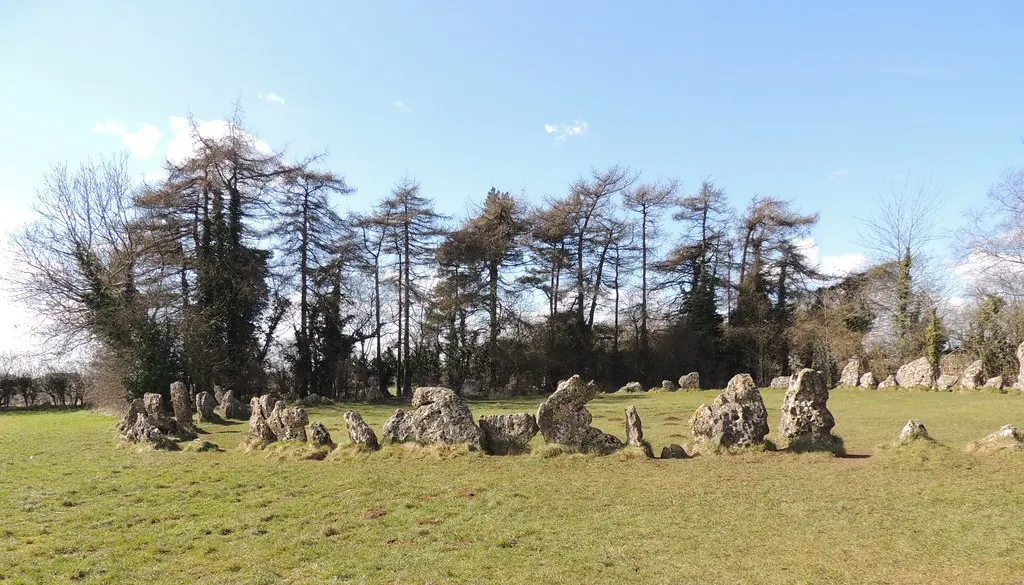
Image of Rollright Stones. Image source
Visit essentials
A quick read before you go
- Duration
- A brief visit to the King's Men circle takes thirty minutes.
- Access
- The stones are located on an unclassified road along the Oxfordshire-Warwickshire boundary,…
Overview
The witch who turned a king to stone was right about one thing: this ridge between Oxfordshire and Warwickshire belongs to something older than ambition.
Three clusters of weathered limestone span nearly two thousand years of prehistoric construction. The Whispering Knights have huddled in conference for five millennia, their burial chamber older than the pyramids. The King's Men formed a circle four and a half thousand years ago, their seventy-seven stones impossible to count twice the same way. The later King Stone is a solitary Bronze Age monolith watching the valley.
No one can say with certainty what ceremonies took place here. Saxon pagans established a cemetery nearby, medieval chroniclers counted the site among Britain's wonders, and modern Wiccans and druids gather at solstices. Their visits continue a pattern of ritual attention stretching back to the stones' raising.
The Rollrights can be approached as archaeology, folklore, energy, or simply a Cotswold walk. They stand indifferent to any framework, in the particular silence certain ancient places hold.
Why this place is sacred
What makes a place sacred before anyone names it so? The Rollright Stones offer no easy answer, but they pose the question with unusual clarity.
Human activity on this ridge predates the first stones by centuries. Mesolithic hunters left flint bladelets and a broken arrowhead here between 6500 and 4000 BC. Then, around 3800 BC, someone chose this location to build a burial chamber for their dead. A thousand years later, a circle of over a hundred touching stones rose nearby. Five centuries after that, a single standing stone marked yet another purpose. Each generation found something here worth memorializing in stone.
The construction speaks to effort. The oolitic limestone boulders, though locally sourced, had to be dragged uphill. Archaeologist George Lambrick concluded they were moved on wooden sledges, possibly with timber rollers. This was not convenience but intention. Whatever the builders understood about this ridge, it was worth considerable labor to mark it.
Visitors today report the effect in varying vocabularies. Some speak of energy, others of presence, others simply of peace. The Dragon Project spent ten years measuring electromagnetic fields and ultrasound levels, finding some anomalous readings but no definitive physical explanation for what people consistently describe. Perhaps the explanation lies beyond what instruments can measure. Perhaps it lies in the accumulated weight of six thousand years of human attention. Perhaps both.
The site's designation as a Dark Skies Discovery Site adds another dimension. On clear nights, with the Milky Way arching overhead and the ancient stones below, the sense of standing at an intersection of time and space becomes difficult to dismiss as mere atmosphere.
The three monuments served distinct purposes across their eras. The Whispering Knights dolmen, built around 3800-3500 BC, held dismembered human remains, indicating sophisticated early Neolithic funerary practices. The King's Men circle, constructed around 2500 BC, likely served ceremonial functions comparable to other late Neolithic stone circles like Avebury, though specific rituals remain unknown. The King Stone, erected around 1500 BC, appears to have marked a Bronze Age cemetery.
The continuity of sacred use across nearly two thousand years of construction suggests the ridge itself, not any single monument, held primary significance.
The stones outlasted their builders by millennia. When Saxon pagans arrived after the Roman period, they recognized the site as special, establishing a cemetery nearby around 700 AD with grave goods including a cremation urn and beads. Medieval chroniclers included the Rollrights among the wonders of Britain, though by then the origin stories had become legends of witches and petrified kings.
The modern chapter began in 1882, when the stones became among the first monuments protected under Britain's Ancient Monuments Protection Act. In 1959, the Bricket Wood coven of Gardnerian Wiccans chose the site for a ritual, drawn by its folkloric associations with witchcraft. Since then, modern pagans, druids, and ceremonial magicians have maintained continuous ritual use.
The Rollright Trust, established in 1997 partly by pagans who used the site, now manages it with an explicit commitment to allowing respectful spiritual practice alongside heritage preservation.
Experience and orientation
The first thing most visitors notice is the intimacy. Unlike grander monuments roped off behind barriers, the Rollright Stones welcome you among them. You can walk into the King's Men circle, stand where countless others have stood, and let the stones gather around you.
Each stone has its own character. Millennia of weathering have sculpted the oolitic limestone into forms that seem almost intentional, grotesque faces and flowing shapes emerging from the pitted surface. Counting them proves difficult, as folklore promises. The number seems to shift depending on where you start, which stones you count as one, where shadow falls. The legend says no one can count them three times and get the same number. The legend may be right.
The King Stone stands apart, across the road in Warwickshire, larger and more solitary. Its surface too has weathered into strange contours, and standing before it feels like standing before something that has been watching the valley since before the concept of valleys had names.
The Whispering Knights huddle to the east, five stones bent toward each other as if in permanent conspiracy. Their collapsed capstone speaks to the weight of time, but their arrangement still suggests the conference that folklore imagined. What are they plotting, after five thousand years?
Visitors who come at dawn or dusk, when the light rakes across the stones and fewer tourists populate the circle, report the strongest impressions. A quality of listening. A sense that time here moves differently, or perhaps does not move at all. Whether this reflects something inherent in the place or something the visitor brings, the effect is consistent enough across accounts to take seriously.
The Rollright Stones reward those who approach as pilgrims rather than tourists. Arrive early or late, when the light is low and the crowds are thin. Begin at the King's Men circle, the most accessible and atmospherically contained of the three monuments. Walk the perimeter before entering, noticing how each stone differs from its neighbors.
Inside the circle, find a place to stand or sit in stillness. The stones do not demand anything of you, but they seem to respond to attention. Some visitors report that certain stones draw them more than others. Follow that pull if it arises.
When ready, walk north to the King Stone. The road crossing is brief but jarring, a reminder that modernity presses close. The King Stone itself requires a different approach, a facing rather than a surrounding. Stand before it as you might stand before something ancient that has outlasted all who raised it.
The Whispering Knights require a short walk east. Their energy differs again, more concentrated, more brooding. Five thousand years of secrets whispered between stones that cannot speak. Listen anyway.
If you can, return at night. The site is open twenty-four hours, and the Dark Skies designation means minimal light pollution. The stones by starlight become something else entirely.
Context and lineage
No founding narrative survives from the people who built these monuments. What remains is the work itself, three structures raised across nearly two thousand years by communities who left no written record of their intentions.
The folklore that later filled this silence tells of a king marching his army across the Cotswolds, dreaming of conquest. A witch met him on the ridge and offered a challenge: take seven strides, and if you can see Long Compton in the valley below, you shall be King of England. On his seventh stride, a mound rose to block his view. The witch spoke again: 'As Long Compton thou canst not see, King of England thou shalt not be.
Rise up stick and stand still stone, for King of England thou shalt be none. Thou and thy men hoar stones shall be, and I myself an eldern tree.'
The king became the King Stone, frozen forever looking toward the view he could not see. His army became the King's Men, gathered in a circle that can never be counted. His plotting knights, conspiring against him even as he marched, became the Whispering Knights, forever bent in treacherous conference. The witch became an elder tree, though which elder among the many in the hedgerows is no longer certain.
This legend, first documented in the 16th century though likely older, has been elaborated over time. The witch was sometimes identified with Mother Shipton, the mythical prophetess, perhaps because of nearby Shipton-under-Wychwood. The detail about cutting the elder tree to break the spell and bring the stones back to life appears to be a mid-19th century addition. The story continues to grow, as stories do around ancient stones.
The Rollright Stones have never entirely lost their hold on human attention. When the Neolithic builders passed, others came. When those communities faded, Saxons recognized the place as sacred. When Christianity displaced older practices, the stones became objects of wonder and warning, cautionary tales about ambition and supernatural power.
The modern spiritual lineage begins in 1959, when Gardnerian Wiccans from the Bricket Wood coven held a ritual at the King's Men. They chose the site as neutral ground, drawn by its folkloric associations with witchcraft. That ritual initiated a continuous thread of contemporary pagan practice that persists today.
The Cotswold Order of Druids has organized public solstice celebrations for years. Various pagan and ritual magic groups hold ceremonies within the circle. The Rollright Trust, which now manages the site, was established partly by pagans who valued it as a place of practice. The ancient and the modern have found accommodation here.
The Petrified King
legendary
The unnamed king whose ambition led him to challenge the witch and lose, becoming the solitary King Stone that still watches toward Long Compton.
The Witch
legendary
The supernatural figure who turned the king and his men to stone before becoming an elder tree herself. Sometimes identified with Mother Shipton.
George Lambrick
scholar
Archaeologist who studied the transportation and origin of the stones, concluding they were naturally occurring surface boulders moved uphill using wooden sledges.
Paul Devereux
researcher
Led the Dragon Project (1977-1987), a decade-long scientific investigation of alleged earth energies at the site. Found some unusual readings but concluded with null results for earth energy claims.
William G. Gray
practitioner
English ceremonial magician who published 'The Rollright Ritual' in 1975, documenting his spiritual work with the site.
Traditions and practice
The original practices performed at the Rollright Stones are lost to prehistory. The Whispering Knights held dismembered human remains, indicating complex funerary rites, but the specific ceremonies are unknown. The King's Men circle presumably hosted gatherings of some significance, given the effort required to construct it, but whether these were calendrical, funerary, or something else entirely remains speculation.
What archaeology confirms is continuity of attention. Mesolithic activity preceded the monuments. Neolithic, late Neolithic, and Bronze Age communities each added to the site. Saxon pagans established a cemetery nearby around 700 AD. Each era recognized something here worth marking, even if the forms of recognition changed.
Modern practice at the Rollright Stones takes several forms. The Cotswold Order of Druids organizes public ceremonies at the summer and winter solstices, welcoming anyone who comes with respect. These typically begin before dawn, with drumming, chanting, and meditation as the sun rises. Participants enter and exit the circle through crossed rods, and ceremonies conclude with communal chants and the traditional 'HO!' flung heavenward.
Samhain brings candlelight ceremonies with incense to honor ancestors. May Day celebrations echo historical traditions when villagers danced and made offerings to ensure good harvests.
Wiccan covens and other pagan groups hold their own ceremonies, sometimes arranged in advance with the Trust. Individual practitioners use the site for personal meditation, particularly drawn to the King's Men circle or the King Stone.
The site hosts private weddings, naming ceremonies, and handfastings by arrangement. The Trust maintains an inclusive approach, welcoming respectful ritual use from various traditions.
Visitors seeking spiritual engagement might consider several approaches. Walking the full site, beginning with the King's Men and proceeding to the King Stone and Whispering Knights, allows encounter with three distinct energies. Within the King's Men circle, sitting in stillness and simply listening creates space for whatever wants to arise.
Some report that particular stones call to them, and following that pull, whether by standing near or laying a palm against the weathered surface, can deepen the experience. The folklore suggests touching certain stones grants wishes or cures ailments, though heritage preservation encourages gentle contact.
A night visit, particularly around new or full moons, offers a different quality of encounter. The Dark Skies designation means the stars are unusually visible, and the stones take on a different presence by starlight.
If solstice or Samhain ceremonies interest you, arrive early for the public druid celebrations. No special preparation is required, only respectful participation.
Prehistoric British Religion
HistoricalThe Rollright Stones represent nearly two thousand years of prehistoric sacred construction on a single ridge, from early Neolithic burial chamber (c. 3800-3500 BC) through late Neolithic stone circle (c. 2500 BC) to Bronze Age standing stone (c. 1500 BC). This continuity suggests the site held persistent sacred significance for successive communities across millennia.
The specific practices are unknown. Archaeological evidence indicates the Whispering Knights served as a burial chamber containing dismembered human remains. The King's Men circle presumably hosted ceremonial gatherings of sufficient importance to justify the labor of moving dozens of limestone boulders uphill. The King Stone marked a Bronze Age cemetery.
Saxon Paganism
HistoricalArchaeological evidence shows that pagan Saxon communities settling in the region after the Roman period recognized the Rollright Stones as a special place. A cemetery established around 700 AD near the stones, containing grave goods including a cremation urn, beads, and a bracelet, indicates the site retained sacred associations centuries after its original builders had passed.
No specific Saxon practices at the site are documented. The presence of the cemetery suggests funerary rites, but details are unknown.
English Folklore
ActiveThe legend of the petrified king, first documented in the 16th century but likely older, has shaped how generations have understood and engaged with the Rollright Stones. The story of ambition punished, a witch's curse, and soldiers frozen in stone gives imaginative form to the site's uncanny quality.
The folkloric tradition involves storytelling, attempts to count the uncountable stones, and local customs such as the belief that cutting the witch's elder tree would break the spell. May Day celebrations historically included dancing near the stones.
Wicca
ActiveSince 1959, when the Bricket Wood coven of Gardnerian Wiccans held a ritual at the King's Men, the Rollright Stones have served as an important site for Wiccan practice. The site was chosen for its folkloric associations with witchcraft and has remained a place where covens gather for ceremonies.
Wiccan groups hold rituals within the King's Men circle, typically working with the seasonal calendar and lunar cycles. The specifics vary by coven and occasion, but the stone circle provides a natural temple space for casting circles and performing ceremonies.
Modern Druidry
ActiveThe Cotswold Order of Druids has organized public ceremonies at the Rollright Stones for years, making it one of the primary druid gathering sites in the Cotswolds region. The summer solstice celebration is the most prominent annual event.
Druid ceremonies at the Rollrights include reading pagan blessings, entering and exiting the circle through crossed rods, drumming, chanting, and meditation to greet the rising or setting sun. Solstice celebrations conclude with participants joining hands, swinging them forward and back while counting to three, then shouting 'HO!' while flinging their hands heavenward.
Earth Mysteries
ActiveThe Rollright Stones have been central to the earth mysteries movement since Alfred Watkins proposed them as a ley line node. The Dragon Project's ten-year investigation (1977-1987) represents the most sustained scientific examination of claimed earth energies at any British megalithic site.
Earth mysteries practitioners visit the stones to sense or measure alleged energy phenomena, using dowsing rods, pendulums, or scientific instruments. Some incorporate the site into pilgrimage routes connecting multiple ancient monuments.
Perspectives and open questions
The Rollright Stones accommodate multiple interpretations without demanding allegiance to any single one. Archaeologists, folklorists, earth mysteries researchers, and spiritual practitioners each bring genuine insight, and each acknowledge what they do not know. The site is spacious enough for contradiction.
Scholarly perspective
Archaeological consensus places the three monuments in distinct periods: the Whispering Knights around 3800-3500 BC as an early Neolithic burial chamber, the King's Men around 2500 BC as a late Neolithic ceremonial circle comparable to Avebury, and the King Stone around 1500 BC as a Bronze Age cemetery marker. George Lambrick's research established that the oolitic limestone boulders were naturally occurring surface stones transported uphill, indicating significant organized effort.
Scholars debate the specific functions the monuments served. The Whispering Knights' dismembered remains suggest complex funerary practices, but the rituals accompanying burial are unknown. The King's Men circle presumably hosted gatherings of social or ceremonial significance, but whether these were astronomical, political, religious, or some combination remains unclear. What is certain is that the ridge attracted sustained attention across nearly two thousand years of prehistoric construction, followed by Saxon pagan recognition and medieval documentation.
Living and traditional perspectives
For modern pagans, Wiccans, and druids who practice at the site, the Rollright Stones are not merely archaeological artifacts but living sacred space. The stone circle functions as a natural temple, a place where the boundary between ordinary reality and something larger becomes permeable. The accumulated centuries of ritual attention, from Neolithic funerary rites through modern solstice ceremonies, have created a reservoir of spiritual potency.
From this perspective, the stones themselves hold presence. Practitioners describe certain stones as having distinct personalities, certain areas of the circle as having particular qualities. The folklore, rather than mere storytelling, preserves genuine understanding about the site's nature, encoded in narrative form.
Alternative interpretations
The Rollright Stones have attracted earth mysteries researchers since Alfred Watkins proposed them as a node on a ley line running through Long Compton church, Chipping Norton church, and a tumulus near Charlbury. The Dragon Project (1977-1987), led by Paul Devereux, spent a decade investigating alleged earth energies at the site using scientific instruments.
The Dragon Project recorded some unusual readings, including ultrasound near the King Stone and magnetometer anomalies, but Devereux himself concluded that physical monitoring gave a null result for earth energy claims. The project's dreamwork research, however, documented interesting visionary experiences among participants who slept near the stones. Whether these experiences reflect something measurable, something psychological, or something that resists both categories remains an open question.
Open questions
Genuine mysteries persist at the Rollright Stones. Why did communities continue building sacred monuments on this particular ridge for nearly two thousand years? What ceremonies took place within the King's Men circle? What exactly were the Whispering Knights' builders doing with dismembered human remains?
The folklore raises its own questions. How old is the legend of the petrified king, and what earlier traditions might it have displaced or absorbed? Why do people consistently struggle to count the stones to the same number, even with modern methods?
The Dragon Project's inconclusive findings point toward something real but unmeasurable. Visitors report consistent experiences that resist conventional explanation. Whether future research will illuminate these questions or whether some aspects of places like the Rollrights exist beyond what methodology can capture remains to be seen.
Plan your visit
Access and arrival
The stones are located on an unclassified road along the Oxfordshire-Warwickshire boundary, between the A44 and A3400, about 2.5 miles north-northwest of Chipping Norton and south of Long Compton. The site is well signposted. Parking consists of two lay-bys with approximately 18 spaces, which frequently overflow at busy times. The paths and gateways are suitable for wheelchairs, mobility scooters, and pushchairs, with reasonably level ground close to the road.
Chipping Norton, 2.5 miles south, offers various accommodation options from pubs with rooms to boutique hotels. Long Compton to the north has smaller establishments. The wider Cotswolds area provides extensive visitor infrastructure. Those seeking to combine the visit with other sacred sites might base themselves in the region for several days.
Respectful visit
No specific dress code applies. Practical considerations matter more: sturdy footwear for uneven ground that may be muddy or slippery, layers for changeable Cotswold weather, and appropriate gear if visiting at night.
Personal photography is welcome. The stones photograph well in early morning or late afternoon light, when shadows emphasize their weathered surfaces. Night photography under the stars offers different possibilities. Tripods and professional equipment require advance permission. Drones are not permitted. Be present before being productive.
The Trust does not prohibit small, respectful offerings, but encourages visitors to consider the cumulative impact of physical items left at the site. Internal offerings, prayers, intentions, or silent gratitude have no such impact. If you bring something physical, ensure it is biodegradable, unobtrusive, and does not accumulate.
During organized ceremonies, offerings may be part of the ritual structure. Follow the guidance of ceremony leaders.
The site is open twenty-four hours, year-round, with very occasional closures for special events. Organized activities, commercial photography, and filming require advance permission from the Rollright Trust. The site is close to a busy road, so children and pets should be supervised. Parking is limited and frequently overflows at busy times.
The stones have weathered for millennia, but they remain vulnerable. Avoid climbing on structures or breaking off pieces, however tempting. During World War I and II, the stones had to be roped off because soldiers were chipping off fragments as good luck charms. Such damage accumulates.
Organized activities, including ceremonies, require advance permission from the Rollright Trust. Do not assume that spiritual intent exempts you from this requirement.
The site sits close to a busy road. Night visitors should exercise caution crossing to the King Stone and bring appropriate lighting. Car break-ins occur frequently in the lay-bys, so valuables should not be left visible.
Current practical details
Address
Rollright Road, Little Rollright, Chipping Norton OX7 5QB, UK
Phone
Hours
Hours, fees, and access can change — verify on the official source before you travel. Practical details last checked Jun 2026.
Location
Map loads as you approach this section.
Pilgrim reflections
A portrait of encounter, not a score
Pilgrims describe what they felt, how present they could become, and whether the place would shape a journey. There are no stars and no ranking of traditions.
No reviewed reflections yet
The first pilgrims can help describe the character of being here.
Share a reflection
Available after an account-backed “Been there.” Every reflection is reviewed before publication.
Nearby sacred places
Explore other sacred places in the region. Proximity does not establish access or travel time; check each place’s guidance.
References
Sources consulted for this page. Source categories describe the publication, not a guarantee that every claim is verified. Traditional accounts and outside interpretations may differ.
- 01The Rollright Stones - Official Websiteofficial
- 02Overview and History | The Rollright Stonesofficial
- 03Folklore and Legends | The Rollright Stonesofficial
- 04Visiting the Stones | The Rollright Stonesofficial
- 05Rollright Stones | English Heritageofficial
- 06The Rollright Stones, Rollright - 1018400 | Historic Englandofficial
- 07Rollright Stones - Wikipediaencyclopedia
- 08Rollright Stones | The Megalithic Portalacademic
- 09Legends of the Rollright Stones, Oxfordshire - World History Encyclopediaencyclopedia
- 10Uncovering the Mysteries of the Rollright Stones | History Toolsacademic
- 11The Rollright Stones - History and Facts | History Hitacademic
- 12Rollright Stones - Little Rollright, England | Sacred DestinationsSource context
- 13The Legendary Rollright Stones of Oxfordshire - Atlas Obscuraguide
- 14Rollright Stones - Cotswoldsguide
- 15Druid Ceremony: Summer Solstice at the Rollright Stones - Exemplorespiritual
- 16Prehistoric Monuments as Numinous Sites of Spiritual Tourism: The Rollright Stonesacademic
Photo gallery
3 curated photos
Share a photo
Help visitors recognize Rollright Stones. Every submission is reviewed before publication.