Devil’s Quoits
A Neolithic stone circle rescued from destruction and returned to the landscape
Understand sacred places, explore living traditions, and learn how to engage respectfully with Pilgrim Map.
Access has not been verified. Check current local guidance before planning a visit.
West Oxfordshire, England, United Kingdom
Read the sources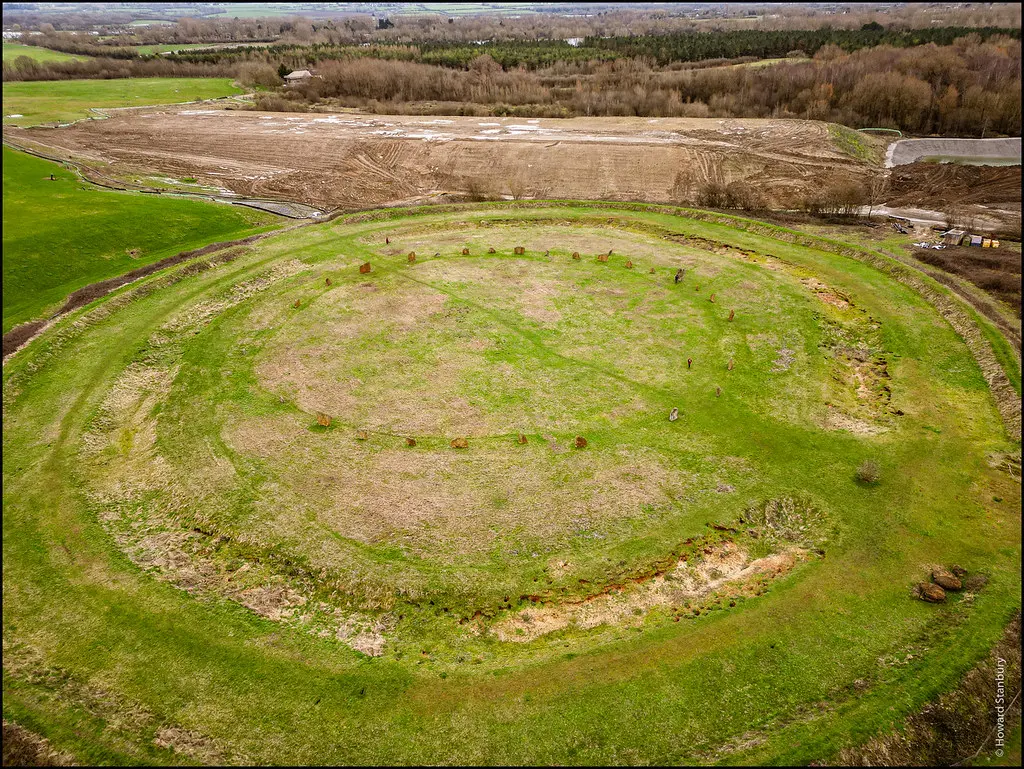
Visit essentials
A quick read before you go
- Duration
- 1 hour to appreciate the full site, distinguish original from replacement stones, and understand…
- Etiquette
- Free open access to a Scheduled Ancient Monument.
Overview
The Devil's Quoits poses every restored monument's question: is this Neolithic place or modern interpretation? Three original stones survived; five were recovered during construction and preserved; conglomerate quarried locally at Ducklington fills the remaining twenty positions. The henge bank, leveled for wartime runways, stands at half its original height. The answer may be both.
Around 2900–2600 BC, Thames Valley builders cut the circular ditch, raised the bank, and erected 36 stones in a concentric oval. Excavations found perimeter hearths, ritually deposited animal bones, and human remains within the enclosure. Ceremonies continued for generations, though their meaning is unrecoverable.
Medieval villagers reused stones—Stanton means “farmstead by the stones”—before war and industry nearly erased the monument. Restoration returned visibility to archaeological evidence while accepting authenticity as a spectrum. A stone touched now may be original or replacement, but this is where Neolithic people gathered: the circle has returned to its landscape.
Why this place is sacred
Most stone circles ask you to imagine what has been lost. The Devil's Quoits asks you to consider what has been found, lost again, and deliberately returned. The archaeological record exists: excavations in 1972, 1973, and 1988 revealed the full plan of the monument, the ditch-and-bank of the henge, the positions where 36 stones once stood. Hearths along the perimeter showed where ceremonial fires burned. Animal bones and human remains indicated ritual deposition.
The Neolithic presence was documented even as the physical monument disappeared under gravel extraction. The restoration project made a choice. Rather than leaving the site as an invisible presence known only to archaeologists, the team rebuilt what could be rebuilt. Original stones were re-erected where their socket holes survived. New stones from a local quarry filled the gaps. The henge bank rose again, though only to half its former height to protect deeper-lying archaeology.
The result is a monument that exists in multiple temporal registers. The space is Neolithic—this is where the original builders placed their sacred enclosure. Some stones are original—weathered survivors of 4,500 years. Others are new—Ducklington conglomerate chosen to approximate the lost megaliths. The experience combines ancient presence with contemporary choice, archaeological evidence with interpretive decision. Standing in the circle, you encounter both what the Neolithic builders made and what the 21st century has chosen to preserve.
Henge-and-stone-circle complex for ceremonial gatherings. The design—external bank, internal ditch, stone circle within—follows a pattern seen at major Neolithic sites across Britain. Evidence suggests use from the late Neolithic through the post-Roman period.
Constructed 2900-2600 BC. Medieval period: stones removed for building material. 1940: henge leveled for WWII airfield construction; only one stone remained in situ. Post-war: gravel extraction further damaged the site. 1972, 1973, 1988: archaeological excavations revealed the complete plan. 2002-2008: restoration project rebuilt henge and re-erected surviving stones alongside new replacements.
Experience and orientation
You will not find the Devil's Quoits by accident. No brown heritage signs mark the route. The approach involves following signs to a recycling center outside Stanton Harcourt, continuing past it to a small parking area by what was once a gravel pit, now a lake reflecting the sky. A footpath leads across restored land toward the monument.
The setting has its own strange beauty: water, grass returning to former extraction sites, the stones rising from what was nearly their grave. The circle appears gradually as you approach. The restored henge bank defines the perimeter, low but unmistakable. The stones stand within, their heights varying, some weathered with lichen, others clean-cut and recent. You enter the space through one of two entrances where the bank was intentionally interrupted.
Inside, you can walk among the stones, touch them if you wish (the site is a Scheduled Ancient Monument, but the stones themselves are robust), attempt to distinguish original from replacement. The originals tend to be more weathered, more irregular; the Ducklington conglomerate is paler, more uniform. But both occupy positions determined by Neolithic planning. The surrounding landscape extends the meditation. Lakes fill former gravel pits. Industrial restoration continues nearby.
The Devil's Quoits exists within a landscape that is itself being transformed, a recovered monument in a recovering terrain. Whether this context diminishes or enriches the experience depends on what you seek.
The site is south of Stanton Harcourt, accessible via a footpath from the parking area near the recycling center. The henge bank surrounds the stone circle; two entrances allow access. The stones stand in a concentric oval pattern within the henge.
Context and lineage
Around 2900-2600 BC, communities living in the Thames Valley began constructing a monument. They dug a circular ditch and piled the excavated material into an external bank—the classic henge design that separates sacred space from the surrounding landscape. Within this enclosure, they erected 36 stones in a concentric oval arrangement, the largest stones positioned near the entrances. For generations, the site saw use. Fires burned around the perimeter during ceremonies. Animal bones were deposited in ritual acts.
Human remains were placed within the sacred enclosure. The site continued in use from the Neolithic through the post-Roman period. Then the long forgetting began. Medieval farmers, pragmatic about the stones their ancestors had venerated, took them for building material. The village of Stanton grew nearby—its name meaning 'farmstead by the stones'—but the monument itself dwindled. By 1940, only one stone remained in situ when wartime necessity demanded an airfield. The henge was leveled, runways laid across the ancient enclosure.
After the war, gravel extraction continued the erasure. The monument might have disappeared entirely had archaeologists not documented what remained. Their excavations revealed the complete plan, proving the site's significance. The restoration project that followed chose visibility over absence, rebuilding what could be rebuilt to return the monument to the landscape.
The Devil's Quoits belongs to the tradition of late Neolithic henge-and-circle monuments that includes Avebury and the early phases of Stonehenge. The concentric stone arrangement and henge design place it within the mainstream of British Neolithic monumental architecture.
Oxford Archaeology
Traditions and practice
Unknown specifically. Archaeological evidence suggests ceremonial fires were lit around the circle's perimeter. Animal bones and human remains were deposited within the enclosure in ritual acts. The henge design indicates a defined sacred space for gatherings. Use continued from the Neolithic through post-Roman times.
Personal pilgrimage to this recovered monument. Walking among the stones and experiencing the restored henge. Photography and quiet contemplation. The site has appeared in popular culture (Assassin's Creed Valhalla, 2020), which has increased awareness of its existence.
Approach the site aware of its multiple layers: Neolithic construction, medieval destruction, 20th-century devastation, 21st-century restoration. Walk the perimeter before entering the henge to understand the enclosure's scale. Within the circle, take time to distinguish original stones from replacements—the distinction itself becomes meaningful. Consider what it means that this space exists again after nearly being lost.
Neolithic ceremonial landscape
HistoricalThe Devil's Quoits was constructed 2900-2600 BC as part of the broader Neolithic tradition of monumental henge-and-circle building. Archaeological evidence confirms ceremonial use including ritual fires and the deposition of animal and human remains.
Unknown specifically. The hearths around the perimeter suggest fires lit during ceremonies. The bone deposits indicate ritual activities involving both animals and humans. The site was used over an extended period from the Neolithic through post-Roman times.
Contemporary heritage engagement
ActiveThe restoration project (2002-2008) represents a contemporary practice of returning visibility to archaeological sites. The decision to rebuild rather than leave the site invisible reflects values about what should be preserved and how.
Personal pilgrimage, photography, quiet contemplation. The site's appearance in Assassin's Creed Valhalla (2020) has increased awareness and visitation.
Perspectives and open questions
The Devil's Quoits exists as both archaeological evidence and interpretive reconstruction, raising questions about authenticity in heritage preservation.
Scholarly perspective
Archaeological excavations (1972, 1973, 1988) by Oxford Archaeology established the site's late Neolithic date (2900-2600 BC) and revealed its full plan. Evidence of ceremonial use includes hearths around the perimeter, animal bone deposits, and human remains. The site was in use from the Neolithic through post-Roman times. The 2002-2008 restoration chose to use the Roman period as a baseline, rebuilding the henge to half its original height to protect deeper-lying archaeology.
Original stones were re-erected where possible; replacement stones from Ducklington quarry filled the gaps.
Living and traditional perspectives
The site name preserves medieval legend: the Devil played quoits with a beggar for his soul and won by throwing a great stone from Wytham Hill. This attribution of ancient monuments to diabolical forces is common across Britain, reflecting Christian unease with unexplained prehistoric remains. The village name Stanton ('farmstead by the stones') preserves memory of the monument's presence.
Alternative interpretations
For those interested in earth energies and sacred landscapes, the Devil's Quoits represents a recovered node in Britain's prehistoric sacred geography. The henge design is seen as defining a container for earth energy. The restoration, from this perspective, has returned not just stones but the energetic function of the site.
Open questions
The specific ceremonies conducted at the circle remain unknowable. The original arrangement of all 36 stones cannot be fully determined. The significance of the human remains deposited at the site—who were these people, why were they placed here?—is lost. Why this particular location in the Thames gravel terraces was chosen for such a major monument is unclear.
Plan your visit
Access and arrival
Witney offers various accommodation. Oxford (8 miles) has extensive hotel and B&B options. The site works well as a day trip from Oxford or as part of a tour of Oxfordshire prehistoric sites.
Respectful visit
Sturdy footwear for walking across uneven ground. Waterproof gear if wet conditions are possible.
Freely permitted. The site's open access and lack of crowds allow unhurried photography.
Not traditional. Nothing should be left that would litter the site or mark it as different from its Neolithic condition.
Scheduled Ancient Monument: do not damage stones or earthworks. Stay on paths when crossing the wider restoration area.
The site is a Scheduled Ancient Monument. Do not damage the stones or henge. The surrounding area is being restored from gravel extraction; stick to marked paths when crossing it.
Current practical details
Address
Stanton Harcourt, Witney OX29 5BB, UK
Hours
Hours, fees, and access can change — verify on the official source before you travel. Practical details last checked Jun 2026.
Location
Map loads as you approach this section.
Pilgrim reflections
A portrait of encounter, not a score
Pilgrims describe what they felt, how present they could become, and whether the place would shape a journey. There are no stars and no ranking of traditions.
No reviewed reflections yet
The first pilgrims can help describe the character of being here.
Share a reflection
Available after an account-backed “Been there.” Every reflection is reviewed before publication.
Nearby sacred places
Explore other sacred places in the region. Proximity does not establish access or travel time; check each place’s guidance.
References
Sources consulted for this page. Source categories describe the publication, not a guarantee that every claim is verified. Traditional accounts and outside interpretations may differ.
- 01Devil's Quoits — WikipediaencyclopediaWell-referenced article
- 02The Devil's Quoits — Atlas ObscuraguideVisitor-focused information
- 03The Devil's Quoits at Stanton Harcourt — Dark OxfordshireSource contextLocal heritage context
- 04Devils Quoits Stone Circle — The Megalithic PortalSource contextDetailed archaeological information
- 05Devil's Quoits, an Impressive Glimpse into Neolithic Britain — Ancient OriginsacademicArchaeological overview
Share a photo
Help visitors recognize Devil’s Quoits. Every submission is reviewed before publication.