Rohia Monastery, Romania
Where a father's grief became a monastery and a prisoner's conversion became a masterwork of faith
Understand sacred places, explore living traditions, and learn how to engage respectfully with Pilgrim Map.
Access has not been verified. Check current local guidance before planning a visit.
Târgu Lăpuș, Maramureș, Romania
Visit essentials
A quick read before you go
- Duration
- A visit of one and a half to two and a half hours allows time to see the church, library,…
- Access
- Located in Rohia village, administratively part of Targu Lapus, Maramures County.
Overview
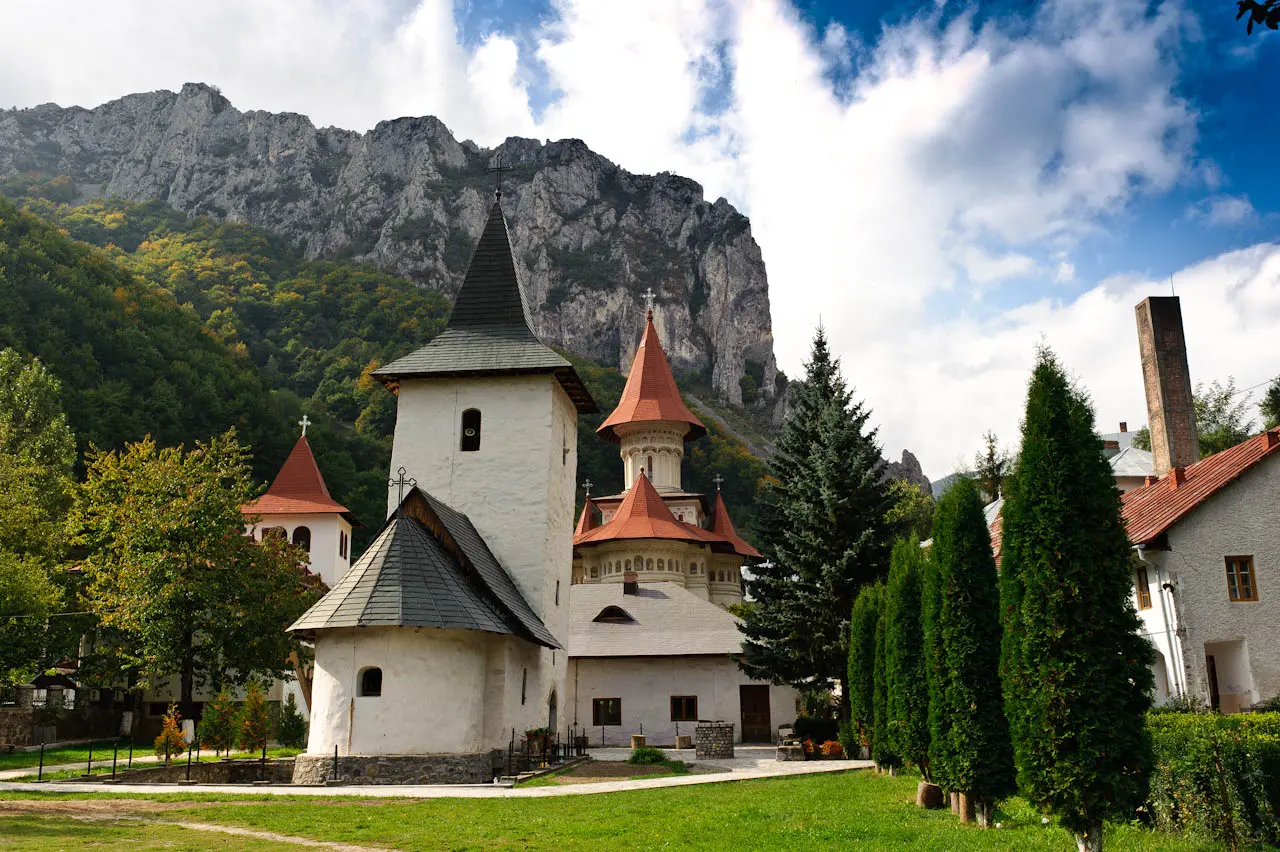
Rohia's road climbs through beech and oak to a five-hundred-meter hilltop. Its foundation arose from grief: Father Nicolae Gherman's ten-year-old daughter Ana died in 1922 and, monastery tradition says, appeared in a dream asking for a house of the Virgin Mary on Vine Hill. Hundreds of volunteers helped him build a church and residence within two years; Bishop Nicolae Ivan consecrated them on August 15, 1926, the Dormition. In 1980 Nicolae Steinhardt entered as a monk.
Born Jewish and imprisoned by the communist regime in 1959, he was baptized Orthodox on March 15, 1960 by a fellow prisoner before Catholic, Greek-Catholic, and Protestant priests. His Jurnalul Fericirii—Diary of Happiness—describes joy amid desolation. During his final nine years as Rohia's librarian he built a forty-thousand-volume collection. He died here in 1989 under secret-police watch; pilgrims visit his grave for a life showing faith in darkness, not miracles.
Rohia remains active, with a Steinhardt cultural center under construction, joining personal devotion and intellectual courage.
Why this place is sacred
The monastery occupies a hilltop wrapped in deciduous forest, and the forest does much of the work. The canopy filters light and absorbs sound. The altitude creates a separation from the settled valley below. Before any building existed, this was a place where the ordinary fell away.
The founding narrative gives the site its emotional foundation. A child dies. Her father, a priest, receives what he understands as a message from beyond death asking him to build something sacred. He obeys. This is not legend from a distant century but documented recent history, the raw material of a faith rooted in personal loss rather than institutional mandate. Visitors who have lost children or loved ones often find this story opens something in them.
Steinhardt's presence adds intellectual depth to the emotional ground. His conversion was not comfortable. It cost him — a Jewish intellectual choosing Christianity in a culture where that choice carried weight. His baptism in prison, in the presence of priests from multiple confessions, was an ecumenical act forced into existence by extremity. The Jurnalul Fericirii does not describe prison as transformative in some easy, redemptive way. It describes finding happiness precisely because circumstances are terrible, not despite them.
The library of forty thousand volumes is its own form of thinness. Steinhardt curated it with care, and its presence gives the monastery an atmosphere of contemplative reading as spiritual practice. Books here are not decoration. They are instruments of the same interior work that prayer performs.
The monastery was founded as a memorial act of devotion — a bereaved father fulfilling what he understood as his dead daughter's request. It was the first Orthodox monastery built in Transylvania after the 1918 Great Union, making it simultaneously a personal and national act of faith.
From a modest hilltop church built by volunteers, Rohia grew through the 20th century into a complex of buildings reflecting Maramures architectural traditions. The Oak House, the House with Paraclis containing the library, the Summer Altar built in the style of Maramures church towers, and most recently the cultural center honoring Steinhardt each represent a different dimension of the monastery's expanding identity as both spiritual and intellectual center.
Experience and orientation
Rohia works on different registers depending on what you bring to it. For those who arrive knowing Steinhardt's story, the experience carries a particular charge. Standing at his grave — a monk who was once a Jewish intellectual, who found God in a prison cell, who spent his final decade shelving books and attending to the divine offices — produces an encounter with a life that refuses easy categorization.
The monastery grounds invite walking. Paths through the surrounding forest lead to quiet clearings where the only sounds are wind and birdsong. The Summer Altar, built in the traditional Maramures tower style, connects the monastery to the deep folk-sacred culture of the region. Summer services held here, open to the sky with the forest as backdrop, carry a quality distinct from worship in enclosed spaces.
The library, when accessible to visitors, offers a rare convergence. Forty thousand volumes gathered by a man who saw reading as inseparable from prayer. The titles range across theology, philosophy, and literature. For visitors drawn to the life of the mind, spending time here can feel like entering Steinhardt's own practice.
The museum preserves icons and religious artifacts from the monastery's history. But it is the relationship between objects and stories that gives them weight. An icon here is not simply a work of art but an element in a narrative that stretches from a child's death in 1922 through a prison baptism in 1960 to the ongoing daily offices performed by the monastic community.
If you have not read the Jurnalul Fericirii, consider reading at least excerpts before visiting. The book transforms the monastery from a pleasant hilltop retreat into a site of pilgrimage with specific spiritual gravity. At the monastery, visit the church, the library, and Steinhardt's grave in that order — moving from communal worship through intellectual engagement to personal encounter. Allow time to walk in the surrounding forest.
The Dormition feast on August 15 brings the community's spiritual life to its most concentrated expression.
Context and lineage
In November 1922, ten-year-old Ana, daughter of Father Nicolae Gherman, died in the village of Rohia. According to the tradition preserved at the monastery, the child appeared to her father in a dream, asking him to build a house of the Virgin Mary on Dealul Viei — Vine Hill. A faithful woman in the community encouraged the grieving priest to follow the vision.
With the help of hundreds of volunteers, Gherman began construction in 1923, completing a modest stone-and-brick church and a monk's residence within two years. Bishop Nicolae Ivan of Cluj consecrated the monastery on August 15, 1926, the Feast of the Dormition, which became the patronal feast.
Rohia's spiritual lineage is unusual in Romanian monasticism because it combines the traditional Orthodox monastic heritage with a distinctly intellectual and literary dimension. The founding by a parish priest rather than a monastic order, the development as the first post-union Transylvanian monastery, and the transformation through Steinhardt's presence create a lineage in which personal devotion and intellectual rigor are understood as complementary paths to the sacred.
Father Nicolae Gherman
historical
Parish priest who founded Rohia in 1923 in memory of his daughter Ana, who died at age ten. He built the monastery with the help of hundreds of local volunteers and served it until his death in 1959.
Nicolae Steinhardt
historical
Writer of Jewish descent who converted to Orthodox Christianity while imprisoned by the communist regime. Baptized in prison in 1960, he entered Rohia as a monk in 1980 and served as librarian until his death in 1989. His Jurnalul Fericirii is considered a masterwork of 20th-century Romanian literature and a defining spiritual text.
Archimandrite Macarie Motogna
religious_leader
Current abbot of Rohia Monastery, overseeing the ongoing construction of the Nicolae Steinhardt cultural center and the preservation of the monastery's spiritual and literary heritage.
Traditions and practice
The monastery follows the Romanian Orthodox rite with daily Divine Liturgy, Matins, Vespers, and Compline. The Dormition of the Mother of God on August 15, the patronal feast, is the most significant annual celebration. Summer services at the outdoor Summer Altar, built in the traditional Maramures tower style, connect the monastery to the region's folk-sacred architecture. Icon veneration, including a reported miracle-working icon, continues in the monastery churches.
The monastic community maintains Steinhardt's library of approximately forty thousand volumes and operates a museum preserving icons and religious artifacts. Icon painting and the creation of liturgical objects continue as monastic crafts. The monastery is constructing a cultural center with a museum, library, reading room, conference hall, and synodicon to honor Steinhardt's legacy. Cultural events and conferences exploring the intersection of literature and spirituality are part of the monastery's expanding mission.
For visitors seeking contemplative engagement, begin with the church to enter the monastery's liturgical atmosphere. Then visit the library, where Steinhardt spent his final years organizing and enriching the collection. Sit with a book if access allows, or simply stand in the space and consider what it meant for a man of letters to find his vocation as a monk-librarian. Visit Steinhardt's grave last, carrying with you whatever arose in the church and library.
Walk the forested hillside before departing, letting the silence of the setting integrate the visit.
Romanian Orthodox Christianity
ActiveRohia was the first Orthodox monastery built in Transylvania after the Great Union of 1918, making it a symbol of Romanian Orthodox identity in a historically contested region. The founding narrative — a priest building a monastery in response to his dead daughter's dream — roots the site in the most intimate form of Orthodox devotion. The monastery has grown into one of the most important spiritual centers in the Diocese of Maramures.
Daily Divine Liturgy and canonical hours. Dormition of the Mother of God celebration on August 15 as the patronal feast. Summer services at the outdoor Summer Altar in traditional Maramures tower style. Icon veneration, including a reported miracle-working icon. Icon painting and liturgical arts by the monastic community.
Literary-Spiritual Heritage (Steinhardt Legacy)
ActiveNicolae Steinhardt's presence at Rohia from 1980 to 1989 transformed the monastery into a convergence of Orthodox spirituality and Romanian intellectual culture. His Jurnalul Fericirii, composed and preserved partly at Rohia, is recognized as a masterwork of anti-communist literature and a spiritual text of international significance. The library of forty thousand volumes and the cultural center under construction ensure this legacy continues to grow.
Pilgrimage to Steinhardt's grave. Visiting the memorial museum. Using the monastery library for study and research. Cultural events and conferences exploring the literary-spiritual legacy. Reading and discussing the Jurnalul Fericirii as a spiritual practice that bridges intellectual inquiry and contemplative devotion.
Perspectives and open questions
Rohia holds together dimensions that do not often coexist: the intimacy of personal grief, the weight of national history, the rigor of intellectual life, and the quiet discipline of monastic prayer. Understanding the monastery requires holding all of these without reducing one to another.
Scholarly perspective
Scholars recognize Rohia primarily through its connection to Steinhardt, whose Jurnalul Fericirii is studied as a masterwork of anti-communist literature and spiritual autobiography. Literary scholars place it alongside the works of Solzhenitsyn and Primo Levi in the canon of concentration camp literature, while noting its uniquely joyful theological dimension. Historians mark the monastery's significance as the first Orthodox foundation in Transylvania after 1918, reflecting the interplay between religious and national identity.
Steinhardt's conversion — from Judaism to Orthodox Christianity, in a prison cell, witnessed by clergy of multiple confessions — is studied as one of the most remarkable conversion narratives of the 20th century.
Living and traditional perspectives
Within Romanian Orthodox tradition, Rohia embodies monasticism as a refuge of the spirit. The founding narrative resonates with the Romanian folk tradition of sacred buildings inspired by divine visions. Steinhardt's presence adds a dimension of providential significance: that a Jewish intellectual would find his deepest faith in a communist prison and bring that faith to this particular monastery is understood as a manifestation of divine purpose.
The monastery is also seen as a testament to Orthodox resilience — founded in the immediate aftermath of the Great Union, when Orthodoxy in Transylvania was reasserting itself after centuries of subordination.
Alternative interpretations
Rohia does not attract significant esoteric or alternative spiritual attention. Its significance is grounded in Orthodox devotion and intellectual-literary heritage. Some visitors are drawn by the intersection of Jewish and Christian identity in Steinhardt's story, finding in his conversion a model for interreligious understanding and dialogue.
Open questions
The nature and history of the miracle-working icon in the monastery chapel are not well documented. Whether unedited or unpublished manuscripts by Steinhardt remain in the monastery library is not fully known. The full circumstances of Steinhardt's death and the Securitate's surveillance of him in his final hours remain only partially documented. The extent of King Michael's visits to the monastery and any private spiritual significance it held for the Romanian royal family is not extensively recorded.
Plan your visit
Access and arrival
Located in Rohia village, administratively part of Targu Lapus, Maramures County. Approximately 50 km from Baia Mare and 43 km from Dej. The monastery sits on a hilltop at 500 meters altitude, accessible via a road from Targu Lapus. A car is recommended as public transport connections are limited. Mobile phone signal information was not available at time of writing; check with local providers for current coverage in the area.
Guesthouses and pensions are available in Targu Lapus and surrounding villages. Baia Mare, approximately 50 km away, offers a full range of accommodation. Whether the monastery itself offers accommodation or retreat facilities for visitors was not documented in available sources; contact the monastery directly for current arrangements.
Respectful visit
Modest dress is required. Women should wear skirts below the knee and cover their shoulders. Head coverings are appreciated but not always strictly enforced. Men should wear long trousers. Sleeveless tops and shorts are not appropriate.
Photography is generally permitted in exterior areas and the grounds. Restrictions may apply inside the churches during services and in parts of the museum. Do not use flash photography indoors. Ask permission before photographing monks.
Visitors may purchase and light candles. Donations to the monastery are welcomed, particularly given the ongoing construction of the cultural center. The monastery may sell icons and religious items crafted by the monks.
Maintain respectful silence near the churches, especially during services. Respect areas reserved for the monastic community. No smoking or alcohol consumption on monastery grounds.
Handle library materials with great care if given access to the collection. Do not photograph monks without their permission. During services, remain at the back of the church if you are not participating in the liturgy. The monastery is a place of active prayer; treat the Steinhardt connection with the seriousness it deserves rather than as literary tourism.
Current practical details
Address
Aleea Mănăstirii 18, 435612 Rohia, Romania
Phone
Hours
Hours, fees, and access can change — verify on the official source before you travel. Practical details last checked Jun 2026.
Location
Map loads as you approach this section.
Pilgrim reflections
A portrait of encounter, not a score
Pilgrims describe what they felt, how present they could become, and whether the place would shape a journey. There are no stars and no ranking of traditions.
No reviewed reflections yet
The first pilgrims can help describe the character of being here.
Share a reflection
Available after an account-backed “Been there.” Every reflection is reviewed before publication.
Nearby sacred places
Explore other sacred places in the region. Proximity does not establish access or travel time; check each place’s guidance.

Share a photo
Help visitors recognize Rohia Monastery, Romania. Every submission is reviewed before publication.