Leud Hill Church, Romania
A hilltop wooden church that sheltered the oldest Romanian manuscript for five centuries
Understand sacred places, explore living traditions, and learn how to engage respectfully with Pilgrim Map.
Access has not been verified. Check current local guidance before planning a visit.
Ieud, Maramureș, Romania
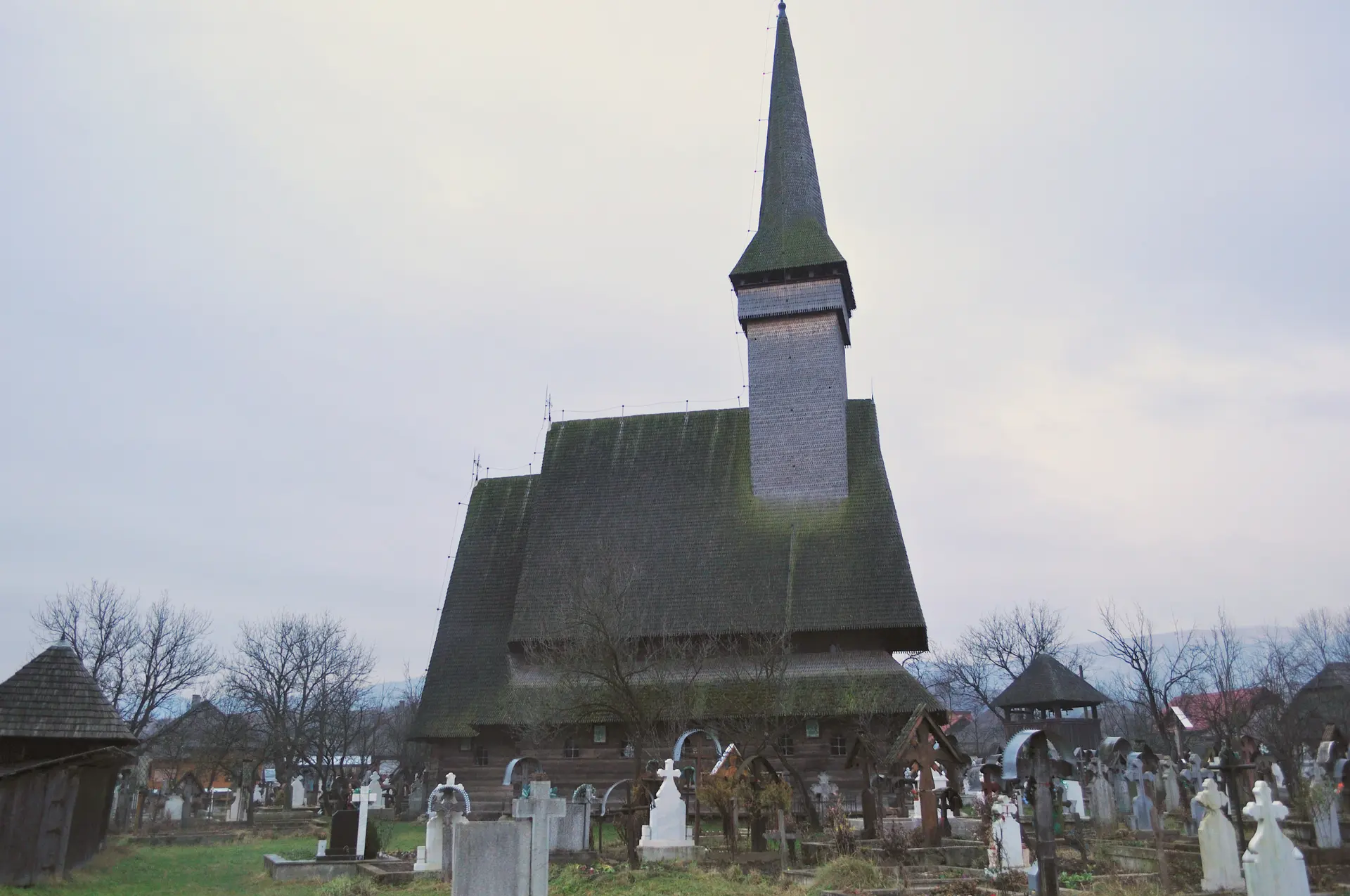
Image of Leud Hill Church, Romania. Image source · CC-BY-SA-4.0
Visit essentials
A quick read before you go
- Duration
- Forty-five minutes to one hour for a thorough visit including the walk up the hill and time…
- Access
- Located in the village of Ieud, Maramures County, northwestern Romania.
Overview
On the hill above Ieud, a simple wooden church compresses centuries into a space crossed in twenty steps, scented by old timber and colored by faded 18th-century frescoes.
Dedicated to the Nativity of the Mother of God, Ieud Hill Church was built in the early 17th century by the noble Balea family. Generations accepted a traditional 1364 date that made it Maramures's oldest wooden church, but dendrochronology revised construction to around 1628. It remains among the tradition's most important survivors. When Habsburg Catholic authorities forbade Orthodox communities to build in stone, worshippers translated Gothic ambitions into timber with skill UNESCO recognized as outstanding universal value.
Alexandru Ponehalschi's 1782 frescoes cover every available surface with biblical scenes between folk art and formal iconography. Small windows reveal them gradually without dispelling their mystery. In 1921, researchers found the Codex of Ieud in the attic: a Cyrillic manuscript dated 1391 and the oldest surviving Romanian-language text. Sheltered here for five centuries, it makes the church a home of written culture and language as well as faith and worship.
Why this place is sacred
The walk up the hill from the village is short but decisive. With each step, the soundscape of Ieud, its dogs and tractors and conversations, falls away. By the time you reach the churchyard, the quality of silence has changed. The Maramures countryside spreads below in every direction: green hills, haystacks, wooden houses with carved gates, a landscape that appears to have resisted modernity not through effort but through a kind of patience.
The hilltop setting is not accidental. In the Maramures tradition, placing a church on high ground was both practical, making it visible to the community, and symbolic, elevating the act of worship above the plane of daily life. Whether the hilltop had sacred significance before the church was built is unknown, but the question lingers in the way such places hold their history.
Inside, the world contracts to the dimensions of the wooden interior. The ceiling is low enough to feel intimate. The walls are darkened by centuries of candle smoke and the natural aging of timber, creating a surface that absorbs light rather than reflecting it. Against this darkness, Ponehalschi's frescoes glow with a subdued luminosity.
Biblical scenes populate every surface: the Nativity, the Crucifixion, scenes from the lives of saints, all rendered in a style that carries both the formal conventions of Orthodox iconography and the distinctive hand of a local painter working within his own community.
The windows are small and few. This was deliberate. The restricted light creates conditions in which the frescoes reveal themselves gradually, a visual equivalent of the contemplative patience that the Orthodox tradition values. In the moments after entering, when your eyes are still adjusting and the paintings are emerging from shadow, you are participating in something that every visitor for four centuries has experienced.
The Codex of Ieud is no longer physically present in the church, having been transferred to the Romanian Academy for preservation. But the knowledge of its five-century presence in the attic above your head transforms the space. This wooden church held the oldest written words of a language, sheltering them through wars, reforms, and the passage of time, as unconsciously and faithfully as it sheltered the faithful who gathered below.
The Balea family, local nobles of Ieud, commissioned the church around 1628 as a place of Orthodox worship for the village community. It was built in the Maramures wooden tradition, using interlocking logs without nails, under conditions of religious prohibition that made wooden construction both a practical necessity and a spiritual statement.
The church has served continuously as a place of Orthodox worship since its construction. The frescoes by Alexandru Ponehalschi, added in 1782, represent the most significant artistic enrichment. The discovery of the Codex of Ieud in 1921 elevated the church from a regional treasure to a site of national cultural importance. UNESCO inscription in 1999, as one of eight Wooden Churches of Maramures, brought international recognition.
The church continues to be used for services, particularly on the feast of the Nativity of the Virgin on September 8, though the frequency of regular services depends on the size of the local congregation.
Experience and orientation
Ieud sits in the Iza Valley surrounded by the green hills and traditional wooden architecture of Maramures. The village itself is worth attention: carved wooden gates mark the entrance to each household, haystacks dry in the fields, and the pace of life moves at a register that the nearby wooden churches seem to have set long ago.
The church is not immediately visible from the village center. You ask. In Maramures, asking is part of the experience. The church is normally locked, and a local key-holder opens it for visitors. This arrangement, which might seem inconvenient, is in fact an encounter with living stewardship. The person who holds the key holds a responsibility passed down through the community.
They may share stories, point out details in the frescoes, or simply open the door and let the building speak for itself.
The uphill walk takes only a few minutes but it creates separation. The village sounds recede. The churchyard appears, with its wooden fence and old trees. The church itself stands with the unself-conscious beauty of a building that was made to serve a purpose and has served it for four hundred years without interruption.
Inside, the first impression is darkness and the smell of very old wood. Then the frescoes begin to emerge. Ponehalschi painted these walls in 1782, working by candlelight and natural light from the small windows, and the conditions of their creation are the conditions of their viewing. The saints look down with the particular intensity of paintings made at close quarters, by a hand that knew the people who would pray beneath them.
If you visit on a Sunday, you may witness the local community arriving for worship in traditional folk costume. The women's embroidered blouses and the men's decorated vests are not worn for tourists but for God and for each other, a visual expression of the unity between faith and cultural identity that defines Maramures. On September 8, the Feast of the Nativity of the Virgin, the church's patron day, the community gathers with particular devotion.
Before leaving the hilltop, turn and face the valley. The view from this elevation encompasses the Maramures landscape in its fullness, the same landscape that the Balea family would have looked upon when they decided to build here. The continuity between their decision and your presence is one of the things the church holds.
Arrive in the village and ask for the key-holder. The walk up the hill takes five to ten minutes. Allow your eyes at least five minutes to adjust inside the church before attempting to study the frescoes. If combining with the Ieud Valley Church, plan for a total visit of one and a half to two hours. Sunday mornings offer the chance to witness living worship in traditional costume.
Context and lineage
The Orthodox communities of Maramures built in wood because they had no choice. From the 14th century onward, Angevin Hungarian kings and later Habsburg rulers prohibited the construction of stone Orthodox churches in the region. The restriction was intended to suppress Orthodox identity and promote Catholic conversion. The response was creative defiance. Using only local timber, oak and fir logs interlocked without nails, Maramures craftsmen developed a distinctive architectural style that combined Gothic verticality with Orthodox liturgical requirements.
Tall spires reached upward from steeply pitched roofs. Interior walls became canvases for frescoes. The prohibition intended to diminish Orthodoxy instead produced some of the most distinctive sacred architecture in Europe.
The Balea family, local nobles of Ieud, commissioned the hill church around 1628. The traditional dating of 1364 persisted in local memory for centuries and was only corrected by dendrochronological analysis of the timber. The church was dedicated to the Nativity of the Mother of God, one of the most important feasts in Orthodox Christianity.
In 1782, Alexandru Ponehalschi, an itinerant painter known to have worked in several Maramures churches, painted the interior frescoes. His work at Ieud is considered his finest, combining the formal conventions of Orthodox iconography with a sensibility shaped by the folk culture of the region.
In 1921, the discovery of the Codex of Ieud, a manuscript in Cyrillic script dating to 1391 and containing apocryphal texts, transformed the church's significance. The manuscript, the oldest surviving written text in the Romanian language, had lain in the church attic for over five centuries.
Ieud Hill Church belongs to the Romanian Orthodox tradition and to the broader Maramures wooden church building tradition recognized by UNESCO. The building practice represents a distinctive cultural response to religious prohibition, transforming material restriction into architectural achievement. The church's role as repository of the oldest Romanian manuscript places it within the history of Romanian language and literature as well as sacred architecture.
The Balea family
Local nobles of Ieud who commissioned the church's construction around 1628. Their patronage ensured the community's place of worship would be built with the skill and ambition that characterizes the finest Maramures wooden churches.
Alexandru Ponehalschi
Itinerant painter who created the interior frescoes in 1782. His work at Ieud Hill Church is considered the finest of his known oeuvre, combining Orthodox iconographic tradition with the distinctive visual culture of Maramures.
The unknown scribe of the Codex of Ieud (1391)
The author of the oldest surviving manuscript written in the Romanian language, whose identity remains unknown. The text, written in Cyrillic script, contains apocryphal religious texts and was discovered in the church attic in 1921.
Traditions and practice
The liturgical calendar at Ieud Hill Church follows the Romanian Orthodox rite. The Feast of the Nativity of the Virgin Mary on September 8 is the church's patron day and its most important annual celebration. Easter processions with candles, Christmas colindatori caroling groups, and Sunday worship attendance in full traditional costume are practices that have continued in Ieud for generations.
The Maramures tradition of dressing in embroidered folk costume for church is not merely decorative but expresses the understanding that worship involves the whole person and the whole community, body and dress as well as soul.
The church remains an active place of worship, though services may not be held weekly given the size of the local congregation. The September 8 feast day is the primary annual service. The church is increasingly visited as a cultural heritage site, and the community has adapted to the role of steward for an internationally recognized monument while maintaining its identity as a worshipping congregation. Local Orthodox traditions of gathering after church for community socializing continue in the village.
For visitors who arrive outside a service, the church invites a particular quality of attention. After the key-holder opens the door, step inside and stand still. Let the darkness gather. The frescoes will emerge on their own schedule, not yours. Notice how the small windows create pools of light that move across the painted surfaces during the course of the day.
Touch the wooden walls if you are permitted, and feel the texture that four centuries of air and light and prayer have shaped.
On the hilltop outside, sit for a few minutes before descending. The view encompasses a landscape that has changed remarkably little since the Balea family chose this spot. The wooden houses, the carved gates, the haystacks, the green hills rolling toward the horizon all belong to the same world that produced the church. The continuity is itself a form of meaning.
Romanian Orthodox Christianity
ActiveThe church has been a center of Orthodox worship since its construction in the early 17th century. It represents the enduring faith of the Maramures people who built wooden churches when Catholic Habsburg authorities prohibited Orthodox communities from building in stone. The dedication to the Nativity of the Mother of God connects it to the deep Marian devotion of Romanian Orthodoxy.
Orthodox liturgical services, particularly on the feast of the Nativity of the Virgin (September 8). Sunday worship in traditional folk costume. Easter processions with candles. Christmas colindatori caroling traditions. Community gathering at the church as a social and spiritual anchor.
Maramures wooden church building tradition
HistoricalThe tradition of building tall wooden churches arose from the 14th-century prohibition on stone Orthodox construction. Local craftsmen developed a style combining Gothic verticality with Orthodox requirements, using interlocking logs and traditional joinery without nails. Ieud Hill Church is one of the finest surviving examples.
Construction using interlocking oak or fir logs, tall spires, steeply pitched roofs for snow shedding, interior frescoes and glass icon painting. The tradition is no longer actively producing new churches in the historical manner, though contemporary revivals exist at sites like Barsana Monastery.
Heritage conservation and scholarship
ActiveOngoing scholarly research, conservation work, and UNESCO stewardship ensure the church's preservation. The Codex of Ieud is maintained by the Romanian Academy. Dendrochronological studies have refined the dating. Heritage tourism brings international awareness and contributes to local economy.
Conservation monitoring of the wooden structure and frescoes. Scholarly research into the building's dating, construction methods, and artistic significance. Guided interpretation for visitors. Community stewardship through the key-holder tradition.
Perspectives and open questions
Ieud Hill Church can be understood as architecture, as an assertion of faith under prohibition, as the cradle of Romanian written language, or as a living community's relationship with a building that has served them for four centuries.
Scholarly perspective
Scholars recognize Ieud Hill Church as a masterpiece of Maramures vernacular wooden architecture, combining Orthodox liturgical requirements with Gothic structural ambitions translated into timber. The 1782 frescoes by Alexandru Ponehalschi are considered among the finest examples of wooden church painting in the region. The dating controversy has been largely resolved through dendrochronology, placing construction in the early 17th century rather than the traditional 1364.
The church's UNESCO inscription recognizes the broader Maramures tradition as an outstanding interchange between Orthodox and Western architectural traditions. The Codex of Ieud, dating to 1391, is of exceptional significance for Romanian literary and linguistic history.
Living and traditional perspectives
For the people of Ieud and the wider Maramures region, the wooden churches are living symbols of their ancestors' faith and cultural resilience. The tradition of building in wood, born of oppressive restrictions, became a source of pride and identity. The discovery of the Codex of Ieud reinforced the church's status as a sacred repository of Romanian cultural memory.
Local oral tradition maintains the 1364 founding date despite scholarly revision, reflecting the community's attachment to the church's ancient origins and the conviction that its significance predates what documents can prove.
Alternative interpretations
Some visitors and writers interpret the wooden churches of Maramures as expressions of a particularly deep connection between spiritual practice and the natural world, given their construction entirely from local timber. The hilltop settings of many churches, including Ieud, are sometimes associated with pre-Christian sacred high places, though archaeological evidence for this is lacking.
The intimate scale and natural materials are said to create an atmosphere distinct from stone churches, one that some visitors describe as more immediate and less mediated.
Open questions
The precise circumstances of the church's founding remain uncertain: why the Balea family built it, what stood on the site before, and whether the hilltop had earlier sacred significance are not established. The full history of the Codex of Ieud before its 1921 discovery is unknown, including how it came to be in the church attic and whether other manuscripts were stored there.
The community of scribes and scholars who produced the manuscript, and their connection to the church, remain open questions.
Plan your visit
Access and arrival
Located in the village of Ieud, Maramures County, northwestern Romania. The church sits atop a hill and requires a short uphill walk of five to ten minutes from the village. Ieud is approximately 30 km from Sighetu Marmatiei. Accessible by car; there is no direct public transport to the village. A local key-holder must be contacted to unlock the church. Ask at the village or arrange through a local guide.
Mobile phone signal may be intermittent in the village and on the hilltop; confirm locally. For key-holder contact information, inquire at the Ieud commune office or through guesthouse hosts in the area.
Ieud has a small number of traditional guesthouses offering Maramures-style hospitality, meals, and immersion in village life. Sighetu Marmatiei, 30 km away, provides a wider range of accommodations. Staying in Ieud itself offers the best chance of experiencing the village at its own pace.
Respectful visit
Modest dress expected. Women: shoulders covered, skirts below the knee or wraps available. Men: long trousers, hats removed. Comfortable shoes recommended for the uphill walk.
Exterior photography is freely permitted. Interior photography may be restricted; always ask the key-holder for permission before photographing the frescoes. Flash photography should not be used, as it can cause cumulative damage to 18th-century pigments.
Small donations for church maintenance are appreciated and customary. There is no formal entrance fee. A separate acknowledgment for the key-holder's time is appropriate.
The church is normally locked; contact the key-holder before visiting. Do not touch the frescoes or painted surfaces. Silence and reverence expected inside. Do not interrupt active worship services. No eating or drinking inside the church.
The church is normally locked. Visitors must contact the local key-holder to gain access. This is not a limitation but a form of community stewardship. Respect the key-holder's time and offer an appropriate donation for their trouble. Do not attempt to force the door or access the church without permission.
Current practical details
Address
Ieud, Romania
Phone
Hours
Hours, fees, and access can change — verify on the official source before you travel. Practical details last checked Jun 2026.
Location
Map loads as you approach this section.
Pilgrim reflections
A portrait of encounter, not a score
Pilgrims describe what they felt, how present they could become, and whether the place would shape a journey. There are no stars and no ranking of traditions.
No reviewed reflections yet
The first pilgrims can help describe the character of being here.
Share a reflection
Available after an account-backed “Been there.” Every reflection is reviewed before publication.
Nearby sacred places
Explore other sacred places in the region. Proximity does not establish access or travel time; check each place’s guidance.



Share a photo
Help visitors recognize Leud Hill Church, Romania. Every submission is reviewed before publication.