Rinnō-ji
Where Tendai Buddhism meets the mountain deities of Nikko in golden splendor
Understand sacred places, explore living traditions, and learn how to engage respectfully with Pilgrim Map.
Access has not been verified. Check current local guidance before planning a visit.
Nikko, Tochigi Prefecture, Japan
Read the sources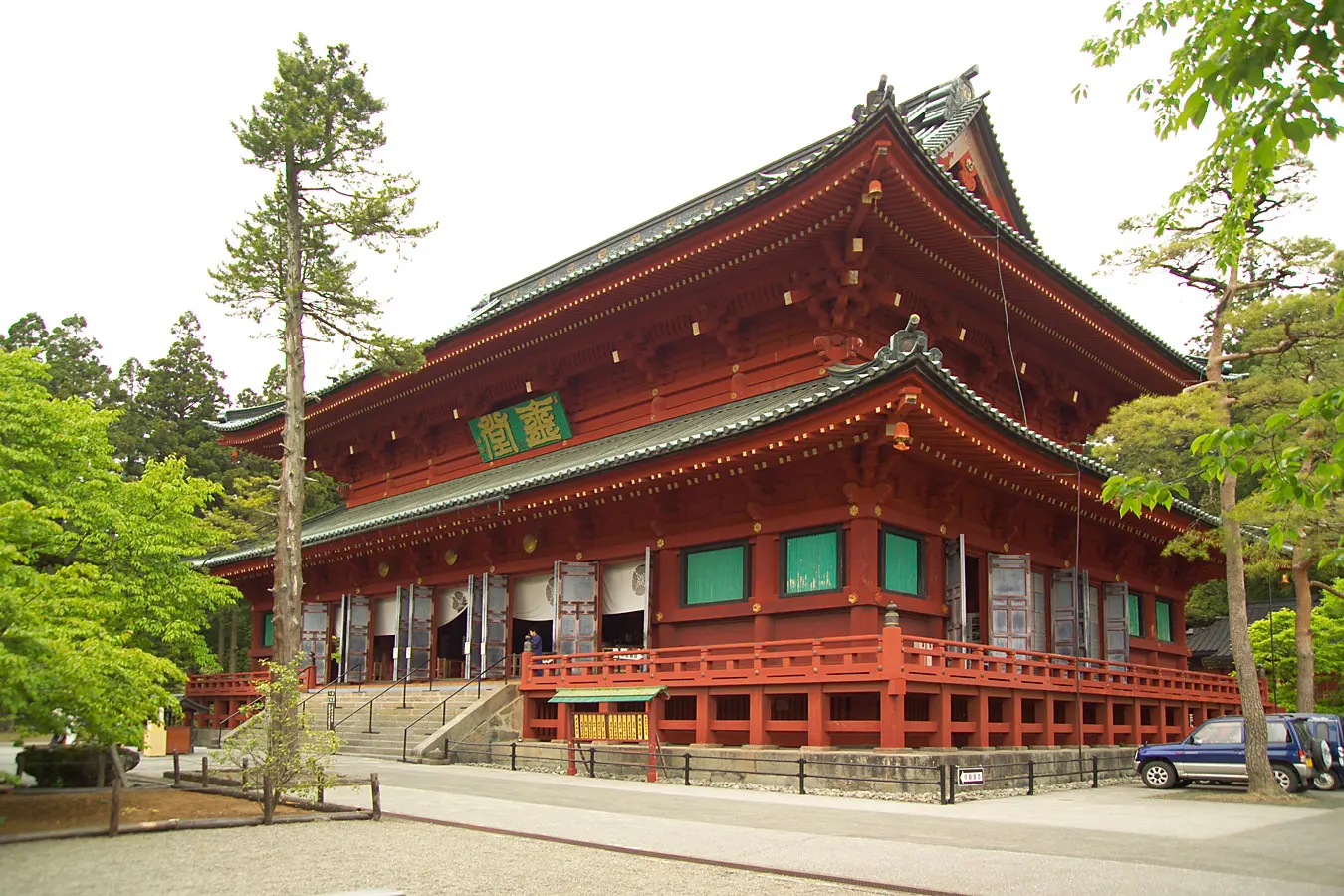
Image of Rinnō-ji. Image source · Public Domain
Visit essentials
A quick read before you go
- Duration
- 1-2 hours for Sanbutsudo and Shoyo-en garden; longer if combined with adjacent Toshogu and…
- Access
- Open 8:00 AM - 5:00 PM (April-October), 8:00 AM - 4:00 PM (November-March).
Overview
Rising from the forested slopes of Nikko, Rinnoji Temple represents over twelve centuries of Tendai Buddhist practice in one of Japan's most sacred landscapes. Founded in 766 CE when the monk Shodo Shonin established Shihonryuji on this remote mountain, the temple was later shaped by two of Buddhism's greatest figures: Kukai, founder of Shingon, and Ennin, who built the magnificent Sanbutsudo in 848 CE.
The Three Buddha Hall remains eastern Japan's largest wooden structure, sheltering three gold-leafed statues that rise 7.5 meters toward its shadowed ceiling. These are no ordinary images. Each Buddha corresponds to one of Nikko's sacred mountains: Amida for Mount Nantai, Senju Kannon for Mount Nyoho, Bato Kannon for Mount Taro. They embody shinbutsu-shugo, the profound Japanese synthesis where mountain kami and Buddhist deities become different faces of one reality.
Today, Rinnoji continues as an active Tendai training center where monks practice esoteric rituals said to transform misfortune into blessing. The temple's 15 buildings, including the serene Shoyo-en garden, invite contemplation of the Buddhist truth that pervades all phenomena. UNESCO recognition in 1999 acknowledged what pilgrims have understood for centuries: in this place, the ordinary world opens to something deeper.
Why this place is sacred
The quality of thinness at Rinnoji arises from its unique position bridging two spiritual worlds. The three golden Buddhas are not merely Buddhist images but the Buddhist essence of Nikko's mountains made visible. When one stands before them, the distinction between worshiping kami and venerating Buddha dissolves. This is not theological compromise but direct encounter with a reality that transcends such categories.
The temple's founding by Shodo Shonin after receiving divine guidance, the subsequent visits by Kukai and Ennin, and 1,250 years of unbroken Tendai practice have saturated this place with accumulated spiritual presence. The Sanbutsudo's massive scale removes visitors from ordinary experience into a space designed for transformation. Here, the esoteric teaching that Buddha nature pervades all reality becomes not doctrine but palpable atmosphere.
Shodo Shonin established the temple to propagate Buddhism in Nikko's wilderness and honor the spiritual power of its mountains. Ennin created the three Buddha images to reveal the Buddhist nature of the local kami, uniting native and imported spiritual traditions.
From its origins as a mountain hermitage, Rinnoji grew into one of the three most important Tendai temples. The construction of the current Sanbutsudo in 1645 continued the medieval tradition of monumental temple building. UNESCO World Heritage inscription in 1999 recognized its role in demonstrating the integration of Buddhist and Shinto traditions characteristic of Japanese religion.
Experience and orientation
Entering the Sanbutsudo, one is immediately struck by the scale of the three Buddha images rising in golden radiance against the darkened interior. Each statue, at 7.5 meters, commands attention while the overall effect creates a sense of having stepped into sacred cosmology made physical. The incense, the sound of chanting from elsewhere in the complex, and the quiet movements of monks all contribute to the living quality of this space.
The Shoyo-en garden offers a contemplative counterpoint to the Sanbutsudo's grandeur. Its careful arrangement of ponds, rocks, and carefully pruned vegetation invites slower attention and internal quieting. Many visitors find the combination of monumental sacred architecture and intimate garden design particularly effective for moving from everyday consciousness to something more receptive.
The sense that genuine practice continues here distinguishes Rinnoji from purely historical sites. Monks train in esoteric rituals, daily services maintain ancient forms, and the temple's spiritual function remains paramount despite its role as a tourist destination.
Begin at the Sanbutsudo to absorb the impact of the three Buddhas. Allow time for adjustment to the scale and atmosphere. Visit the Shoyo-en garden for quieter reflection. The temple is adjacent to Toshogu and Futarasan Shrine; experiencing all three reveals Nikko's integrated sacred landscape.
Context and lineage
In 766 CE, the monk Shodo Shonin, guided by divine signs, established a temple on Mount Nikko to propagate Buddhism in this remote mountain region. The area's isolation attracted monks seeking solitude for intensive practice. When the famous priest Ennin visited in the 9th century, he constructed the Sanbutsudo and created three great Buddha images to serve as Buddhist counterparts to the mountain kami already venerated in the region.
Rinnoji belongs to the Tendai sect of Buddhism, introduced from China by Saicho in the 8th century. The temple is one of the three main Tendai temples in Japan. Ennin, who built the Sanbutsudo, was Saicho's chief disciple and later traveled to China, returning with esoteric teachings that enriched Tendai practice.
Shodo Shonin
Founder
Ennin (Jikaku Daishi)
Second founder
Kukai
Visiting master
Traditions and practice
The temple maintains Tendai esoteric practices including the Chinjo Yashaho ritual, believed to transform misfortune into blessing. Monks undergo training in meditation, ritual, and scriptural study according to methods established over 1,200 years ago. The temple serves as one of the Tendai sect's primary training centers.
Daily Buddhist services continue throughout the year. Visitors can receive goshuin temple stamps and purchase omamori protective amulets. The temple offers the experience of active Buddhist practice within a UNESCO World Heritage setting.
Stand quietly before the three Buddhas in the Sanbutsudo, allowing their scale and radiance to work on you without forcing interpretation. Spend time in the Shoyo-en garden, letting its careful design quiet mental activity. Consider the teaching that these Buddha images and Nikko's mountains are different expressions of one reality.
Tendai Buddhism
ActiveRinnoji Temple is one of the three main temples of the Tendai sect, which was introduced from China by Saicho in the 8th century. The temple preserves esoteric teachings and practices dating back over 1,200 years, including the Chinjo Yashaho ritual said to transform misfortune into blessing.
Daily Buddhist services, esoteric rituals, meditation, Tendai monk training, seasonal ceremonies, pilgrim reception
Perspectives and open questions
Understanding Rinnoji benefits from multiple viewpoints that reveal different aspects of its significance.
Scholarly perspective
Rinnoji Temple represents the Buddhist component of Nikko's syncretistic religious complex. The correspondence between the three Buddha statues and Nikko's mountain kami exemplifies honji suijaku theory, the medieval Japanese understanding that kami are local manifestations of universal Buddhist deities. UNESCO recognition acknowledges the site's role in demonstrating the integration of Buddhist and Shinto traditions that characterized Japanese religion until the Meiji-era separation in 1868.
Living and traditional perspectives
In Tendai teaching, the Buddha nature pervades all reality. The mountain kami venerated at Futarasan Shrine and the Buddha images at Rinnoji are different expressions of the same enlightened reality. Practice at Rinnoji connects practitioners with this ultimate truth through ritual, meditation, and pilgrimage. The three golden Buddhas are not merely statues but presence.
Open questions
The full content of esoteric rituals preserved at the temple remains known only to initiated monks. The original appearance of Ennin's 9th-century Sanbutsudo has been lost to time. The temple archives likely contain treasures and texts not yet fully studied or revealed.
Plan your visit
Access and arrival
Open 8:00 AM - 5:00 PM (April-October), 8:00 AM - 4:00 PM (November-March). Sanbutsudo admission 400 yen, Shoyo-en garden 300 yen; combined tickets available. Ten-minute walk from Nikko Station.
Nikko offers various accommodations from traditional ryokan to modern hotels. Temple lodging is not available at Rinnoji but can be found at other Buddhist sites in Japan.
Respectful visit
No specific dress code exists, but respectful attire is appreciated at this active religious site.
Photography is restricted inside the Sanbutsudo; check posted signage. Outdoor photography is generally permitted.
Coins may be placed in offering boxes. Incense is available for purchase. These offerings support the temple and connect you to centuries of pilgrimage tradition.
{"Remove shoes where indicated","Maintain quiet in worship areas","Follow photography rules","Respect restricted training areas"}
This is an active training temple. Maintain quiet and respect in all areas. Photography is restricted inside the Sanbutsudo; check signage. Some areas are reserved for monastic training.
Current practical details
Address
2300 Sannai, Nikko, Tochigi 321-1494, Japan
Phone
Hours
Hours, fees, and access can change — verify on the official source before you travel. Practical details last checked Jun 2026.
Location
Map loads as you approach this section.
Pilgrim reflections
A portrait of encounter, not a score
Pilgrims describe what they felt, how present they could become, and whether the place would shape a journey. There are no stars and no ranking of traditions.
No reviewed reflections yet
The first pilgrims can help describe the character of being here.
Share a reflection
Available after an account-backed “Been there.” Every reflection is reviewed before publication.
Nearby sacred places
Explore other sacred places in the region. Proximity does not establish access or travel time; check each place’s guidance.

References
Sources consulted for this page. Source categories describe the publication, not a guarantee that every claim is verified. Traditional accounts and outside interpretations may differ.
- 01Nikko-san Rinnoji Temple - Japan Travel — Japan National Tourism OrganizationSource contextOfficial tourism information
- 02Nikkosan Rinnoji Temple - Visit Nikko — Visit NikkoSource contextOfficial local tourism information
- 03Rinnō-ji - Wikipedia — Wikipedia contributorsencyclopediaComprehensive overview
- 04Rinnoji Temple - Japan Guide — Japan GuideguidePractical visitor information
Pilgrim glossary
- Kannon
- The bodhisattva of compassion, central to many East Asian pilgrimage routes.
- Shingon
- An esoteric Japanese Buddhist school emphasizing ritual, mantra, and mandala practice.
- Tendai
- A Japanese Buddhist school based on the Lotus Sutra, foundational to many later traditions.
Share a photo
Help visitors recognize Rinnō-ji. Every submission is reviewed before publication.