Puʻu o Mahuka Heiau
Oʻahu's largest heiau, a luakini temple of chiefly authority above Waimea Bay
Understand sacred places, explore living traditions, and learn how to engage respectfully with Pilgrim Map.
Access has not been verified. Check current local guidance before planning a visit.
Pūpūkea / Haleʻiwa, Oʻahu, Hawaiʻi, Hawaii, United States
Read the sources
Visit essentials
A quick read before you go
- Duration
- A short visit; the site is compact, with an accessible walking path and interpretive signage,…
- Access
- Located above Waimea Bay in Pūpūkea, on the North Shore of Oʻahu, Hawaiʻi.
Overview
Above Waimea Bay on Oʻahu's North Shore, low stone walls enclose nearly two acres: Puʻu o Mahuka, the island's largest heiau. Built under Oʻahu's paramount chiefs, possibly in the 1600s and expanded through the 1700s, this luakini temple belonged to a class reserved for the highest-stakes rites and dedicable only by a ruling chief.
Its history includes ceremonies conducted in 1795 by Hewahewa, Kamehameha I's high priest, after the conquest of Oʻahu. Sources also report roles as a royal birthing site and a node in an inter-island signal-fire network reaching a heiau on Kauaʻi. The religious system that gave Puʻu o Mahuka its function ended in 1819, and no organized ceremony has continued here since.
A quiet platform of stacked stone and its commanding coastal view remain, asking how to stand respectfully where the original purpose has passed into history.
Why this place is sacred
Puʻu o Mahuka's significance begins with its classification. A luakini heiau was not an ordinary temple but the category of site dedicable only by an aliʻi ʻai moku, a paramount chief, and reserved for rites of the highest political and religious consequence — rites that expressed and reinforced authority over life, death, land, and order itself. Covering nearly two acres, it is the largest such structure on Oʻahu, its scale alone signaling the weight of what took place there.
The site's reported functions extend beyond a single ceremonial use: sources describe it as one of two places where the wives of ancient chiefs gave birth, and as a link in a signal-fire communication network reaching as far as a heiau at Wailua on Kauaʻi, its elevated position, roughly three hundred feet above Waimea Bay, suited to both purposes at once.
In 1795, following Kamehameha I's conquest of Oʻahu, his high priest Hewahewa conducted ceremonies here, tying the site directly into the consolidation of the entire island chain under one rule. That density of function, political, ceremonial, and practical, is what gives the site its weight; its thinness is not the hush of a single myth but the accumulated seriousness of a place where the highest authority on the island was regularly exercised and renewed.
As a luakini-class heiau, the site's original purpose was to host the political-religious rites reserved for a paramount chief, dedications that expressed and reinforced chiefly authority over life, death, land, and political order across the Waimea Valley region and, by 1795, the wider island.
Ceremonial use ended in 1819 with the formal abolition of the traditional Hawaiian religious system, the ʻai kapu. The site passed into federal recognition as a National Historic Landmark in 1962 and was placed under Hawaii Division of State Parks jurisdiction the same year, shifting its identity from an active religious site to a preserved archaeological monument managed for public visitation.
Experience and orientation
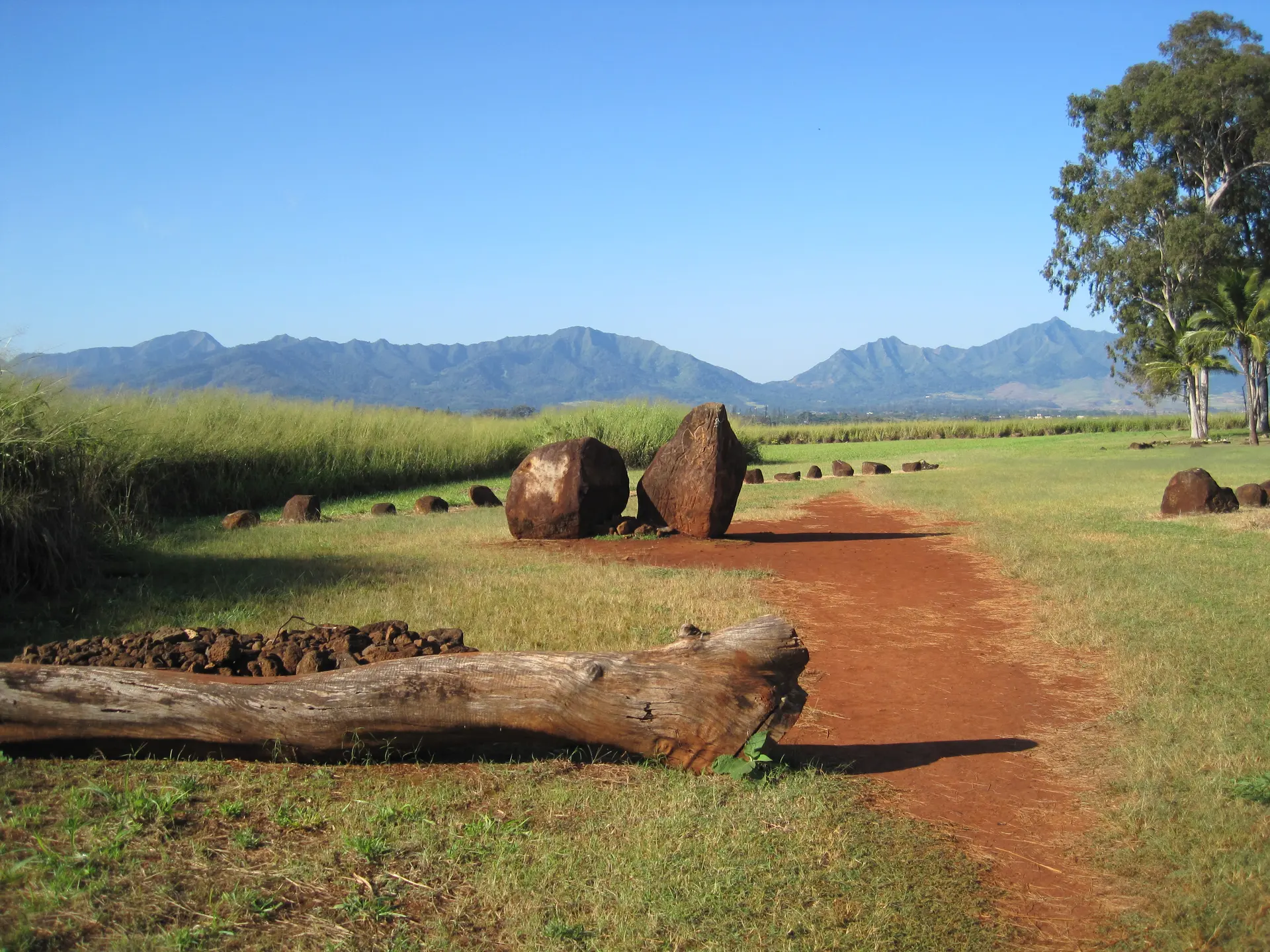
The approach to Puʻu o Mahuka is brief and unassuming: a signed turnoff from Pūpūkea Road, a short walk, and then the ground opens onto a broad, grassy plateau bounded by low stacked-stone walls, three to six feet high, enclosing an area larger than it first appears.
Interpretive signage marks the site's history, but the walls themselves do most of the work — walking their perimeter from outside makes the scale of the original temple legible in a way no photograph quite captures. The land drops away toward Waimea Bay below, the North Shore's coastline stretching out in a view that explains, without needing further comment, why this elevated point mattered for both ceremony and signal-fire communication.
Visitors commonly notice leis, flowers, and ti-leaf-wrapped stones left along the walls by others before them — tributes that read, at first glance, as continuity with the site's sacred past, though the reality is more complicated than it appears.
What the site offers instead of ceremony is unobstructed sightline and unhurried stillness: a place to stand at the boundary of a space that once authorized the highest decisions on the island, and to let that weight register without needing a ritual to prompt it.
Reachable by car via a signed turnoff from Pūpūkea Road above Waimea Bay on Oʻahu's North Shore; the walk from the parking area to the heiau enclosure is short and level, suitable for most visitors, with the site open daily from 9:00am to 5:30pm.
Context and lineage
No specific founding legend or origin myth distinct from the site's general historical and functional account has been located; its establishment is understood through the practical record of chiefly construction and use rather than through a named creation story.
Constructed and expanded under the successive authority of Oʻahu's paramount chiefs from roughly the 1600s through the 1700s; its use passed from regional chiefly control under Kahahana and priest Kaʻopulupulu in the 1770s to Kamehameha I's consolidated authority after 1795, before the site's religious function ended entirely with the 1819 abolition of the kapu system.
Hewahewa
High priest to Kamehameha I
Conducted ceremonies at Puʻu o Mahuka in 1795 following Kamehameha I's conquest of Oʻahu, tying the site directly to the consolidation of chiefly authority across the island.
Kaʻopulupulu
Priest under chief Kahahana
Associated with the heiau's use during the 1770s under the authority of chief Kahahana, part of the site's recorded chain of priestly and chiefly use before Kamehameha's conquest.
Traditions and practice
Luakini-class dedication and political-religious ceremonies, overseen by kahuna under the authority of a paramount chief, historically included rites tied to warfare and chiefly succession, in keeping with the general functions documented for this class of heiau. Hewahewa's 1795 ceremonies following Kamehameha I's conquest of Oʻahu are the site's most specifically documented ritual moment. This practice ceased entirely in 1819.
No organized contemporary ceremonial practice is documented at the site. What continues is informal visitor engagement — leis and flowers left along the stone walls, and, more problematically, ti-leaf-wrapped stones left in the belief that this constitutes a traditional offering (addressed directly in etiquette.offerings below).
A visitor can meet the site well by walking its perimeter slowly from outside the walls, tracing the stonework with attention rather than haste, standing long enough at the viewpoint to take in the full sweep of Waimea Bay, and letting the site's silence stand as its own form of acknowledgment rather than filling it with an improvised gesture.
Reading the interpretive signage before or after this walk helps the scale of the walls register as the record of something once actively governed, not simply admired.
Traditional Hawaiian religion (kapu system, pre-1819)
HistoricalPuʻu o Mahuka functioned as a luakini heiau, the class of temple reserved for the highest-stakes political-religious rites and dedicable only by a paramount chief, expressing and reinforcing chiefly authority over life, death, land, and political order in the Waimea Valley region and, after 1795, the wider island.
Dedication rites overseen by kahuna requiring paramount-chief authority; in 1795, Kamehameha I's high priest Hewahewa conducted ceremonies here following the conquest of Oʻahu. Practice ended in 1819 with the formal abolition of the traditional religious system.
Perspectives and open questions
Puʻu o Mahuka is read consistently by historians and Native Hawaiian cultural sources as a serious site of chiefly religious authority, a reading this content holds against popular tourism framings that lean toward sensational or spooky color.
Scholarly perspective
Historians and archaeologists treat Puʻu o Mahuka as a well-documented example of a luakini-class heiau reflecting the political and religious authority structures of pre-contact and early-contact Oʻahu, a significance formally recognized through its 1962 National Historic Landmark designation.
Living and traditional perspectives
Native Hawaiian cultural sources emphasize that authentic engagement with sites like this requires trained protocol, hoʻokupu, rather than improvised visitor gestures, and that misunderstood practices such as ti-leaf-wrapped stones can constitute a real, if unintentional, disrespect toward the site and the tradition it represents.
Alternative interpretations
Some popular tourism and 'haunted Hawaii' genre sources frame the site through a ghost-story or spooky lens tied to its history of sacrificial rites; this content treats that framing as a distortion of the site's actual historical and religious significance rather than as a documented traditional belief, and does not repeat it as fact.
Open questions
The site's exact construction date remains only approximately established, described as possibly the 1600s with expansion through the 1700s, rather than precisely dated. No source located in this research documents a specific founding legend distinct from the general historical account of the heiau's chiefly construction and use, and this content preserves that absence rather than inventing an origin story to fill it.
Plan your visit
Access and arrival
Located above Waimea Bay in Pūpūkea, on the North Shore of Oʻahu, Hawaiʻi. No entrance fee. Reachable by car via a signed turnoff from Pūpūkea Road.
No specific on-site or nearby accommodation information was located in research for this site; the North Shore of Oʻahu offers a range of visitor accommodation at typical short driving distance, and travelers should consult current North Shore lodging listings directly.
Respectful visit
General guidance for visiting heiau recommends respectful, non-swimwear attire, though no dress code specific to Puʻu o Mahuka has been documented.
No specific photography restriction has been documented in official sources.
Do not leave ti-leaf-wrapped stones at this site. This is a widespread practice among visitors who believe it to be a traditional and respectful offering, but Native Hawaiian cultural sources, including Kaʻahele Hawaiʻi, identify it as a misunderstood, non-traditional custom that itself disturbs site stones and can be considered disrespectful or, in some circumstances, illegal. Do not leave personal items, burn money, or leave alcohol at the site either.
Authentic hoʻokupu, the Native Hawaiian offering tradition, requires proper training from a knowledgeable practitioner and protocol that an untrained visitor does not have access to; attempting an improvised version of it is not a substitute for that training and risks doing the opposite of what is intended. The most culturally appropriate offering available to a visitor without that training is simply mindful, respectful presence and, if desired, quietly spoken intention — not any physical object left behind.
Do not enter the heiau enclosure itself; observe from outside the stone walls. Do not climb on or disturb the rock walls or paving. Do not remove, move, or add to any stones at the site, including through the ti-leaf-wrapping practice described above.
Do not enter the heiau enclosure or climb on the stone walls; the structure is fragile and its paving and walls have already sustained damage from foot traffic. Avoid leaving any physical object, particularly stones, at the site — see etiquette.offerings for the specific reasoning.
Location
Map loads as you approach this section.
Pilgrim reflections
A portrait of encounter, not a score
Pilgrims describe what they felt, how present they could become, and whether the place would shape a journey. There are no stars and no ranking of traditions.
No reviewed reflections yet
The first pilgrims can help describe the character of being here.
Share a reflection
Available after an account-backed “Been there.” Every reflection is reviewed before publication.
Nearby sacred places
Explore other sacred places in the region. Proximity does not establish access or travel time; check each place’s guidance.


References
Sources consulted for this page. Source categories describe the publication, not a guarantee that every claim is verified. Traditional accounts and outside interpretations may differ.
- 01Puʻu O Mahuka Heiau State Historic Site — Hawaii Department of Land and Natural Resources, Division of State ParksofficialOfficial state park management authority; primary source for visitor etiquette, hours, and access guidance
- 02Pu'u o Mahuka Heiau — U.S. National Park ServiceofficialFederal heritage listing; corroborates historical/religious significance and National Historic Landmark status
- 03Hoʻokupu – Offerings — Kaʻahele HawaiʻiSource contextNative Hawaiian cultural practice resource explaining authentic hoʻokupu (offering) protocol and correcting common visitor misconceptions (e.g., ti-leaf-wrapped rocks); important corrective source for etiquette accuracy
- 04Puʻu o Mahuka Heiau State Monument — Wikipedia contributorsacademicGeneral encyclopedia overview, cross-checked against official sources for accuracy
- 05Visiting a Heiau: A Visitor's Guide to Hawaiian Temples — Hawaii-Guide.comSource contextTravel guide with general heiau-visiting etiquette guidance applicable across Hawaiian sacred sites, including this one
- 06Pu'u o Mahuka Heiau, Oahu — To-Hawaii.comSource contextTravel guide with historical detail on construction, size, and layout
- 07Sacred Pu'u o Mahuka Heiau — Mysteries of HawaiiSource contextPopular/tourism-oriented source with historical narrative; used only for supplementary color, not primary historical claims
Share a photo
Help visitors recognize Puʻu o Mahuka Heiau. Every submission is reviewed before publication.