Hikinaakala Heiau, Kauai
Where Hawaiian priests once greeted the first light of day with prayers that reached across worlds
Kapaa, Hawaii, United States
Visit essentials
Before you go
- Address
- Nalu Rd, Kapaʻa, HI 96746, USA
- Duration
- 30-60 minutes for Hikinaakala Heiau alone.
- Etiquette
- The center of the heiau is kapu—forbidden to enter.
Overview
Some places hold time differently. Hikinaakala Heiau, whose name translates as 'Rising of the Sun,' sits at the mouth of the Wailua River where Kauai's shore meets the Pacific. Here, over eight centuries ago, Hawaiian builders constructed a massive stone enclosure covering nearly an acre, oriented precisely so that the equinox sunrise would illuminate the entire structure.
Each dawn, kahuna and ali'i gathered in darkness, waiting for the first edge of light to break the horizon, then raised their voices in chants that had been passed down through generations.
The walls that once stood six feet high and eleven feet thick are mostly gone now, their stones removed for road construction after the Hawaiian religious system was abolished in 1819. What remains is the foundation—and something less tangible but no less real. This ground was the center of chiefly power on Kauai, part of the Wailua Complex of Heiaus where the paramount chiefs resided, where royal children were born, where those who broke kapu could find sanctuary.
The accumulation of centuries of prayer does not vanish when walls fall.
Today the site sits within Lydgate Beach Park, accessible to anyone who walks to its northern end. The interior remains kapu—forbidden to enter. For those who arrive at dawn and stand where priests once stood, watching the same sun rise over the same ocean, the distance between past and present contracts. The prayers offered here were for connection between realms. That connection does not require walls.
Why this place is sacred
The Hawaiian concept of mana—spiritual power that flows through people, places, and things—helps explain why certain sites become thin places. Mana accumulates where extraordinary acts occur, where chiefs and priests conduct ceremony, where generations of devotion leave their mark. Hikinaakala was positioned to receive mana at its most potent: the first light of a new day.
The location itself is liminal. The mouth of the Wailua River marks the meeting of fresh water and salt, of mountain and sea. In Hawaiian cosmology, such convergence points carry spiritual significance. The Wailua River—one of the only navigable rivers in Hawaii—connected the shore to the interior, forming a sacred corridor along which multiple heiaus were built. Hikinaakala stood at its terminus, the gatekeeper where the river's journey ended and the ocean's expanse began.
The equinox alignment adds another dimension. Twice a year, the sun rises at the exact point that causes its rays to illuminate the entire heiau. This was not coincidence but intention—the builders possessed astronomical knowledge sophisticated enough to orient the massive structure to celestial events. On those mornings, the physical and spiritual worlds aligned.
Centuries of ceremony have left their residue. Though the walls are gone and the kahuna no longer gather at dawn, visitors consistently report a quality of stillness at the site, a sense that the ground itself remembers what happened here. The prayers offered at Hikinaakala were directed upward, toward the rising sun and the forces it represented. That vertical axis—earth reaching toward sky—remains the orientation of the place.
Hikinaakala Heiau was constructed around the 13th century as a temple for greeting the rising sun with chants and prayers. The name itself—Hikina a ka La, 'Rising of the Sun'—describes its function. Hawaiian tradition held that the dawn carried mana, spiritual power that could be received through proper ceremony. The heiau served as the instrument of that reception.
Beyond sunrise ceremony, Hikinaakala functioned as part of the broader Wailua Complex, the principal seat of Kauai's paramount chiefs. The concentration of sacred sites along the Wailua River created one of the most important spiritual landscapes in the Hawaiian Islands. The ali'i nui—the highest-ranking chief—resided here for much of the year, conducting both governance and religious observance. The heiau was not separate from political life but integral to it.
The heiau remained in active ceremonial use until 1819, when King Kamehameha II abolished the kapu system that governed Hawaiian religious and social life. With the abolition came the abandonment of formal temple worship. The structure began to deteriorate.
In the late 1800s and early 1900s, workers removed many of the heiau's stones for road construction—a common fate for Hawaiian sacred sites during this period. What had been a massive enclosure with walls six feet high became a foundation, an outline of what once stood.
Recognition came in the 20th century. The Wailua Complex of Heiaus was designated a National Historic Landmark in 1962, acknowledging its significance as one of the most important archaeological complexes in Hawaii. The Wailua River State Park, established in 1954, provides protection for the area. Today the site is managed by the Hawaii Division of State Parks, with interpretation provided to help visitors understand what they encounter.
For Native Hawaiians, the legal designations matter less than the enduring nature of the site's sacredness. The ground remains kapu regardless of what structures remain above it. The mana that accumulated here over centuries does not dissipate because walls fall.
Experience and orientation
The approach to Hikinaakala Heiau passes through Lydgate Beach Park, one of Kauai's most popular family beaches. Children play in the protected swimming pools. Families picnic on the grass. The ordinariness of the setting makes the encounter with sacred ground more striking—a reminder that the boundary between the everyday and the profound is often invisible.
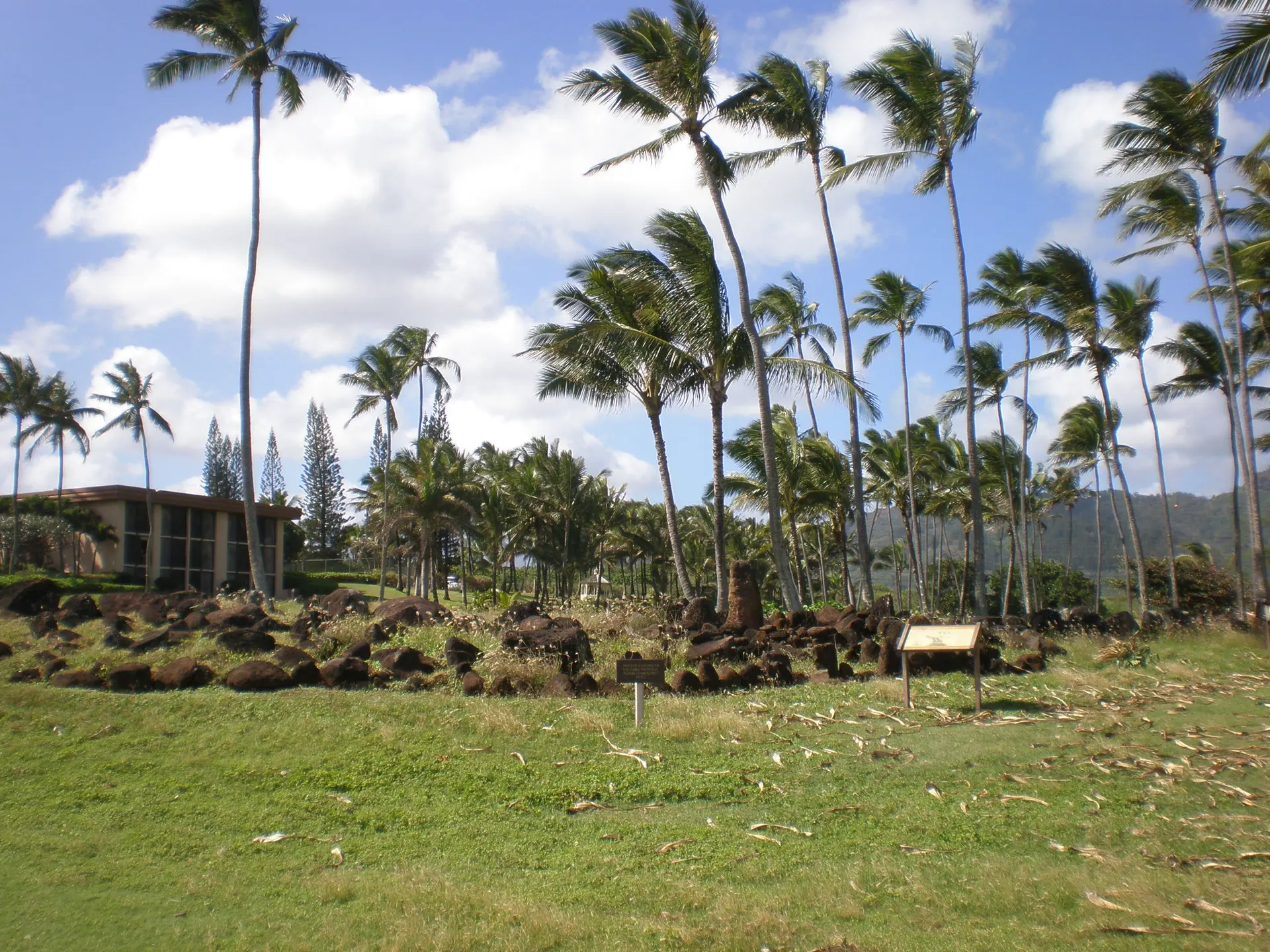
Walking north along the shore, the beach gives way to the mouth of the Wailua River. Here, where the river meets the sea, the foundation stones of Hikinaakala become visible. The original structure covered nearly an acre, its walls thick enough to walk upon. What remains is a trace, a footprint. The stones that survive are low, arranged in patterns that suggest enclosure without providing it.
Signage explains the site's history and significance. The Hawaii Division of State Parks has created interpretive materials that contextualize what visitors see. But the most important information is not on the signs—it is in the orientation of the site itself, facing east toward the ocean, toward the point where the sun rises.
The interior of the heiau is kapu. This is not a rule that visitors are asked to follow but a statement of enduring sacred reality. The ground within the foundation remains forbidden, as it was when kahuna conducted ceremonies here centuries ago. Respect this boundary.
For those who arrive at dawn, the experience takes on a different quality. The darkness gives way to the first gray light. The horizon sharpens. Then the sun emerges from the Pacific, exactly as it did when priests gathered here to greet it. You stand where they stood, watching what they watched. The specific prayers they offered are lost to history, but the phenomenon that inspired them continues, unchanged.
Plan for 30-60 minutes at the heiau itself. To experience the full Wailua Complex—including Holoholoku Heiau with the royal birthstones, Poliahu Heiau with the bellstone, and Malae Heiau—allow 2-3 hours. The park is open 7:00 AM to 7:45 PM daily. For sunrise visits, arrive before 7:00 AM and walk to the heiau in the pre-dawn darkness; the park gates typically open at 7:00 AM, so you may need to park outside and walk in.
Low tide is optimal for viewing the petroglyphs on the rocks near the heiau.
Context and lineage
Hawaiian tradition holds that the Wailua area was chosen as a center of power because of its exceptional mana. The Wailua River, one of the few navigable rivers in Hawaii, formed a sacred corridor from the coast to the interior mountains. The concentration of heiaus along its banks created a landscape saturated with spiritual significance.
Legend says that when a child born at the royal birthstones near Holoholoku Heiau was destined to be a great ali'i, the sky would fill with lightning, thunder, and rain at the moment of birth. The natural world itself announced the arrival of chiefly power. Some accounts credit the menehune—mythical small craftsmen—with building the heiaus, a way of expressing the extraordinary effort their construction required.
Hikinaakala's specific origin is tied to its function. The builders understood that this precise location, at the mouth of the river on the eastern shore, would receive the first light of day. The heiau was constructed not where it was convenient but where the sunrise could be properly greeted.
Hikinaakala belongs to the Hawaiian religious tradition that developed over centuries following Polynesian settlement of the islands. This tradition centered on the relationship between humans and gods, mediated by kahuna and concentrated in heiaus built at locations of spiritual power. The specific practices at Hikinaakala—sunrise ceremonies, chants to greet the dawn—were part of a broader Hawaiian understanding of mana and its flow through the world.
The Wailua Complex represents the height of Hawaiian religious and political organization on Kauai. The four major heiaus—Hikinaakala, Holoholoku, Malae, and Poliahu—served different functions but together constituted a sacred landscape where the spiritual and political orders were unified. The ali'i nui was both ruler and religious figure, and the heiaus were sites where both forms of authority were exercised.
The Ali'i Nui of Kauai
The paramount chiefs of Kauai resided at the Wailua Complex for much of each year, conducting governance and religious observance. Hikinaakala was one of the temples where they participated in ceremony.
The Kahuna
Priests who conducted the sunrise ceremonies at Hikinaakala, greeting the dawn with chants and prayers passed down through generations. They possessed the astronomical knowledge needed to align the heiau with solstice and equinox.
King Kamehameha II (Liholiho)
The Hawaiian king who abolished the kapu system in 1819, ending formal temple worship throughout the islands. After this abolition, Hikinaakala and other heiaus fell into disuse.
Traditions and practice
Before dawn, kahuna and ali'i would gather at Hikinaakala Heiau, waiting in darkness for the first light. As the sun emerged from the Pacific, they offered oli—chants—and pule—prayers—that had been passed down through generations. The specific words are not fully documented, but the function is clear: to greet the sun, to receive its mana, to begin the day in proper relationship with the forces that governed the world.
Special ceremonies occurred during the equinoxes, when the sun rose at the precise point that caused its rays to illuminate the entire heiau. These alignments were intentional, the result of astronomical knowledge encoded in stone. The 28 spokes of other medicine wheels have been interpreted as lunar; at Hikinaakala, the solar orientation was paramount.
The heiau also served broader ceremonial functions as part of the Wailua Complex. Nearby was Hauola, a pu'uhonua where those who broke kapu could find sanctuary. The proximity suggests a landscape where different sacred functions were organized in relationship to each other—a spiritual architecture as deliberate as the stone architecture of the heiau itself.
Formal sunrise ceremonies are no longer conducted at Hikinaakala. The abolition of the kapu system in 1819 ended the religious framework within which such ceremonies made sense. What remains is the site itself, managed as an archaeological and cultural resource by the Hawaii Division of State Parks.
Native Hawaiian practitioners may conduct private ceremonies with appropriate permissions, maintaining a thread of connection to traditional practice. However, these are not public events. For most visitors, the site functions as a place of education—learning about Hawaiian history and religion—and quiet reflection.
The cultural significance of Hikinaakala to Native Hawaiians should not be underestimated because formal ceremonies are rare. The ground remains sacred. The connection to ancestors who worshipped here for centuries remains alive. The site's status as kapu—forbidden to enter—is not a historical curiosity but a continuing reality.
Visitors cannot participate in ceremonies at Hikinaakala—none are publicly held. What visitors can do is approach with respect and attention. Walk to the northern end of Lydgate Beach Park. Stand before the foundation stones. Read the interpretive signs. Then simply be present.
The most meaningful practice available to visitors is to arrive at sunrise. Stand where the kahuna once stood and watch the sun rise over the Pacific. You need not know the chants they offered; the phenomenon that inspired those chants speaks for itself. Light emerging from darkness, the world renewed each day—this is what Hikinaakala was built to honor.
Do not enter the interior of the heiau. This is kapu. The boundary may be invisible, but it is real.
Hawaiian Sunrise Ceremony Tradition
HistoricalHikinaakala Heiau was specifically positioned and oriented for greeting the rising sun with prayers and chants. The dawn was understood to carry mana—spiritual power—that could be received through proper ceremony. This practice reflects the deep Hawaiian connection between celestial events and spiritual life.
Kahuna and ali'i gathered before dawn to offer oli (chants) and pule (prayers) as the sun emerged from the Pacific. Special ceremonies occurred at the equinoxes when the sun's position caused it to illuminate the entire heiau. These practices ceased after 1819 when the kapu system was abolished.
Wailua Complex as Center of Chiefly Power
HistoricalThe Wailua Complex was the principal residence of Kauai's paramount chief and one of two primary political, social, and religious centers on the island. The concentration of heiaus created a landscape where spiritual and political authority were unified.
The ali'i nui resided at Wailua for much of the year, conducting governance and religious observance. Royal children were born at the pohaku ho'ohanau to ensure their chiefly status. The bellstone announced royal births and chiefly processions. Ceremonies at the various heiaus marked important events, seasonal transitions, and political occasions.
Pu'uhonua (Place of Refuge) Tradition
HistoricalAdjacent to Hikinaakala is Hauola, a pu'uhonua where those who violated kapu could find sanctuary and absolution. This tradition reflects the Hawaiian system of restorative justice and the belief in spiritual cleansing.
Those who broke kapu could flee to Hauola, often swimming across the Wailua River to reach safety. Once within the pu'uhonua, they were under divine protection and could not be harmed. After ritual purification by kahuna, they could return to society with their violation absolved. During warfare, non-combatants could seek sanctuary until hostilities ceased.
Contemporary Native Hawaiian Cultural Connection
ActiveFor Native Hawaiians today, Hikinaakala and the Wailua Complex remain wahi kapu—sacred places—that embody connection to ancestors, cultural identity, and traditional spiritual values. The sites' significance is not historical but living.
Cultural education and interpretation programs share traditional knowledge with new generations. Private ceremonies may be conducted with appropriate permissions. The recognition of the site as kapu continues to shape how Native Hawaiians relate to the space. Cultural consultation with Hawaiian practitioners informs site management decisions.
Perspectives and open questions
Hikinaakala Heiau invites interpretation through archaeological, astronomical, and spiritual lenses. What distinguishes the site is the convergence of these perspectives: a structure built with astronomical precision for spiritual purposes, now understood through archaeological methods. For Native Hawaiians, the scholarly questions matter less than the enduring sacredness of the ground.
Scholarly perspective
Archaeologists date Hikinaakala Heiau to approximately the 13th century, part of the Wailua Complex that served as one of two primary centers of chiefly power on Kauai. The structure was a large rectangular enclosure covering almost an acre, with walls of stone and coral measuring up to six feet high and eleven feet thick.
The heiau's orientation to the rising sun—its name means 'Rising of the Sun'—indicates astronomical knowledge among its builders. The alignment with equinox sunrise, when light would illuminate the entire structure, suggests deliberate positioning rather than coincidence. Some sources also note alignment with the North Star (Hokupa'a, meaning 'Immovable Star'), indicating broader astronomical literacy.
The Wailua Complex's designation as a National Historic Landmark in 1962 recognized its significance as one of the most important archaeological site complexes in the Hawaiian Islands, with components spanning all phases of Hawaiian cultural development. The complex provides evidence of the sophisticated religious, political, and economic organization that had evolved on Kauai before European contact.
Living and traditional perspectives
For Native Hawaiians, Hikinaakala Heiau and the Wailua Complex remain wahi kapu—sacred places—that demand respect regardless of their archaeological condition. The stones that remain carry the mana of ancestors who worshipped here for centuries. The site's significance is not diminished by the loss of its walls; the land itself remains sacred.
The abolition of the kapu system in 1819 ended formal temple worship but did not erase the spiritual importance of these places to Hawaiian people. Contemporary Native Hawaiians maintain connection to Hikinaakala through cultural education, occasional private ceremonies, and the simple recognition that this ground is kapu. The boundary is not physical but spiritual—it exists whether or not there is a fence.
The emphasis on sunrise ceremony reflects the Hawaiian understanding of mana and its flow through the world. The rising sun was not merely observed but greeted, its power received through proper ritual. This relationship between humans and cosmic forces, mediated through specific places, remains central to Hawaiian spiritual tradition.
Alternative interpretations
Some visitors approach Hawaiian sacred sites through New Age or esoteric frameworks, interpreting them as 'power spots' or locations of concentrated earth energy. While these perspectives reflect genuine spiritual experiences, they should be distinguished from both scholarly archaeological understanding and traditional Hawaiian spiritual beliefs.
Hawaiian tradition has its own sophisticated understanding of mana and sacred geography that does not require external interpretive frameworks. The heiau was not a generic power spot but a specific instrument for specific purposes, built by people with their own cosmology. Visitors are welcome to have meaningful experiences at Hikinaakala, but should recognize the difference between Hawaiian tradition and projections from outside it.
Open questions
Several questions remain about Hikinaakala Heiau. The precise dating of construction varies between sources—some cite 1200 AD, others 1300 AD, others simply 'the 13th century.' The specific ceremonies conducted and the exact chants used are not fully documented in historical records, much traditional knowledge having been lost with the abolition of the kapu system.
Whether the heiau was primarily an astronomical observatory or primarily a temple—or whether these categories even make sense in Hawaiian thought—remains uncertain. The original height and exact configuration of the walls cannot be fully determined due to stone removal in the 19th century. The relationship between Hikinaakala and the other heiaus in the Wailua Complex, and the specific functions each served, are understood in outline but not in detail.
Plan your visit
Access and arrival
Wailua and nearby Kapaa offer numerous hotels, vacation rentals, and bed-and-breakfasts. The Royal Coconut Coast area has accommodations at various price points. Lihue, 10 minutes south, has additional options including hotels near the airport.
Respectful visit
No specific dress code, though modest attire is appropriate given the sacred nature of the site. Practical beachwear is acceptable as the heiau is within Lydgate Beach Park. Sun protection is essential in Kauai's tropical climate.
Photography is permitted from outside the heiau boundaries for personal use. Do not enter the heiau to take photographs. If Native Hawaiian practitioners are present, do not photograph them without permission. Approach photography as you would at any sacred site—quietly, without disruption.
Visitors unfamiliar with Hawaiian practice should not leave offerings. The appropriate offering is respectful attention and silence. Do not leave flowers, food, coins, or other items that would constitute litter. If you wish to make a traditional offering, consult with local Hawaiian cultural practitioners about proper protocols.
{"The interior of the heiau is kapu (forbidden)—do not enter","Do not climb on, sit on, move, or remove stones","Do not touch the petroglyphs","Do not leave offerings unless following traditional Hawaiian protocol","Obey all posted signs","Photography from outside the heiau only","Treat the entire area with quiet reverence"}
The interior of the heiau is forbidden. Do not enter it to take photographs, to meditate, or for any other reason. Do not climb on, sit on, move, or remove any stones. Do not leave offerings unless you are a Native Hawaiian practitioner following traditional protocol. The petroglyphs visible at low tide should be viewed but not touched.
Current practical details
Address
Nalu Rd, Kapaʻa, HI 96746, USA
Hours
Hours, fees, and access can change — verify on the official source before you travel. Practical details last checked Jun 2026.
Location
Map loads as you approach this section.
Pilgrim reflections
A portrait of encounter, not a score
Pilgrims describe what they felt, how present they could become, and whether the place would shape a journey. There are no stars and no ranking of traditions.
No reviewed reflections yet
The first pilgrims can help describe the character of being here.
Share a reflection
Available after an account-backed “Been there.” Every reflection is reviewed before publication.
Nearby sacred places
Explore other sacred places in the region. Proximity does not establish access or travel time; check each place’s guidance.

References
Sources consulted for this page. Source categories describe the publication, not a guarantee that every claim is verified. Traditional accounts and outside interpretations may differ.
- 01Wailua Complex of Heiaus — National Park ServiceacademicOfficial National Historic Landmark documentation
- 02Hikinaakala Heiau - Wailua Complex of Heiau Brochure — Hawaii Department of Land and Natural Resources, Division of State ParksacademicOfficial state park interpretation materials
- 03Wailua Complex of Heiau — Historic Hawaii FoundationacademicHistoric preservation organization documentation
- 04Hikinaakala Heiau, Kauai — To-Hawaii.comSource contextDetailed visitor information and historical context
- 05Wailua River Cultural Sites - The Land of the Alii — Hawaii GuideSource contextComprehensive overview of the Wailua Complex cultural sites
- 06Day 101: Wailua Complex of Heiaus, Kauai, Hawaii — Asian Pacific Islander Americans in Historic Preservation (APIAHiP)Source contextCultural preservation perspective on the site
- 07Kauai's Historical Sites on the Royal Coconut Coast — Royal Coconut CoastSource contextRegional historical context and visitor information
- 08Hikinaakala (Rising Sun) Heiau and Hauola Heiau Tour Stop — Shaka GuideSource contextCultural interpretation for visitors
Share a photo
Help visitors recognize Hikinaakala Heiau, Kauai. Every submission is reviewed before publication.