Keahiakawelo (Garden of the Gods), Hawaii
Where a kahuna's sacred fire stripped the earth bare to save an island
Lanai City, Hawaii, United States
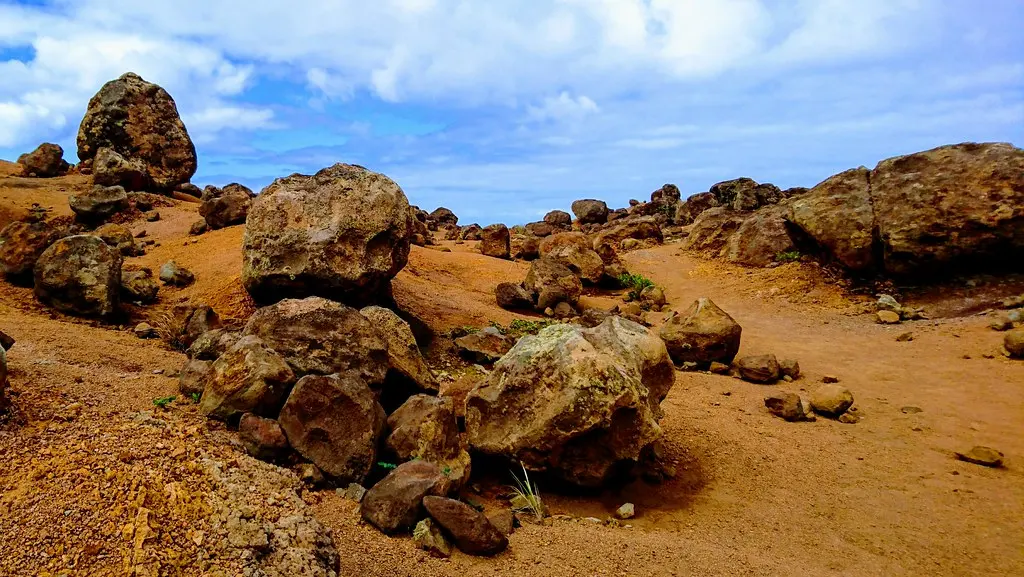
Image of Keahiakawelo (Garden of the Gods), Hawaii. Image source
Visit essentials
Before you go
- Address
- Lanai City, HI 96763, USA
- Duration
- 1-2 hours to fully explore the site and experience the landscape at dawn or dusk, plus 45-minute…
- Etiquette
- The fundamental principle: do not disturb the rocks.
Overview
The rocks appear without warning. After miles of rough dirt road through Lanai's dry uplands, the landscape opens to reveal a scene that belongs to another planet entirely: rust-red spires and balanced boulders scattered across barren earth, colors shifting through ochre and purple in the angled light. No palm trees. No lush greenery. This is Hawaii as almost no one imagines it.
Keahiakawelo translates simply as 'the fire of Kawelo,' but the name carries a weight of meaning that unfolds across generations of Hawaiian oral tradition. Kawelo was a kahuna, a priest of Lanai, who maintained a perpetual fire at an altar on this windswept plateau. As long as that fire burned, prosperity was assured for the island's people. But a rival kahuna on Molokai, visible across the channel, kindled his own fire while offering prayers of ill will.
Kawelo perceived the attack. To keep his protective fire burning against this spiritual assault, he used every piece of vegetation in the surrounding landscape. Tree by tree, shrub by shrub, he fed the flames until nothing remained but bare earth and stone. He won the contest. The people of Lanai were saved. The barren landscape you walk through today is said to be the evidence of that victory.
This is what makes Keahiakawelo a wahi pana, a storied landscape where Hawaiian culture inscribes its deepest meanings onto the physical world. The legend is not separate from the place; they are one phenomenon. The extinction of the purple lehua flowers that once grew here, said to have been transformed by smoke from Kawelo's fire, adds another layer of loss woven into the land.
Western visitors arriving in 1912 saw the alien terrain and named it Garden of the Gods, comparing it to the Colorado formation. That name persists on tourist maps, but it overlays rather than replaces the Hawaiian understanding. For contemporary visitors who learn the traditional name and its story, the landscape transforms from geological curiosity to sacred geography. You walk on ground where a priest's determination shaped both spiritual and physical reality.
Why this place is sacred
What makes Keahiakawelo feel sacred? The question has different answers depending on who asks and how they listen. From one perspective, this is geology: sedimentary deposits of iron-rich soil, volcanic ash, and silt, sculpted over thousands of years by relentless wind erosion, the process accelerated when introduced goats and deer stripped away the native dryland forest. From another perspective, the scientific explanation is not wrong but incomplete. For Native Hawaiians, the landscape speaks.
It tells of a kahuna who loved his people enough to burn every living thing within reach to protect them. It remembers purple flowers that no longer exist, transformed by smoke from a sacred fire. It holds the silence of a contest won across the waters, the moment when a rival priest on Molokai saw Kawelo's final act and fell dead. The thin place quality of Keahiakawelo lies in this layering.
Stand among the rock towers at sunset, when shadows stretch long and the stones glow in colors you cannot quite name, and you encounter a landscape that refuses ordinary explanation. The silence is not empty but weighted. The wind that carved these formations carries something you cannot quite articulate. Visitors consistently report experiences that transcend sightseeing: a sense of entering another realm, an awareness of depths beneath the surface of things.
For those who know the legend, these sensations take on meaning. You are walking on ground where worlds met, where a fire burned between realms, where the well-being of an entire island hung in the balance. The landscape looks stripped, barren, strange because something happened here that left its mark on the earth itself. The transmission persists not because anyone enforces it but because the place itself seems to require explanation.
Even visitors who arrive knowing nothing of Kawelo leave with questions. The thinness of Keahiakawelo is the thinness of a place that will not let you forget you are standing somewhere significant.
Site of Kawelo's altar fire in Hawaiian tradition. Sacred landscape where spiritual practice shaped physical reality.
Indigenous significance predates Western contact by centuries. Lanai was settled by Polynesians around 1200 AD. The landscape was already recognized as the site of Kawelo's legendary fire when Western visitors arrived. The Western nickname 'Garden of the Gods' was coined in 1912 by journalist Alexander Hume Ford, who compared it to the Colorado formation. Introduction of grazing animals in the 1800s accelerated erosion of native vegetation.
Today the site is managed as a public landmark while the Lanai Culture & Heritage Center works to preserve and transmit its Hawaiian significance.
Experience and orientation
You cannot arrive at Keahiakawelo casually. The site lies seven miles from Lanai City, but those miles require a four-wheel-drive vehicle and nearly an hour of careful navigation. Polihua Road leaves pavement behind and becomes a rutted track through dry forest, past the Kanepuu Preserve with its native lama and olopua trees, the last significant remnant of the dryland forest that once covered this region. The difficulty of access is part of the experience. You earn this place.
The landscape announces itself suddenly. After miles of dusty road and dry scrub, the terrain opens to reveal the rock garden: towers of red and orange stone rising from barren earth, some as tall as a person, others balanced in arrangements that seem impossible. The colors are the first surprise, brilliant reds and ochres that shift toward purple in certain light, the result of iron oxidation in the ancient soils. The silence is the second surprise, broken only by wind.
The formations invite exploration. There are no marked trails, no interpretive signs, no facilities of any kind. You simply walk among the rocks, finding your own path between the spires and boulders. The terrain is uneven but not difficult. Some visitors spend half an hour; others lose track of time entirely. Views extend to Molokai across the channel, the island where Kawelo's rival once burned his own fire in spiritual contest. On clear days, Oahu appears on the horizon.
The light matters enormously. At midday, the formations can appear flat and washed out under harsh sun. At sunrise or sunset, they become something else entirely: glowing sculptures in colors that seem to shift as you watch, shadows stretching between towers, the landscape achieving a quality that explains why people reach for words like otherworldly, lunar, sacred. This is when Keahiakawelo reveals what it has to offer. You can combine the visit with nearby attractions.
The Kanepuu Preserve, passed en route, offers a half-mile interpretive trail through one of Hawaii's last dryland forests. Polihua Beach, at the road's end beyond Keahiakawelo, is a remote strand where sea turtles nest. But Keahiakawelo rewards focused attention. Let it be what it is rather than a stop on a checklist.
Northwestern Lanai, approximately 7 miles from Lanai City via Polihua Road. Coordinates: 20.8819N, 157.0000W. Elevation approximately 1,600 feet. The site is reached by passing through dry uplands and the Kanepuu Preserve. No facilities, no marked trails, no services at the site.
Context and lineage
The legend exists in several versions, but the core elements persist across tellings. Kawelo was a kahuna, a Hawaiian priest, who served the people of Lanai. He maintained a perpetual fire on an altar at this site, visible across the channel to Molokai. As long as the fire burned, prosperity was assured. A rival kahuna on Molokai, named Lanikaula or Waha in different versions, became hostile to Lanai's people.
He kindled his own fire while offering prayers intended to bring harm across the water. Kawelo perceived the attack. The contest became a matter of which priest could keep his fire burning longer. Kawelo fed every plant within reach to his flames. The shrubs went first, then the trees, until the landscape was stripped bare. At the critical moment, Kawelo employed sacred knowledge against his rival.
When Lanikaula saw Kawelo's final act from across the channel, he cried 'Alas, I died!' and fell dead. The people of Lanai were saved. The landscape remembers. The barren terrain you walk through is said to be the direct result of Kawelo's sacrifice. A further layer of loss: the smoke from Kawelo's fire is said to have transformed the nearby ohia lehua trees, turning their blossoms purple, a variety found nowhere else.
These po lehua, purple lehua, became a symbol of Lanai for centuries. They went extinct in the 1800s when introduced grazing animals destroyed the remaining native forest. Elders born around 1890 recalled seeing the last purple lehua as children. The Western name 'Garden of the Gods' was applied in 1912 by journalist Alexander Hume Ford, who visited and compared the formations to the Colorado landmark.
The name has persisted on tourist maps, but it carries none of the cultural weight of Keahiakawelo. Alternative legends also circulate: that the rocks fell from gardens in the sky, that they hold spirits of ancient warriors, that gods created them as sculptures. These stories reflect the site's capacity to inspire interpretation, but the core tradition of Kawelo and his fire remains the primary Hawaiian understanding.
Keahiakawelo represents Hawaiian wahi pana tradition, the understanding that significant places carry stories that are inseparable from their physical form. The legend of Kawelo reflects broader themes in Hawaiian culture: the power of kahuna, inter-island rivalries in the centuries before Western contact, and the responsibility of priests to protect their communities. The site connects to other sacred landscapes on Lanai including Kaunolu Village, Halulu Heiau, and the Luahiwa Petroglyphs.
Kawelo
Lanikaula (or Waha)
Alexander Hume Ford
Traditions and practice
The kahuna Kawelo maintained a perpetual fire on an altar at this site. Specific ceremonial practices beyond the fire-keeping are not detailed in surviving oral traditions. At nearby Kaa, in the same northern land division, traditional Hawaiians offered prayers to Kane, a god associated with freshwater and life. The broader context was one of ongoing spiritual protection and responsibility for community well-being.
The Lanai Culture & Heritage Center actively works to preserve and transmit knowledge of Keahiakawelo and other sacred sites on the island. Their GPS-enabled mobile app provides cultural interpretation for self-guided visits. Community stewardship efforts work to preserve both Keahiakawelo and the nearby Kanepuu Preserve. The primary contemporary practice is respectful visitation: approaching the site with awareness of its significance, using the traditional name, learning the legend, and above all not disturbing the rock formations.
Begin by downloading the Lanai Guide mobile app from the Lanai Culture & Heritage Center for cultural context and GPS-enabled directions. Time your visit for sunrise or sunset when the rocks display their most dramatic colors. Allow at least an hour at the site itself, plus driving time. Walk slowly among the formations. Listen to the wind. Consider the legend: you are standing where a priest burned everything in sight to protect his people.
Let the landscape speak before you speak about it. If you want deeper context, visit the Lanai Culture & Heritage Center in Lanai City before or after your visit.
Native Hawaiian wahi pana observance
ActiveKeahiakawelo is recognized as a wahi pana, a sacred storied landscape in Hawaiian tradition. The site holds significance for the Lanai community and for Native Hawaiians more broadly as a place where legend and landscape are inseparable.
Respectful visitation. Recognition of the site's sacred nature. Preservation of the landscape in its natural state. Transmission of traditional stories and place-name knowledge through the Lanai Culture & Heritage Center and community education.
Kahuna altar fire tradition
HistoricalThe legendary kahuna Kawelo maintained a perpetual fire at this site to protect Lanai's people. The fire served as both protective spiritual practice and symbol of the island's prosperity. The contest between Kawelo and his Molokai rival represents broader themes of inter-island spiritual competition in traditional Hawaiian society.
Kawelo maintained a continuous fire on an altar. When threatened by a rival priest's malevolent prayers, he used every piece of vegetation in the area to keep his fire burning. He won the contest through sacred knowledge, saving the people of Lanai.
Perspectives and open questions
Keahiakawelo exists at the intersection of geological process and Hawaiian oral tradition, offering different but not necessarily incompatible ways of understanding how a landscape comes to be and what it means.
Scholarly perspective
Geologists explain the rock formations through natural processes: sedimentary deposition of iron-rich soils, volcanic ash, and silt over thousands of years, subsequently sculpted by wind erosion. The introduction of goats, sheep, and axis deer in the 1800s stripped native vegetation and accelerated erosion. The site's significance to Native Hawaiian culture is documented through ethnographic research and the work of institutions like the Lanai Culture & Heritage Center.
The legend of Kawelo represents important themes in Hawaiian tradition: the power and responsibility of kahuna, inter-island rivalries, and the intimate relationship between place and story.
Living and traditional perspectives
For Native Hawaiians, Keahiakawelo is primarily understood through its legend and its status as a wahi pana, a sacred storied landscape. The name itself carries the cultural memory of a kahuna who protected his people through sacrifice. The barren landscape is not merely the result of erosion but the lasting evidence of Kawelo's victory. The extinction of the purple lehua flowers adds poignancy to this understanding.
The Lanai Culture & Heritage Center actively works to preserve these traditional perspectives and ensure the Hawaiian name and story are transmitted alongside the Western nickname.
Alternative interpretations
Some visitors approach the site through alternative frameworks. Lesser-known legends hold that the rocks fell from gardens in the sky, that they contain the spirits of ancient warriors, or that gods created them as sculptures. While these interpretations are not from traditional Hawaiian sources, they reflect the site's capacity to inspire spiritual imagination. Visitors report experiences of otherworldliness, of entering a different realm, of encountering something that defies ordinary explanation.
Open questions
Questions remain open: the precise nature of ceremonies that may have been conducted at Kawelo's altar; archaeological evidence that might date the site's sacred use; whether Kawelo was a historical figure or purely legendary; the full traditional chants or prayers associated with the site; why some rocks appear balanced in arrangements that seem impossible. The landscape holds more than has been transmitted or recorded.
Plan your visit
Access and arrival
Lanai City offers the Four Seasons Resort at Koele (currently under renovation) and Hotel Lanai, a small historic hotel. The Four Seasons Resort Lanai at Manele Bay is on the south shore. Limited vacation rentals available. No camping at Keahiakawelo. The island has limited accommodations overall; booking in advance is recommended.
Respectful visit
Practical outdoor clothing appropriate for sun, wind, and dust. Bring a jacket as it can be windy even when lower elevations are calm. Sunglasses protect against loose dust. Closed-toe shoes recommended for walking on uneven terrain.
Permitted. The dramatic light at sunrise and sunset provides the best conditions. Be respectful if you encounter other visitors in contemplation.
Not a typical practice for visitors. The most appropriate offering is respectful behavior: walking carefully, not disturbing the rocks, and learning the site's true name and history.
Do not move, stack, or disturb the rocks. Do not remove rocks, plants, or materials. No camping. No facilities available. Four-wheel-drive vehicle required for access.
Do not move, stack, or disturb the rocks. This is both culturally disrespectful and environmentally damaging. The natural placement of the rocks is part of the island's heritage. Stacking rocks, a practice some visitors import from other contexts, is inappropriate here. Do not remove any rocks, plants, or materials. Pack out all trash. The road requires four-wheel drive and should be avoided after heavy rain.
Current practical details
Address
Lanai City, HI 96763, USA
Hours
Hours, fees, and access can change — verify on the official source before you travel. Practical details last checked Jun 2026.
Location
Map loads as you approach this section.
Pilgrim reflections
A portrait of encounter, not a score
Pilgrims describe what they felt, how present they could become, and whether the place would shape a journey. There are no stars and no ranking of traditions.
No reviewed reflections yet
The first pilgrims can help describe the character of being here.
Share a reflection
Available after an account-backed “Been there.” Every reflection is reviewed before publication.
Nearby sacred places
Explore other sacred places in the region. Proximity does not establish access or travel time; check each place’s guidance.


References
Sources consulted for this page. Source categories describe the publication, not a guarantee that every claim is verified. Traditional accounts and outside interpretations may differ.
- 01Keahiakawelo (Garden of the Gods) | Go Hawaii — Hawaii Tourism AuthorityofficialOfficial Hawaii state tourism resource
- 02Keahiakawelo, Lanai's legendary 'Garden of the Gods' — Hawaii MagazinenewsDetailed cultural and historical coverage
- 03Ke-ahi-a-Kawelo | Images of Old Hawaii — Images of Old HawaiiacademicHistorical accounts and traditional oral histories
- 04Lanai Culture & Heritage Center — Lanai Culture & Heritage CenterSource contextLocal cultural institution preserving Lanai heritage
- 05The Storied Places of Lanai — Ka Wai Ola (Office of Hawaiian Affairs)newsNative Hawaiian perspective on cultural sites
- 06Kanepuu Preserve — The Nature ConservancySource contextConservation context for nearby preserve
- 07Hawaiian Mythology: Sorcery Gods — Internet Sacred Text ArchiveacademicAcademic compilation of Hawaiian mythology
- 08Keahiakawelo (Garden of the Gods) — Frommer'sguidePractical visitor information
- 09Garden of the Gods, Lanai — To-Hawaii.comguideVisitor information and cultural context
- 10Take me there Tuesday: Keahiakawelo — Go Visit HawaiiguideTravel guide with cultural context
Share a photo
Help visitors recognize Keahiakawelo (Garden of the Gods), Hawaii. Every submission is reviewed before publication.