Pohaku Ho'ohanau, Kauai
Where Kauai's royal children entered the world, their umbilical cords bound to sacred stone
Understand sacred places, explore living traditions, and learn how to engage respectfully with Pilgrim Map.
Access has not been verified. Check current local guidance before planning a visit.
Kapaa, Hawaii, United States
Read the sources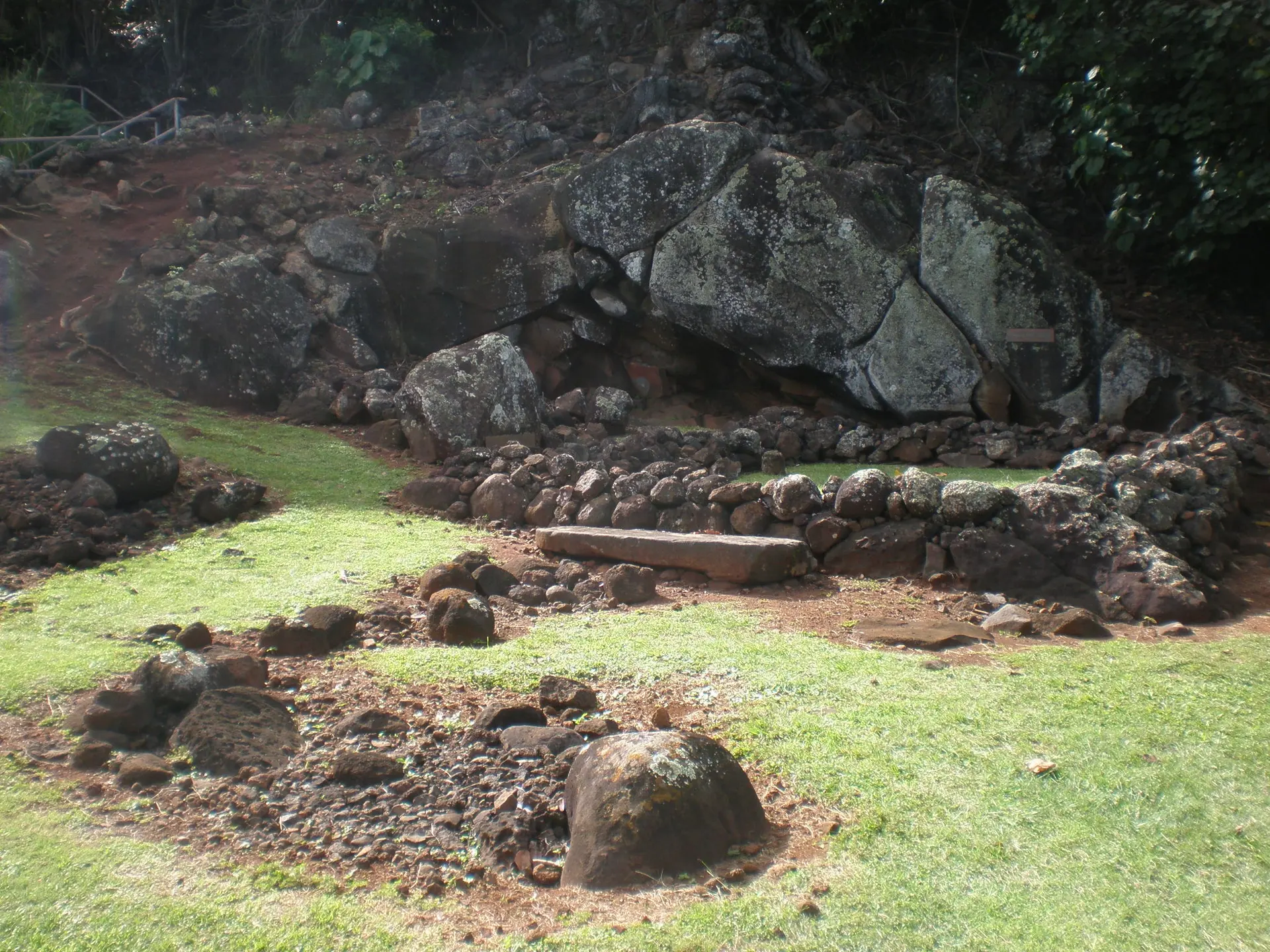
Visit essentials
A quick read before you go
- Duration
- 30-60 minutes for the birthing stones and Pohaku Piko.
- Etiquette
- Pohaku Ho'ohanau is a protected sacred site requiring respectful behavior.
Overview
The birthing stones of Pohaku Ho'ohanau rest in a small clearing above the Wailua River, part of a sacred complex that served as the seat of power for Kauai's paramount chiefs. Two stones stand here: one where the mother leaned her back, another where she braced her feet during labor. Within the stone enclosure, a grass shelter once housed expectant mothers of royal lineage.
A flat stone covered the sacrifice of a dog, marking the space as kapu, forbidden to all but royalty, priests, and their attendants.
The purpose of this place was nothing less than the legitimization of divine right. Hawaiian ali'i traced their ancestry back to Wakea, the Sky Father, and Papa, the Earth Mother. Genealogical purity determined mana, spiritual power. A child born at Pohaku Ho'ohanau inherited not just rank but cosmic standing. Birth at the wrong location, to the wrong attendants, could disqualify a chief from the highest positions. The stakes of this threshold were absolute.
Nearby stands Pohaku Piko, a rock wall where the newborn's umbilical cord was placed. The piko bound the child to the land, to their ancestors, to the unbroken chain of lineage reaching back to the gods. According to tradition preserved at the Bishop Museum, if the cord disappeared by morning, the child would live a long life. Some say storms attended births of destined leaders, followed by rainbows indicating the exact spot where greatness entered the world.
The kapu system that governed this site ended in October 1819, when Kamehameha II abolished the traditional religious restrictions. No more royal births have occurred at these stones in over two centuries. Yet they remain, part of a National Historic Landmark, holding the memory of a time when birth was not merely biological but cosmological, when the threshold of life was also the threshold of divinity.
Why this place is sacred
Some places become thin through accident of geography. Others are made thin through sustained human intention. Pohaku Ho'ohanau belongs to the second category. Every element of the site was designed to create a controlled threshold between the world of spirits and the world of the living.
The kapu system established the necessary separation. Commoners could not approach. A sacrificed dog beneath a flat stone announced to any who might pass that sacred business was being conducted within. The bellstone, when struck, broadcast news of the threshold's crossing throughout the entire Wailua Valley, from mountains to sea. The birth itself occurred at stones selected and consecrated for this single purpose.
The piko ceremony extended the threshold's significance beyond the moment of birth. The umbilical cord, placed in sacred stone, created a permanent bond between the newborn and the land. The child entered the physical world not as an isolated individual but as a link in a chain stretching back through generations to the gods themselves. Past and future met at the birthing stones.
The celestial signs reportedly accompanying royal births, storms followed by rainbows, suggest that the threshold extended beyond earth to sky. Heaven itself was believed to acknowledge the crossing. The Wailua Complex was aligned from river mouth to mountain summit, creating a sacred geography where the birthing stones occupied their proper place in a larger cosmological order.
The thinness here is not ambient but concentrated. It does not arise from landscape, though the Wailua Valley possesses its own beauty. It arises from the accumulated weight of what happened at this specific spot: the concentrated spiritual power of generations of royal births, each adding mana to the stones, each strengthening the connection between worlds. The kapu system is gone. The ceremonies have ceased. But the threshold remains inscribed in stone.
Pohaku Ho'ohanau existed for a single purpose: to serve as the ceremonial birthplace for Kauai's ali'i, legitimizing their divine status and right to rule. Hawaiian chiefs traced their lineage to Wakea and Papa, progenitors of the Hawaiian people. Birth at a designated sacred site confirmed this cosmic ancestry. Children born elsewhere, even to high-ranking mothers, could not claim the same standing. The birthing stones were a gate through which future leaders had to pass.
The site functioned within the larger Wailua Complex, which served as the principal residence of Kauai's paramount chief. Holoholoku Heiau, adjacent to the birthing stones, was a luakini heiau where human sacrifices were performed. The proximity was not accidental: birth and death, creation and destruction, the beginning and end of life all occupied the same sacred ground.
The complex also included Hikinaakala Heiau at the river's mouth, where priests greeted the rising sun, and Poliahu Heiau further up the valley, dedicated to the snow goddess. The birthing stones took their place within this cosmologically ordered landscape.
The traditional use of Pohaku Ho'ohanau ended with the abolition of the kapu system in October 1819. King Kamehameha II, under the influence of his mother Keopuolani and the powerful regent Ka'ahumanu, dismantled the religious restrictions that had governed Hawaiian life for centuries. The heiau were abandoned; the birthing stones fell silent.
In 1933, Holoholoku Heiau was restored by the Bishop Museum, beginning a period of archaeological interest in the Wailua Complex. Recognition of the site's significance grew throughout the 20th century, culminating in the designation of the Wailua Complex of Heiaus as a National Historic Landmark in 1962. This status, one of the first granted to a Hawaiian cultural site, acknowledged the complex's archaeological and historical importance.
Today, the birthing stones are preserved as part of Wailua River State Park. While traditional ceremonies no longer take place, the site remains culturally significant to Native Hawaiians as part of their ancestral heritage. Cultural practitioners may visit for spiritual connection. The stones have transitioned from active sacred site to protected heritage site, but the transformation has not erased their meaning. What happened here still matters to those who trace their ancestry through these islands.
Experience and orientation
The path to Pohaku Ho'ohanau begins just off Kuamoo Road, about a quarter mile up from the main highway. The trail is short, perhaps three hundred yards, and easy. Tropical vegetation lines the way, the lush growth of Kauai's wet eastern side. The Wailua River flows nearby, its waters moving toward the sea.
The birthing stones themselves are modest. Two stones, waist-high, the basalt worn smooth by time. One stone supported the mother's back; the other held her feet. Around them, the remnants of a stone enclosure suggest the sacred boundary that once separated this spot from the ordinary world. A grass shelter stood here once, housing expectant mothers in their final days before labor. A flat stone marked where a sacrificed dog lay, signifying kapu.
Nearby, Pohaku Piko presents a rock wall with cracks and crevices where umbilical cords were placed. The piko of royal children, wrapped in kapa cloth along with the placenta, were wedged into these openings, binding the newborn to the land. Some of these crevices remain visible, their significance unchanged by the passing of centuries.
What strikes visitors is the quietness. No crowds gather here. No vendors line the path. The birthing stones receive a fraction of the attention given to Opaeka'a Falls up the road. Those who come arrive with intention, or else wander in from the nearby parking area, curious about the weathered interpretive signs.
The experience is contemplative rather than dramatic. Standing before these stones, you confront the mystery of birth itself, filtered through a tradition that understood the entry into physical existence as a matter of cosmic significance. Where you were born determined who you could become. The threshold mattered. These stones mark that threshold, holding the memory of a time when the crossing from one world to another was attended by priests, announced by bellstones, and confirmed by rainbows.
Plan for 30 to 60 minutes at the birthing stones themselves. The walk is short and easy. If you wish to explore the broader Wailua Complex, allow 2 to 4 hours to visit the various heiau and sacred sites spread along Kuamoo Road and down toward the river mouth. Interpretive signs provide context, though the information is general. Early morning offers cooler temperatures and softer light. Bring water and sun protection.
The site is open during state park hours, 7am to 7:45pm daily. Entry fees apply for non-residents.
Context and lineage
Hawaiian tradition traces the lineage of the ali'i back to Wakea, the Sky Father, and Papa, the Earth Mother. From this divine union came the Hawaiian people, with the highest-ranking chiefs possessing the greatest mana through their genealogical purity. Genealogies were memorized and recited in long chants such as the Kumulipo, a 2,000-line creation account tracing the royal line back to the beginning of existence.
The lower Wailua Valley was named Wailuanuiaho'ano, 'great sacred Wailua,' in the 14th century after the paramount chief of that era. The name reflects both the sacred character of the landscape and its function as the royal seat. Within this context, Pohaku Ho'ohanau served as the designated birthplace for royal children, one node in a network of sacred sites that together constituted the ritual infrastructure of Hawaiian kingship.
The bellstone near Poliahu Heiau connected the birthing stones to the broader complex. When struck, its resonant tone carried throughout the valley, reaching Malae Heiau at the river's mouth. News of a royal birth traveled on sound waves, announcing to the entire kingdom that a new link had been forged in the chain of divine descent.
The birthing stones belong to the broader Hawaiian tradition of the ali'i, the chiefly class whose divine ancestry legitimized their rule. This tradition spans all the Hawaiian islands, with Kukaniloko on O'ahu serving a parallel function as a royal birthing site. The practices observed at Pohaku Ho'ohanau, including the piko ceremony, reflect pan-Hawaiian cultural patterns while serving Kauai's specific royal lineage.
The Wailua Complex's designation as a National Historic Landmark in 1962 recognized its significance not just for Kauai but for Hawaiian history as a whole. The complex represents one of the most complete surviving examples of the sacred geography that once organized Hawaiian society, with components spanning all phases of Hawaiian culture from before 1200 AD through the abolition of the kapu system.
Wailuanuiaho'ano
Paramount chief after whom the lower Wailua Valley was named in the 14th century. His name, meaning 'great sacred Wailua,' reflects the spiritual significance of the region during his reign.
Kamehameha II (Liholiho)
Hawaiian king who abolished the kapu system in October 1819, ending the traditional religious practices including royal births at designated sacred sites. His act transformed Hawaiian society and ended the ceremonial function of sites like Pohaku Ho'ohanau.
Bishop Museum Restoration Team
In 1933, researchers from the Bishop Museum in Honolulu restored Holoholoku Heiau, beginning modern preservation efforts at the Wailua Complex. Their work helped document and protect the site's heritage.
Traditions and practice
The birth ritual at Pohaku Ho'ohanau followed precise protocols. An expectant mother of royal lineage would travel to the site in her final days of pregnancy, taking residence in the grass shelter within the stone enclosure. When labor began, she positioned herself at the birthing stones, leaning against one while bracing her feet against the other. Attendants, priests, and perhaps high-ranking family members were present.
A dog was sacrificed and placed beneath a flat stone, marking the space as kapu and warning commoners to stay away. The birth itself was attended by signs, according to tradition: storms and thunder if the child was destined for greatness, followed by a rainbow indicating the exact spot of birth.
After delivery, the piko ceremony bound the child to the land. The umbilical cord was wrapped in kapa cloth, along with the placenta, and placed in a crack in the rock wall at Pohaku Piko. If the cord disappeared by the next morning, the child would live a long life. The bellstone was struck to announce the birth, its resonant tone carrying throughout the Wailua Valley.
Genealogical chants established the newborn's place in the cosmic order. These chants, some stretching to thousands of lines, traced the child's ancestry back through generations to Wakea and Papa, the progenitors of all Hawaiians. The birth at Pohaku Ho'ohanau was not merely biological but cosmological, inserting the child into a lineage of divine descent.
The ceremonial function of Pohaku Ho'ohanau ceased with the abolition of the kapu system in 1819. No royal births have occurred at the site in over two centuries. Today, the birthing stones are preserved as part of Wailua River State Park and the Wailua Complex of Heiaus National Historic Landmark.
Native Hawaiian cultural practitioners may visit the site for spiritual connection to their ancestral heritage. The site remains meaningful to those who trace their genealogy through Kauai's royal lines or who seek to honor Hawaiian tradition more broadly. Educational tours explain the historical and cultural significance of the stones to visitors.
The broader Wailua Complex continues to hold significance for Hawaiian cultural identity. The preservation of the heiau and sacred sites represents an ongoing commitment to honoring the ancestors and maintaining connection to traditional knowledge, even when the specific ceremonies are no longer performed.
Visitors to Pohaku Ho'ohanau are welcome to observe and learn but should not expect to participate in ceremonies. The appropriate approach is respectful witness: quiet observation, reflection on the site's significance, and consideration of what birth meant in a culture where genealogical standing determined cosmic status.
Take time to read the interpretive signs. Walk slowly through the enclosure. Consider the two stones and their function: one for the mother's back, one for her feet. Look at Pohaku Piko and the crevices where umbilical cords were placed. Think about what it meant to bind a child to the land at the moment of birth.
If you have Hawaiian ancestry, or if you feel drawn to honor Hawaiian tradition, you may wish to spend time in quiet contemplation. The site does not require ceremony to be meaningful. Its significance lies in what happened here across generations: the threshold crossings, the piko bindings, the bellstone announcements that carried the news of royal births throughout the sacred valley.
Hawaiian Ali'i Royal Birth Tradition
HistoricalPohaku Ho'ohanau served as the ceremonial birthplace for Kauai's ali'i, the chiefly class whose divine lineage traced back to Wakea and Papa. Birth at this sacred site legitimized a royal child's status and right to rule. Only children born at designated sites like Pohaku Ho'ohanau or Kukaniloko (O'ahu) could claim the highest rank.
Expectant mothers of royal lineage traveled to the birthing stones for delivery. One stone supported the mother's back; another held her feet. A grass shelter housed the mother before labor. A sacrificed dog marked the site as kapu. The bellstone announced births throughout the valley. Celestial signs, storms followed by rainbows, were watched for as omens of the child's destiny.
Piko (Umbilical Cord) Ceremony
HistoricalThe piko held profound spiritual significance in Hawaiian culture, representing the connection between generations and between child and land. The umbilical cord bound the newborn to their ancestors and to the sacred geography where they entered the world.
After birth, the baby's umbilical cord was wrapped in kapa cloth along with the placenta and placed in a crack in the rock wall at Pohaku Piko. If the cord disappeared by the next morning, the child would live a long life. The piko connected the child to their life path while the placenta connected them to a specific place.
Bellstone Birth Announcement
HistoricalThe Wailua Bellstone (Pohaku Kani) served as the communication network of the sacred complex. Its resonant tone, produced when struck, carried news throughout the Wailua Valley, reaching from the mountains to Malae Heiau at the river's mouth.
Kahuna struck the bellstone to announce royal births, signal ceremonial events, and warn commoners away from kapu land. The sound traveled the length of the valley, making the birth of a new chief a public event heard by the entire community.
Divine Omen Tradition
HistoricalHawaiian tradition held that celestial signs accompanied the birth of children destined for greatness. These omens served as divine confirmation of the newborn's status and future.
According to legend, if a child was destined to be a great ali'i, the sky would fill with lightning, thunder, and rain at the moment of birth. When the storm cleared, a rainbow would appear over the birth area, with one end marking the exact spot where the child entered the world.
Perspectives and open questions
Pohaku Ho'ohanau invites interpretation from multiple angles: archaeological, anthropological, and cultural. The site's significance rests not on mystery or ambiguity but on documented tradition. The birthing stones served a specific function within a specific culture. What remains open is how contemporary visitors, whether of Hawaiian descent or not, might relate to a place where birth carried cosmic weight.
Scholarly perspective
The Wailua Complex of Heiaus is recognized by archaeologists and historians as one of the most significant archaeological site complexes in the Hawaiian Islands. Components span all phases of Hawaiian culture, from Malae Heiau (built before 1200 AD) through the abolition of the kapu system in 1819. The Complex's designation as a National Historic Landmark in 1962 reflects scholarly consensus about its importance.
The birthing stones are documented through ethnographic sources as the ceremonial birthplace for Kauai's ali'i. The piko ceremonies are recorded by the Bishop Museum and other institutions. The function of these stones within the Hawaiian system of legitimizing royal status is well established. Unlike many sacred sites where original purpose remains speculative, Pohaku Ho'ohanau's role is clearly understood.
What remains uncertain are details: exact construction dates, the specific names of chiefs born here, the full ritual protocols observed during birth. Hawaiian oral tradition, while rich, did not document every detail of every site. The birthing stones preserve a known function within a partly unknowable history.
Living and traditional perspectives
For Native Hawaiians, Pohaku Ho'ohanau represents the sacred threshold where royal ancestors entered the physical world. The stones embody the mana accumulated through generations of sacred births. The piko ceremonies bound royal children to the land in ways that persist across time; the descendants of those children carry that connection today.
The abolition of the kapu system in 1819 ended the ceremonial function of the birthing stones but did not erase their meaning. Native Hawaiian cultural practitioners continue to regard the Wailua Complex as ancestral ground, a place where the relationships between gods, chiefs, and land were enacted in ritual. The preservation of the site as a National Historic Landmark represents a form of ongoing respect for Hawaiian heritage, even if the specific ceremonies can no longer be performed.
The site's connection to Kukaniloko on O'ahu places it within a broader Hawaiian tradition of designated royal birthing sites. Both locations served the same function: ensuring that future leaders entered the world at places consecrated for the purpose, their divine ancestry confirmed through the geography of birth.
Alternative interpretations
Some visitors approach Pohaku Ho'ohanau through a lens of fertility spirituality or earth-based practice, drawn by the site's connection to birth and the threshold between worlds. The concept of binding the newborn's piko to the land resonates with those interested in embodied spirituality and human connection to place.
However, the site's meaning is grounded in specific Hawaiian cultural and religious traditions. The birthing stones were not generic sacred space but the designated threshold for Kauai's royal lineage. Visitors seeking spiritual experience here are asked to recognize the difference between appreciation of Hawaiian tradition and appropriation of it. The former involves learning and respect; the latter involves projecting external frameworks onto indigenous ground.
Open questions
Several aspects of Pohaku Ho'ohanau remain uncertain. The specific names of ali'i born at this site are largely undocumented. Exact construction dates are unknown, though the broader Wailua Complex dates to the mid-13th century or earlier. The full ritual protocols observed during royal births, details of how the ceremonies were conducted, survive only in general outline. The relationship between Pohaku Ho'ohanau and Kukaniloko, whether both were equally designated or one took precedence, is not fully clear.
How the site was originally selected and consecrated remains a matter of tradition rather than documentation.
Plan your visit
Access and arrival
Numerous hotels and vacation rentals in nearby Kapaa and along the Royal Coconut Coast. Wailua is centrally located on Kauai's east side, convenient to both north and south island destinations.
Respectful visit
Casual outdoor attire appropriate for Kauai's tropical climate. Comfortable walking shoes for the short trail. Sun protection is advisable.
Photography is generally permitted and should be conducted respectfully. Do not use the stones as props for posed photographs. If Native Hawaiian practitioners are present, do not photograph them without permission.
Do not leave offerings unless you are a Native Hawaiian practitioner with cultural connection to the site. If you encounter offerings left by others, do not disturb them. The site is protected; leaving objects behind may violate park regulations.
{"Do not touch, climb on, or sit on the sacred stones","Stay on designated paths","Do not remove any rocks, plants, or artifacts","Maintain respectful quiet appropriate for a sacred site","Keep the area clean; pack out all trash","Do not leave offerings unless you have cultural connection","Give space to Native Hawaiian practitioners"}
Do not touch, climb on, or disturb the sacred stones. Do not leave offerings unless you are a Native Hawaiian practitioner with cultural connection to the site. Do not remove any rocks, plants, or artifacts. The site is protected as part of a National Historic Landmark; respect these protections. Treat the birthing stones as what they are: a sacred threshold, not a tourist attraction.
Current practical details
Address
4593-4599 Kuamoo Rd, Kapaʻa, HI 96746, USA
Hours, fees, and access can change — verify on the official source before you travel. Practical details last checked Jun 2026.
Location
Map loads as you approach this section.
Pilgrim reflections
A portrait of encounter, not a score
Pilgrims describe what they felt, how present they could become, and whether the place would shape a journey. There are no stars and no ranking of traditions.
No reviewed reflections yet
The first pilgrims can help describe the character of being here.
Share a reflection
Available after an account-backed “Been there.” Every reflection is reviewed before publication.
Nearby sacred places
Explore other sacred places in the region. Proximity does not establish access or travel time; check each place’s guidance.

References
Sources consulted for this page. Source categories describe the publication, not a guarantee that every claim is verified. Traditional accounts and outside interpretations may differ.
- 01Wailua Complex of Heiaus — U.S. National Park ServiceofficialOfficial National Park Service documentation of National Historic Landmark
- 02Wailua River State Park — Hawaii Division of State ParksofficialOfficial state park information
- 03Day 101: Wailua Complex of Heiaus, Kauai, Hawai'i — APIAHIP (Asian & Pacific Islander American Health Forum)Source contextCultural heritage organization documentation
- 04Wailua Complex of Heiau — Historic Hawaii FoundationSource contextHistoric preservation organization
- 05Pohaku Ho'ohanau (Royal Birthstones), Kauai — To-Hawaii.comguideComprehensive travel guide with historical details
- 06Pohaku-ho'ohanau and Pohaku Piko — City-Data.comencyclopediaGeneral information resource
- 07Wailua River Cultural Sites — Hawaii-Guide.comguideDetailed cultural and historical context
- 08Holoholoku Heiau, Kauai — To-Hawaii.comguideInformation about adjacent heiau
- 09Birthing Stones Tour Stop — Shaka GuideguideAudio tour guide with cultural information
- 10The Birthstones — The Gift of Giving LifeblogAccount of birthing traditions with Bishop Museum references
Share a photo
Help visitors recognize Pohaku Ho'ohanau, Kauai. Every submission is reviewed before publication.