Puma Punku
Part ofTiwanaku Archaeological Site
Where Andean builders cut stone with impossible precision, and the creator god first walked the earth
Understand sacred places, explore living traditions, and learn how to engage respectfully with Pilgrim Map.
Access has not been verified. Check current local guidance before planning a visit.
Tiwanaku, La Paz, Bolivia
Read the sources
Visit essentials
A quick read before you go
- Duration
- Allow at least half a day for Puma Punku and the broader Tiwanaku complex.
- Access
- From La Paz, the drive takes approximately 1.5 to 2 hours westward toward the Peruvian border.
Overview
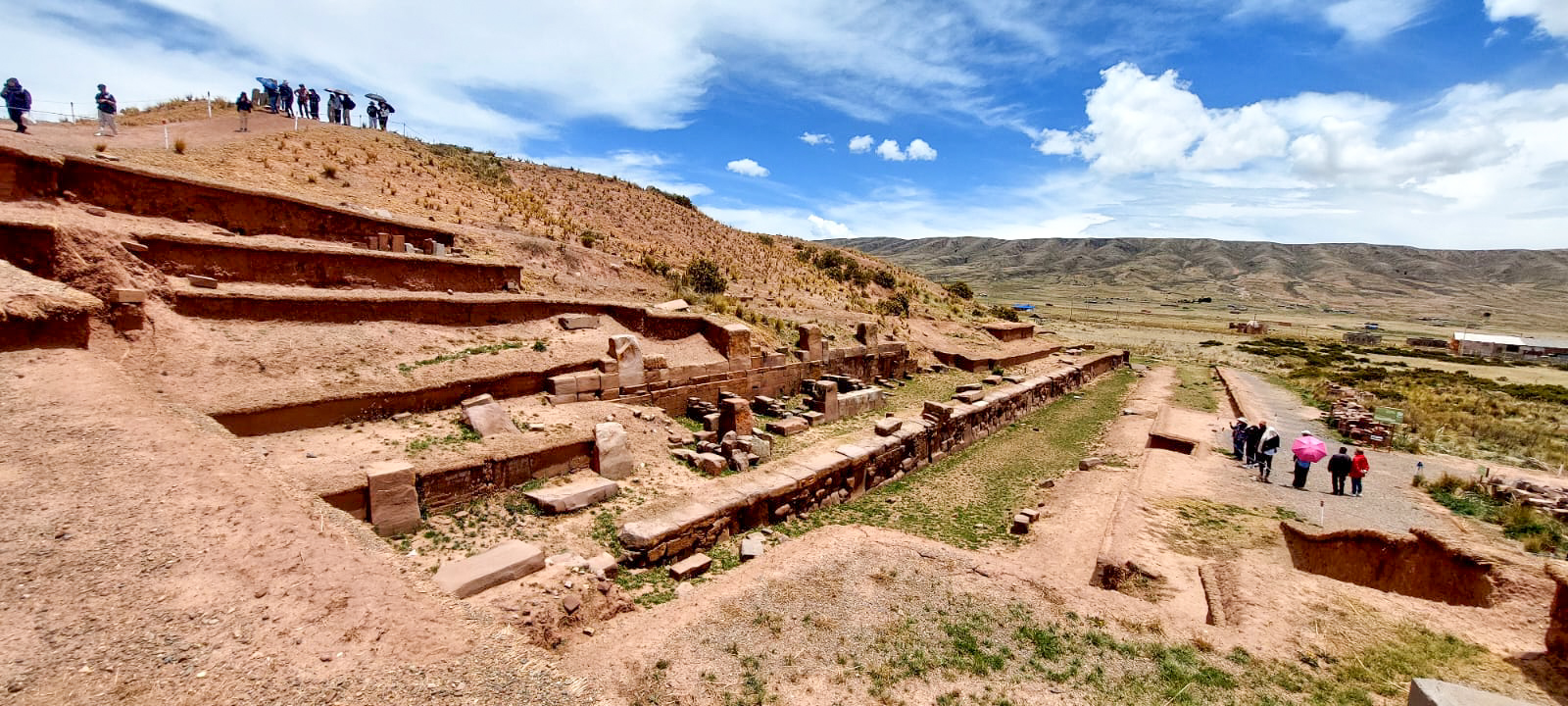
Puma Punku is an unfinished question in andesite and red sandstone. H-shaped blocks, cut so precisely that a razor blade cannot pass between their joints, lie across the altiplano like a puzzle abandoned during assembly. No mortar holds them, and no chisel marks explain them.
At 3,850 meters on Bolivia's plateau, it forms part of the Tiwanaku complex, which UNESCO recognizes as one of the Americas' most important pre-Columbian centers. Built after AD 536, its monumental architecture entered a sacred-threshold landscape where the creator deity Viracocha was understood to have risen from Lake Titicaca, brought light from darkness, and shaped humanity from stone.
That relationship endures each June 21, when tens of thousands of Aymara people gather at dawn and raise their hands toward the returning sun. Shamans offer coca leaves to Inti and Pachamama while Andean wind instruments fill the freezing air. The builders are gone, but this meeting point between human and divine remains active.
The scattered stones still hold the tension between ruin and intention: they were shaped for a specific but unfinished work requiring extraordinary knowledge and labor.
Why this place is sacred
In Andean cosmology, certain places function as thresholds. Not metaphorically — literally. The Tiwanaku understood the world as layered, with realms of sky, earth, and underworld connected at specific points where passage between them became possible. Puma Punku, whose name means 'Gate of the Puma' in Aymara, was built as one of these points of connection.
The architecture embodies the idea. The monumental stone gateways were not merely entrances to buildings but passages between states of being. To walk through one was, in Tiwanaku understanding, to cross from the mundane into the sacred — or perhaps from one realm into another entirely.
The precision of the stonework reinforced this: joints so perfect they seem to eliminate the boundary between separate blocks, as though the builders were attempting to create seamless transitions in stone that mirrored seamless transitions between worlds.
The site's astronomical orientation deepens this reading. The main complex aligns with cardinal directions, and on the spring equinox, the sun rises directly through a stone archway, centering itself above the temple. This is not decoration but calendar — a way of synchronizing human ceremony with cosmic rhythm. The Tiwanaku appear to have understood certain moments in time as thresholds, just as certain places were thresholds. Puma Punku sits at the intersection of both.
Then there is the unfinished quality. The site was abandoned before completion, for reasons that remain debated. Blocks lie in positions that suggest assembly in progress rather than decay after completion. This incompleteness gives Puma Punku a quality distinct from polished heritage sites — the sense of a conversation interrupted, of something still in the process of becoming.
Archaeological evidence and Andean oral tradition converge on a reading of Puma Punku as a ceremonial center of the highest order. The T-shaped terraced platform with its sunken court was designed for rituals that likely involved astronomical observation, offerings to divine forces, and ceremonies marking transitions — of seasons, of power, perhaps of consciousness itself.
The site's acoustic properties may have played a role in these ceremonies, enhancing sound in ways that blurred the boundary between performer and listener, human and divine. The use of sacred plants in ritual contexts is well-attested in Tiwanaku culture and almost certainly featured in ceremonies here.
The Tiwanaku civilization dissolved around AD 1000, likely under the pressure of extended drought. Puma Punku fell silent — but not for long, in cosmological terms. The Inca, arriving centuries later, adopted the entire Tiwanaku complex into their own sacred geography, identifying it as the place where Viracocha created humanity. In this way, the site gained a second layer of sacred meaning without losing the first.
Spanish colonization disrupted formal worship but could not sever the connection between the Aymara people and their ancestral landscape. The Willka Kuti ceremony, celebrated each winter solstice, represents continuity that predates and outlasts colonial power. When Bolivia declared it a national holiday in 2010, this was recognition of something the Aymara had never stopped knowing: the site remains alive.
Today, Puma Punku draws archaeologists, spiritual seekers, and alternative theorists in roughly equal measure. Each group brings its own framework. What they share is the recognition that something here exceeds ordinary explanation — whether they attribute that to human genius, divine presence, or forces not yet understood.
Experience and orientation
The altitude registers before the stones do. At 3,850 meters, the air thins enough that walking becomes deliberate, breathing conscious. This involuntary slowness serves the site well. Puma Punku does not reward rushing.
What you encounter first is scale — not of intact buildings, since none remain standing, but of the blocks themselves. The largest weighs 131 metric tons. These are not pebbles arranged by patient hands but monuments of cut stone transported across distance by means that continue to generate scholarly discussion. Seeing them in photographs prepares you for their size but not for their precision.
The H-shaped blocks, when you crouch beside them, show tolerances that seem to belong to machine shops rather than ancient quarries. The dovetail joints — grooves with non-parallel walls designed to lock blocks together without mortar — are engineering of a sophistication that demands explanation and resists easy ones.
The altiplano itself shapes the experience. The landscape is vast, dry, and largely treeless. Wind moves across it constantly. On clear days, the sky achieves a blue so deep it verges on violet. The Cordillera Real rises to the east, snow-capped and remote. In this setting, the ruins feel both monumental and vulnerable — human effort laid bare on a plateau that seems indifferent to it.
For those who visit during the winter solstice, the experience transforms entirely. The night before, traditional music fills the darkness — Andean wind instruments creating harmonics that carry across the altiplano. Before dawn, the crowd thickens. By sunrise, over 30,000 people face east, arms raised. When the first rays strike, shamans begin their offerings. The cold is severe, the light is golden, and the stones that seemed like ruins become part of a living ceremony that predates written history.
Give yourself time. The drive from La Paz takes roughly two hours and deposits you at an altitude your body has not yet adjusted to. If possible, spend at least two days acclimatizing before visiting. The lightheadedness of altitude sickness and the disorientation of encountering Puma Punku are different experiences; try not to conflate them.
Hire a local guide. The scattered blocks do not explain themselves — they need context, and the best context comes from someone who knows both the archaeology and the Aymara understanding. Without a guide, you are looking at rubble. With one, you begin to see an unfinished cathedral of stone.
Spend time with individual blocks rather than trying to comprehend the whole site at once. Kneel beside an H-block and examine the joints. Run your eye along the angles. Let the precision register not as an intellectual fact but as an encounter — with the hands and minds that achieved this, and with whatever drove them to attempt it.
Context and lineage
In Aymara and Inca telling, what happened at Tiwanaku precedes history. Viracocha — the creator god known by many names, including Wiracocha, Apu Qun Tiqsi Wiraqutra, and Con-Tici — rose from the waters of Lake Titicaca during a time of total darkness. He brought forth light. He made the sun, the moon, and the stars.
Then, at Tiwanaku itself, he shaped the ancestral peoples of every ethnicity from stone, breathing life into them and sending them out to populate their respective lands.
This is not peripheral mythology. For the Inca, who encountered the already-ancient Tiwanaku ruins centuries after the civilization's collapse, the site's monumental stonework served as physical evidence of the creation story. The precision of the blocks, in this reading, reflected divine origin — these were not merely human works but traces of the moment when gods walked the earth.
The archaeological record tells a different but compatible story. The Tiwanaku civilization emerged over centuries along the southern shore of Lake Titicaca, developing sophisticated agricultural systems that converted the harsh altiplano into productive farmland. At its height, the capital supported a population of 10,000 to 20,000, sustained by an irrigation network spanning over 80 square kilometers for cultivating potatoes, quinoa, and corn.
Puma Punku, begun after AD 536, represents the civilization's most ambitious architectural project — one that was never completed.
The Tiwanaku civilization built and used Puma Punku for perhaps four centuries before drought drove its dissolution around AD 1000. The Inca, arriving in the region centuries later, inherited the ruins and wove them into their own cosmology — Tiwanaku became the birthplace of humanity itself. Spanish colonization suppressed but did not eliminate Aymara connection to the site. Through colonial and republican periods, indigenous communities maintained ceremonial relationships with the landscape.
Modern archaeology arrived with Posnansky in the early 20th century, followed by systematic work that continues today. UNESCO inscription in 2000 brought international recognition and preservation resources, including an $870,000 Japan Funds-in-Trust project launched in 2015. Meanwhile, the Willka Kuti ceremony has grown from a local observance to a national event, drawing tens of thousands and affirming that the site's spiritual lineage remains unbroken.
Viracocha
deity
The creator god who, according to Andean tradition, rose from Lake Titicaca at Tiwanaku, brought light from darkness, created the celestial bodies, and shaped humanity from stone. The monumental architecture of Puma Punku was understood as bearing his imprint.
Arthur Posnansky
historical
Austrian archaeologist who spent decades at Tiwanaku beginning in the early 20th century. His controversial archaeoastronomical dating of the site to approximately 15,000 years old — based on solstice alignments with cornerstones — was rejected by modern scholars but helped establish the site's international profile.
Alexei N. Vranich
historical
UC Berkeley archaeologist whose 1999 radiocarbon dating established the post-AD 536 construction timeline now accepted by mainstream archaeology. His pioneering 3D-printed reconstructions of Puma Punku offered the first plausible models of what the completed structure might have looked like.
Inti
deity
The Sun god, central to Andean religious life. The spring equinox alignment at Puma Punku — sun rising through the temple archway — reflects the importance of solar observation in Tiwanaku ceremony. Contemporary Willka Kuti celebrations honor Inti's return at the winter solstice.
Pachamama
deity
Earth Mother, still actively venerated by Aymara communities. Offerings to Pachamama during solstice ceremonies at Tiwanaku maintain the ayni — the reciprocal relationship between humans and the living earth — that Andean cosmology holds as foundational.
Traditions and practice
Tiwanaku ceremonial life centered on the relationship between astronomical cycles and sacred architecture. Evidence suggests rituals were performed at solstices and equinoxes, when solar alignments activated specific gateways and temple features. The spring equinox at Puma Punku produced a precise effect: the sun rising directly through a stone archway, centering itself above the temple. Offerings to solar and earth deities maintained the reciprocal bond between human community and cosmic forces.
Sacred plant use is well-attested in Tiwanaku culture. Hallucinogenic substances, administered in ritual contexts, are believed to have amplified the experience of ceremonies already designed to blur the boundary between ordinary and divine perception. The site's acoustic properties — still perceptible today — may have been deliberately engineered to enhance this effect, creating sound environments that felt otherworldly.
These practices died with the civilization, though their echoes persist in contemporary Aymara ceremony.
The Willka Kuti ceremony transforms Puma Punku each winter solstice. On the night of June 20, traditional musicians fill the darkness with Andean highland wind instruments, playing through until dawn. As the sun rises at approximately 7:25 AM on June 21, over 30,000 celebrants raise their hands to receive the first rays of the new sun. Yatiris — Aymara shamans — perform blessing rituals with offerings of coca leaves to Inti and Pachamama.
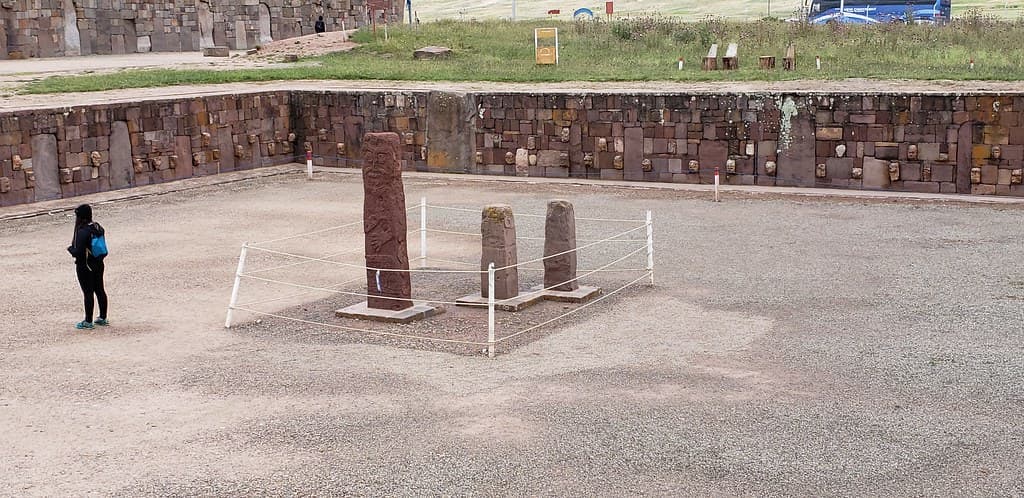
At the broader Tiwanaku complex, the sunrise illuminates the Ponce Monolith through the Doorway of the Sun, completing a ceremony that connects the present to pre-Columbian practice. Bolivia declared the Willka Kuti a national holiday in 2010.
Beyond the solstice, local yatiris offer traditional Aymara blessing ceremonies to visitors throughout the year, providing spiritual connection to the land and its ancient inhabitants. These are not performances but living practice — the yatiris work within a tradition that predates and outlasts the ruins they bless beside.
Outside the solstice period, Puma Punku asks for a different kind of attention. Stand at the eastern edge of the platform at dawn and watch how light moves across the scattered blocks. The builders oriented this space to the cardinal directions for reasons that were not decorative. Even without the equinox alignment, the play of light on cut stone at sunrise reveals surfaces and angles that flatten under midday glare.
Spend time with the H-blocks. These are not museum pieces behind glass but stone you can approach closely. Observe the dovetail joints — grooves cut with non-parallel walls, designed to lock blocks together without mortar. The precision is not an abstraction; it is visible, tangible, and confronting. Sit with the question of how rather than reaching for an answer.
If the altitude permits, walk the full perimeter of the Pumapunku zone. The surrounding altiplano — vast, wind-scoured, treeless — is not separate from the sacred site but part of it. The Tiwanaku did not build in isolation from landscape; they built in dialogue with it. From the edges, the relationship between human construction and high-altitude plateau becomes legible in a way it cannot from the center.
Tiwanaku Civilization
HistoricalThe Tiwanaku people built Puma Punku as one of the most important ceremonial structures in the central Andes, embedding cosmological understanding into its orientation, acoustic design, and monumental stonework. The site appears to have functioned as a threshold between realms — a place where astronomical observation, sacred plant use, and ritual practice converged to facilitate contact between the human and divine.
Ceremonies likely centered on solstice and equinox events, when solar alignments activated architectural features. Offerings to solar and earth deities maintained reciprocal relationships with cosmic forces. Sacred plant use in ritual contexts is well-attested in Tiwanaku culture. The site's acoustic properties suggest sound played a deliberate role in ceremony, creating environments designed to alter perception.
Inca Religious Tradition
HistoricalThe Inca adopted Tiwanaku as the sacred origin site of humanity, where the creator god Viracocha shaped the ancestral peoples from stone. This incorporation elevated already-ancient ruins to the status of cosmological foundation — the place where creation itself began. The monumental stonework served as physical evidence of divine involvement in human origins.
The Inca likely performed pilgrimages to Tiwanaku and conducted offerings within the framework of their state religion, honoring Viracocha, Inti, and Pachamama at a site they understood as bearing the imprint of creation. Specific Inca-era practices at Puma Punku are not well-documented, as the site's deeper layers of Tiwanaku construction predominate in the archaeological record.
Contemporary Aymara Spirituality
ActiveThe Aymara people maintain an unbroken connection to the Tiwanaku complex as ancestral sacred landscape. Puma Punku and its surrounding sites are not relics of a dead civilization but living features of a sacred geography that continues to structure Aymara spiritual life. The winter solstice ceremony at the complex is the most visible expression of a relationship that persists year-round.
The Willka Kuti ceremony on June 21 is the central annual observance — an all-night celebration with traditional music followed by sunrise rituals involving coca leaf offerings to Inti and Pachamama. Yatiris lead blessing ceremonies throughout the year, available to visitors seeking spiritual connection with the site. Offerings and petitions to Pachamama follow pre-Columbian patterns transmitted through generations. The practice is not reconstructed from archaeological evidence but transmitted through continuous oral and ceremonial tradition.
Archaeological Research
ActiveOngoing archaeological investigation at Puma Punku represents a living scholarly tradition that continues to reveal new understanding of the site. From Posnansky's controversial early work through Vranich's modern reconstructions to current UNESCO-funded preservation projects, the scholarly tradition has its own lineage and its own form of reverence — for evidence, precision, and honest acknowledgment of what remains unknown.
Active research includes geophysical surveys of unexcavated areas, structural assessments of exposed stonework, 3D documentation and virtual reconstruction, paleoclimate analysis, and conservation measures including vegetation control and seismic retrofitting. UVU students and international researchers continue collaborative preservation work under UNESCO frameworks.
Heritage Conservation
ActiveUNESCO inscription in 2000 and subsequent preservation efforts represent an international commitment to maintaining Puma Punku for future generations. The site faces real threats from climate change, illegal excavation, and the pressure of over 125,000 annual visitors, making conservation an active and ongoing practice.
The UNESCO Japan Funds-in-Trust project allocated $870,000 for preservation including geophysical surveys, structural assessments, and protective measures. Seismic retrofitting was conducted in the 2010s. Vegetation control prevents root damage to exposed stonework. Monitoring programs track erosion rates accelerated by climate change. Visitor management balances access with preservation.
Perspectives and open questions
Puma Punku generates more competing interpretations than most archaeological sites. The extreme precision of its stonework, combined with genuine gaps in understanding of how it was achieved, creates space that different frameworks rush to fill. Holding these perspectives together — scholarly, indigenous, alternative — without forcing premature resolution is more honest than choosing sides.
Scholarly perspective
Mainstream archaeology dates Puma Punku's construction to after AD 536, based on radiocarbon analysis conducted by Alexei Vranich in 1999. The prevailing view interprets the site as a major ceremonial center of the Tiwanaku civilization — a culture that achieved sophisticated engineering through centuries of accumulated knowledge rather than any single breakthrough or external influence.
The precision of the H-blocks, while remarkable, is understood within the context of Andean stonemasonry traditions that developed over millennia. Techniques of angular cutting, modular prefabrication, and copper-alloy cramps demonstrate engineering knowledge that was advanced but human. Vranich's 3D-printed reconstructions suggest the completed structure would have been a terraced platform with a sunken court — architecturally ambitious but structurally comprehensible.
Scholars continue to debate specific questions: the exact methods used to achieve sub-millimeter precision without metal tools as we understand them, the logistics of transporting 131-ton blocks, and the reasons for the site's abandonment before completion. The prevailing explanation for the civilization's collapse — rapid-onset extended drought around AD 1000 — is supported by paleoclimate data but does not fully explain why Puma Punku appears to have been abandoned mid-construction.
Living and traditional perspectives
In Aymara understanding, Puma Punku is not an archaeological curiosity but an ancestral sacred place. The land itself holds memory. The stones were shaped at a time when the creator deity walked the earth, and their precision reflects not merely human skill but the proximity of divine presence.
The Inca, who encountered the already-ancient ruins centuries after the Tiwanaku collapse, recognized the site's sacred character and incorporated it into their own cosmology. Tiwanaku became the place where Viracocha created humanity — a claim that elevated the ruins from historical artifact to cosmological anchor. The monumental stonework served as evidence: only divine hands, or hands guided by the divine, could have achieved such work.
Contemporary Aymara practitioners maintain a living relationship with the site that does not depend on resolving archaeological questions. The land is sacred because it has always been sacred. The ceremonies continue because the relationship between people and place was never broken, only compressed by colonization. The Willka Kuti is not a revival or a reenactment but a continuation.
Alternative interpretations
Puma Punku's precision stonework has made it a focal point for alternative theories proposing lost advanced civilizations, extraterrestrial involvement, or dating far older than mainstream archaeology accepts. Arthur Posnansky's archaeoastronomical dating to approximately 15,000 years old, though rejected by modern scholars, provided an early framework for these interpretations. Contemporary alternative theorists extend his reasoning, pointing to the difficulty of explaining the H-blocks' precision with known ancient tools.
These theories are not supported by archaeological evidence. However, they often originate in a genuine observation — the stonework is difficult to explain fully, and scholarly acknowledgment of this difficulty is sometimes inadequately communicated to the public. The gap between what mainstream archaeology confidently explains and what visitors see with their own eyes creates space that alternative narratives fill. Dismissing the questions is less productive than acknowledging that some aspects of Puma Punku's construction remain genuinely open.
Open questions
Significant questions persist. The site was never completed, and the specific reason remains uncertain — drought is the leading hypothesis for the broader Tiwanaku collapse, but why construction halted at Puma Punku specifically, and whether the abandonment was sudden or gradual, is not established. The exact techniques used to cut H-blocks to sub-millimeter tolerances without the metal tools typically associated with such precision continue to generate scholarly discussion rather than consensus.
The full extent of the site remains unknown — unexcavated areas surround the visible ruins, and illegal excavations have compromised some of these. The acoustic properties of the original structure, suggested by the surviving elements, cannot be fully reconstructed without knowing the complete form. Perhaps most fundamentally, the specific ceremonies performed here — what was said, sung, offered, and experienced — exist beyond the reach of archaeology. The stones hold their precision. They do not hold their story.
Plan your visit
Access and arrival
From La Paz, the drive takes approximately 1.5 to 2 hours westward toward the Peruvian border. Organized tours depart daily and handle logistics; independent visitors can reach Tiwanaku by public minibuses from the Cemetery District terminal in La Paz. The road is paved but the final approach is basic. Within the Tiwanaku complex, Puma Punku is reached by a short walk from the main site area. The terrain is uneven but generally navigable without special equipment.
Mobile phone signal is unreliable at the site — do not depend on it for navigation or communication. The nearest settlement with reliable connectivity is Tiwanaku town. For emergencies, the site staff and on-site museum personnel are the first points of contact.
Tiwanaku town offers basic accommodations — simple hostels and guesthouses adequate for an overnight stay. For greater comfort, most visitors base themselves in La Paz, where lodging ranges from budget to international-standard hotels. Those attending the Willka Kuti should book accommodations well in advance, as the ceremony draws massive crowds and nearby options fill quickly. Some organized tours include camping near the site for the solstice. Amenities at the site itself are minimal — bring water, snacks, and sun protection.
A small museum and ticket area provide basic facilities.
Respectful visit
Dress for extreme conditions. The altiplano at 3,850 meters is cold year-round, with fierce wind and intense UV radiation. Layers are essential — temperatures can shift dramatically between sun and shade. A hat, sunglasses, and high-SPF sunscreen are necessary, not optional. Comfortable walking shoes with good grip suit the uneven terrain. For the Willka Kuti, bring your warmest clothing — pre-dawn temperatures in June can drop well below freezing.
Personal photography is permitted at the archaeological site during normal visiting hours. Be mindful of other visitors and avoid prolonged staging. During ceremonies, photograph from a respectful distance and never position yourself to obstruct participants. Do not photograph yatiris or ceremony participants without explicit permission. Drones are not permitted.
Physical offerings within the archaeological zone are not appropriate outside of sanctioned ceremonial contexts. During the Willka Kuti, offerings are made by yatiris within the ritual framework — this is not an invitation for visitors to leave their own objects. If you wish to make an offering, do so internally: a moment of silent acknowledgment to the builders, to the land, to Pachamama. If participating in a yatiri-led blessing ceremony, follow the yatiri's guidance regarding what is offered and how.
The site is open daily from 9:00 AM to 4:00 PM. Entry tickets cost approximately $14 USD and include access to the broader Tiwanaku complex and on-site museums. Only Bolivian currency is accepted for payment. Do not remove stones, fragments, or soil from the site. Stay on established paths. Areas under active archaeological investigation may be roped off — respect these boundaries.
The altitude at 3,850 meters is a serious physiological factor. Allow at least two days of acclimatization in La Paz or the Lake Titicaca region before visiting. Altitude sickness can produce headaches, nausea, and disorientation that will override any contemplative intention. Drink water, move slowly, and do not confuse breathlessness with spiritual experience.
During the Willka Kuti, the crowd size creates its own challenges. Temperatures before dawn in June can be severely cold at this altitude — dress in heavy layers. The ceremony is not a spectacle organized for tourists but a living observance; your role is participant or respectful witness, not audience.
Be discerning about guides and tour operators. The site's association with alternative theories about ancient civilizations means some guides present speculation as established fact. Seek guides who are grounded in either mainstream archaeology or traditional Aymara knowledge — or ideally both.
Current practical details
Address
C8Q9+9PP, Tiwanaku, Bolivia
Phone
Hours
Hours, fees, and access can change — verify on the official source before you travel. Practical details last checked Jun 2026.
Location
Map loads as you approach this section.
Pilgrim reflections
A portrait of encounter, not a score
Pilgrims describe what they felt, how present they could become, and whether the place would shape a journey. There are no stars and no ranking of traditions.
No reviewed reflections yet
The first pilgrims can help describe the character of being here.
Share a reflection
Available after an account-backed “Been there.” Every reflection is reviewed before publication.
Nearby sacred places
Explore other sacred places in the region. Proximity does not establish access or travel time; check each place’s guidance.

References
Sources consulted for this page. Source categories describe the publication, not a guarantee that every claim is verified. Traditional accounts and outside interpretations may differ.
- 01Tiwanaku: Spiritual and Political Centre of the Tiwanaku Culture - UNESCO World Heritage Centre — UNESCOofficialOfficial UNESCO World Heritage listing for Tiwanaku complex including Pumapunku
- 02Reconstructing ancient architecture at Tiwanaku, Bolivia: the potential and promise of 3D printing — Alexei Vranich et al.academicPeer-reviewed article in npj Heritage Science on 3D reconstruction of Pumapunku
- 03UVU Students Collaborate on Preservation Project at UNESCO World Heritage Site in Bolivia — Utah Valley UniversityofficialUniversity-led conservation project documentation
- 04Ruins of Puma Punku - UNESCO World Heritage Centre Document — UNESCOofficialOfficial UNESCO document specifically about Puma Punku ruins
- 05Pumapunku - WikipediaacademicComprehensive encyclopedic article with citations to archaeological literature
- 06The non-mystery of Puma Punku and Tiwanaku - Digging Up Ancient Aliens — FredrikacademicEvidence-based debunking resource with archaeological citations
- 07Puma Punku: This Ancient Andean Site Keeps Everyone Guessing - Ancient Origins — Ancient OriginsspiritualPopular archaeology site; useful for alternative perspectives but requires cross-referencing
- 08A Visitor's Guide to Tiwanaku and Puma Punku in Bolivia - The Spunky Curl — The Spunky CurlguideFirst-hand visitor account with practical information
- 09The Mystery of Puma Punku's Precise Stonework - Amusing Planet — Amusing PlanetguideDetailed visual documentation of stonework precision
- 10Winter Solstice - Willkakuti - Aymara New Year - Bolivia Travel Site — Bolivia Travel SitespiritualDetails of contemporary Aymara ceremonial practices at Tiwanaku
Share a photo
Help visitors recognize Puma Punku. Every submission is reviewed before publication.