Puig de sa Morisca
A fortified Bronze Age village above the Bay of Santa Ponça
Understand sacred places, explore living traditions, and learn how to engage respectfully with Pilgrim Map.
Access has not been verified. Check current local guidance before planning a visit.
Calvià, Balearic Islands, Spain
Read the sources
Visit essentials
A quick read before you go
- Duration
- Approximately 1–2 hours to see the exhibition and walk the main trails; the full 8-kilometer…
- Access
- The park is reached via the Palma–Andratx road near Santa Ponça, with a car park and waymarked…
Overview
On a 120-meter hill above the Bay of Santa Ponça, Puig de sa Morisca records roughly two and a half thousand years of continuous human presence. Its oldest walls date to around 1300 BCE, when a Late Bronze Age Talayotic community—part of the Balearic Islands' unique prehistoric culture—built a village on this exposed, defensible rise. Fortification intensified in the Iron Age, when a circular tower was raised to guard the settlement's approach.
Roman-era occupants later left traces of contact with Punic traders, and an Islamic Almohad-period community built anew on the same ground before final abandonment.
The layered settlement preserves dwelling foundations, the fortified tower, the Tomb of Son Ferrer burial site, and charcoal-burners' huts from the island's forestry era, within a protected park of pine and Mediterranean scrub. Designated an archaeological park in 2002, it forms a physical timeline of island transitions from prehistoric fortification to Christian conquest.
Why this place is sacred
There is no evidence that Puig de sa Morisca was ever a place of worship in the way a temple or shrine would be; its importance lies in what it demonstrates about how people used this specific hill across very different eras. A Late Bronze Age community chose it first, likely for the same reasons any hilltop position recommends itself — visibility of the coastline, defensibility, and control of the routes below.
That original choice proved durable: the Iron Age fortification phase built on it rather than starting over, and centuries later, Roman-period inhabitants and then an Islamic Almohad community did the same. The site's Punic-influenced ceramic finds suggest the settlement operated as a point of contact and exchange between the indigenous Talayotic population and wider Mediterranean trade networks, rather than as an isolated redoubt.
Its final historical distinction — as the reported site of the first battle in the Christian conquest of Mallorca — marks the point where this long sequence of continuous habitation ends and the hill's active life becomes archaeological memory rather than lived history.
A fortified Talayotic village and, in later periods, a Roman-contact and then Islamic settlement occupying the same defensible hilltop.
Late Bronze Age settlement (c. 1300 BCE) → Iron Age fortification with circular tower (c.
900–800 BCE) → reduced defensive need and village expansion beyond the walls (3rd century BCE) → Roman-period and Punic-trade contact → Islamic Almohad-period settlement → abandonment sometime between late antiquity and the Almohad period (exact date not established in sourced material) → later use of the hill by charcoal-burners (barracas de roters) → designation as a protected archaeological park in 2002, following a 1997 research partnership between the University of the Balearic Islands and Calvià Town Hall.
Experience and orientation
The approach begins from a car park near the Palma–Andratx road, where marked trails lead up through pine forest and low Mediterranean scrub — wild olive, rosemary, lavender, mastic — before opening onto the exposed rock of the hilltop itself. The climb is unhurried by design: the park's 8 kilometers of paths are meant to be walked slowly, with five viewpoints spaced along the way rather than a single destination at the end.
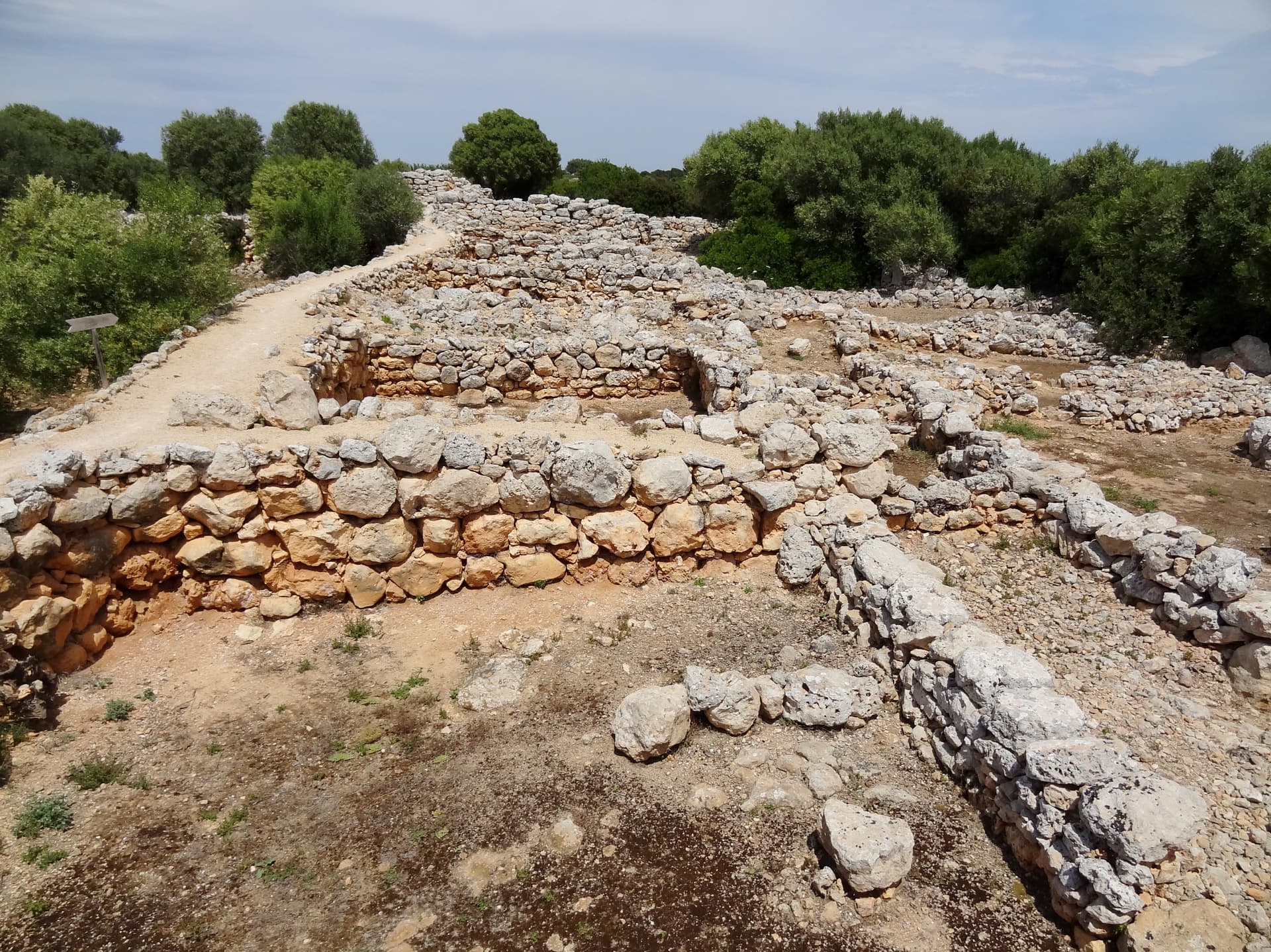
Where the trail reaches the settlement remains, the transition from natural landscape to worked stone is abrupt — squared and rounded foundations emerge from the same scrubland, low enough that their layout, rather than their height, is what registers. The reconstructed drum-stone column of Tower III, damaged by vandalism in February 2025 and previously restored in 2006, stands as a reminder of how fragile these unmortared or lime-mortared structures remain, even after three thousand years of survival.
At the summit, the reward is less the ruins themselves than the view they command: the full curve of the Bay of Santa Ponça below, and a clear sense of why a Bronze Age community, and every group that followed it, chose this exact hill.
Begin at the marked car park off the Palma–Andratx road; follow the waymarked trail uphill toward the settlement remains and continue to the highest viewpoint for the panorama over the bay; allow the walk itself, not just the ruins, to set the pace.
Context and lineage
No foundation legend survives; the site's origin is known only archaeologically. The earliest occupation layer dates to the Late Bronze Age, approximately 1300 BCE, when a Talayotic community established a settlement on the hill. Fortification, including a circular defensive tower, was added during the Iron Age, around 900–800 BCE.
No single lineage of builders can be traced; the site instead shows sequential occupation by unrelated cultures — Talayotic, Roman-period/Punic-contact, and Islamic Almohad — each adapting the same hilltop to its own defensive and residential needs.
Traditions and practice
No ceremonial or ritual practices from the Talayotic, Roman-contact, or Islamic occupation phases are documented in the sourced material. What is known is functional: fortification, dwelling, trade, and — in the case of the Son Ferrer tomb — burial.
The site is maintained as a public archaeological park with a permanent exhibition, 'Humans in Contact,' housed in a 1,700 m² building that displays finds from over sixty years of municipal excavation. Ongoing conservation work followed the 2025 vandalism of Tower III, whose central column had previously been restored in 2006.
Walk the marked trail at a deliberate pace rather than making straight for the summit viewpoint. At the tower and dwelling foundations, pause before moving on: notice how the stonework uses the natural streambed and rock outcrops rather than working against them, and how the tower's position controls the sightline down toward the bay. Let the climb and the ruins register as one continuous piece of terrain shaped by people, rather than a set of separate stops.
Talayotic Culture
HistoricalPuig de sa Morisca preserves one of the most important known Talayotic settlements in the municipality of Calvià, with continuous occupation from the Late Bronze Age (c. 1300 BCE) through Iron Age fortification (c. 900–800 BCE) and into later periods of Roman-contact and Islamic Almohad use.
Fortified settlement life, dwelling construction adapted to the natural streambed and rock terrain, and trade contact with the Punic world evidenced by imported ceramics found on site.
Archaeological and heritage conservation stewardship
ActiveSince the 1997 research partnership between the University of the Balearic Islands and Calvià Town Hall, and the site's 2002 designation as a protected archaeological park, the site has been the object of active excavation, exhibition-building, and conservation work — most visibly the 2006 restoration and 2025 post-vandalism response to Tower III.
Ongoing excavation and research (including the 2000–2009 Son Ferrer tomb project), public exhibition ('Humans in Contact'), trail maintenance, and structural restoration.
Perspectives and open questions
Puig de sa Morisca is read differently depending on which layer of its history a given source foregrounds — the prehistoric Talayotic settlement, the Islamic Almohad occupation, or the site's role in the Christian conquest of Mallorca — and each layer is documented with different degrees of certainty.
Scholarly perspective
The excavating institutions — the University of the Balearic Islands, University of Barcelona, and University of Valencia — treat the site as the most important prehistoric village in the municipality of Calvià, with a stratified sequence running from Late Bronze Age settlement through Iron Age fortification, a 3rd-century-BCE expansion beyond the original walls, Punic-influenced trade ceramics, and a later Islamic Almohad-period settlement.
Open questions
No individual excavation director is named in the sourced material, only the collaborating institutions. The exact date of the site's final abandonment is described only loosely — 'between late antiquity and the Almohad period' — leaving a chronological gap that sourced material does not resolve. Sources also disagree on the protected area's size: Wikipedia and a 2025 news report cite 35 hectares, while the official Calvià municipal site and its tourism arm cite 45 hectares.
Plan your visit
Access and arrival
The park is reached via the Palma–Andratx road near Santa Ponça, with a car park and waymarked trails; the address is given as C/ Puig de sa Morisca, s/n, 07180, Calvià (also listed as C/ Puig de na Morisca, 17). Paved pathways and ramps exist in parts of the park, but overall wheelchair accessibility is limited by the natural, hilly terrain.
No mobile phone signal information was available at time of writing; check the Ajuntament de Calvià heritage website (calvia.com) for current details. No specific keyholder or advance-booking requirement is documented — access is described as free and unrestricted year-round — but visitors seeking guided interpretation or the exhibition building's opening hours should consult the Ajuntament de Calvià heritage website (calvia.com) directly; sourced material did not confirm a specific tourist-office phone number or email for this park.
Respectful visit
No dress code is specified in sourced material; sturdy walking shoes are recommended given the uneven, rocky terrain and the hill climb involved.
No photography restrictions were found in sourced material.
Not applicable — the site has no devotional or ritual function, past or present.
Visitors should not climb on the tower, walls, or other structures, and should not remove, move, or handle stones or artifacts. This guidance was made explicit by the Guardia Civil's Nature Protection unit following the February 2025 vandalism of Tower III, which knocked down a restored central column and damaged a replica Iron Age smelting oven used for education.
Do not climb on the tower or dwelling structures, and do not remove or handle loose stones — both were explicitly flagged by the Guardia Civil's Nature Protection unit after the 2025 damage to Tower III's restored column and a replica Iron Age smelting oven.
Location
Map loads as you approach this section.
Pilgrim reflections
A portrait of encounter, not a score
Pilgrims describe what they felt, how present they could become, and whether the place would shape a journey. There are no stars and no ranking of traditions.
No reviewed reflections yet
The first pilgrims can help describe the character of being here.
Share a reflection
Available after an account-backed “Been there.” Every reflection is reviewed before publication.
Nearby sacred places
Explore other sacred places in the region. Proximity does not establish access or travel time; check each place’s guidance.



References
Sources consulted for this page. Source categories describe the publication, not a guarantee that every claim is verified. Traditional accounts and outside interpretations may differ.
- 01Puig de sa Morisca Archaeological Park - Ajuntament de Calvià. Mallorca — Ajuntament de CalviàofficialOfficial municipal source. Confirms 45-hectare size, 8km of trails, year-round free admission, three cultural layers (Talayotic, Almohad settlement, site of first battle of the Christian conquest of Mallorca), Tomb of Son Ferrer and burial caves, 1,700m² exhibition building, permanent exhibition 'Humans in Contact'.
- 02Archaeological Site Puig de sa Morisca - Illes Balears — Consell de Mallorca / Illes Balears TravelofficialRegional tourism board source. Confirms Late Bronze Age settlement (1300-800 BCE), Iron Age fortification (900-800 BCE) with circular tower, 3rd century BCE expansion beyond walls, abandonment between late antiquity and the Almohad period, Punic trade ceramics, address at C/ Puig de sa Morisca, s/n, 07180, Calvià.
- 03Puig de Sa Morisca - visitcalvia — Visit Calvià (municipal tourism board)officialConfirms address C/ Puig de na Morisca, 17, Calvià; describes walk culminating at the park's highest point with views over the Bay of Santa Ponça; tourist information contact and hours (Mon-Fri, 8:30am-2pm).
- 04Puig de sa Morisca Archaeological Park - Wikipedia — Wikipedia contributorsacademicConfirms coordinates (39°30'27"N 2°28'52"E), 35-hectare size, 2002 preservation as archaeological park, Son Ferrer tomb excavation 2000-2009 by University of the Balearic Islands, University of Barcelona, and University of Valencia. Flagged by Wikipedia itself as a stub article.
- 05Puig de Sa Morisca (Santa Ponça) - Turismo en Mallorca — AllMallorca.comSource contextConfirms site sits on a 120-meter hill near Santa Ponça beach, access via Palma-Andratx road, pine forest and Mediterranean vegetation (wild olive, rosemary, lavender, mastic), presence of barracas de roters (charcoal burners' dwellings) and sitjas (charcoal kilns) from later forestry-era use, multi-period defensive structures.
- 06Santa Ponsa archaeological site vandalised — Euro Weekly NewsSource contextReports February 2025 vandalism to Tower III (central column of two drum-shaped stones, restored in 2006, knocked down; a replica Iron Age smelting oven also damaged). Corroborates 35-hectare protected area, 2002 designation, Late Bronze Age origin (c. 1300 BC), Iron Age fortification (900-800 BC), continuous habitation until 123 AD. Includes Guardia Civil Nature Protection unit statement urging visitors not to climb structures or remove stones.
- 07Comprehensive Guide to Visiting Puig De Sa Morisca Archaeological Park, Palma, Spain — AudialaSource contextCorroborates founding of the archaeological park project in 1997 (University of the Balearic Islands and Calvià Town Hall collaboration), 2002 official designation, Roman conquest of the Balearic Islands in 123 BC as a turning point, 10th-century Islamic/Moorish period with mosque and residential building remains, and current annual visitation of over 70,000 people. Practical visiting tips: go in cooler late afternoon, wear sturdy shoes, bring water and sun protection, allow 1-2 hours; limited wheelchair accessibility despite paved paths and ramps in parts.
Share a photo
Help visitors recognize Puig de sa Morisca. Every submission is reviewed before publication.