Porto Cathedral
A fortress built for both God and city, where pilgrims still take their first steps toward Santiago
Understand sacred places, explore living traditions, and learn how to engage respectfully with Pilgrim Map.
Access has not been verified. Check current local guidance before planning a visit.
Porto, Porto, Portugal
Read the sources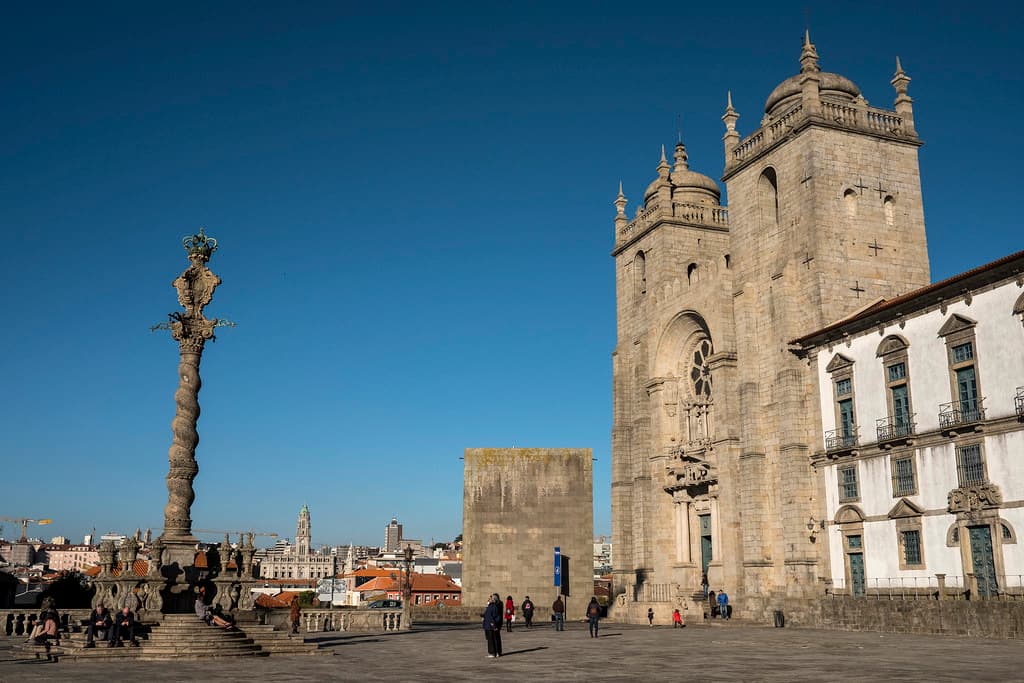
Image of Porto Cathedral. Image source
Visit essentials
A quick read before you go
- Duration
- 60 to 90 minutes covers the nave, Gothic cloister with its azulejo panels, treasury, and terrace…
- Access
- Located at Terreiro da Sé in central Porto, roughly 10-15 minutes uphill on foot from São Bento…
Overview
Before it was ornamented, the Sé do Porto was armored. It rose on the hill above the Douro with walls thick enough for a garrison and twin towers that still resemble a keep from the street below. Bishop and city wall rose together in a young, contested county needing both prayers and ramparts.
Worship has continued across nine centuries. The cathedral remains the working seat of the Diocese of Porto, with daily liturgy beneath stone that has witnessed a royal wedding and now sees pilgrims depart each year for Santiago de Compostela. Some come for Mass; others have a credencial stamped before walking north. Both leave through the same door.
Inside, austerity gives way: a Baroque loggia softens the fortress face, a Gothic cloister opens onto blue-and-white tile panels, and a terrace overlooks the Ribeira district and river. Stronghold and sanctuary remain nested without resolving.
Why this place is sacred
Few churches make their defensive purpose so visible. The Sé's thick walls, deliberately small windows, and battlemented twin towers were raised when the County of Portugal was still a militarized frontier, and a bishop's seat needed to double as a place of last refuge. That fortress silhouette is not a later fortification bolted onto a sanctuary — it is original to the building's conception, a rare case of a church built simultaneously as stronghold and holy place.
What lies beneath the building complicates the story further. Ninth-century tombs were found under the cathedral's front staircase, predating even the 1108 chapel traditionally linked to Henry of Burgundy and Teresa of León. Local tradition reads this as evidence that the hill carried sacred use before any structure now visible was built. What that use was is not established — the record stops at the tombs themselves, leaving the deeper history of the site an open question.
The cathedral was conceived jointly as the seat of the Bishop of Porto and as a defensive anchor for the city's new walls — a single building doing double duty as ecclesiastical authority and civic stronghold during the early, contested years of the County of Portugal.
Romanesque austerity gave way over centuries to Gothic additions (the cloister and the funerary chapel of João Gordo, fourteenth century) and then Baroque ornament — Nicolau Nasoni's 1736 loggia and the cloister's azulejo panels by Valentim de Almeida (1729-1731). Each phase layered a gentler aesthetic onto the fortress without erasing it; the twin towers and heavy walls remain legible beneath every addition.
Experience and orientation
The approach is uphill, and meant to be felt that way. Terreiro da Sé sits above the rest of central Porto, reached on foot from São Bento station by a climb steep enough that the cathedral seems to be waiting rather than simply standing. From the square, the building reads as defensive before it reads as sacred — thick masonry, small openings, a pair of towers that could belong to a castle.
Step inside and the register shifts. The Romanesque nave keeps its weight and dimness, but the eye is pulled toward a silver altarpiece and later Baroque additions that soften the stone. The Gothic cloister, reached through a separate ticket, changes register again: blue-and-white azulejo panels cover the walls, quieter than the nave, with an upper terrace opening onto the Ribeira rooftops and the Douro beyond. Visitors moving between these spaces often describe the sequence itself as the experience.
For those beginning the Camino Português, the steps carry a different weight. This is where the walk starts, whichever of the three routes out of Porto a pilgrim has chosen. Something changes in a person's posture at that threshold — a shift from visiting to setting out — that has little to do with architecture and everything to do with what happens next, on the road toward Vila do Conde, Barcelos, or the coast.
Give the nave a few minutes of stillness before moving to the cloister — rushing between them flattens the contrast that makes the visit worth having. If departing on the Camino, resist treating the steps as merely a photo backdrop; pause there deliberately before you walk.
Context and lineage
Tradition places an earlier chapel or hermitage on this hill around 1108, founded under Henry of Burgundy and his wife, Teresa of León. The present cathedral is credited to Bishop D. Hugo, likely of French origin and formerly an archdeacon at Compostela, who began building after Countess D. Teresa granted the diocese the Portucalense territory and funds in 1120.
Sources differ on the precise groundbreaking — some cite 1110 for an earlier phase, others the second half of the twelfth century for the main Romanesque build — most likely describing different phases rather than a contradiction to resolve. Not in dispute: the decision to raise the cathedral alongside the city's first defensive walls, giving it its fortress character from the outset.
The cathedral has functioned continuously as the mother church of the Diocese of Porto, a suffragan see of the Archdiocese of Braga, from its medieval founding to the present bishop. Its role expanded beyond the devotional in 1387, when it hosted the wedding by proxy of King João I and Philippa of Lancaster, sealing the Anglo-Portuguese Alliance — a dynastic use of sacred space alongside its ordinary liturgical life.
D. Hugo
founder
Bishop of Porto, likely of French origin and formerly an archdeacon in Compostela, credited with beginning the present cathedral after receiving territory and funds from Countess D. Teresa.
Teresa of León
founder
Countess of Portugal, whose 1120 grant enabled Bishop D. Hugo's construction; also traditionally linked, with husband Henry of Burgundy, to the earlier chapel of 1108.
Nicolau Nasoni
architect
Baroque architect who added the cathedral's loggia in 1736, softening the Romanesque fortress face.
Valentim de Almeida
artist
Tile painter credited with the Gothic cloister's blue-and-white azulejo panels (1729-1731), depicting the life of the Virgin Mary and scenes from Ovid's Metamorphoses.
Traditions and practice
The cathedral's ceremonial history includes the 1387 wedding by proxy of João I and Philippa of Lancaster and centuries of ordinations and feast-day Masses under successive bishops.
Mass is commonly reported around 11:00 daily, part of the ongoing diocesan liturgical calendar and sacramental life of the seat of the Bishop of Porto. On 23 June, a solemn Mass honors the eve of the Festa de São João, Porto's patron-saint festival, followed by a dawn procession around 05:00 on 24 June — an ecclesiastical observance running alongside the city's larger secular street celebration.
Pilgrims beginning the Camino Português commonly collect their first credencial stamp at the cathedral or a nearby tourist office before setting out toward Vila do Conde and Barcelos, or toward Matosinhos and the coast.
If attending Mass, arrive a few minutes early and take a seat toward the rear, observing rather than disrupting an active service. If beginning the Camino, treat the stamp and the first steps as a small, deliberate ritual rather than a formality — many pilgrims report that how they mark this threshold shapes how the rest of the walk feels. Early morning suits both purposes: quieter for prayer, cooler for walking.
Roman Catholicism (Diocese of Porto)
ActiveThe cathedral is the mother church and seat of the Bishop of Porto, one of the most important Catholic sees on the Iberian Peninsula, its founding recounted in context above.
Daily Mass, commonly reported around 11:00, alongside the diocesan liturgical calendar, sacraments, and veneration of Nossa Senhora da Vandoma as city patroness.
Camino de Santiago (Camino Português)
ActiveThe Sé do Porto is the starting point for pilgrims beginning the Camino Português toward Santiago de Compostela, honoring Saint James the Greater, whose relics are said to rest there.
Pilgrims commonly collect a first credencial stamp at the cathedral or a nearby tourist office before departing toward Vila do Conde and Barcelos, or toward Matosinhos and the coast.
Festa de São João do Porto (Saint John's Feast)
ActivePorto's largest annual festival honors Saint John the Baptist as the city's patron saint, including solemn ecclesiastical observance at the cathedral alongside its secular street celebrations.
A solemn Mass at the Sé on the evening of 23 June and a dawn procession on 24 June, tracing back to religious gatherings first recorded in the fourteenth century.
Perspectives and open questions
Porto Cathedral is read differently depending on which lens is applied — architectural history, Catholic devotional continuity, or the practical experience of a pilgrim about to walk north — and these readings sit alongside each other rather than competing for the final word.
Scholarly perspective
Architectural historians treat the Sé do Porto as an example of the militarized Romanesque cathedral-fortress typology common to the Reconquista-era Iberian frontier, its Romanesque, Gothic, and Baroque phases documented through archival research. The cathedral sits within the 'Historic Centre of Porto, Luiz I Bridge and Monastery of Serra do Pilar' UNESCO World Heritage Site, inscribed 1996, as a protected monument within that zone rather than an individually separate listing.
Living and traditional perspectives
Within Portuguese Catholic devotional history, tradition holds the cathedral first and foremost as the mother church of the Diocese of Porto and the home of Marian devotion to Nossa Senhora da Vandoma, the city's patroness, whose title has appeared on Porto's municipal coat of arms since the sixteenth century. Local tradition regards the ninth-century tombs beneath the cathedral steps as evidence of an even older sacred use of the hill, though it does not specify what that earlier use involved.
Alternative interpretations
No substantial esoteric or alternative-spirituality interpretive tradition is associated with Porto Cathedral in available sources. Its symbolic weight in popular narrative centers on national and dynastic history — chiefly the 1387 royal wedding — rather than mystical claims.
Open questions
Sources differ on the chronology connecting the 1108 predecessor chapel, a possible 1110 groundbreaking cited by one source, and the 'second half of the twelfth century' start date given elsewhere for the main Romanesque build; the discrepancy has not been reconciled, and may simply reflect different building phases described loosely by different sources rather than a true conflict. The precise nature of whatever structure once stood over the ninth-century tombs beneath the front staircase remains undetermined.
Plan your visit
Access and arrival
Located at Terreiro da Sé in central Porto, roughly 10-15 minutes uphill on foot from São Bento train station, or reachable by metro or tram. Comfortable footwear is advisable given the hill. Nave entry is free; the cloister, treasury, and chapter house require a small paid ticket.
Respectful visit
Modest dress is recommended, as at any active church: covered shoulders and longer hemlines are commonly advised, though no strict dress code is enforced at the door.
Photography is generally permitted in the nave, cloister, and terraces. Visitors are asked to stay quiet and respectful, particularly during services, and to avoid flash or tripod use while Mass is underway.
No distinct votive-offering custom is documented beyond the standard candle-lighting found in most Catholic churches. Donations toward the cloister and treasury entry fee are welcomed.
The main nave is free to enter. The Gothic cloister, treasury, and chapter house require a small paid ticket, roughly three euros. Visitors should not enter for sightseeing during an active liturgical service unless attending it.
The cathedral is an active place of worship, not a stage set. Avoid entering the nave during Mass unless attending respectfully, and avoid flash or tripod photography while a service is underway.
Location
Map loads as you approach this section.
Pilgrim reflections
A portrait of encounter, not a score
Pilgrims describe what they felt, how present they could become, and whether the place would shape a journey. There are no stars and no ranking of traditions.
No reviewed reflections yet
The first pilgrims can help describe the character of being here.
Share a reflection
Available after an account-backed “Been there.” Every reflection is reviewed before publication.
Nearby sacred places
Explore other sacred places in the region. Proximity does not establish access or travel time; check each place’s guidance.


References
Sources consulted for this page. Source categories describe the publication, not a guarantee that every claim is verified. Traditional accounts and outside interpretations may differ.
- 01Porto Cathedral — Wikipedia — Wikipedia contributorsSource contextFounding chapel 1108 by Henry of Burgundy and wife; Romanesque nave with barrel vaulting and early flying buttresses; Gothic funerary chapel of João Gordo c.1333; Nasoni's 1736 loggia; 1387 royal wedding; 17th-c. silver altarpiece; 18th-c. azulejos depicting the Song of Songs.
- 02Sé Catedral do Porto — Turismo de PortugalofficialOfficial national tourism board entry. Confirms founding by Bishop D. Hugo in the 12th century alongside the first city walls; 14 February 1387 royal wedding of João I and Filipa de Lencastre; Marian devotion (Nossa Senhora da Vandoma as city patron, on municipal coat of arms since 16th century); silver main-chapel altarpiece.
- 03Roman Catholic Diocese of Porto, Portugal — Wikipedia — Wikipedia contributorsSource contextConfirms the cathedral is the seat of the Diocese of Porto, a suffragan see of the Archdiocese of Braga; active Catholic institution.
- 04Everything about Porto's cathedral — Portoalities Travel BlogSource contextDescribes cathedral's multiple Marian dedications (Santa Maria do Porto, Nossa Senhora do Porto da Eterna Salvação, Nossa Senhora da Vandoma) and general visitor context.
- 05Porto Cathedral (Sé do Porto): History and Architecture — Cooltour OportoSource contextDescribes fortress-like Romanesque exterior (thick walls, small openings, twin towers with cupolas), Baroque porch, rose window, Gothic cloister and chapel with ribbed vaults.
- 06The 3 routes of the Portuguese Camino out of Porto — Stingy NomadsSource contextConfirms all three Portuguese Camino routes out of Porto (Central, Coastal, and Senda Litoral/coastal boardwalk variant) begin at Sé Cathedral in Porto.
- 07Camino Route Overviews: Camino Portugués — American Pilgrims on the CaminoSource contextConfirms Camino Português route structure from Porto onward toward Santiago de Compostela, part of the wider Camino de Santiago network venerating Saint James the Greater.
- 08Porto Cathedral – Sé do Porto - Location, opening hours and price — Introducing PortoSource contextPractical visitor details: opening hours (09:00-12:30, 14:30-18:00 Apr-Oct; 14:30-17:30 Nov-Mar), free nave entry, small paid entry for cloister/treasury/chapter house.
- 09Tile of the day: Sé Cathedral do Porto — Olá DanielaSource contextAttributes the Gothic cloister's blue-and-white azulejo panels (life of the Virgin Mary, Ovid's Metamorphoses) to Valentim de Almeida, 1729-1731, sourced from a Lisbon workshop; also notes upstairs terrace panels by António Vidal.
- 10São João Festival 2026: guide to Porto's biggest party — idealista/newsSource contextConfirms solemn Mass at Sé Cathedral on the afternoon/evening of 23 June honoring Saint John the Baptist, Porto's patron saint, and a dawn procession on 24 June.
Share a photo
Help visitors recognize Porto Cathedral. Every submission is reviewed before publication.