Monastery of Leça do Balio
Portugal's first Hospitaller stronghold, built to shelter pilgrims and still on their path
Understand sacred places, explore living traditions, and learn how to engage respectfully with Pilgrim Map.
Access has not been verified. Check current local guidance before planning a visit.
Matosinhos, Porto, Portugal
Read the sources
On this pilgrimage
Camino de Santiago — Selected Sacred SitesVisit essentials
A quick read before you go
- Duration
- Approximately one to one and a half hours for the church, tower, chapter room, exhibition…
- Access
- Located at Rua do Mosteiro s/n, in Leça do Balio, Matosinhos, in the Porto district, roughly 20…
Overview
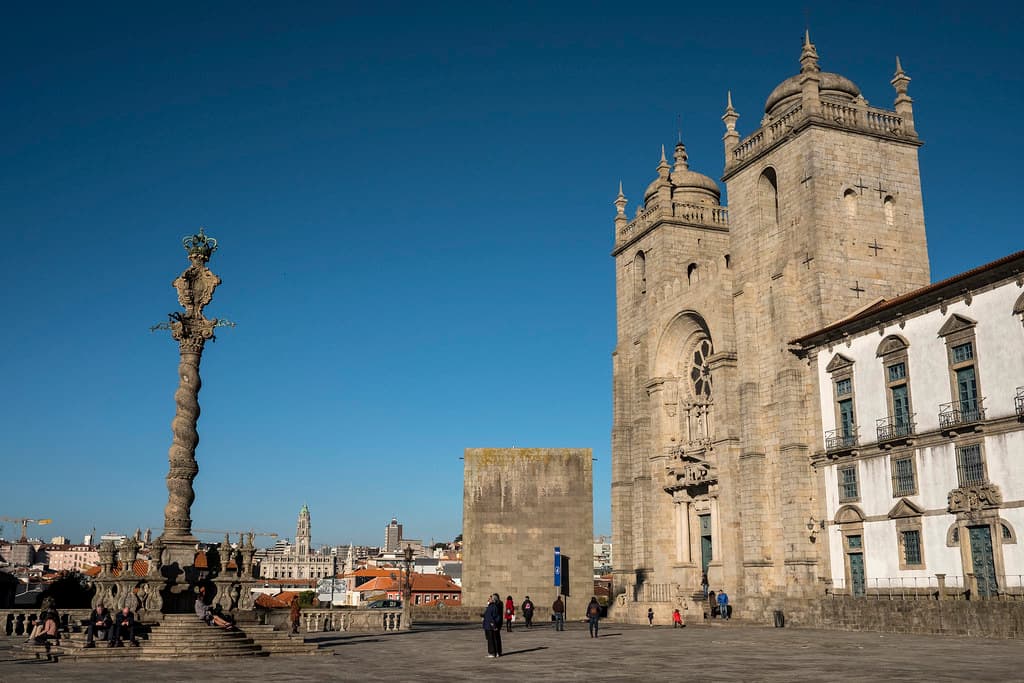
Leça do Balio's 28-meter defensive tower rises above a fortified church: a monastery built to fight as well as pray. Queen Teresa granted it to the Knights Hospitaller in the early 12th century. For over two centuries it served as their Portuguese base, transplanting the Jerusalem pilgrim-protecting order to guard those walking north toward Santiago de Compostela.
After the Hospitallers moved their headquarters to Crato in 1340, the church remained. Gradually rebuilt in Gothic style, it hosted a royal wedding in 1372, then passed through centuries of parish use, a 1930 restoration, and contemporary renewal by architect Álvaro Siza. The complex became a cultural venue while remaining an active place of worship.
A coastal Camino pilgrim can still pause where pilgrims did eight centuries ago, sharing this purpose-built refuge with exhibitions, concerts, and an ecumenical sculpture garden that holds multiple kinds of reverence without contradiction.
Why this place is sacred
Local tradition holds that Christian worship at Leça do Balio sits on older foundations still: a Roman temple to Jupiter, said to have stood here before the Benedictine community that first appears in the record in the 10th century.
No archaeological source in the research corroborates this claim, and it is best understood as legend rather than established fact — but its persistence says something about how the site is felt locally, as ground whose sacredness predates any one religion's claim to it.
What is documented is scarcely less striking. Queen Teresa's grant of the site to the Knights Hospitaller, confirmed by her son Afonso Henriques, made Leça do Balio the Order's first home in Portugal and, from 1123, the seat of a formal priory. The Hospitallers' mission wherever they operated was the same: caring for the sick and protecting travelers on the roads to Jerusalem — and, here, toward Santiago.
That mission was concrete and geographic — the coastal road to Santiago de Compostela ran past this exact point, and the fortified church that rose around the 12th-13th century, with its 28-meter tower, existed specifically to make that road safer to walk.
Experience and orientation
Approach the church first from outside, where the defensive tower and thick walls make the building's original military-religious purpose legible before you've read a word of history. Only once inside does the architectural transition become clear — the shift from Romanesque solidity toward Gothic verticality that marks the church's 14th-century remodeling.
Siza's restoration deliberately avoids competing with this history; his additions sit alongside the medieval fabric rather than over it. Visitors report the effect as one of contrast held in balance rather than resolved — old fortification and new cultural space occupying the same ground without either one dominating.
Context and lineage
The earliest confirmed religious use of this site is a Benedictine community of monks and nuns, probably established in the 10th century and dedicated to the Savior — though no source gives an exact founding year, and the community's origins are described only as likely rather than documented with certainty.
In the early 12th century, Queen Teresa, ruling Portugal's founding county, granted the site to the Knights Hospitaller of St John of Jerusalem; her son and successor Afonso Henriques confirmed the grant, and a formal priory was established in 1123, making Leça do Balio the Order's first headquarters in Portugal.
For the Hospitallers, the site's purpose was explicit: shelter and protect pilgrims traveling the Way of St James, mirroring the Order's role protecting pilgrims in Jerusalem itself. Brother Estevão Vasques Pimentel of the Order commissioned a major Gothic remodeling and enlargement in the 14th century.
The Order moved its Portuguese headquarters to Crato in 1340, after which the fortified church hosted the 1372 marriage of King Ferdinand I of Portugal and Leonor Teles — a moment of considerable royal significance for a site that had, by then, already outlived its original military function.
From its likely 10th-century Benedictine origins through more than two centuries as the Knights Hospitaller's Portuguese headquarters, the site's religious character shifted from monastic to militant-devotional and back again after the Order's 1340 departure for Crato, when the fortified church settled into a longer, quieter life as a parish and pilgrim waypoint.
That life continues today: the church remains an active place of worship tied to the local parish, while the surrounding buildings, following Siza's restoration, host the Fundação Livraria Lello's cultural and ecumenical programming.
Queen Teresa of Portugal
founder/patron
Ruler of the County of Portugal who granted Leça do Balio to the Knights Hospitaller in the early 12th century, establishing what became the Order's first Portuguese headquarters.
Afonso Henriques
historical
Son of Queen Teresa and first King of Portugal, who confirmed his mother's grant of the site to the Knights Hospitaller.
Estevão Vasques Pimentel
patron
Brother of the Order of the Hospital who commissioned the major 14th-century Gothic remodeling and enlargement of the church.
Álvaro Siza Vieira
conservator
Portuguese architect who led the most recent restoration and cultural-venue conversion of the monastery, working with landscape architect Sidónio Pardal on the ecumenical 'Open Sculpture' and Garden of Thought.
Traditions and practice
Historically, the site's religious rhythm moved from Benedictine monastic observance to a combined military-religious life under the Knights Hospitaller — the Divine Office alongside the concrete work of sheltering and defending pilgrims on the road to Santiago. No detailed record of specific rites survives; what is known comes from the Order's documented mission and architecture rather than a liturgical calendar specific to this house.
The church is described as remaining an active place of worship associated with the local parish, though its exact Mass schedule is not confirmed by any source reviewed. Alongside this, the Fundação Livraria Lello programs exhibitions, concerts, debates, and educational activities within the restored monastic buildings, and maintains an ecumenical space anchored by Siza's 'Open Sculpture' landmark.
A visitor arriving without any pilgrimage intention can still register what this place was built to do: stand at the base of the defensive tower and consider that its thickness was a direct, practical response to the danger pilgrims once faced on this road — then walk into the Garden of Thought, where that same protective impulse has been reframed as an ecumenical, rather than military, gesture.
Roman Catholic / Benedictine monasticism
HistoricalThe site's earliest documented religious use was probably a 10th-century Benedictine community of monks and nuns dedicated to the Savior, established during the Reconquista at the southern border of the Asturian Kingdom, with some sources noting a possible earlier Roman temple substrate beneath the foundations.
Historically: communal Benedictine monastic life prior to the site's transfer to the Knights Hospitaller in the 12th century.
Knights Hospitaller of St John of Jerusalem (Order of Malta)
HistoricalGranted to the Order by Queen Teresa in the early 12th century and confirmed by her son Afonso Henriques, Leça do Balio became the first headquarters and priory, established in 1123, of the Knights Hospitaller in Portugal. As in Jerusalem, the Order's core mission here was the protection and hospitality of pilgrims traveling the Way of St James, fortifying the monastery with a 28-meter defensive tower before relocating its Portuguese headquarters to Crato in 1340.
Historically: military-religious conventual life combining monastic observance with pilgrim hospitality and defense; hosted the 1372 marriage of King Ferdinand I of Portugal and Leonor Teles.
Camino de Santiago pilgrimage tradition
ActiveThe monastery's historic role sheltering and protecting pilgrims bound for Santiago de Compostela continues today, as the site remains an integrated waypoint on the coastal Portuguese Way of the Camino de Santiago.
Contemporary pilgrims passing along the coastal route may stop at the monastery as a heritage and hospitality waypoint, echoing its medieval Hospitaller function.
Perspectives and open questions
Leça do Balio invites at least three readings held together rather than resolved: an architectural case study in the Romanesque-to-Gothic transition, a founding chapter in the Knights Hospitaller's history in Portugal, and a site whose claimed pre-Christian layer remains, honestly, unverified.
Scholarly perspective
Architectural and religious historians regard Leça do Balio as one of the most important surviving examples of the Romanesque-to-Gothic transition in Portugal, and as an unusually well-documented case of a Knights Hospitaller headquarters directly tied to the practical work of Camino de Santiago pilgrim protection.
Living and traditional perspectives
Local tradition holds that the church stands on the ruins of a Roman temple dedicated to Jupiter, a claim some heritage and travel sources repeat but which is not corroborated here by any archaeological source. Within Catholic devotional understanding, the church's continued function as a place of worship is treated as an unbroken thread rather than a revived one.
Alternative interpretations
Some travel and heritage sources frame the Roman-temple substrate less as settled history than as an atmospheric legend, one that adds a sense of deep time to the site without academic verification standing behind it.
Open questions
The precise founding year of the original Benedictine community remains undocumented — sources describe it only as probably 10th century — and the claimed Roman temple foundation has not been corroborated by any archaeological source within the research reviewed here.
Plan your visit
Access and arrival
Located at Rua do Mosteiro s/n, in Leça do Balio, Matosinhos, in the Porto district, roughly 20 to 30 minutes by car or public transport from central Porto.
No specific accommodation recommendations were documented for the site; its proximity to central Porto (roughly 20 to 30 minutes) puts it within reach of the city's full range of lodging options.
Respectful visit
No formal dress code has been published. Modest, practical clothing appropriate to an active church and heritage site is the general expectation, though no source specifies particulars.
No published photography policy exists for the site in the sources reviewed; standard courtesy toward an active place of worship and any current exhibition applies.
No offerings custom was documented for the site.
The site is closed Mondays and Tuesdays except by prior reservation, and closed on December 25, January 1, Easter, May 1, and June 24, per the Fundação Livraria Lello's official schedule.
As the church remains active for worship, cultural and tourist visits are best scheduled around, rather than during, any service in progress; the site is otherwise open to respectful public visitation.
Location
Map loads as you approach this section.
Pilgrim reflections
A portrait of encounter, not a score
Pilgrims describe what they felt, how present they could become, and whether the place would shape a journey. There are no stars and no ranking of traditions.
No reviewed reflections yet
The first pilgrims can help describe the character of being here.
Share a reflection
Available after an account-backed “Been there.” Every reflection is reviewed before publication.
Nearby sacred places
Explore other sacred places in the region. Proximity does not establish access or travel time; check each place’s guidance.



References
Sources consulted for this page. Source categories describe the publication, not a guarantee that every claim is verified. Traditional accounts and outside interpretations may differ.
- 01Monastery of Leça do Balio — Fundação Livraria Lello — Fundação Livraria LelloofficialOfficial managing-foundation page: current cultural use, Álvaro Siza/Sidónio Pardal restoration and 'Open Sculpture' ecumenical landmark, Garden of Thought sculpture garden plans, official opening hours (Wed-Sun 10:00-18:30), closure dates, address and contact.
- 02The Order of Malta — Xistopedia, Aldeias do Xisto — Aldeias do Xisto (Portuguese heritage network)academicConfirms the Order of Malta (Knights Hospitaller) arrived in Portugal under Queen Teresa (r. 1112-1128), who granted them Leça do Balio as their first Portuguese home, and that a Priory was established there in 1123 before relocating to Crato in 1340.
- 03Fortified church of Leça do Balio — Religiana — Religiana (European religious heritage route database)academicEuropean religious-heritage-route reference confirming the fortified church's role supporting pilgrims on the Way of St James, its Romanesque-to-Gothic transitional architecture, and status as headquarters of the Knights Hospitaller in Portugal.
- 04Leça do Balio Monastery: History & Architecture in Porto — Mad About Porto — Mad About PortoSource contextDetailed historical account: 10th-century Benedictine mixed convent dedicated to Salvador, possible Roman temple substrate, Queen Teresa's donation to the Knights Hospitaller (1112-1185), first Hospitaller headquarters in Portugal, fortification with 28m tower, 1372 royal wedding of D. Fernando and D. Leonor Teles, order's relocation to Crato in 1340.
- 05How a Portuguese sanctuary for pilgrims became a modern-day haven for the arts — The Art Newspaper — The Art NewspaperSource contextJournalistic coverage of the monastery's recent reopening after Álvaro Siza's restoration, its transformation into a cultural venue for the Livraria Lello Foundation, and its historic pilgrim-sanctuary function.
- 06The beautiful fragmentation of a cube. Monastery of Leça do Balio extension by Álvaro Siza — METALOCUS — METALOCUS (architecture publication)academicArchitectural-press analysis of Siza's contemporary extension and restoration approach, confirming the National Monument classification since 1910 and the Romanesque-to-Gothic architectural transition on site.
- 07Mosteiro de Leça do Balio — Caminho Português da Costa — Caminho Português da Costa (Camino de Santiago coastal route guide)Source contextCamino de Santiago route-guide entry confirming the monastery's continued integration as a waypoint on the coastal Portuguese Way to Santiago de Compostela.
- 08Igreja do Mosteiro de Leça do Balio — Tripadvisor — Tripadvisor contributorsSource contextAggregated visitor reviews of the church interior, fortified tower, and grounds, used to corroborate general visitor experience.
Share a photo
Help visitors recognize Monastery of Leça do Balio. Every submission is reviewed before publication.