Pirunpöytä
A cup-marked offering stone half a forest walk from where the Kalevala was recorded
Understand sacred places, explore living traditions, and learn how to engage respectfully with Pilgrim Map.
Access has not been verified. Check current local guidance before planning a visit.
Kitee, North Karelia, Finland
Read the sources
Visit essentials
A quick read before you go
- Duration
- 20-40 minutes for the stone alone; allow closer to an hour if combining with the walk to…
- Access
- Located in Hummovaara village, within the Kesälahti district of Kitee municipality, North…
Overview
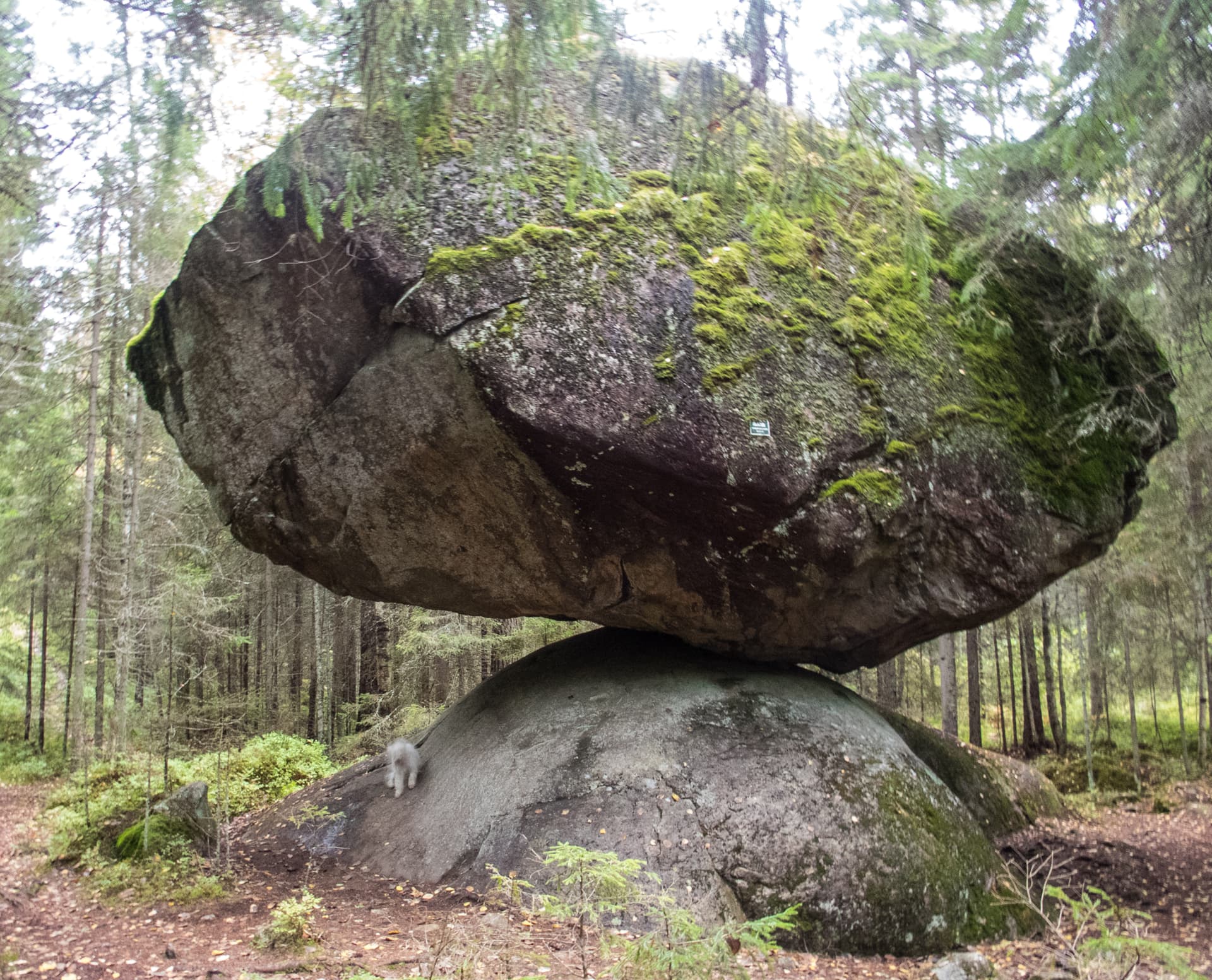
Pirunpöytä—the Devil's Table—is a roughly square stone about two metres on each side and half a metre high, its flat top bearing dozens of shallow, rounded depressions. The Finnish Heritage Agency registers it as a cup-marked stone among cult and narrative sites, dated only loosely to the Iron Age or a later historical period.
Local memory says the Kainulainen family offered grain, milk, blood, and meat there, and that the devil's hooves pressed its cups while he danced at midnight.
Half a kilometre west stands the pine where Elias Lönnrot recorded local rune-singer Juhana Kainulainen's incantations in 1828; that material entered the Kalevala. Walking between them joins a folk-ritual stone to the ground where oral tradition became national literature.
Why this place is sacred
Pirunpöytä belongs to a wider Baltic-Finnic and Karelian tradition of cup-marked stones used as sites of small, practical offering — grain for a good harvest, blood or meat for protection, milk given as a matter of ongoing relationship with a place understood to have its own claim on attention.
The register entry itself is cautious about dating and origin, noting only that the site fits the 'cult and narrative sites' classification; it is the surrounding oral tradition, not the archaeological record, that supplies the devil's-hoofprint legend and the specific Kainulainen family association. That oral tradition, though, is unusually well-anchored: this same patch of forest produced documented material with a name attached, a date attached, and a downstream textual history that can be traced into the printed Kalevala.
Few stone-offering traditions in Finland connect this directly, and this concretely, to a named individual and a canonical text.
A folk-religious offering site, used by the local Kainulainen family and, the tradition implies, by others before them, for grain, milk, blood, and meat offerings.
From an undated folk offering site (Iron Age/historical period, per the official register) through documented rune-singing culture in the same locale in the early 1800s — most visibly Juhana Kainulainen's 1828 collaboration with Elias Lönnrot at the neighboring pine — to its current status as a legally protected, unstaffed heritage monument reached via forest paths and included on occasional municipal history walks.
Experience and orientation
The approach is on foot, along forest paths that branch from the parking area near the pine — paths that can be overgrown enough to make a map or offline GPS track more reliable than trailside signage. The stone itself does not announce itself with scale; it sits low, roughly furniture-height, and it is only on approaching closely that the surface resolves into dozens of individual cups, some paired and linked by shallow channels worn or cut between them.
Run your attention slowly across that surface rather than photographing it immediately — the depressions vary enough in size and depth that they read less like a single deliberate pattern than like an accumulation, consistent with a site returned to repeatedly over a long, uncertain span of time. The surrounding woodland is quiet, coniferous, unmanaged for tourism in any visible way; there is no interpretive signage at the stone itself, which leaves the encounter unmediated.
Afterward, walk the half-kilometre to the pine. Standing beneath a tree old enough to have already been substantial in 1828 changes the register of the visit — the offering stone stops being an isolated curiosity and becomes one part of a landscape that also produced documented cultural memory.
Visit the pine first if you want the Kalevala context to frame your reading of the stone; visit the stone first if you'd rather encounter it without that frame. Either order works; the sites are close enough to hold both.
Context and lineage
Local tradition attributes the stone's cup-marks to the devil, who is said to have danced on its surface at midnight, his hooves pressing the depressions into the rock. A parallel, non-supernatural strand of memory holds that the Kainulainen family used the stone as an offering site for generations — grain, milk, animal blood, and meat given at the stone — a use the official register neither confirms nor rules out, dating the site only broadly.
The stone's documented cultural weight comes less from resolving which story is 'true' than from its proximity to a dated historical event: in June 1828, Elias Lönnrot sat beneath the pine now named for him and recorded roughly fifty-seven poems and incantations from Juhana Kainulainen, a local tietäjä whose specialty was loitsut — incantations — learned from his own father. That material passed into the Kantele collection, then the Alku-Kalevala, and finally both the Old and New Kalevala.
Undated folk offering tradition (register: Iron Age/historical period, undetermined) → documented rune-singing culture in the same locale by the early 19th century → transcription into the Kalevala corpus (1828 onward) → 20th-century archaeological registration → present-day protected monument status with occasional inclusion in municipal heritage walks
Traditions and practice
Offerings of grain, milk, animal blood, and meat placed at or on the stone, associated with the Kainulainen family and, the tradition implies, with an offering practice that predates that specific family's stewardship. Elsewhere in the wider Baltic-Finnic cup-marked-stone tradition, such offerings were typically made to secure good harvests, protect livestock, or maintain a working relationship with a place understood to hold its own agency.
No ongoing ritual offerings are documented at the stone today. The site's active life is cultural: it appears on municipal history walks (Kitee's guided tour pairing Lönnrot's Pine and Pirunpöytä) and remains a reference point within Kalevala Society scholarship on Lönnrot's 1828 collecting journey.
Approach slowly and spend real time with the stone's surface before moving on — the cup-marks are easy to glance at and hard to actually look at. Consider the walk to the pine as part of a single visit rather than a separate errand; the two sites make more sense held together than apart.
Baltic-Finnic Folk Religion – Sacrificial Stone (Uhrikivi) Tradition
HistoricalPirunpöytä belongs to Finland's wider tradition of cup-marked offering stones, registered by Museovirasto within its 'cult and narrative sites' category, associated locally with generations of grain, milk, blood, and meat offerings by the Kainulainen family.
Offerings placed at or on the stone's cup-marked surface; the precise original function of the cups themselves is not conclusively established.
Finnish Folklore – The Devil's Table Legend
ActiveThe stone's name and continuing local retelling come from the legend of the devil dancing on its surface at midnight, pressing the cup-marks with his hooves — a living piece of oral tradition kept in circulation through storytelling and municipal heritage walks.
Oral storytelling and inclusion in guided local-history tours pairing the stone with Lönnrot's Pine.
Runolaulu (Rune-Singing) and the Kalevala
ActiveHalf a kilometre from the stone, the pine now called Lönnrot's Pine marks the spot where Elias Lönnrot recorded some fifty-seven poems and incantations from rune-singer Juhana Kainulainen in June 1828 — material that passed through the Kantele and Alku-Kalevala into both editions of the Kalevala, tying this stretch of North Karelian forest directly to the textual foundation of Finland's national epic.
Historically, rune-singing and incantation (loitsu) performance transmitted within the Kainulainen family; today preserved through Kalevala Society scholarship and local heritage interpretation.
Perspectives and open questions
Pirunpöytä sits at a genuinely interesting seam between archaeology, folklore, and documented literary history, and the available sources hold these apart rather than collapsing them into a single tidy narrative.
Scholarly perspective
Museovirasto's register treats the site cautiously: a cup-marked stone within the 'cult and narrative sites' category, dated only broadly to the Iron Age or later historical period, without endorsing the specific 14th-19th century sacrificial chronology found in tourism material. What is scholarly firm is the site's proximity to, and cultural entanglement with, Lönnrot's documented 1828 fieldwork — an event with a precise date, a named informant, and a traceable textual afterlife in the Kalevala.
Living and traditional perspectives
In local and regional memory, the explanation is simpler and more direct: the devil danced on the stone at midnight and left his hoofprints, and the Kainulainen family made their offerings there for generations. This account is retold on municipal heritage walks and functions as living oral tradition rather than a claim requiring archaeological verification.
Alternative interpretations
No distinct alternative or esoteric interpretive community beyond the traditional devil-legend framing was identified in available sources; the legend itself operates as folk etymology for a naturally striking rock formation rather than a contested metaphysical claim requiring separate treatment.
Open questions
Whether the cup-marks are human-made, naturally weathered and later adopted into ritual use, or some combination of both remains unresolved. The precise span of the stone's active use as an offering site — and how much belongs specifically to the Kainulainen family line versus a longer, anonymous tradition before them — is not conclusively established.
Plan your visit
Access and arrival
Located in Hummovaara village, within the Kesälahti district of Kitee municipality, North Karelia, off road 71 between North Karelia and South Savo. Parking is available near Lönnrot's Pine; forest paths, including the historic 'Juhanan polku,' lead from there toward the stone, though these paths are not consistently maintained and can become overgrown — carry a map or offline GPS track rather than relying on trail signage alone.
Mobile phone signal in this rural North Karelian forest area is generally available given standard Finnish rural network coverage, but has not been independently confirmed at the exact site; do not treat this as guaranteed in a genuine emergency, and let someone know your route if walking alone off the marked pine-side parking area.
There is no visitor centre, ticket booth, keyholder, or booking requirement — this is open forest land under Finland's everyman's-right (jokamiehenoikeus) access norms, with the stone itself protected from damage by law.
Kitee town centre offers the nearest range of accommodation; Kesälahti village has more limited options. Joensuu, roughly an hour's drive north, provides the fuller range of hotels and services for the wider North Karelia region.
Respectful visit
No dress requirements. Sturdy, weatherproof footwear is recommended for the unpaved forest approach.
No restrictions identified; this is an open, unstaffed monument with no custodian to seek permission from.
The historical offering practice is not actively encouraged or discouraged for visitors today. If you choose to leave anything at the stone in the spirit of the tradition, use only biodegradable materials and avoid anything that could stain, mark, or otherwise damage the protected surface.
Protected under Finland's Antiquities Act (295/1963) — do not damage, mark, or disturb the stone. Stay on established paths where they exist to limit erosion of the surrounding forest floor.
The stone is a legally protected ancient monument. Do not attempt to clean, deepen, mark, or otherwise alter the cup-marks, and avoid climbing on the surface. Forest paths in the area can be poorly marked or overgrown; do not rely solely on trailside signage.
Location
Map loads as you approach this section.
Pilgrim reflections
A portrait of encounter, not a score
Pilgrims describe what they felt, how present they could become, and whether the place would shape a journey. There are no stars and no ranking of traditions.
No reviewed reflections yet
The first pilgrims can help describe the character of being here.
Share a reflection
Available after an account-backed “Been there.” Every reflection is reviewed before publication.
Nearby sacred places
Explore other sacred places in the region. Proximity does not establish access or travel time; check each place’s guidance.


References
Sources consulted for this page. Source categories describe the publication, not a guarantee that every claim is verified. Traditional accounts and outside interpretations may differ.
- 01Pirunpöytä (kohde-ID 248010004) – Muinaisjäännösrekisteri — Museovirasto (Finnish Heritage Agency)officialOfficial ancient monuments register entry: coordinates, dimensions, cup count, dating, site classification (cult and narrative sites / cup-marked stones)
- 02Runoja keräämässä – Kalevalan kulttuurihistoria — Kalevalaseura (Kalevala Society)academicCultural-historical account of Lönnrot's 1828 collecting journey, the roughly 57 poems and incantations recorded from Kainulainen at Hummovaara, and their path into the Kalevala
- 03Kainulaisen petäjä, puun juurella ovat Lönnrot ja Juhana Kainulainen istuneet ja laulaneet — Museovirasto / Finna.fiofficialMuseovirasto archival record documenting the pine associated with the Lönnrot–Kainulainen meeting
- 04Pirunpöytä – Wikipedia — Wikipedia contributorsencyclopediaLocation, physical description, legend, proximity to Lönnrot's Pine
- 05Juhana Kainulainen – Wikipedia — Wikipedia contributorsencyclopediaBiography of the rune-singer/tietäjä from whom Lönnrot collected poems at Hummovaara in 1828
- 06Lönnrotin petäjä – runonlaulajan uhripuu — Kerran elämässäguideVisitor-oriented coverage of Lönnrot's Pine and Pirunpöytä, access notes, tradition of grain/blood/meat offerings
- 07Kiteeläinen uhrikivi, eli pirunpöytä! — Maunon tarinoitablogFirst-person visitor account confirming the stone's impressive physical presence; no historical detail, used only for phenomenological texture
Share a photo
Help visitors recognize Pirunpöytä. Every submission is reviewed before publication.