Pessinus
The earthly home of Cybele — where a stone from the sky became the body of the goddess
Understand sacred places, explore living traditions, and learn how to engage respectfully with Pilgrim Map.
Access has not been verified. Check current local guidance before planning a visit.
Eskişehir, Turkey
Read the sources
Visit essentials
A quick read before you go
- Duration
- Allow 1–3 hours for a thorough exploration of the temple precinct, theatre, and surrounding…
- Access
- Ballıhisar village is approximately 13 km from Sivrihisar and 75 km from Eskişehir via the D-200…
Overview
In a shallow Anatolian valley, Pessinus was the heart of Cybele's cult. Its name may derive from the Greek for 'to fall,' recalling the heavenly black baetyl held as Cybele's physical body—not a symbol, but divine presence made solid. From at least the fourth century BC and possibly earlier, worshippers came from across Anatolia and the wider Mediterranean. Rome's removal of the sacred stone in 204 BC carried the theological force of borrowing the goddess's body.
Today Ballıhisar's livestock move among Byzantine stones and excavation trenches; the absence of interpretation is the encounter.
Why this place is sacred
The sacredness of Pessinus rested on a convergence that is difficult to reconstruct fully because it operated through presence rather than doctrine. The valley setting — the way the plateau drops and the Gallus River runs below — mattered. So did the meteorite itself, a black stone that fell from the sky and was understood not as a curiosity but as a visitation: the goddess choosing to inhabit a piece of herself that had traveled from beyond the earth.
In Phrygian theology, Cybele was already the rock — she emerged from it in some tellings, manifested in mountain cliffs and outcrops. A stone that literally fell from space completed the logic perfectly. Then there is the Gallus River, said to induce madness or ecstatic states in those who drank from it — the geography itself producing altered consciousness.
The Galloi priests, named for the river, carried this in their vocation: through ritual castration and ecstatic practice, they had crossed a threshold that ordinary worshippers had not. Pessinus was a place where the boundary between human and divine states, between ordinary consciousness and possession, between the surface of the earth and whatever lay beneath it, was understood to be thinner than elsewhere.
The Attis myth anchored this: his death beneath the pine tree, Cybele's grief, his resurrection — the whole cycle was enacted here, in the city that claimed the myth as its own.
Active sanctuary of Cybele, the Phrygian Great Mother Goddess, housing her sacred meteorite baetyl and administering a temple-state economy built around pilgrimage, priestly authority, and ecstatic ritual.
From Phrygian cult center to Galatian-controlled sanctuary to Hellenistic temple-state under Seleucid and Attalid influence; then deeply integrated into Roman state religion after the baetyl's transfer to Rome in 204 BC. The city continued as an active pilgrimage center through the Roman Imperial period, became an early Christian bishopric, and was progressively abandoned after the ninth century AD.
Experience and orientation
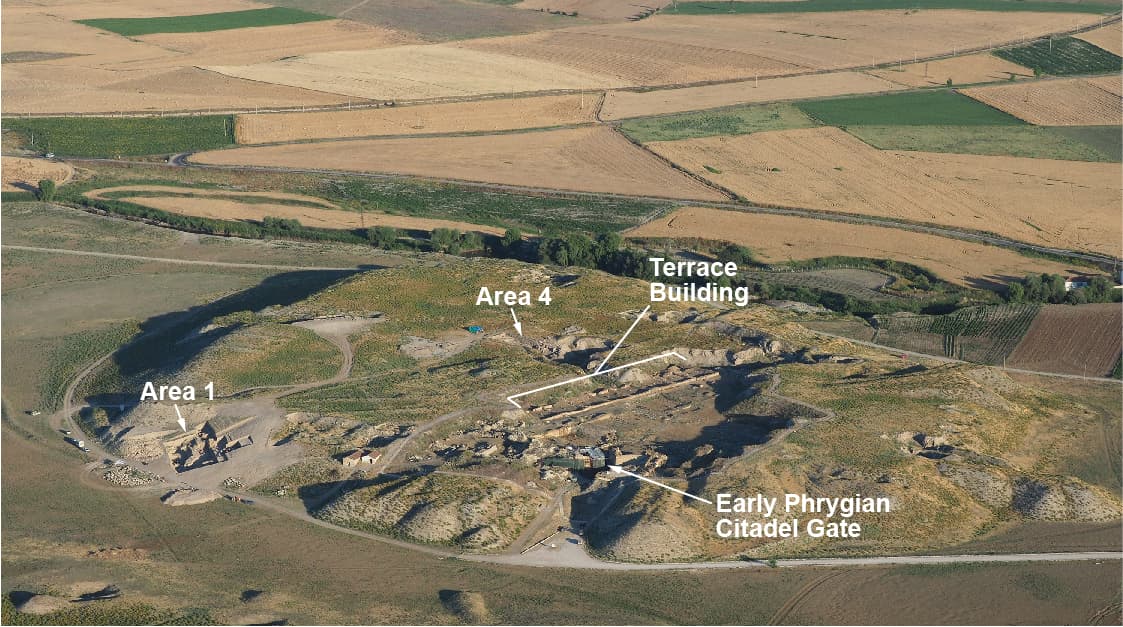
There is no visitor center, no interpretive sign that does justice to what this place was. Arriving in Ballıhisar, you find a modern Turkish village where the ancient city surfaces in fragments — column drums incorporated into walls, limestone blocks repurposed, excavation trenches fenced off in the fields. The temple precinct (temenos) is the most legible section: the outline of stoa corridors, the remains of a colonnaded street, the theatre's skeleton visible on the slope.
The scale of the ancient city is larger than it first appears. Walk to the edges of the modern village and the ruins follow you. What visitors consistently describe is not grandeur but something rawer — the paradox of standing on one of antiquity's most important sacred sites with almost no mediation between yourself and the ruins. The Gallus River still runs nearby, though it no longer carries the reputation for inducing ecstasy.
The plateau light in spring and autumn is clear and relentless; in summer, the heat of the high Anatolian plateau arrives early. The quality of the encounter is shaped by what you bring to it. Knowing that the meteorite — the physical body of the goddess — was removed from this place over two thousand years ago and never returned introduces a quality of absence that is not merely historical. Something was taken.
The place still holds the shape of what was here.
Enter from the main road into Ballıhisar village. The temple precinct and main excavation area are visible from the road. The theatre is accessible on the village's northern slope. The site has no formal entrance — walk among the ruins as the terrain permits and respect any active excavation barriers.
Context and lineage
Ancient tradition traced the cult at Pessinus to King Midas of Phrygia, who was said to have built the first costly temple to Cybele at this site — a tradition that, if not historically precise, at least reflects the depth of Phrygian identification with the place.
The city's name was derived in antiquity from the Greek verb meaning 'to fall,' referring to the baetyl: a black stone believed to have fallen from the sky, which was kept in the inner sanctuary and venerated as Cybele's physical body. The Gallus River that ran through the city's valley was said to induce madness or ecstatic states in those who drank from it, and the eunuch priests — the Galloi — took their name from it.
Archaeological evidence suggests the city as a formal urban center dates from around the fourth century BC, though the sacred tradition is older. In 204 BC, following a series of calamities during the Second Punic War, the Roman Senate consulted the Sibylline Books and was instructed to bring the goddess from Pessinus to Rome. A delegation traveled to Phrygia and received the sacred stone from King Attalus I of Pergamon, who controlled the city.
The stone was transported to Rome, welcomed by a procession of senators and Vestal Virgins, and housed on the Palatine Hill, establishing the Magna Mater cult as a formal element of Roman state religion. Pessinus remained an important pilgrimage center even after this removal, which suggests either that the transferred stone was a copy, or that the site retained its sanctity independent of the physical object — or both.
Phrygian → Galatian → Seleucid and Attalid Hellenistic → Roman Imperial → Early Christian bishopric → Byzantine → abandoned c. 9th century AD
King Midas
Legendary founder of the Cybele cult at Pessinus; Phrygian king said to have built her first temple here (8th century BC, but historically uncertain)
The Galloi (priestly dynasty)
Hereditary eunuch priests who administered the temple-state, performed ecstatic rituals, and maintained the cult across centuries
Deiotarus
Galatian ruler who controlled Pessinus and maintained relations with Rome during the Republican period
Emperor Julian the Apostate
Made a pilgrimage to Pessinus c. AD 362 to defend the sanctuary of Cybele against Christian suppression — evidence the site remained contested sacred ground into late antiquity
Charles Texier
French archaeologist who first identified the ancient site of Pessinus with the ruins at Ballıhisar in 1834
Pierre Lambrechts
Led the first systematic scientific excavations beginning in 1967
John Devreker
Excavation director 1987–2008, significantly advancing understanding of the site's stratigraphy
Gocha Tsetskhladze
Current excavation director since 2009, continuing ongoing archaeological study
Traditions and practice
The liturgical life of Pessinus revolved around the Attis myth and the Megalesia festival cycle. The Galloi — the eunuch priests named for the nearby Gallus River — administered the sanctuary and performed ecstatic processions, self-flagellation, and the deep mourning and jubilation rituals tied to Attis's death and resurrection. Castration was understood as the highest act of devotion to Cybele, a voluntary crossing of the threshold between human states.
Pilgrims came from across the Mediterranean world; the temple operated as an economic and political entity, collecting revenues from pilgrims and maintaining direct diplomatic relations with Hellenistic kingdoms and later with Rome. The annual Megalesia festival in March was observed both here and, after 204 BC, in Rome simultaneously — an extraordinary instance of synchronized imperial cult.
No religious practices are currently observed at the site. Seasonal archaeological excavations by Ghent University and subsequent teams have been conducted since 1967. The site is accessible to visitors as an open archaeological landscape.
Walk the full perimeter of the temple precinct (temenos) before approaching the central excavation area — this gives a sense of the sanctuary's scale that the fragments alone do not convey. At the main excavation trench, spend time with the column drums and architectural blocks: note the quality of the stonework, the different building phases visible in the masonry, the way later periods repurposed earlier materials.
The theatre on the northern slope offers the best elevated view of the site's relationship to the valley and plateau. Consider the Gallus River below the site — small, unremarkable today, but named for the priests who claimed it transformed them. Walk along its bank if accessible. Carry water; the site has no facilities.
Phrygian Cybele Cult
HistoricalPessinus was the most important cult center of Cybele in antiquity — the place where her physical body, a heaven-sent meteorite, was kept and venerated. The entire city was organized around this religious function, administered by the hereditary Galloi priesthood.
Ecstatic processions; annual Attis cycle mourning and resurrection rites; the Megalesia festival in March; self-flagellation and ritual castration as priestly devotion; pilgrimage from across the Mediterranean world
Roman Magna Mater Worship
HistoricalIn 204 BC, Rome retrieved Cybele's sacred stone from Pessinus and established the Magna Mater cult at the heart of Roman state religion. This act tied the fate of the Roman Empire to this Phrygian city in an unprecedented way.
Annual Megalesia festival in Rome (April 4–10); Galli priests brought to Rome; official diplomatic relations between the Roman Senate and the Pessinus priestly hierarchy
Early Christian and Byzantine
HistoricalPessinus became an early Christian bishopric. Emperor Julian the Apostate's pilgrimage to defend the Cybele sanctuary against Christian suppression (c. AD 362) marks the site's final phase as a contested sacred space between the old religion and the new.
Episcopal administration; Christian worship on and near former pagan cult sites; Byzantine-era building activity visible in the archaeological record
Archaeological Heritage
ActiveSystematic excavations since 1967 have progressively revealed Pessinus's urban complexity. The site is under ongoing scholarly study, with questions about the temple's exact location and the nature of the sacred baetyl still open.
Seasonal archaeological excavations; academic publication; ongoing international scholarly engagement with the site
Perspectives and open questions
Pessinus has been read through many lenses: as a primitive goddess cult superseded by Rome and then Christianity, as an ancient precedent for the universal human impulse toward the maternal divine, and as an unresolved mystery whose central sacred object — the meteorite — has not been seen for over two thousand years.
Scholarly perspective
Modern archaeological consensus confirms Pessinus as the primary cult center of Cybele in the ancient world, though questions remain about its founding date and the relationship between the Phrygian cult and earlier Bronze Age Anatolian mother goddess traditions. The city's Hellenistic development as a temple-state — a theocratic urban economy built around the sanctuary — is well documented. Excavations since 1967 have revealed a complex multi-period urban site with Hellenistic stoa, colonnaded streets, theatre, and Byzantine-era structures.
The exact location of the main temple housing the baetyl has not yet been conclusively identified.
Living and traditional perspectives
In Phrygian theology, the goddess herself chose this place as her earthly home. The meteorite was not a symbol or representation of Cybele — it was her physical body made available to human veneration. The priestly Galloi carried a divine mandate expressed in their very persons: having crossed the threshold of ordinary human gender, they existed in a liminal state that allowed them to serve as intermediaries.
For adherents of the Magna Mater tradition, Pessinus remains a place of foundational significance even in its ruined state.
Alternative interpretations
Some researchers propose continuities between the Cybele cult at Pessinus and much earlier prehistoric goddess traditions in Anatolia, drawing possible lines back to Çatalhöyük and the Neolithic figurine tradition of the seventh millennium BC. Whether this represents genuine cultural continuity or parallel human responses to similar landscape and spiritual needs is a matter of genuine academic debate.
The meteorite itself — understood as fallen from space — has attracted speculation about the cultural significance of cosmic objects in pre-modern sacred systems.
Open questions
The sacred baetyl — the meteorite stone removed to Rome in 204 BC — has never been conclusively identified among surviving Roman artifacts. Its location, if it still exists, is unknown. The exact site of the main temple within the excavated temenos has not been established. The full range of initiatory practices performed by the Galloi, and the experience of ordinary pilgrims at the sanctuary, is poorly documented in surviving sources.
Plan your visit
Access and arrival
Ballıhisar village is approximately 13 km from Sivrihisar and 75 km from Eskişehir via the D-200 highway. Access by car is straightforward; there is no reliable public transport to the village. No entrance fee. The site has no visitor facilities — bring water, food, and sun protection. Mobile phone signal may be unreliable in the village; note your route before arrival. For emergency access, Sivrihisar (13 km) is the nearest town with services.
No accommodation in Ballıhisar itself. Sivrihisar (13 km) has limited options. Eskişehir (75 km) offers a full range of hotels and is the most practical base for day-trip access to Pessinus.
Respectful visit
No dress requirements. Practical outdoor clothing and sturdy footwear appropriate for uneven terrain.
Photography is freely permitted throughout the site. No restrictions noted.
No tradition of offerings at the site currently. The ancient practice of offerings to Cybele is a historical matter.
Do not remove or disturb archaeological material. Respect fencing around active excavation areas. The site is partly within private land — stay on paths and accessible areas.
Do not disturb or remove archaeological material. Respect any active excavation fencing. The site has no formal facilities — bring water, sun protection, and food. Mobile signal may be unreliable in Ballıhisar; note your route before arriving.
Location
Map loads as you approach this section.
Pilgrim reflections
A portrait of encounter, not a score
Pilgrims describe what they felt, how present they could become, and whether the place would shape a journey. There are no stars and no ranking of traditions.
No reviewed reflections yet
The first pilgrims can help describe the character of being here.
Share a reflection
Available after an account-backed “Been there.” Every reflection is reviewed before publication.
Nearby sacred places
Explore other sacred places in the region. Proximity does not establish access or travel time; check each place’s guidance.

References
Sources consulted for this page. Source categories describe the publication, not a guarantee that every claim is verified. Traditional accounts and outside interpretations may differ.
- 01Pessinus - Wikipedia — Wikipedia contributorsencyclopediaComprehensive overview with references to excavation history
- 02Pessinus (Ballihisar) - Livius — Livius.orgacademicScholarly classical history reference
- 03Galli - Wikipedia — Wikipedia contributorsencyclopediaContext on eunuch priests of Cybele based at Pessinus
- 04Pessinus: The Mysterious Home of Cybele in the Heart of Anatolia — Anatolian ArchaeologyacademicDetailed archaeological and sacred context
- 05Eskişehir Pessinus Archaeological Site - Turkish Museums — TurkishMuseums.comofficialOfficial museum listing
- 06Pessinus - Sanctuary of the Mother Goddess Cybele — Alaturka.infoguideTourism-oriented but historically informed
- 07Pessinus (Ballihisar) - All About Turkey — AllAboutTurkey.comguideGeneral site overview
- 08Pessinus: The Origin of Cybele's Abduction and the Attis Myth — Andrew GoughSource contextDetailed mythology and alternative interpretations
Share a photo
Help visitors recognize Pessinus. Every submission is reviewed before publication.