Penghu Guanyin Temple
Penghu's oldest Buddhist shrine, where a sunset park now surrounds an old temple
Understand sacred places, explore living traditions, and learn how to engage respectfully with Pilgrim Map.
Access has not been verified. Check current local guidance before planning a visit.
Magong, Penghu County, Penghu County, Taiwan
Read the sources
Visit essentials
A quick read before you go
- Duration
- The temple itself can be toured in 20-40 minutes; combined with a walk through the Guanyinting…
- Access
- Located at No.
Overview
Penghu Guanyin Temple stands on Magong Bay's shore, once prized for unobstructed views toward Xiyu and Beishan—a vantage used in turn for military, devotional, and recreational purposes. A small pavilion is said to have stood here since the late Ming dynasty; in 1696 Xue Kui, a Qing naval officer with Penghu's garrison, expanded it into a full temple.
For much of the Qing period it was the officially sanctioned temple for the entire archipelago, giving the modest shrine outsized civic weight.
Seriously damaged in the 1884–85 Sino-French War, the temple was rebuilt in stages and reached its present form after a 1926–1927 reconstruction led by master carpenters from a nearby fishing village. Beside the Guanyin hall, a Dragon King shrine was added by a Qing magistrate in 1826 specifically to protect Penghu's fishermen and sailors, reflecting the archipelago's dependence on the sea.
The temple maintains its ritual calendar for Guanyin's birthday, enlightenment, and renunciation, while the surrounding waterfront park has become one of Magong's most reliable sunset viewpoints.
Why this place is sacred
Penghu Guanyin Temple's claim to sacred weight is layered rather than singular. It is, first, simply old — the oldest Buddhist temple in the Penghu archipelago, expanded from a smaller pavilion in 1696 by Xue Kui, a Vice General of the Penghu Naval Garrison's Right Battalion, and for much of the Qing dynasty the designated official temple for the entire archipelago, a status Chinese sources describe with the phrase '全澎官廟' — the officially sanctioned temple for all of Penghu.
That civic-religious authority mattered in a place where the sea determined nearly everything about daily survival, which is why a separate Dragon King shrine was added on the temple's eastern side in 1826, under Penghu magistrate Jiang Yong, specifically to protect the archipelago's fishermen and sailors.
The temple's most commonly repeated devotional legend holds that Guanyin herself descended to admire the beauty of Magong Harbor during the late Ming dynasty and lingered, prompting residents to build a small pavilion in her honor — the seed from which the 1696 temple grew. This should be read as a devotional origin story, not a historical claim, and is presented here as the tradition's own account of its beginnings.
A separate, better-documented historical episode from the 1884-85 Sino-French War adds its own layer: a Qing military officer named Liu Canying commemorated what he described as divine protection — a miraculous light seen near the temple during combat — in a couplet still associated with the site.
Between legend and documented history, what the temple offers most consistently is a literal threshold quality: it sits at the edge of Magong Bay, facing outward toward Xiyu and Beishan, a position that has anchored military lookout duty, religious devotion, and, in recent decades, the simple civic pleasure of watching a sunset, all from the same stretch of shoreline.
The site's earliest function, according to the temple's own devotional tradition, was as a small pavilion honoring Guanyin after she was said to have lingered at Magong Harbor's scenic beauty. Its formal expansion into a full temple in 1696 gave the archipelago its first dedicated Buddhist worship site, quickly elevated to serve as Penghu's officially sanctioned temple through much of the Qing dynasty.
The temple absorbed a Taoist folk-religion element in 1826 with the addition of the Dragon King shrine, becoming a Buddhist-Taoist syncretic complex rather than a purely Buddhist site. During the Japanese colonial period, from 1897, it was formally incorporated into the Rinzai school of Zen Buddhism under the Myōshin-ji lineage, a historical affiliation not necessarily reflected in the temple's practice today.
War damage in the 1884-85 Sino-French War and further disruption during the Second World War were each followed by reconstruction, most significantly the 1926-1927 rebuild that gave the temple its present form. In recent decades, the surrounding Guanyinting Recreation Area has grown into a public park hosting civic events including the Penghu International Fireworks Festival, layering secular recreation onto a site that remains, at its center, an active place of worship.
Experience and orientation
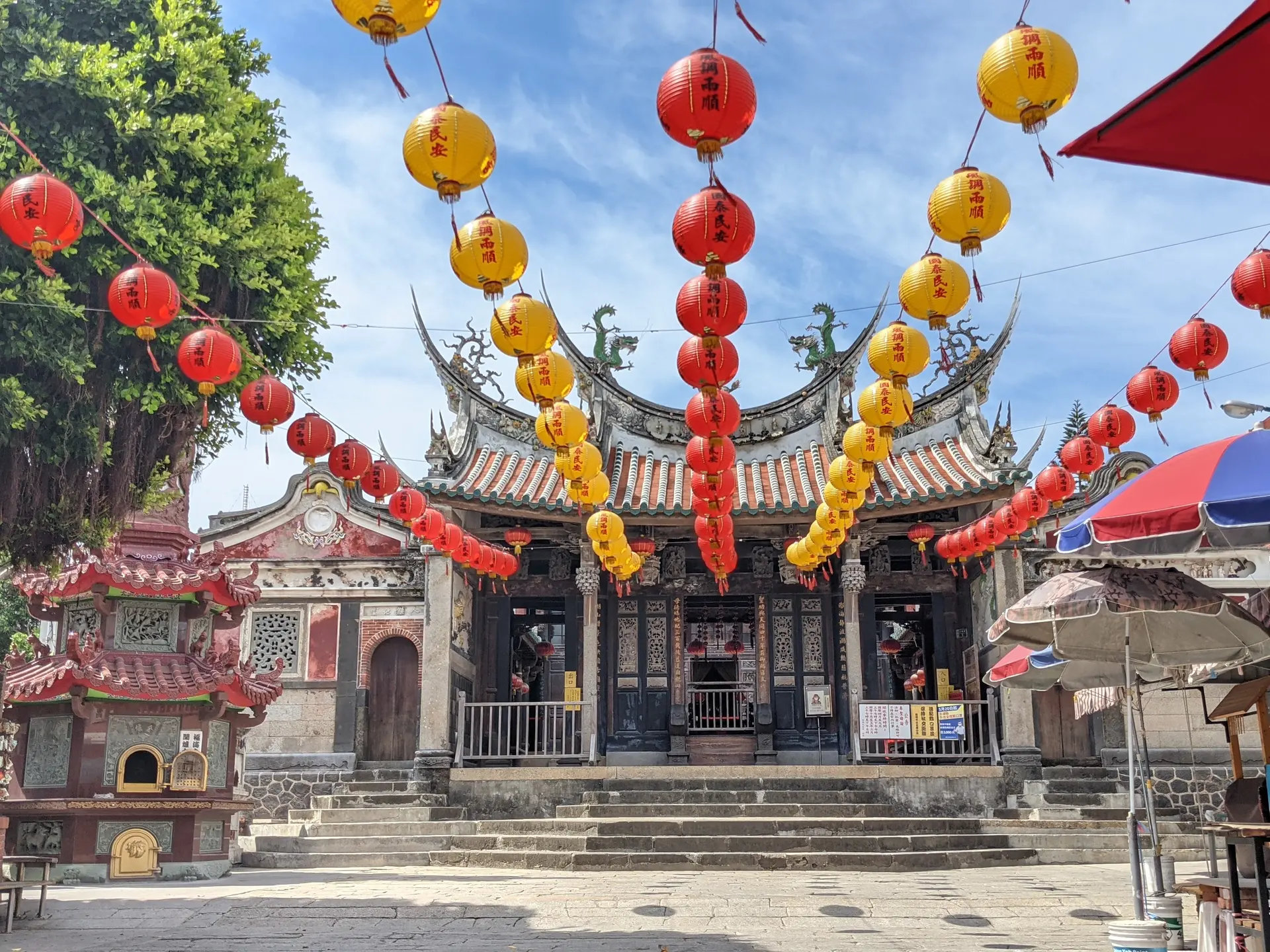
The temple itself can be toured in twenty to forty minutes, and what visitors most often note are its pale-green rice-paste stone lions, dated to 1889 and relocated to their current position in 1923, along with surviving plaques dated 1841, 1886, and 1890 that make the building's layered reconstruction history legible to anyone who looks closely. It is a modest, atmospheric working shrine rather than a grand architectural showpiece — its significance is historical and civic rather than visually overwhelming.
What far more visitors actually experience, according to travel accounts, is the surrounding Guanyinting Recreation Area: a waterfront park built around the temple, connected by the Xiying Rainbow Bridge, with walking paths along the water and consistently strong sunset views west over Xiyu, Fisherman's Island. In summer, the adjacent beach draws swimmers, sunbathers, and windsurfers, and the park hosts the seasonal Penghu International Fireworks Festival, drawing large evening crowds for fireworks paired with drone shows and music.
This layering is worth naming honestly: the temple anchors a place that functions, for most who visit, primarily as civic recreational space, with the shrine itself as one stop within a longer, more leisurely waterfront visit rather than the singular destination. For worshippers observing the temple's traditional ritual calendar, the register is naturally more solemn, but the general visitor's experience here trends contemplative and aesthetic — sea breeze, evening light, an easy walk — rather than intensely devotional.
The temple sits at No. 7, Jieshou Road, Magong City, directly on the Magong Bay waterfront, a ten-to-fifteen-minute walk from central Magong hotels and also reachable by local bus, taxi, rental scooter, or car. Visit in late afternoon into evening for the fullest experience, combining the temple itself with a walk through the surrounding park and across the Xiying Rainbow Bridge as the light changes over the water.
Context and lineage
A small pavilion is said to have existed at this site since the late Ming dynasty, before 1644. In 1696, during the thirty-fifth year of the Kangxi Emperor's reign, Xue Kui, Vice General of the Penghu Naval Garrison's Right Battalion, expanded it into a full temple, which soon became the officially sanctioned temple for the entire Penghu archipelago through much of the Qing period.
The temple suffered severe damage during the 1884-85 Sino-French War; reconstruction proceeded across several documented stages, including repairs around 1886 and further funded rebuilding around 1890-1891, a sequence some sources compress into a single date.
In 1826, Penghu magistrate Jiang Yong established a dedicated Dragon King shrine on the temple's eastern side to protect the archipelago's seafarers, and the temple underwent its most significant modern reconstruction in 1926-1927 under master carpenters Hsieh Chiang and his son Hsieh Tsu-nan, of nearby Houkutan. It was designated a Grade III Historic Site on November 27, 1985, and is now administered as a Penghu County-level monument.
The temple was formally incorporated into the Rinzai school of Zen Buddhism, under the Myōshin-ji lineage, during the Japanese colonial period beginning in 1897 — a historical institutional affiliation distinct from its earlier, more syncretic Buddhist-Taoist folk-religious practice.
A Phoenix Hall spirit-writing tradition, part of the broader Taiwanese folk-Confucian movement, was historically associated with the temple; it lapsed after the Second World War and was reportedly revived in 1974, though its current active status could not be confirmed in available sources. A lay management committee replaced older temple governance structures in 2014.
Xue Kui
Temple founder and expander
Vice General of the Penghu Naval Garrison's Right Battalion who expanded a small late-Ming pavilion into a full temple in 1696, establishing what became the officially sanctioned temple for all of Penghu.
Jiang Yong
Founder of the Dragon King shrine
Qing-era Penghu magistrate who established a dedicated Dragon King shrine on the temple's eastern side in 1826 to protect the archipelago's fishermen and sailors.
Hsieh Chiang and Hsieh Tsu-nan
Master carpenters, 1926-1927 reconstruction
Father-and-son master carpenters from Houkutan, near Magong, who designed and led the 1926-1927 reconstruction that gave the temple its present architectural form.
Liu Canying
Qing military officer, commemorator of wartime legend
Qing military officer who commemorated a reported miraculous light seen near the temple during combat in the 1884-85 Sino-French War, framing it as a sign of divine protection in a couplet still associated with the site.
Traditions and practice
Historically, the temple's core devotional practice centered on incense offerings and prayer tied to the three annual Guanyin observance dates — her birthday on the nineteenth day of the second lunar month, her enlightenment on the nineteenth day of the sixth lunar month, and her renunciation, or monastic ordination, on the nineteenth day of the ninth lunar month.
The attached Dragon King shrine added its own layer of maritime-protection ritual, reflecting the everyday risk faced by an island population dependent on the sea for its livelihood.
The temple continues daily worship, open from roughly 5am to 8pm per one government-affiliated source, with free admission, alongside its historic ritual calendar. It also plays a distinctive role in Magong's seventh-lunar-month Ghost Festival cycle, captured in the local saying 'the City God Temple releases the spirits, the Guanyin Temple receives them' — positioning this temple as the ritual closing point of the citywide Ghost Festival, with large-scale universal salvation rites coordinated alongside Magong's City God Temple.
General visitors are welcome to enter, observe, and offer incense in keeping with standard Taiwanese temple etiquette; there is no indication of restricted or members-only ritual access. Visitors interested in the fuller devotional calendar might time a visit to one of the three annual Guanyin observance dates, or to the seventh-lunar-month Ghost Festival period, for a more solemn register than an ordinary sunset-park visit.
Mahayana Buddhist veneration of Guanyin (Avalokiteshvara)
ActiveGuanyin, the Bodhisattva of Compassion, is the primary deity of the temple, which is considered the oldest Buddhist temple in the Penghu archipelago and described in local tradition as the heart of Buddhism in Penghu. Three annual festivals mark her birthday, enlightenment, and renunciation, each on the nineteenth day of a lunar month.
Incense offerings, prayer, and temple visitation tied to the three annual Guanyin observance dates. The temple was formally incorporated into the Rinzai, Myōshin-ji, Zen Buddhist lineage during the Japanese colonial period beginning in 1897.
Dragon King (Long Wang) worship for maritime protection
ActiveA Taoist folk-religion shrine to the Dragon King was established on the temple's eastern side in 1826 by Penghu magistrate Jiang Yong, reflecting the seafaring livelihood of Penghu's island population and their dependence on calm seas and safe voyages.
Dragon King statues, previously housed temporarily at the Penghu Shuixian Temple and Penghu Tianhou Temple, were formally enshrined in a dedicated hall built by demolishing four side rooms on the temple's east side; the shrine functions as a Buddhist-Taoist syncretic annex to the main Guanyin hall.
Ghost Festival / Yu Lan Buddhist-folk rites
ActiveThe temple plays a role in the seventh-lunar-month Ghost Festival tradition in Magong, encapsulated in the local saying that the City God Temple releases the spirits and the Guanyin Temple receives them — positioning this temple as the ritual closing point of the citywide Ghost Festival cycle.
Large-scale universal salvation rites during the seventh lunar month, coordinated with Magong's City God Temple.
Phoenix Hall (鸞堂) spirit-writing tradition
HistoricalA historical spirit-channeling and moral-teaching tradition associated with the temple, part of the broader Taiwanese folk-Confucian Phoenix Hall movement.
Spirit-channeling rites; the practice lapsed after the Second World War and was reportedly revived in 1974, but current active status could not be confirmed in available sources.
Perspectives and open questions
The temple's history supports a scholarly reading grounded in documented reconstruction and heritage registry, a devotional reading centered on Guanyin's own presence at the site, and an honest set of open questions about exactly when some of its rebuilding took place.
Scholarly perspective
Historical and heritage-registry sources agree the temple originated from a late-Ming-era pavilion formally expanded into a temple in 1696 by Qing naval officer Xue Kui, that it served as Penghu's officially sanctioned temple through much of the Qing period, was severely damaged in the 1884-85 Sino-French War, underwent multiple documented reconstructions in 1781, 1875, 1886, and definitively in 1926-1927 under master carpenters Hsieh Chiang and Hsieh Tsu-nan, and received formal heritage-monument protection in 1985.
Living and traditional perspectives
Local devotional memory frames the temple's founding through the legend of Guanyin descending to admire Magong Harbor's beauty, and frames the attached Dragon King shrine, built in 1826, as a direct response to the everyday maritime risks facing an island population whose livelihood depended on the sea. This is a devotional logic that fuses Buddhist compassion worship with Taoist folk-religious protection rites within a single temple complex, rather than treating the two as separate or competing traditions.
Alternative interpretations
No distinct esoteric or alternative interpretive tradition was found in available sources beyond the Phoenix Hall spirit-writing practice documented as historically active at the temple, dormant after the Second World War and reportedly revived in 1974. This sits within mainstream Taiwanese folk-religious practice rather than constituting a fringe or New Age reinterpretation of the site.
Open questions
The precise year the post-Sino-French-War reconstruction was completed remains ambiguous across sources — 1886 in one account, 1891 in another — likely reflecting a multi-stage repair-then-rebuild process rather than a single event. Similarly, a claimed 1996 heritage reclassification mentioned in one English source is not corroborated in Chinese-language sources and may be an error or a distinct administrative event not otherwise documented.
Whether the 1987-1989 'aerial pilgrimage,' in which Guanyin statues were reportedly transported by chartered aircraft, actually occurred as described is mentioned only in one English-language summary and remains unverified elsewhere.
Plan your visit
Access and arrival
Located at No. 7, Jieshou Road, Magong City, Penghu County, directly on the Magong Bay waterfront. Reachable on foot in ten to fifteen minutes from central Magong hotels, or by local bus — the Magong Station/Terminal stop is within roughly 230 meters — taxi, rental scooter, or rental car. Penghu itself is reached from Taiwan's main island by short domestic flight to Magong Airport or by ferry.
No temple-specific accommodation information was documented; central Magong, a short walk from the temple, offers a full range of standard lodging given the site's central waterfront location.
Respectful visit
No specific dress code was documented for this temple in available sources; standard Taiwanese temple norms of modest, respectful dress would reasonably apply, though this is an inference rather than a confirmed rule.
No explicit photography restriction was found in sources. The temple and its stone lions are commonly photographed by visitors and featured in tourism materials, suggesting photography is generally permitted throughout.
Incense offering is the standard form of devotional practice at the temple, consistent with Buddhist-Taoist syncretic temples across Taiwan, though no site-specific offering protocol was documented in sources.
No documented restrictions on visitor access; the temple is described in official tourism sources as freely open to the public daily.
No specific ritual restrictions were documented for outside visitors, but those attending during the Ghost Festival's universal salvation rites, or the three Guanyin observance dates, should recognize these as active devotional occasions rather than performances staged for tourists, and adjust their conduct accordingly.
Location
Map loads as you approach this section.
Pilgrim reflections
A portrait of encounter, not a score
Pilgrims describe what they felt, how present they could become, and whether the place would shape a journey. There are no stars and no ranking of traditions.
No reviewed reflections yet
The first pilgrims can help describe the character of being here.
Share a reflection
Available after an account-backed “Been there.” Every reflection is reviewed before publication.
Nearby sacred places
Explore other sacred places in the region. Proximity does not establish access or travel time; check each place’s guidance.
Penghu Tianhou Temple
Magong, Penghu County, Penghu County, Taiwan
0.1 km away

Nankunshen Daitian Temple
Beimen, Tainan City, Tainan, Taiwan
66.6 km away

Mailiao Gongfan Temple
Mailiao, Yunlin County, Yunlin County, Taiwan
70.6 km away

Beigang Chaotian Temple
Beigang, Yunlin County, Yunlin County, Taiwan
75.2 km away
References
Sources consulted for this page. Source categories describe the publication, not a guarantee that every claim is verified. Traditional accounts and outside interpretations may differ.
- 01Penghu Guanyin Temple — Wikipedia — Wikipedia contributorsacademicMost detailed English-language source; covers founding (1696), Qing-era renovations, Sino-French War damage, Japanese colonial period incorporation into Rinzai school, WWII bombardment, heritage designation, and architectural detail.
- 02澎湖觀音亭 — 維基百科 — Wikipedia contributorsacademicChinese-language counterpart with granular renovation dates (1781, 1875, 1886, 1927, 1959), architects' names, heritage status, and a Qing military officer's couplet referencing a wartime divine-light legend.
- 03Guanyin Pavilion (Guanyinting) — Penghu County — Tourism Administration, Republic of China (Taiwan)officialOfficial Taiwan tourism board page confirming founding date, destruction/rebuild dates, address, coordinates, and nearby facilities.
- 04Penghu Guanyinting (Old Buddhist Temple) — Penghu National Scenic Area AdministrationofficialOfficial scenic area administration listing for the temple and adjoining waterfront recreation area.
- 05Guanyin Temple, Penghu — Taiwan Religious Culture Map — Ministry of the Interior, Taiwan (moi.gov.tw)officialOfficial government religious-culture database entry; details architectural elements (hexagonal bell towers, 1841/1886/1890 plaques, pale-green rice-paste lions relocated 1923), festivals (Guanyin's Birthday, Yu Lan Festival), and visiting hours (5am-8pm, free admission).
- 06馬公觀音亭 — 臺灣宗教文化地圖 — Ministry of the Interior, Taiwan (moi.gov.tw)officialGovernment cultural-heritage database entry confirming stone lion provenance (1889, relocated 1923), Dragon King shrine (1826) founded by magistrate Jiang Yong (蔣鏞) to protect seafarers, and the annual ritual calendar (2/19, 6/19, 9/19 lunar month Guanyin observances plus the 'City God releases, Guanyin Temple receives' Ghost Festival tradition).
- 07文化資產複合查詢 — 澎湖觀音亭 (Monument Registry Record) — Bureau of Cultural Heritage, Ministry of Culture, TaiwanofficialNational Cultural Heritage Database record confirming designation date of November 27, 1985 (registry ID encodes this date); page did not fully render on fetch but the ID and designation date corroborate secondary source claims.
- 08The 2026 Penghu International Fireworks Festival — PENGHU-GO (Penghu County Government tourism portal)officialCounty government tourism portal confirming 2026 festival dates (May 4 - Aug 25), venue (Guanyinting Recreation Area), and format (fireworks + drone show + music, free public viewing).
- 09觀音亭 — penghu.info (Penghu local cultural archive)Source contextLocal cultural archive recording the devotional origin legend of Guanyin descending at the scenic harbor and residents building a pavilion in her honor, plus details on the Dragon King shrine's founding by magistrate Jiang Yong in 1826.
- 10Penghu Flower and Fire Festival — 2026 basic info — twosevenths.comSource contextTravel guide corroborating fireworks festival scheduling and venue at Guanyinting.
- 11Guanyinting Recreation Area, Magong, Taiwan — WanderlogSource contextTravel aggregator describing the Xiying Rainbow Bridge, waterside walking paths, sunset viewing, and swimming/windsurfing activity at the adjoining park.
Pilgrim glossary
- Zen
- A Japanese Buddhist school emphasizing seated meditation and direct insight.
Share a photo
Help visitors recognize Penghu Guanyin Temple. Every submission is reviewed before publication.