Penghu Tianhou Temple
The temple so old that Magong took its name from it
Understand sacred places, explore living traditions, and learn how to engage respectfully with Pilgrim Map.
Access has not been verified. Check current local guidance before planning a visit.
Magong, Penghu County, Penghu County, Taiwan
Read the sources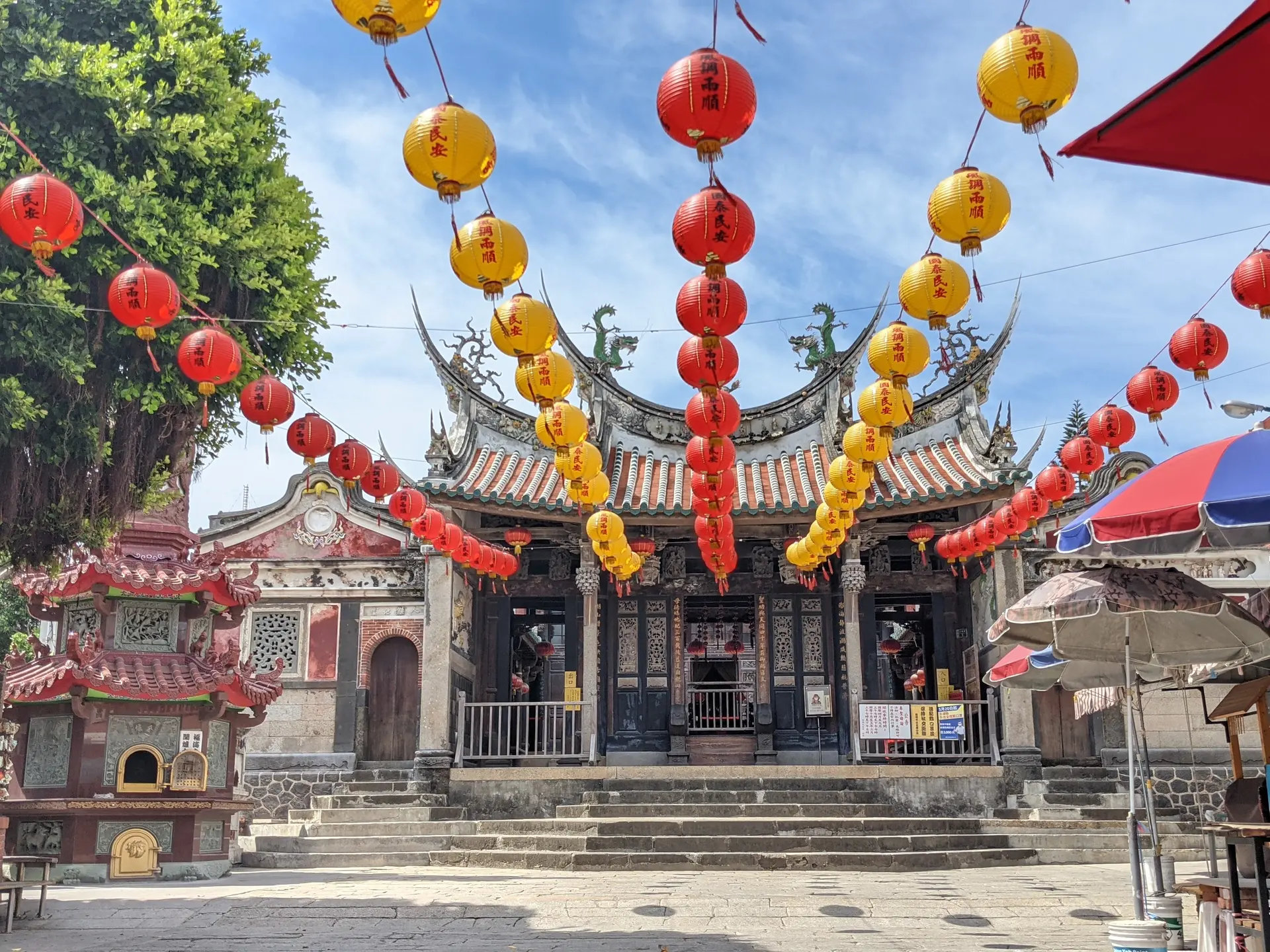
Visit essentials
A quick read before you go
- Duration
- Approximately one hour for a typical visit, per tourism-board guidance.
- Access
- Located at No.
Overview
Penghu Tianhou Temple stands in old Magong, whose name derives from 媽宮, `Mazu's Palace`, the temple's historic name. A Mazu temple certainly existed here by 1604, when Ming military commissioner Shen Yourong used it to negotiate the Dutch withdrawal from Penghu. A granite stele commemorating that episode, found on the grounds in 1919, is called the `First Stele of Taiwan`; a Dutch 1623 map marking a `Sineesche Tempel` here confirms the early landmark.
Earlier proposed foundations—a 1281 Yuan shrine or Ming construction after anti-piracy victories in 1563 or 1592—appear in tourism materials, but Taiwan's heritage authorities explicitly call them unverifiable for lack of documentation. Continuous use since at least the early seventeenth century shaped civic identity. Renamed Tianhou, `Empress of Heaven`, after Admiral Shi Lang credited Mazu with his 1683 conquest of Penghu, the temple was repeatedly rebuilt, most substantially in 1922 by Chaozhou-tradition master carpenter Lan Mu.
It remains a national monument and active center of Mazu devotion.
Why this place is sacred
Precision matters here, because tourism materials rarely offer it. The founding date of Penghu Tianhou Temple is not settled, and Taiwan's own Ministry of the Interior religious-heritage database and Penghu County government sources say so explicitly: candidate dates of 1281 during the Yuan dynasty, and 1563 or 1592 during the Ming, each tied to specific historical episodes — a Yuan emperor establishing a Tianfei Gong, or military victories over Japanese pirates — 'cannot be verified due to insufficient documentary evidence.'
What can be verified is narrower but solid: a granite stele, discovered on-site in 1919, records that in 1604 the Ming regional military commissioner Shen Yourong met Dutch captain Wybrand van Waerwijck at this temple to negotiate a Dutch withdrawal from Penghu. That stele proves the temple existed by 1604 — it establishes a latest-possible founding date, not a confirmed year of construction.
A 1623 Dutch map marking a 'Sineesche Tempel' at the same site adds independent corroboration that the temple was already a recognized landmark by the early 1620s. Tourism copy from commercial platforms and even some official tourism-board pages routinely compresses this nuance into a flat claim that the temple was 'built in 1604' or is simply 'Taiwan's oldest temple' — a framing this content deliberately resists, because it overstates the certainty the evidence actually supports.
What is not in dispute is the temple's role in 1683, when Admiral Shi Lang, having conquered Penghu for the Qing, credited his victory to Mazu's aid and petitioned the Kangxi Emperor to elevate her rank — the origin of the temple's rename from Tianfei Gong to Tianhou Gong, 'Palace of the Empress of Heaven.'
That renaming, and the fact that Magong's very name derives from the temple's older appellation, reflect a scale of civic-religious fusion that doesn't require an exact founding year to register as significant.
The temple's earliest documented function, from at least 1604, combined religious devotion to Mazu with practical civic and even diplomatic use — the 1604 stele records the site being used for a formal negotiation between Ming and Dutch military representatives, suggesting the temple already held recognized standing as a meeting place of consequence, not merely a private shrine.
The temple's name changed at least once in a documented, datable way: after Admiral Shi Lang's 1683 conquest of Penghu, credited to Mazu's aid, the site was renamed from its earlier appellations, including Tianfei Gong and Niangma Temple, to Tianhou Gong, reflecting Mazu's elevated imperial rank.
Architecturally, the temple reached its present form through a major 1922 reconstruction under Chaozhou-tradition master carpenter Lan Mu, and a 2011-2014 restoration addressed storm damage to the Qingfeng Pavilion, which houses the 1604 stele — physical evolution running alongside the temple's unchanged core function as the anchor of Mazu worship on the island.
Experience and orientation
Penghu Tianhou Temple rewards visitors who slow down to look closely at its woodcarving, stone carving, and gilded painting, particularly the dense Chaozhou-style carvings added during the 1922 reconstruction and the swallowtail roofline typical of southern Chinese temple architecture.
For many visitors, the temple's most resonant feature is not devotional but documentary: the 1604 stele, housed in the Qingfeng Pavilion, offers a rare point of tangible contact with an event four centuries old — a Ming commissioner's actual negotiation with Dutch forces, preserved in stone rather than only in written record.
The temple sits within easy walking distance of Magong's Central and Old Street heritage district and the Four-Eyed Well, a historic freshwater well, making it easy to fold into a longer walk through the oldest part of the city rather than treating it as an isolated stop.
A typical visit takes about an hour, enough time to take in the architectural detail without rushing, though the temple rewards a second, slower pass for anyone genuinely interested in reading its layered carving and plaques as historical text rather than decoration.
The temple is located at No. 1, Zhengyi Road, in the heart of old Magong, walkable from Magong Commercial Harbor and the local bus terminal via Minzu Road. Daytime visits are recommended for appreciating the architectural detail — the carvings and gilded painting reward direct light — and the temple courtyard and archway are commonly noted as good vantage points for taking in the building's full facade.
Context and lineage
The temple's documented history begins in 1604, when Ming regional military commissioner Shen Yourong met Dutch captain Wybrand van Waerwijck at the site to negotiate a Dutch withdrawal from Penghu — an event commemorated by a granite stele discovered on the temple grounds in 1919 and now known as the 'First Stele of Taiwan.'
A 1623 Dutch-drawn map of Penghu marks a 'Sineesche Tempel,' or Chinese temple, at the same location, corroborating the temple's existence and recognized status by the early 1620s.
Multiple earlier, folk-tradition founding dates circulate in tourism materials — a Yuan-dynasty Tianfei Gong from 1281, and Ming-era construction in 1563 or 1592 tied to anti-piracy military victories — but Taiwan's own Ministry of the Interior and Penghu County government sources state plainly that these earlier dates cannot be verified due to insufficient documentary evidence.
In 1683, following Admiral Shi Lang's conquest of Penghu for the Qing, which he credited to Mazu's divine aid, the temple was renamed from its earlier names, including Tianfei Gong and Niangma Temple, to Tianhou Gong, following Shi Lang's petition to elevate Mazu's imperial rank.
The temple stands as the point of origin, in Taiwanese folk-religious tradition, for the spread of Mazu worship into Taiwan proper, given Penghu's role as the first stepping-stone for Han Chinese settlers crossing the Taiwan Strait. The city of Magong itself is named after the temple's historic appellation, 媽宮, 'Mazu's Palace' — a fusion of civic and religious identity that persists regardless of the precise founding date.
Shen Yourong
Ming military commissioner
Ming regional military commissioner who met Dutch captain Wybrand van Waerwijck at the temple in 1604 to negotiate a Dutch withdrawal from Penghu, an event commemorated by the on-site stele discovered in 1919.
Shi Lang
Qing admiral, temple renamer
Qing admiral who conquered Penghu in 1683, credited his victory to Mazu's aid, and petitioned the Kangxi Emperor to elevate Mazu's rank — the origin of the temple's renaming from Tianfei Gong to Tianhou Gong.
Lan Mu
Master carpenter, 1922 reconstruction
Master carpenter of the Chaozhou tradition who led the temple's major reconstruction in 1922, during the Japanese colonial period, giving the temple its current architectural form.
Traditions and practice
Daily incense offerings to Mazu and attendant deities, and the use of divination blocks for fortune-seeking, form the core of ongoing devotional practice. Ceremonial sacrificial rites and a birthday blessing ritual are performed on Mazu's lunar birthday, the twenty-third day of the third lunar month.
The temple continues as an active place of worship fully integrated into Magong civic life, alongside its heritage-tourism function; a major restoration, completed in 2014, was undertaken specifically to preserve both the religious and historical-architectural functions of the site. The Penghu Mazu Sea Pilgrimage, a maritime procession distinctive among Taiwan's Mazu pilgrimages for its boat-based route, remains associated with the temple, reflecting Penghu's island geography.
General visitors are welcome to observe and may offer incense respectfully, consistent with standard practice at active Mazu temples; specific rules on visitor participation in ceremonies such as the birthday festival rites were not detailed in available sources, though incense offering by the general public is standard.
Mazu (Chinese folk religion / Taoist-Buddhist syncretic sea goddess worship)
ActiveMazu, deified as the fisherman's daughter Lin Moniang of Meizhou Island, Fujian, is the most widely worshipped deity in Taiwanese folk religion, primarily as protector of seafarers but with jurisdiction popularly extended to nearly all life domains. Penghu Tianhou Temple is considered the point of origin for Mazu worship's spread into Taiwan proper, given Penghu's role as the first stepping-stone for Han Chinese settlers crossing the Taiwan Strait.
Daily incense offerings, fortune-telling via divination blocks, an annual Mazu birthday festival on the twenty-third day of the third lunar month featuring sacrificial rites and blessing ceremonies, and a distinctive sea-based Mazu pilgrimage procession specific to Penghu's island geography.
Perspectives and open questions
This temple's history offers an unusually clear case study in the gap between what tourism copy repeats and what documentary evidence actually supports — a gap Taiwan's own heritage authorities have been candid about closing honestly.
Scholarly perspective
There is broad consensus, reflected even in Taiwan's own official cultural-heritage sources, that Penghu Tianhou Temple is the oldest surviving Mazu temple in Taiwan with continuous religious use, and plausibly the oldest Han Chinese temple structure of any kind on Taiwanese soil — but this consensus applies to relative seniority among Taiwan's temples, not to a precisely known founding date.
Scholars and heritage-registry sources agree that the specific year of founding is not settled: Taiwan's Ministry of Interior religious-heritage database and Penghu County government sources explicitly state that pre-1604 founding dates, including the Yuan-dynasty 1281 and Ming-era 1563 and 1592 candidates, cannot be verified due to insufficient documentary evidence. The only historically anchored fact is that a Mazu temple existed at this site by 1604, established via the granite stele discovered in 1919, corroborated by the 1623 Dutch map.
Tourism materials frequently compress this nuance into a flat claim of 'built in 1604,' which overstates the certainty of the evidence: 1604 is the latest-possible founding date proven by documentation, not a confirmed construction year.
Living and traditional perspectives
Within Taiwanese folk-religious tradition and local Penghu memory, the temple is regarded unambiguously as the fountainhead of Mazu worship in Taiwan and a foundational site of Han settlement identity. The city of Magong's very name derives from the temple's historic appellation, 媽宮, 'Mazu's Palace,' reflecting how thoroughly the temple's sacred status has fused with civic identity, regardless of the precise founding date debate that occupies historians rather than worshippers.
Alternative interpretations
No distinct alternative or esoteric interpretive tradition was identified in research beyond standard Mazu folk-religious cosmology — her role as sea-protector deity elevated through both grassroots devotion and imperial recognition following the 1683 conquest.
Open questions
The core open question is the true founding date and founding circumstances of the temple prior to 1604 — whether any of the Yuan-dynasty 1281, or mid-Ming 1563 and 1592, traditions reflect a real, undocumented earlier shrine on the site, or are later folk elaborations projected backward to deepen the temple's claimed antiquity. No archaeological excavation data addressing pre-1604 site occupation was found in available sources, and this question likely cannot be resolved without new physical evidence.
Plan your visit
Access and arrival
Located at No. 1, Zhengyi Road, Magong City, Penghu County, in the heart of old Magong, walkable from Magong Commercial Harbor and the local bus terminal via Minzu Road. Penghu is reached from Taiwan proper by short domestic flight from Kaohsiung, Tainan, Taichung, or Taipei, or by ferry.
No temple-specific accommodation information was documented; central Magong, within walking distance of the temple, offers a full range of standard lodging options.
Respectful visit
No temple-specific dress code was found in sources; general Taiwanese temple etiquette, meaning modest dress and respectful demeanor, is the reasonable default expectation, though this was not explicitly confirmed for this site.
Photography appears permitted in courtyard and architectural areas — the temple plaza and archway are noted as recommended photo spots by tourism sources. No explicit restriction on interior photography was found, though visitors are generally advised to be respectful during active worship.
Incense offering is the standard devotional practice; specific rules on other offerings, such as food or flowers, were not detailed in sources found.
General guidance found is limited to maintaining silence and respect during visits; no specific access restrictions, gender restrictions, or areas closed to visitors were identified in sources.
No specific participation restrictions were documented, but visitors should recognize the temple's active devotional life, particularly around Mazu's birthday festival, as ongoing worship rather than a historical reenactment staged for visitors.
Location
Map loads as you approach this section.
Pilgrim reflections
A portrait of encounter, not a score
Pilgrims describe what they felt, how present they could become, and whether the place would shape a journey. There are no stars and no ranking of traditions.
No reviewed reflections yet
The first pilgrims can help describe the character of being here.
Share a reflection
Available after an account-backed “Been there.” Every reflection is reviewed before publication.
Nearby sacred places
Explore other sacred places in the region. Proximity does not establish access or travel time; check each place’s guidance.

Penghu Guanyin Temple
Magong, Penghu County, Penghu County, Taiwan
0.1 km away

Nankunshen Daitian Temple
Beimen, Tainan City, Tainan, Taiwan
66.7 km away

Mailiao Gongfan Temple
Mailiao, Yunlin County, Yunlin County, Taiwan
70.8 km away

Beigang Chaotian Temple
Beigang, Yunlin County, Yunlin County, Taiwan
75.3 km away
References
Sources consulted for this page. Source categories describe the publication, not a guarantee that every claim is verified. Traditional accounts and outside interpretations may differ.
- 01澎湖天后宮 (Penghu Tianhou/Mazu Temple) — Taiwan Religious Culture Map — Ministry of the Interior, Taiwan (內政部)officialOfficial government religious-heritage database. States temple is the first built by Han settlers in Taiwan, with earliest reliable historical record being the 1604 Shen Yourong stele; explicitly frames earlier dates (Yuan 1281, Ming 1563/1592) as unverifiable due to insufficient documentation.
- 02澎湖天后宮 — 國家文化資產網 (National Cultural Heritage Database, monument record) — Bureau of Cultural Heritage, Ministry of Culture, Taiwan (文化部文化資產局)officialOfficial national monument registry entry; designated a national monument (國定古蹟) in 1983 (民國72年). Site could not be fully parsed via automated fetch (JS-rendered) but registry ID and designation year confirmed via search indexing.
- 03國定古蹟環景導覽 — 澎湖天后宮 — Bureau of Cultural Heritage, Ministry of Culture, TaiwanofficialOfficial 360-degree virtual tour and heritage-site descriptor page maintained by Taiwan's Bureau of Cultural Heritage.
- 04An Overview of Penghu (澎湖概覽), page 26 — Penghu County Government (澎湖縣政府)officialCounty government publication; corroborates founding-date uncertainty and 1604 stele evidence, 1922 (Taisho 11) Japanese-era reconstruction by master carpenter Lan Mu of Chaozhou style, 1983 national monument designation, and 2011-2014 restoration of the Qingfeng Pavilion housing the stele.
- 05Penghu Tianhou Temple — Tourism Administration, Republic of China (Taiwan) — Tourism Administration, MOTC, TaiwanofficialOfficial English-language tourism board description; states temple built 1604, first-grade national historic site, oldest Mazu temple in Taiwan.
- 06百年守護——救難女神澎湖媽 (A Century of Protection: Penghu's Rescuer Goddess Mazu) — Digital Archives and e-Learning National Science and Technology Program, Taiwan (數位典藏與數位學習國家型科技計畫)academicState-funded digital humanities exhibition on Penghu Mazu worship history; used to corroborate founding-date ambiguity and local devotional history.
- 07Using Mazu to Teach Key Elements of Chinese Religions — Association for Asian StudiesacademicAcademic association publication on Mazu religion generally; used for broader tradition/significance context, not Penghu-specific dating.
- 08Penghu Tianhou Temple — Wikipedia — Wikipedia contributorsacademicSummarizes multiple candidate founding dates (1592, 1593, 1604) and the 1604/1919 stele discovery; itself notes the claim of Ming-dynasty (or earlier) origin is contested.
- 09澎湖天后宮 — 維基百科 — Wikipedia contributorsacademicChinese-language article with fuller detail on name changes (天妃宮/媽娘宮/娘媽宮/媽宮 to 天后宮 after 1683) and Qing-era renaming following Shi Lang's Penghu campaign.
- 10西元1604年建成!全台歷史最悠久的廟宇「澎湖天后宮」 — 報時光 (udn Time Report), United Daily NewsSource contextTaiwanese newspaper heritage-history feature; repeats 1604 construction date and 'oldest temple in Taiwan' framing, consistent with official sources.
- 11Tianhou Temple, Magong — Taiwan's Oldest Mazu Temple — Penghu B (penghub.tw), Penghu tourism platformSource contextLocal tourism platform; repeats 'oldest Mazu temple' claim without critical caveat, illustrating how tourism materials flatten the dating controversy.
- 12The Taiwanese Camino: Mazu Pilgrimages — Taiwan PanoramaSource contextGovernment-affiliated long-form magazine (Ministry of Foreign Affairs-linked); good context on Mazu pilgrimage culture generally, incl. sea-based pilgrimage traditions relevant to Penghu's maritime Mazu procession.
- 132025 Penghu Tianhou Temple: Historic Site, Mazu Faith Guide — KKdaySource contextCommercial travel-booking platform content; general visitor information, uncritical repetition of tourism claims.
Share a photo
Help visitors recognize Penghu Tianhou Temple. Every submission is reviewed before publication.