Mailiao Gongfan Temple
Two rival artisan teams, one roof, one Mazu since 1685
Understand sacred places, explore living traditions, and learn how to engage respectfully with Pilgrim Map.
Access has not been verified. Check current local guidance before planning a visit.
Mailiao, Yunlin County, Yunlin County, Taiwan
Read the sources
Visit essentials
A quick read before you go
- Duration
- Roughly 30-60 minutes is typical for a temple complex of this scale (three halls, courtyard),…
- Access
- No.
Overview
On Mailiao's cramped main commercial road, Gongfan Temple conceals densely carved wood screens, a Qing-dynasty stone incense censer, and wood-carved figures in Western three-piece suits, a stylistic quirk predating 1945. Its founding Mazu statue, Kaishan Liuma or 'Founding Sixth Mazu,' is said to have crossed the Taiwan Strait with the monk Chunzhen Chanshi in 1685, arriving from Meizhou Island, the traditional wellspring of Mazu worship.
The temple's national significance rests not on the statue's age but on its 1930s reconstruction. Two master-artisan teams—one from Quanzhou and one trained in the Zhangzhou lineage—built opposite halves in open competition, each displaying its craftsmanship beside the other's. Architectural historians regard this 'front-rear competing teams' arrangement as a high point of Taiwanese temple carpentry and the basis for its 2012 national monument designation.
Why this place is sacred
Gongfan Temple's felt sanctity is bound to the perceived age and authenticity of a single object: the Kaishan Liuma statue, brought, per temple tradition, from Meizhou Island by the monk Chunzhen Chanshi in 1685. Meizhou is regarded across Taiwanese Mazu worship as the deity's place of origin, so a statue's documented (or believed) passage from there carries considerable devotional weight.
A widely repeated story recounts that in 1881, a pilgrimage delegation from Mailiao carried the statue back to the ancestral Meizhou temple, where its base was found to match precisely one of six recessed niches on the altar — taken by believers as confirmation that this was, in fact, one of the six original Meizhou Mazu images.
Complicating this narrative, some Chinese-language sources separately reference a 'Golden-faced Fourth Mazu' statue said to have returned from Meizhou's Chaotian Pavilion in 1919; sources do not clearly reconcile whether this refers to the same statue described inconsistently, a second image, or a translation conflation, and this content preserves that uncertainty rather than resolving it. The temple's authority extends outward through its role consecrating statues for other Taiwanese temples via fenling, a spirit-dividing practice common to Chinese popular religion.
The temple exists to house and venerate the Kaishan Liuma Mazu statue, brought to Taiwan in 1685 specifically to give the Haifeng Port settlement a shrine tied directly to the deity's Meizhou origin.
After flooding destroyed the original Haifeng Port site (dated variously to 1738 or 1742 across sources), the temple relocated to its present Mailiao location, and grew through successive renovations — 1800, 1832, and especially the competing-team reconstruction of the 1930s — from a modest port shrine into a building of recognized architectural distinction.
Experience and orientation
Visitors and travel writers consistently note the contrast between Gongfan Temple's unassuming, almost hemmed-in position on Mailiao's main road and the richness of what stands inside — elaborately carved wood beam ends, a Qing-era Kangxi incense censer, and those unusual Western-suited wood-carving figures that reward a slow, attentive look.
The temple functions as both a bustling neighborhood worship site and a national monument, a duality frequently remarked on in coverage: this is not a museum piece cordoned off from daily life, but an actively used three-hall temple where incense offering continues around the architectural details that draw heritage visitors.
A visit of roughly 30-60 minutes suits the temple's scale — three halls and a courtyard — with daily worship continuing from 8am to 9pm and no admission fee.
Context and lineage
The Linji-school monk Chunzhen Chanshi crossed from Meizhou Island to the Haifeng Port area of Mailiao in 1685, carrying the Mazu statue that would become known as Kaishan Liuma, 'Founding Sixth Mazu.' After the original site was destroyed by flooding — one source gives 1738, most others 1742 — the temple relocated to its current site. The 1930s reconstruction (see key figures) is treated in Taiwanese architectural heritage scholarship as the temple's defining historical moment.
Gongfan Temple's authority within the wider Mazu cult stems from its role consecrating statues for branch temples through fenling, and from the Kaishan Liuma statue's contested but widely believed direct lineage to one of the original Meizhou images.
Chunzhen Chanshi
Founding monk
Brought the Kaishan Liuma Mazu statue from Meizhou Island to Haifeng Port in 1685.
Wang Shu-fa
Master carpenter, main hall team
Led one of two competing artisan teams during the 1930s reconstruction, responsible for the main hall and worship hall.
Lin Huo-yin
Master carpenter, rear hall team
Led the second competing artisan team, responsible for the Sanchuan Hall and rear hall, in the rare 'front-rear competing teams' arrangement.
Huang Gui-li
Wood carver
Recarved the main Mazu statue and the guardian generals Qianliyan and Shunfeng'er, alongside Lin Guan-chang.
Traditions and practice
Historic practice centers on incense offering before the Mazu and Guanyin altars, and on consecration or fenling ceremonies in which statues destined for branch or affiliate temples were ritually imbued with Mazu's spirit at Gongfan Temple before installation elsewhere.
Daily worship continues during opening hours (8am-9pm), with an annual peak of activity around the 23rd day of the third lunar month, Mazu's birthday, when representatives and pilgrims from temples with historical ties to Gongfan Temple travel to Mailiao to pay respects.
General Taiwanese temple norms suggest visitors may offer incense and observe worship freely; the temple's own published guidance on visitor ritual participation was not found in available sources, so visitors should default to standard respectful practice.
Mazu (Matsu) worship — Taiwanese folk religion / Chinese popular religion
ActiveGongfan Temple is one of Taiwan's oldest Mazu temples, tracing its founding statue to a 1685 crossing from Meizhou Island, the mythological birthplace of Mazu worship. Many other Taiwanese Mazu temples have had statues consecrated and spiritually divided at this temple, making it an important node in Taiwan's wider Mazu pilgrimage and branch-temple network.
Daily incense offering and worship; consecration and spirit-transfer rituals for statues destined for branch temples; annual celebration of Mazu's birthday on the 23rd day of the third lunar month.
Guanyin (Avalokiteśvara) worship
ActiveSecondary devotional tradition housed in the temple's rear hall since 1827, reflecting the common Taiwanese temple pattern of multiple co-located deities under one roof.
Worship of Guanyin alongside Mazu within the temple's three-hall layout.
Perspectives and open questions
Gongfan Temple can be read as a case study in Taiwanese temple carpentry as much as a devotional site, its architectural distinction and its Mazu lineage claim standing somewhat independently of each other.
Scholarly perspective
Taiwanese heritage authorities and architectural historians recognize Gongfan Temple primarily for its 1930s reconstruction, notable as a rare example of a 'front-rear competing teams' construction where two separate master-artisan teams built different halls of the same temple in parallel, each showcasing its own stylistic virtuosity — a practice architectural scholarship treats as a high point of Taiwanese temple craftsmanship of the era.
This architectural and craft significance, rather than doctrinal distinctiveness, is the primary basis for its 2012 national monument status.
Living and traditional perspectives
Within Taiwanese folk-religious tradition, the temple's authority rests on the believed authenticity and antiquity of its founding Mazu statue, reinforced by the origin story of its 1685 crossing from Meizhou and the 1881 confirmation-by-altar-fit story. This lineage narrative underpins the temple's role consecrating Mazu statues for other temples across Taiwan.
Alternative interpretations
No distinct alternative or esoteric interpretive tradition was found documented for this site beyond mainstream Taiwanese Mazu folk-religious belief.
Open questions
Sources do not reconcile the discrepancy between the 'Sixth Mazu' origin story tied to the 1685 founding statue and the separate reference to a 'Golden-faced Fourth Mazu' said to have arrived from Meizhou's Chaotian Pavilion in 1919. It remains unclear whether these describe the same statue inconsistently, two different statues housed at different times, or a conflation between Chinese-language source materials.
Plan your visit
Access and arrival
No. 3, Zhongzheng Rd., Mailiao Township, Yunlin County, Taiwan (approx. GPS 23.74825, 120.25520), at the eastern end of the town's main commercial street. Admission is free.
Not documented in available sources; Mailiao is a small township, and visitors are likely to base themselves in larger nearby towns such as Douliu or Huwei.
Respectful visit
Not explicitly published by the temple; general Taiwanese temple etiquette of modest dress likely applies but is not confirmed as site-specific guidance.
Not explicitly addressed in available sources.
Incense offering is the customary practice at Mazu temples generally; no site-specific offering rules (such as particular foods or incense types) were found documented for this temple specifically.
None documented. Admission is free and the temple is open daily 8am-9pm.
No specific caution beyond general respectful conduct is documented; visitors should be mindful that this remains an active daily worship site alongside its heritage-monument status.
Location
Map loads as you approach this section.
Pilgrim reflections
A portrait of encounter, not a score
Pilgrims describe what they felt, how present they could become, and whether the place would shape a journey. There are no stars and no ranking of traditions.
No reviewed reflections yet
The first pilgrims can help describe the character of being here.
Share a reflection
Available after an account-backed “Been there.” Every reflection is reviewed before publication.
Nearby sacred places
Explore other sacred places in the region. Proximity does not establish access or travel time; check each place’s guidance.

Shuntian Temple, Tuku
Tuku, Yunlin County, Yunlin County, Taiwan
10.9 km away

Beigang Chaotian Temple
Beigang, Yunlin County, Yunlin County, Taiwan
22.6 km away
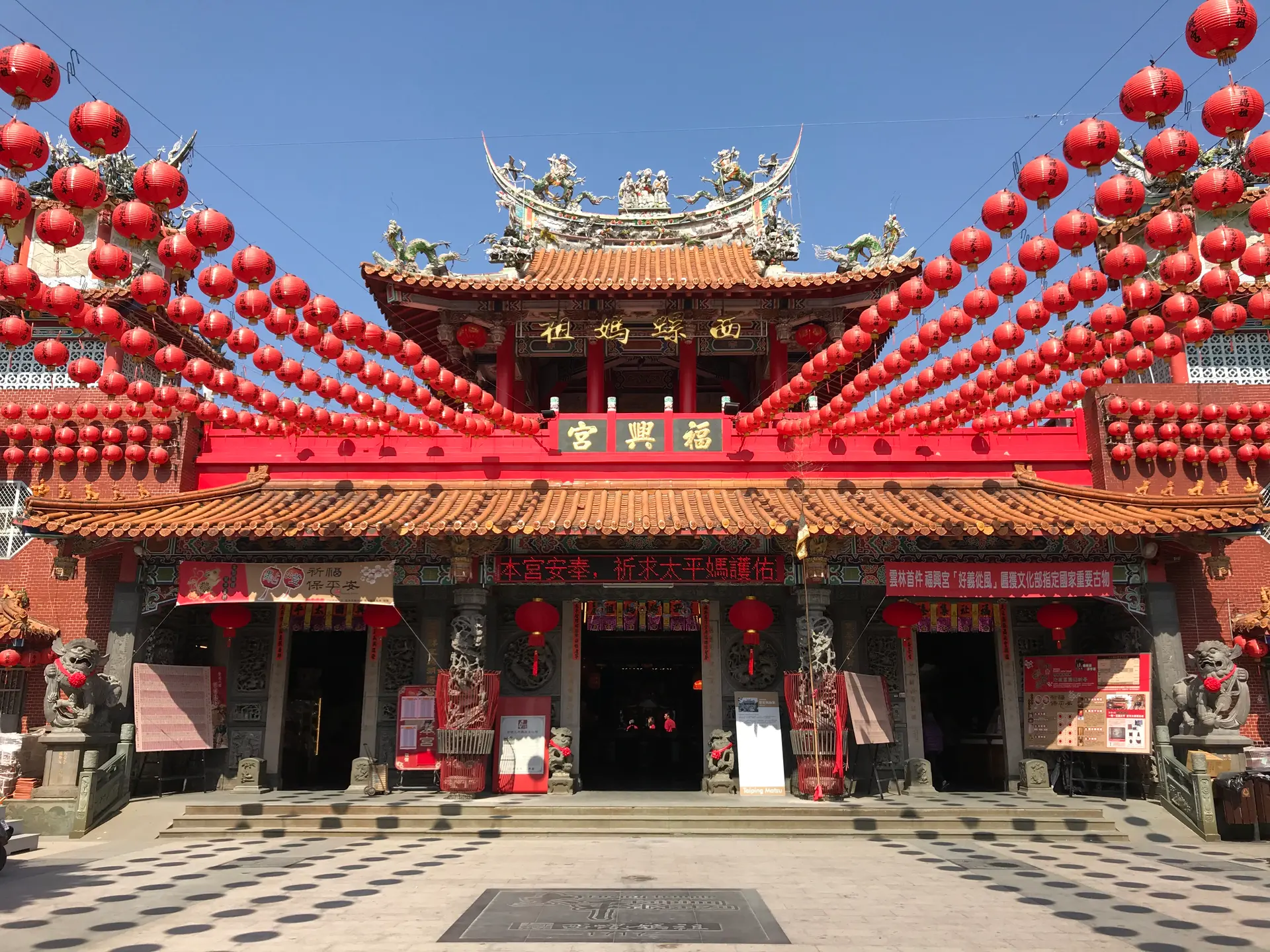
Xiluo Fuxing Temple
Xiluo, Yunlin County, Yunlin County, Taiwan
25.4 km away

Xingang Fengtian Temple
Xingang, Chiayi County, Chiayi County, Taiwan
27.9 km away
References
Sources consulted for this page. Source categories describe the publication, not a guarantee that every claim is verified. Traditional accounts and outside interpretations may differ.
- 01Mailiao Gongfan Temple — Taiwan Religious Culture Map (臺灣宗教百景) — Ministry of the Interior, TaiwanofficialOfficial government religious-heritage site. Confirms address, admission/hours, architectural competition between two artisan teams, and the 'one of six original Meizhou statues' claim.
- 02麥寮拱範宮-臺灣宗教文化地圖-臺灣宗教百景 — Ministry of the Interior, TaiwanofficialChinese-language counterpart of the official government heritage page.
- 03國定古蹟麥寮拱範宮 — 國家文化資產網 — Bureau of Cultural Heritage, Ministry of Culture, TaiwanofficialOfficial national monument registry entry; confirms July 18, 2012 designation date as national monument. Full page content could not be extracted (page loaded via JavaScript), designation date corroborated via search summary.
- 04National Historic Monument Panorama — Mailiao Gongfan Temple — Bureau of Cultural Heritage, Ministry of Culture, TaiwanofficialOfficial heritage bureau panorama/virtual-tour listing confirming national monument status.
- 05麥寮拱範宮 — 文化資源地理資訊系統 (Cultural Resources GIS) — Academia SinicaacademicAcademia Sinica temple database entry identified via search; full content could not be fetched (connection error) so used only as a corroborating existence/identity reference, not for specific factual claims.
- 06Gongfan Temple — Wikipedia — Wikipedia contributorsacademicEnglish-language overview of founding (1685), relocation (1742), Japanese-era reconstruction (1906-1908, 1930-1937), national monument designation (2012), and 2011-2018 restoration funded partly by Formosa Plastics Group.
- 07麥寮拱範宮 — 維基百科 — Wikipedia contributorsacademicChinese-language history with more granular renovation timeline (1800, 1832, 1906, 1930, 1956, 1977) and named patrons/artisans; source of the 'Golden-faced Fourth Mazu' 1919 detail that conflicts with the English 'Sixth Mazu' framing.
- 08Highways and Byways: Deities, mosquitoes and flying sand — Taipei TimesSource contextFeature article by a reputable English-language Taiwan newspaper describing the temple's setting, atmosphere, Qing-era Kangxi incense censer, and Western-suited wood-carving figures; gives 1738 (rather than 1742) as the flood/relocation year, a conflict noted above.
- 09麥寮拱範宮由來詳細介紹、起源故事與拜拜該準備什麼? — HaveFunDaySource contextTaiwanese travel/temple-guide blog; source of the 1881 Meizhou pilgrimage story in which the 'Kaishan Liuma' statue base reportedly matched one of six recessed altar positions at the Meizhou ancestral temple, and of statue dimension (about 33 cm).
- 10Gongfan Temple — Wikidata — Wikidata contributorsacademicStructured data entry corroborating identity, location, and heritage status; used as a supplementary cross-reference.
Share a photo
Help visitors recognize Mailiao Gongfan Temple. Every submission is reviewed before publication.