Our Lord of the Miracles of Buga
A crucifix of mud and grass, found in a river, that has drawn millions for over four centuries
Understand sacred places, explore living traditions, and learn how to engage respectfully with Pilgrim Map.
Access has not been verified. Check current local guidance before planning a visit.
Calle del Cauca, Valle del Cauca, Colombia
Read the sources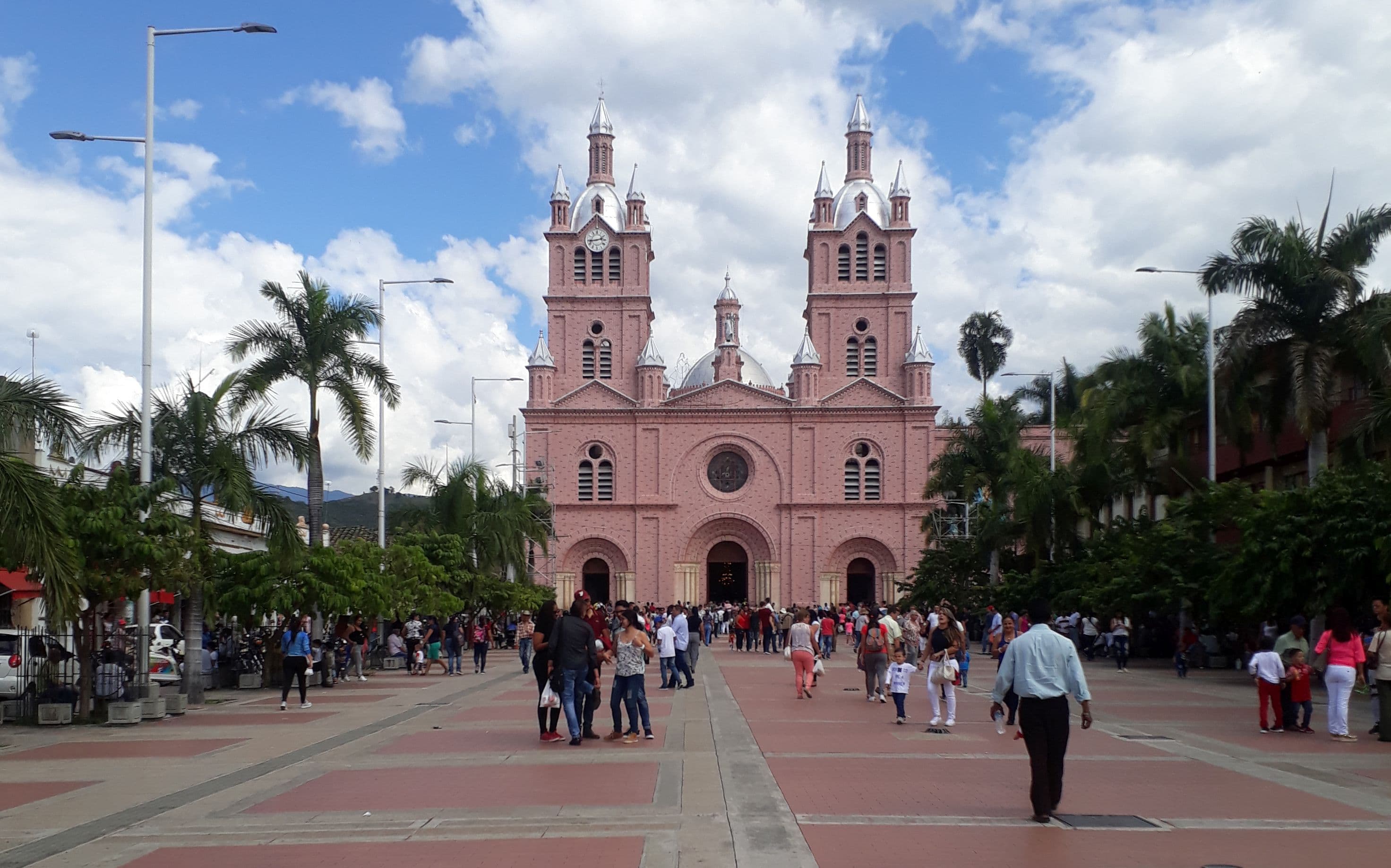
Image of Our Lord of the Miracles of Buga. Image source · CC0
Visit essentials
A quick read before you go
- Duration
- 1-2 hours for the basilica and ex-voto museum.
- Etiquette
- Standard Catholic basilica etiquette applies: modest dress, quiet behavior, and respect for the…
Overview
The crucifix is not carved from wood or cast from metal but formed from mud and dried grass, materials that should have dissolved in the river that yielded it and deteriorated in the centuries since. It has not. The figure of Christ on its fragile substrate has persisted through four hundred years of veneration, and the discrepancy between its composition and its durability is itself considered part of the miracle.
The Redemptorist Congregation took charge of the shrine in 1875 and oversaw the construction of the current basilica, completed in 1907. The neo-classical building serves as the vessel for a devotion that is older and more elemental than its architecture. What matters is not the building but what it holds: a figure that emerged from water, made of earth, that will not be destroyed.
Hundreds of miracles have been attributed to the Señor de los Milagros. The ex-voto museum adjacent to the basilica contains letters, photographs, crutches, and tokens left by those who believe they received divine intervention. Each object is a story condensed into a single thing: the crutch no longer needed, the letter of gratitude, the photograph of the healed child.
During the annual feast from September 5 to 14, hundreds of thousands converge on Buga. Many walk for days from distant cities, carrying their faith in the physical reality of their tired bodies. The procession that carries the crucifix through the streets transforms the town into a single expression of devotion, the distance between individual prayer and collective worship collapsed into the movement of feet.
Why this place is sacred
The atmosphere in the basilica operates through accumulation. Each visitor brings a need: healing, forgiveness, reconciliation, hope. These needs, concentrated in a single space around a single object, produce an intensity that operates independently of the visitor's own beliefs. The air is thick with candle smoke and petition.
The crucifix itself is the focal point, and its material composition is the key to its power. A wooden figure or a bronze casting would be impressive but comprehensible. A figure made of mud and grass, found in a river, that has not deteriorated in four centuries, resists comprehension. The mind cannot resolve the gap between what the object is and how it has survived, and this gap is where devotion lives.
The ex-voto museum extends the encounter beyond the basilica walls. Walking through a room filled with physical evidence of reported miracles, from medical braces to handwritten letters, the visitor confronts the accumulated testimony of thousands of individuals who believed something happened to them here that cannot be explained by ordinary means.
Whether one accepts these claims as miraculous or interprets them through other frameworks, the sheer volume of testimony is itself a kind of evidence: evidence of the human capacity for faith, evidence of the power of sacred places to concentrate hope.
The pilgrims who walk for days to reach Buga embody the devotion most literally. Their arrival at the basilica after days of walking is itself a form of prayer, the body's testimony to the seriousness of the petition. The distance they have covered is the measure of what they are asking.
The devotion began with the discovery of the crucifix in the Guadalajara River around 1573 and the recognition of its miraculous qualities. The original chapel was built to house and honor the crucifix as a site of divine presence.
From the original chapel, the devotion grew over four centuries into one of the most important pilgrimage traditions in Latin America. The Redemptorist Congregation's management since 1875 professionalized the shrine's operations. The current basilica was completed in 1907. The site's elevation to Minor Basilica status by the Vatican confirmed its significance within the Catholic Church.
Healing traditions
Miraculous-image and renewal tradition
Buga's basilica tells of an Indigenous woman who gave away the money she had saved for a crucifix to help a man facing imprisonment. A small crucifix then came to her through the river and, in the narrative, grew in size. The sanctuary connects this story with compassion and the transformation of life. Its healing pilgrimage encompasses requests for bodily relief, but the founding account itself is a story of generosity and a miraculous image, not a named medical recovery.
Ways to participate
Pray before the image or use the basilica's novena to give shape to your intention. The sanctuary's own interpretation invites solidarity with people in need, so a practical act of help can accompany the visit. Use official offering arrangements and allow space for others praying in the shrine.
These accounts describe religious traditions and reported experiences. They do not promise a cure or replace medical care.
Experience and orientation
The basilica's neo-classical facade opens onto a large plaza that serves as gathering space for the thousands who visit daily. The transition from street to sacred space is immediate upon entering the main doors.
Inside, the nave leads directly to the high altar where the crucifix occupies its golden shrine. The eye is drawn to it as the focal point of the entire architectural composition. The figure is small relative to the shrine that houses it, a quality that somehow increases rather than diminishes its presence. The gold of the shrine surrounds the humble materials of the crucifix, creating a visual paradox: the most precious setting for the most common materials.
Pilgrims approach the crucifix in various postures of devotion. Some walk on their knees from the entrance to the altar, a journey of perhaps fifty meters that takes considerable time and visible effort. Others stand in prayer, lips moving silently. Others weep. The diversity of devotional expression within a single space creates an atmosphere that is both intensely personal and inescapably communal.
The ex-voto museum is typically visited after the basilica itself. The collections, organized by category of miracle (healing, protection, provision), present the history of the devotion through the objects left by those who believe they were helped. Medical devices no longer needed, photographs of accidents survived, letters of gratitude written in careful hand. Each object represents a moment when someone believed the boundary between the human and the divine had been crossed.
The town of Buga wraps around the basilica with the infrastructure of pilgrimage: religious shops, restaurants, hostels for pilgrims, and the particular atmosphere of a place whose economy and identity are shaped by the presence of the sacred.
The basilica is in the center of Guadalajara de Buga, approximately 74 km north of Cali in the Valle del Cauca. The plaza in front of the basilica is the gathering point. The ex-voto museum is adjacent. Religious shops and services line the surrounding streets.
Context and lineage
Around 1573, an indigenous washerwoman found a small crucifix in the Guadalajara River near Buga. She took it home, but it repeatedly grew in size. Frightened, she returned it to the river, but it kept reappearing. The townspeople recognized a miraculous sign and built a chapel to house the crucifix. The figure, made of an unusual mixture of mud and dried grass, has never deteriorated despite its fragile materials, a fact devotees consider another aspect of its miraculous nature.
The devotion to the Señor de los Milagros of Buga belongs to the broader tradition of miracle-associated sacred images in Latin American Catholicism. Alongside the Sanctuary of Las Lajas in Nariño, Buga represents one of the two most important miracle shrines in Colombia.
The indigenous washerwoman
Discovered the crucifix in the Guadalajara River around 1573
Redemptorist Congregation
Has managed the shrine since 1875, building the current basilica and establishing the pilgrimage infrastructure
Traditions and practice
Pilgrims have approached the crucifix on their knees as an act of humility since the early centuries of the devotion. Candle lighting, prayer petitions, and walking pilgrimages from distant cities are established practices. The September 5-14 feast includes processions carrying the crucifix through Buga's streets.
Daily Mass with multiple celebrations, confessions heard throughout the day, Eucharistic adoration, and devotional prayer before the crucifix. The September feast is the annual culmination, with special liturgies, processions, and cultural events drawing hundreds of thousands. The Redemptorist community offers spiritual retreats and counseling.
If visiting outside the September feast, the basilica offers a more intimate encounter with the crucifix and the devotion. Attend Mass to experience the devotion in its liturgical context rather than as a spectacle. Visit the ex-voto museum after spending time in the basilica, so the objects are read against the experience of the space.
If you are not Catholic, the devotion can still be encountered as a witness to the human capacity for faith and the power of sacred objects to concentrate it.
Roman Catholicism — Miracle Devotion
ActiveThe Señor de los Milagros of Buga is one of the most venerated Catholic sacred images in Latin America, with over four centuries of continuous devotion and hundreds of attributed miracles. The Redemptorist Congregation has managed the shrine since 1875.
Daily Mass, confession, and Eucharistic adoration. Veneration of the crucifix. Annual September 5-14 feast with processions. Walking pilgrimages from distant cities. Ex-voto offerings. Spiritual retreats.
Perspectives and open questions
Buga invites interpretation as a site of active popular Catholic devotion, as a case study in the power of sacred objects, and as evidence of the human capacity to find the miraculous in the most ordinary materials.
Scholarly perspective
Historians document the Señor de los Milagros as one of the most enduring popular Catholic devotions in Latin America. The crucifix's unusual material composition has been studied but not fully explained. The devotion is understood within the context of colonial-era Catholicism's integration with indigenous and African spiritual traditions in the Valle del Cauca.
Living and traditional perspectives
For Catholic faithful, the Señor de los Milagros is a living presence that responds to prayer. The crucifix's mysterious origin and unusual materials are evidence of its divine nature. The centuries of reported miracles confirm Buga as a place where heaven and earth are close.
Alternative interpretations
The crucifix's emergence from water resonates with pre-Columbian traditions of water offerings. Its mud and grass composition connects the Christ figure to the earth itself, suggesting an unconscious syncretism between Catholic devotion and indigenous earth veneration.
Open questions
Who made the crucifix and how it came to be in the river has never been explained. Why it is made of mud and grass rather than conventional materials is unknown. How these fragile materials have survived more than four centuries without deterioration defies material explanation.
Plan your visit
Access and arrival
Buga offers a range of accommodations from pilgrim hostels to hotels. The town is well-equipped for visitors given its long history as a pilgrimage destination.
Respectful visit
Modest dress appropriate for a Catholic basilica. Shoulders and knees covered.
Generally permitted outside of Mass. Flash may be restricted near the crucifix. Be sensitive when photographing pilgrims in devotional practice.
Candle lighting is customary. Donations support the basilica and Redemptorist mission. Ex-voto offerings, tokens of gratitude for answered prayers, have a long tradition.
Quiet and reverent behavior in the basilica | No visiting during Mass unless attending worship | Modest dress required
During the September feast, Buga is extremely crowded and accommodations fill well in advance. The basilica can be physically crowded during peak times. Be respectful of pilgrims in deep devotional practice.
Current practical details
Address
Carrera 14 #3-62, Guadalajara de Buga, Valle del Cauca, Colombia
Phone
Hours
Hours, fees, and access can change — verify on the official source before you travel. Practical details last checked Jun 2026.
Location
Map loads as you approach this section.
Pilgrim reflections
A portrait of encounter, not a score
Pilgrims describe what they felt, how present they could become, and whether the place would shape a journey. There are no stars and no ranking of traditions.
No reviewed reflections yet
The first pilgrims can help describe the character of being here.
Share a reflection
Available after an account-backed “Been there.” Every reflection is reviewed before publication.
Nearby sacred places
Explore other sacred places in the region. Proximity does not establish access or travel time; check each place’s guidance.

References
Sources consulted for this page. Source categories describe the publication, not a guarantee that every claim is verified. Traditional accounts and outside interpretations may differ.
- 01History of the Christ of the Waters — Buga basilicaofficialSupports the attributed account or visitor practice in the healing section; not evidence of clinical efficacy.
- 02Novena to the Lord of Miracles — Buga basilicaofficialSupports the attributed account or visitor practice in the healing section; not evidence of clinical efficacy.
Share a photo
Help visitors recognize Our Lord of the Miracles of Buga. Every submission is reviewed before publication.