Our Lady of Le Puy
A colossal Virgin cast from captured cannons, watching over Le Puy's volcanic landscape
Le Puy-en-Velay, Haute-Loire, France
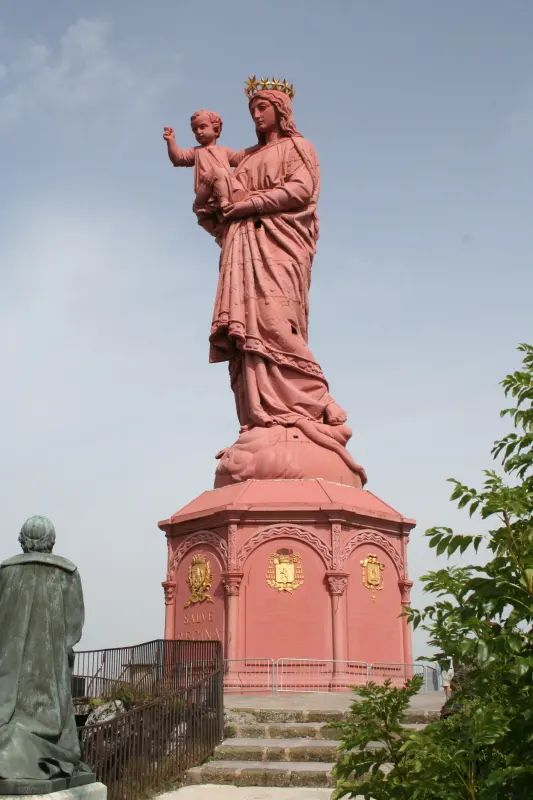
Image of Our Lady of Le Puy. Image source · CC-BY-SA-3.0
Visit essentials
Before you go
- Access
- Ascend Rocher Corneille from Le Puy-en-Velay center.
- Address
- 2 Bd Dr André Chantemesse, 43000 Le Puy-en-Velay, France
- Duration
- 45-60 minutes including climb and interior
- Etiquette
- Outdoor monument with interior access; respectful behavior appropriate.
Overview
Napoleon III's gift of captured Russian cannons could have become monuments to military triumph. Instead, they became the Virgin Mary. Sculptor Bonnassieux won the 1847 competition to create a worthy monument for Le Puy, and the result—835 tonnes of metal transformed into maternal protection—rises from Rocher Corneille like a second volcanic peak.
The statue's scale is deliberately overwhelming: feet measuring nearly two meters, forearm extending to 3.75 meters, total height of 22.7 meters. The Virgin crushes a serpent beneath her foot while the Child Jesus on her arm blesses the city without obscuring his mother's face—a specific requirement of the original competition. Stars crown her head.
Nearly 90,000 visitors annually make the climb to Rocher Corneille, ascending the volcanic spur to stand at the base of the statue. The brave continue inside, climbing 33 steps in the pedestal and 58 rotating stairs within the hollow statue to reach the crown. The panorama from there encompasses the entire volcanic basin—cathedral, Saint-Michel d'Aiguilhe, and the town where pilgrims have gathered for fifteen centuries.
Why this place is sacred
The thinness of this place is not ancient but intentional. When Le Puy sought to express its Marian devotion in monumental form, it chose not merely to build but to transform. The cannons that killed on Crimean battlefields now compose the body of mercy. This alchemy of violence into protection carries its own spiritual weight.
The setting amplifies the meaning. Volcanic rock, already sacred in Le Puy's landscape, elevates the Virgin above the ordinary world. From below, she appears to float between earth and heaven. From above—from her crown—visitors see the pattern of sacred sites that makes Le Puy unique: cathedral, chapel, statue, aligned across the volcanic basin.
Created as monumental expression of regional Marian devotion, using transformed war materiel as statement of peace.
From competition (1847) through inauguration (1860) to historical monument status (1997) and major restoration (2012). Continues as pilgrimage site drawing 90,000 visitors annually.
Experience and orientation
The approach to Notre-Dame de France begins with the climb up Rocher Corneille, the volcanic spur that places the statue above the town. The path winds upward through the rock formation, offering increasingly dramatic views of Le Puy's landscape. At the summit, the statue's scale becomes apparent—feet taller than a human, serpent crushed beneath metal that once killed.
The experience deepens for those who enter. Thirty-three steps in the pedestal, then 58 rotating iron stairs within the hollow statue itself, ascending through the body of transformed cannons to the crown. The climb is not demanding but is intimate—visitors pass through the Virgin's form to reach her height. From the crown, the panorama completes the pilgrimage: cathedral, Saint-Michel d'Aiguilhe, the town, and the volcanic basin spread below.
Approach as pilgrimage rather than sightseeing. The climb—both to the statue and inside it—is the practice.
Context and lineage
In 1847, Le Puy launched a competition to create a worthy monument to the Virgin. The requirements were specific: the Child Jesus must bless the city without hiding his mother's face. Bonnassieux won. When Napoleon III donated 213 Russian cannons captured in the Crimean War, the material met the vision. On September 12, 1860, 120,000 pilgrims witnessed the inauguration.
Part of 19th-century wave of monumental Marian statues across France. Joins Le Puy's ensemble of volcanic sacred sites.
J. Bonnassieux
Sculptor who won the 1847 competition
Napoleon III
Donated 213 captured cannons
Traditions and practice
Pilgrimage, prayer at base
Climbing to summit and entering statue interior, prayer, contemplation of panoramic views, photography
Make the full ascent: Rocher Corneille, then inside the statue to the crown. Let the climb be prayer. At the top, survey the sacred landscape of Le Puy.
Roman Catholicism / Marian Devotion
ActiveMonumental expression of Marian devotion cast from transformed weapons. Continues Le Puy's 15 centuries of pilgrimage.
Pilgrimage, interior ascent, prayer, contemplation
Perspectives and open questions
Notre-Dame de France can be approached as artistic achievement, transformation of war into peace, or continuation of Le Puy's volcanic sacred landscape.
Scholarly perspective
Recognized as significant 19th-century religious monument. The transformation of war materiel into sacred image reflects post-Crimean War sentiment.
Living and traditional perspectives
For Catholic tradition, the statue represents Mary's maternal protection over Le Puy and France—cannons that killed now compose her protective form.
Alternative interpretations
Some note the alignment with Le Puy's other volcanic sacred sites as evidence of intentional sacred geography.
Open questions
None documented
Plan your visit
Access and arrival
Ascend Rocher Corneille from Le Puy-en-Velay center. Interior: 33 steps in pedestal, 58 in statue. Small entrance fee.
Le Puy-en-Velay offers full range of accommodation
Respectful visit
Casual outdoor clothing; comfortable shoes for climbing
Permitted
None traditional
None
Interior stairs are narrow; not suitable for claustrophobic visitors.
Current practical details
Address
2 Bd Dr André Chantemesse, 43000 Le Puy-en-Velay, France
Hours
Hours, fees, and access can change — verify on the official source before you travel. Practical details last checked Jun 2026.
Location
Map loads as you approach this section.
Pilgrim reflections
A portrait of encounter, not a score
Pilgrims describe what they felt, how present they could become, and whether the place would shape a journey. There are no stars and no ranking of traditions.
No reviewed reflections yet
The first pilgrims can help describe the character of being here.
Share a reflection
Available after an account-backed “Been there.” Every reflection is reviewed before publication.
Nearby sacred places
Explore other sacred places in the region. Proximity does not establish access or travel time; check each place’s guidance.


References
Sources consulted for this page. Source categories describe the publication, not a guarantee that every claim is verified. Traditional accounts and outside interpretations may differ.
- 01The Notre-Dame de France statue — Le Puy-en-Velay TourismSource contextOfficial tourism site
- 02Statue of Our Lady of France — My Haute-LoireSource contextRegional tourism
Share a photo
Help visitors recognize Our Lady of Le Puy. Every submission is reviewed before publication.