Chapel of Saint-Michel d’Aiguilhe
A Romanesque chapel crowning an 85-metre volcanic needle at the threshold of the Le Puy road to Santiago
Understand sacred places, explore living traditions, and learn how to engage respectfully with Pilgrim Map.
Access has not been verified. Check current local guidance before planning a visit.
Haute-Loire, France
Read the sources
Visit essentials
A quick read before you go
- Duration
- 30-60 minutes including the climb.
- Access
- In Aiguilhe at the edge of Le Puy-en-Velay; reached on foot via 268 rock-cut steps from the base…
Overview
Saint-Michel d'Aiguilhe perches on the narrow summit of an almost vertical, eighty-five-metre volcanic plug above the Le Puy valley, reached by 268 rock-cut steps. Sacred from a prehistoric dolmen through the Roman cult of Mercury, god of travellers and thresholds, to Bishop Godescalc's tenth-century sanctuary, the rock physically layers traditions; three dolmen stones are said to be built into the chapel.
From Le Puy, start of the 764-kilometre Via Podiensis now walked as the GR65, this is the first sacred station. Its intimate interior, twelfth-century polychrome facade with Islamic-influenced mosaics, panorama over the cathedral and town, and 1955 reliquary hoard concentrate more than a millennium of devotion. For departing pilgrims, the ascent becomes a rite of leaving ordinary life below.
Why this place is sacred
The thinness of Aiguilhe is vertical and literal. The rock lifts the chapel out of the everyday valley and sets it against the sky, and the climb of 268 steps makes the visitor's body enact the rising. What gives the place its particular charge is continuity: the same outcrop served a megalithic dolmen, a Roman cult of Mercury, and finally a Christian chapel, each tradition recognising the same height as a meeting point between the human and the more-than-human.
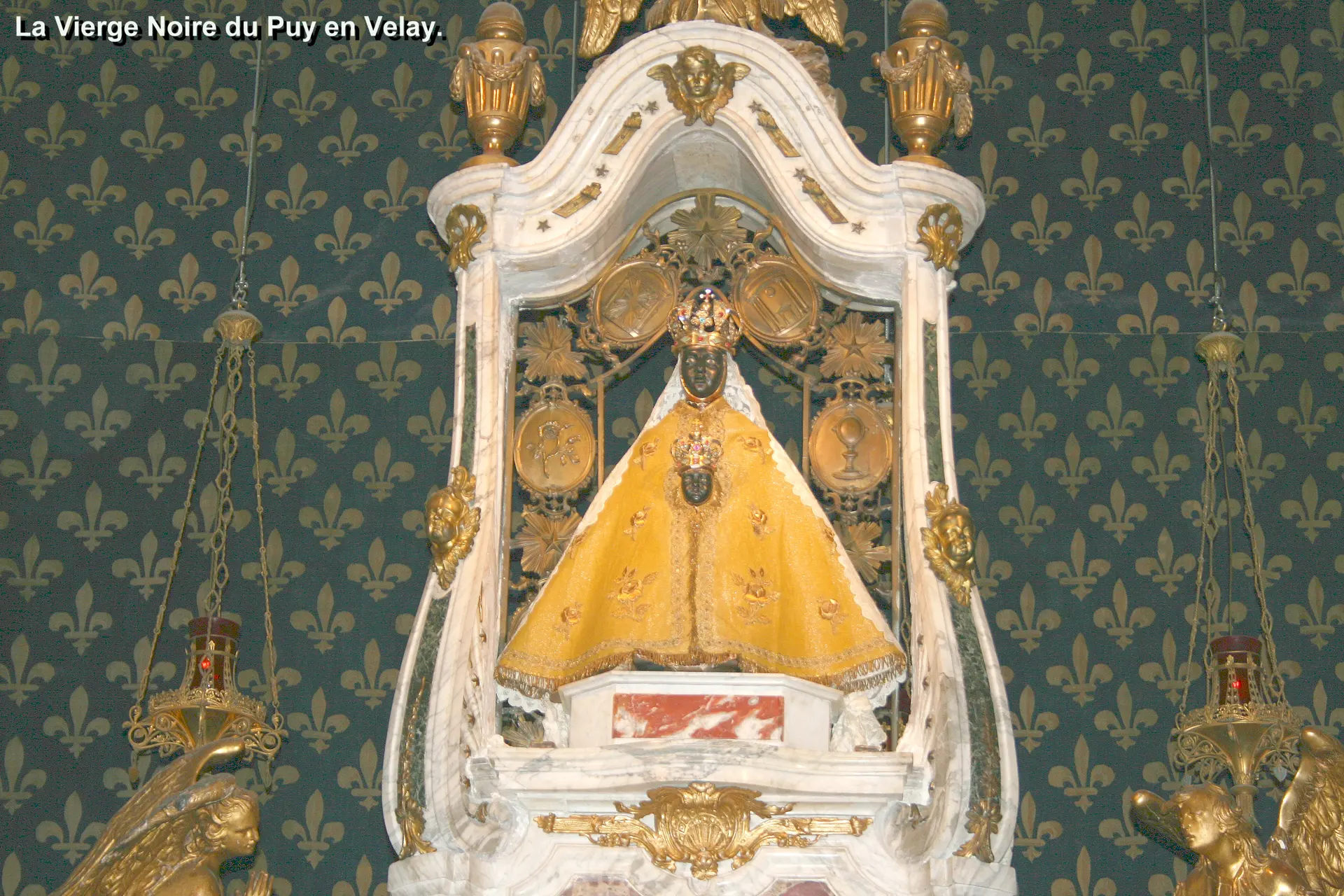
Standing at the summit, with Le Puy spread below and the cathedral's Black Madonna across the valley, pilgrims describe a sense of standing at a beginning rather than an arrival.
A votive chapel to Saint Michael, founded by Bishop Godescalc in thanksgiving for his pilgrimage to Santiago, on a rock already sacred to earlier cults.
From prehistoric dolmen to Roman shrine of Mercury to tenth-century Christian oratory and chapel, expanded in the eleventh and twelfth centuries to receive growing numbers of pilgrims, and now the symbolic first landmark of the Via Podiensis.
Experience and orientation
The visit begins at the base of the plug, where the 268 steps wind up the rock. The climb is steady rather than treacherous, but it asks something of the body, and most visitors arrive at the top a little breathless and quieted. The chapel itself is small, its irregular plan shaped by the summit it occupies, with faded frescoes and the warm tones of Romanesque stone.
The carved and mosaic facade, its patterning influenced by Islamic and Andalusian design carried north along the pilgrim roads, repays slow looking. From the threshold the whole of Le Puy opens out, the cathedral and the great statue of Notre-Dame de France on the neighbouring Rocher Corneille both in view. Pilgrims often come here before setting out on the GR65, treating the ascent as the first act of their walk.
The chapel sits in Aiguilhe at the edge of Le Puy-en-Velay, reached only on foot via the 268 rock-cut steps. The morning pilgrim Mass and blessing take place not here but at the nearby Notre-Dame cathedral. Allow time both for the climb and for a quiet pause at the summit before descending.
Context and lineage
Bishop Godescalc of Le Puy-en-Velay walked to Santiago de Compostela around 951, among the earliest documented pilgrims to the shrine of Saint James. In thanksgiving he founded a sanctuary on the volcanic needle of Aiguilhe, dedicating it to the Archangel Michael, patron of high and mountaintop places. An oratory was consecrated around 961-962 and the chapel completed by 969; sources vary on the precise dates between 961, 962 and 969.
The rock, however, had been sacred far earlier, crowned by a prehistoric dolmen and dedicated by the Romans to Mercury, with three dolmen stones said to be incorporated into the chapel.
A Romanesque sanctuary of the Auvergne, classified as a French monument historique and standing within Le Puy-en-Velay, the UNESCO-recognised departure point of the Routes of Santiago de Compostela in France (inscribed 1998).
Bishop Godescalc of Le Puy-en-Velay
Founder
Truannus
Dean of the cathedral chapter
The Archangel Michael
Patron and dedicatee
Traditions and practice
Catholic worship dedicated to Saint Michael, including occasional Mass within the small sanctuary, and veneration of the medieval reliquary hoard discovered in 1955. The chapel is associated with the pilgrim departure traditions of Le Puy.
Guided and self-guided visits, prayer, and contemplation of the Romanesque facade and frescoes. Pilgrims often climb the rock before setting out on the GR65; the formal morning pilgrim Mass and blessing take place at the nearby cathedral.
Climb without hurry, letting the 268 steps slow your breath. At the summit, before turning to the views, pause in the small interior. If you are about to walk the Via Podiensis, you might mark here the intention you carry onto the road.
Roman Catholicism
ActiveDedicated to the Archangel Michael, patron of high places, and founded by Bishop Godescalc as thanksgiving after one of the earliest recorded pilgrimages to Santiago, tying the chapel intimately to the cult of Saint James.
Visits, prayer and occasional Mass within the small Romanesque sanctuary; veneration of the medieval reliquary hoard found in 1955.
Camino de Santiago pilgrimage (Via Podiensis)
ActiveAs the volcanic spire crowning the departure point of the GR65, the chapel is the first sacred station pilgrims encounter, embodying the route's founding story of Bishop Godescalc's journey to Compostela.
Pilgrims climb the 268 steps to begin their journey; the nearby cathedral offers a 7am pilgrim Mass and blessing as the traditional send-off.
Pre-Christian megalithic and Gallo-Roman cult
HistoricalThe needle was sacred long before Christianity: a prehistoric dolmen stood on its summit and the Romans dedicated the site to Mercury; three dolmen stones are said to be built into the chapel.
No longer practised; survives as archaeological and folk memory.
Perspectives and open questions
Saint-Michel d'Aiguilhe is read at once as a Romanesque masterwork, a Catholic chapel, a pilgrimage threshold, and a rock sacred long before Christianity.
Scholarly perspective
A major surviving example of pre-Romanesque and Romanesque Auvergnat architecture, archaeologically significant for the 1955 reliquary discovery and for its documented foundation by Bishop Godescalc, tied to the earliest Santiago pilgrimages.
Living and traditional perspectives
In Catholic tradition the chapel honours Saint Michael, guardian of high places and protector of travellers, an apt patron for a pilgrimage threshold.
Alternative interpretations
The chapel is often cited within a chain of Saint Michael sanctuaries on prominent rocks and peaks across Europe, and some link it to ley-line and 'sword of Saint Michael' lore. These associations are not supported by scholarship and are best held lightly.
Open questions
The full prehistoric use of the dolmen and the exact transition from the Roman cult of Mercury to the Christian dedication remain incompletely documented.
Plan your visit
Access and arrival
In Aiguilhe at the edge of Le Puy-en-Velay; reached on foot via 268 rock-cut steps from the base of the volcanic plug. An admission ticket is required. Exact fees and seasonal hours vary year to year; check the Le Puy-en-Velay tourism office for current details.
Le Puy-en-Velay, as the start of the Via Podiensis, offers extensive pilgrim lodging, gîtes and hotels within easy reach of the chapel.
Respectful visit
Modest dress appropriate to an active chapel; sturdy footwear for the climb.
Permitted; avoid flash near the frescoes.
No required offerings; the admission ticket supports upkeep.
Reached only via 268 rock-cut steps; not accessible to those with limited mobility. Quiet respect expected inside.
Access is only by the steps; the chapel is not reachable by those with limited mobility. Keep quiet respect inside the active sanctuary.
Current practical details
Address
Rue du Rocher, 43000 Aiguilhe, France
Phone
Hours
Hours, fees, and access can change — verify on the official source before you travel. Practical details last checked Jun 2026.
Location
Map loads as you approach this section.
Pilgrim reflections
A portrait of encounter, not a score
Pilgrims describe what they felt, how present they could become, and whether the place would shape a journey. There are no stars and no ranking of traditions.
No reviewed reflections yet
The first pilgrims can help describe the character of being here.
Share a reflection
Available after an account-backed “Been there.” Every reflection is reviewed before publication.
Nearby sacred places
Explore other sacred places in the region. Proximity does not establish access or travel time; check each place’s guidance.


References
Sources consulted for this page. Source categories describe the publication, not a guarantee that every claim is verified. Traditional accounts and outside interpretations may differ.
- 01Saint Michel d'Aiguilhe — Wikipedia — Wikipedia contributorsacademicConfirms 969 construction by Bishop Godescalc after his pilgrimage to Santiago in 951, Romanesque style, prehistoric dolmen to Mercury, 1955 reliquary discovery, coordinates ~45.05N 3.8825E.
- 02Rock and Chapel of Saint-Michel d'Aiguilhe — Le Puy-en-Velay Tourism — Le Puy-en-Velay Tourism OfficeofficialOfficial tourism: 85m volcanic plug, 268 steps, two-stage construction (961 oratory, late 11th-c chapel for pilgrim influx), 12th-c polychrome facade with Islamic-influenced mosaics.
- 03Rock and chapel of Saint-Michel-d'Aiguilhe in Puy-en-Velay — My Haute-Loire — Haute-Loire TourismofficialConfirms sacred continuity: prehistoric dolmen, Roman dedication to Mercury, then Christian chapel to St Michael.
- 04Via Podiensis Route Overview — American Pilgrims on the Camino — American Pilgrims on the CaminoSource contextConfirms Le Puy-en-Velay as start of the 764 km Via Podiensis (GR65), Godescalc's 951 pilgrimage as foundational, route revived in the 1970s.
- 05St. Michel d'Aiguilhe — Le Puy, France — Sacred DestinationsSource contextTravel reference on architecture, dedication to Archangel Michael as patron of high places, pilgrimage context.
- 06Le Puy-en-Velay | The Via Podiensis | Wise Pilgrim — Wise PilgrimSource contextPilgrim resource: Le Puy as starting town, 7am pilgrim mass and blessing at the cathedral, Saint-Michel chapel and Black Madonna as the spiritual anchors of the departure.
- 07Le Chemin du Puy | Camino Route from France to Santiago — CaminoWays — CaminoWaysSource contextLe Puy as UNESCO-listed starting point; Saint-Michel d'Aiguilhe and Notre-Dame cathedral as the route's opening landmarks.
Share a photo
Help visitors recognize Chapel of Saint-Michel d’Aiguilhe. Every submission is reviewed before publication.