The Black Madonna of Le Puy
InsideCathédrale Notre-Dame-du-Puy
A Black Virgin destroyed by Revolution and reborn, carrying centuries of devotion
Understand sacred places, explore living traditions, and learn how to engage respectfully with Pilgrim Map.
Access has not been verified. Check current local guidance before planning a visit.
Le Puy-en-Velay, Haute-Loire, France
Read the sources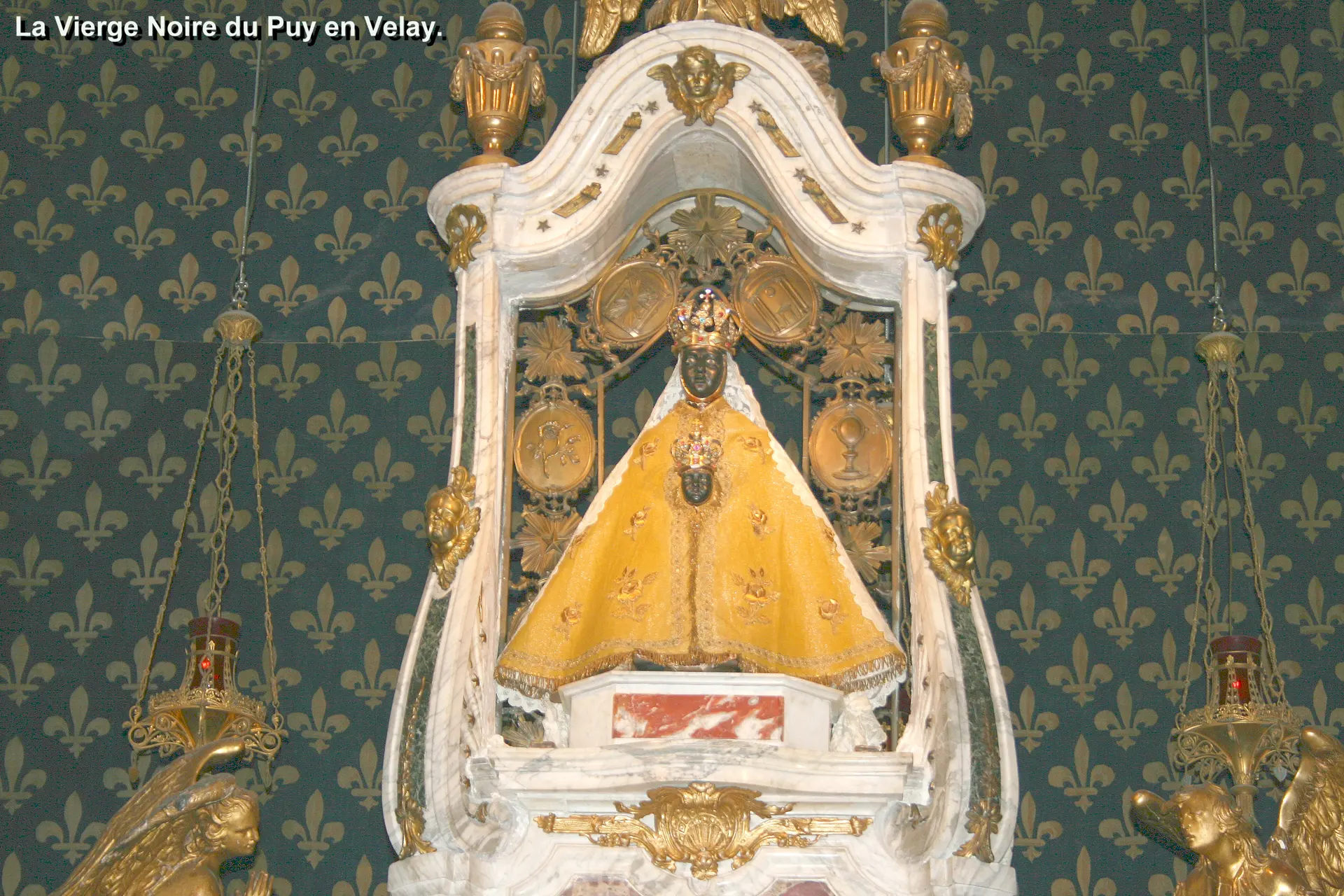
Visit essentials
A quick read before you go
- Duration
- Part of 1-2 hour cathedral visit
- Access
- Within cathedral at main altar
Overview
For five centuries pilgrims approached Le Puy's ebony Virgin clothed in gold, a gift from Louis IX on his return from Crusade. In 1794 revolutionaries tried the statue like a human, condemned her like a queen, guillotined and burned her. A hidden drawer opened in the flames, and a parchment's secret was lost with it. Eight years later the current walnut statue renewed the devotion. Each August 15, ten thousand faithful fill Le Puy's streets for the Assumption procession.
Among the most venerated of Europe's 400-500 documented Black Madonnas—180 in France—she draws Catholic devotion alongside debated readings of darkness as pre-Christian tradition, age-darkened wood, or Mary's earthier aspect.
Why this place is sacred
What makes a place thin sometimes includes what has been lost. The original Black Madonna of Le Puy is gone—guillotined, burned, her secrets consumed. But the devotion she gathered over five centuries could not be destroyed. Eight years after her burning, a new statue took her place, and the pilgrims returned.
This pattern of destruction and renewal deepens rather than diminishes the site's power. The current statue carries the weight of its predecessor's martyrdom. To kneel before her is to kneel before something that has survived the worst that iconoclasm could do. The Revolution could burn wood and melt gold; it could not burn faith.
Marian devotion at dolmen site since 5th century. Black Madonna tradition since at least 13th century.
From 'Our Lady of the Rock' near dolmen (5th century) through Louis IX's ebony gift (1254) through Revolutionary destruction (1794) to current walnut statue (1802). Devotion continuous despite statue's replacement.
Experience and orientation
The Black Madonna of Le Puy sits in the cathedral where pilgrims have sought her for centuries. She is not tall—about 25 inches—but she holds presence. The walnut figure shows Mary seated on a throne, Child on her left knee, right hand raised in blessing. Rich vestments and jewelry adorn her, offerings accumulated since her creation in 1802.
To approach is to join a very long line. Kings came here—thirteen of them, including Charlemagne and Saint Louis. Crusaders came to bid farewell before departing for the Holy Land. Pilgrims en route to Santiago stopped to receive blessing. And still they come, lighting candles, whispering prayers, seeking the particular intercession that Black Madonnas are said to offer.
The Assumption procession each August 15 brings ten thousand into the streets, carrying the devotion that survived Revolution into another year.
Approach as pilgrims have for centuries—with whatever need you carry, trusting it to her dark maternal presence.
Context and lineage
The first Black Madonna at Le Puy may have been 'Our Lady of the Rock,' placed near the dolmen in the 5th century. In 1254, Louis IX gave an ebony statue from the Holy Land. This was destroyed in 1794; the current statue dates to 1802.
Part of the 180+ Black Madonnas in France, the highest concentration in Europe. Connected to broader European Black Madonna phenomenon (400-500 documented).
Louis IX (Saint Louis)
Gave ebony Black Virgin in 1254
Revolutionary authorities
Tried and destroyed original statue in 1794
Traditions and practice
Veneration, prayer, candle lighting, procession
Prayer before statue, candle lighting, annual Assumption procession (August 15, 10,000+ participants)
Come with whatever weighs on you. Light a candle. Offer it to her dark presence. If possible, participate in the Assumption procession to experience the living tradition.
Black Madonna Veneration
ActiveOne of France's most venerated Black Madonnas, demonstrating devotion that survived Revolutionary destruction. Part of Europe's 400-500 documented Black Madonnas, with France holding 180.
Veneration, prayer, candle lighting, Assumption procession
Perspectives and open questions
The Black Madonna can be approached through Catholic devotion, folk tradition, or the mystery of dark-skinned Virgins that spans pre-Christian history.
Scholarly perspective
Black Madonna phenomenon widespread in Europe; origins debated (age-darkened wood, pre-Christian traditions, Byzantine influence). Le Puy's destruction/replacement provides documented case of devotion continuity.
Living and traditional perspectives
For Catholic tradition, Black Madonnas carry the same maternal grace as other Marian images. Their popularity reflects devotion rather than doctrinal distinction.
Alternative interpretations
Some connect Black Madonnas to pre-Christian goddess traditions, earth wisdom, and fertility cults. Their darkness is seen as representing Mary's earthier, more ancient aspect.
Open questions
Original appearance of destroyed statue. Content of parchment burned with it. Origins of 5th century 'Our Lady of the Rock.'
Plan your visit
Access and arrival
Within cathedral at main altar
Le Puy-en-Velay offers full range
Respectful visit
Modest church attire
Permitted with respect
Candles available
Quiet near statue
Located within active cathedral; standard church comportment required.
Current practical details
Address
2 Rue de la Manecanterie, 43000 Le Puy-en-Velay, France
Phone
Hours
Hours, fees, and access can change — verify on the official source before you travel. Practical details last checked Jun 2026.
Location
Map loads as you approach this section.
Pilgrim reflections
A portrait of encounter, not a score
Pilgrims describe what they felt, how present they could become, and whether the place would shape a journey. There are no stars and no ranking of traditions.
No reviewed reflections yet
The first pilgrims can help describe the character of being here.
Share a reflection
Available after an account-backed “Been there.” Every reflection is reviewed before publication.
Nearby sacred places
Explore other sacred places in the region. Proximity does not establish access or travel time; check each place’s guidance.


References
Sources consulted for this page. Source categories describe the publication, not a guarantee that every claim is verified. Traditional accounts and outside interpretations may differ.
- 01Black Madonna - Wikipedia — WikipediaencyclopediaGeneral reference
- 02Le Puy - World Pilgrimage Guide — Sacred SitesSource contextDetailed pilgrimage info
- 03Black Madonna Le Puy — Interfaith Mary PageSource contextBlack Madonna specialist site
Share a photo
Help visitors recognize The Black Madonna of Le Puy. Every submission is reviewed before publication.