Our Lady of Altötting
InsideChapel of Grace (Gnadenkapelle), Altötting
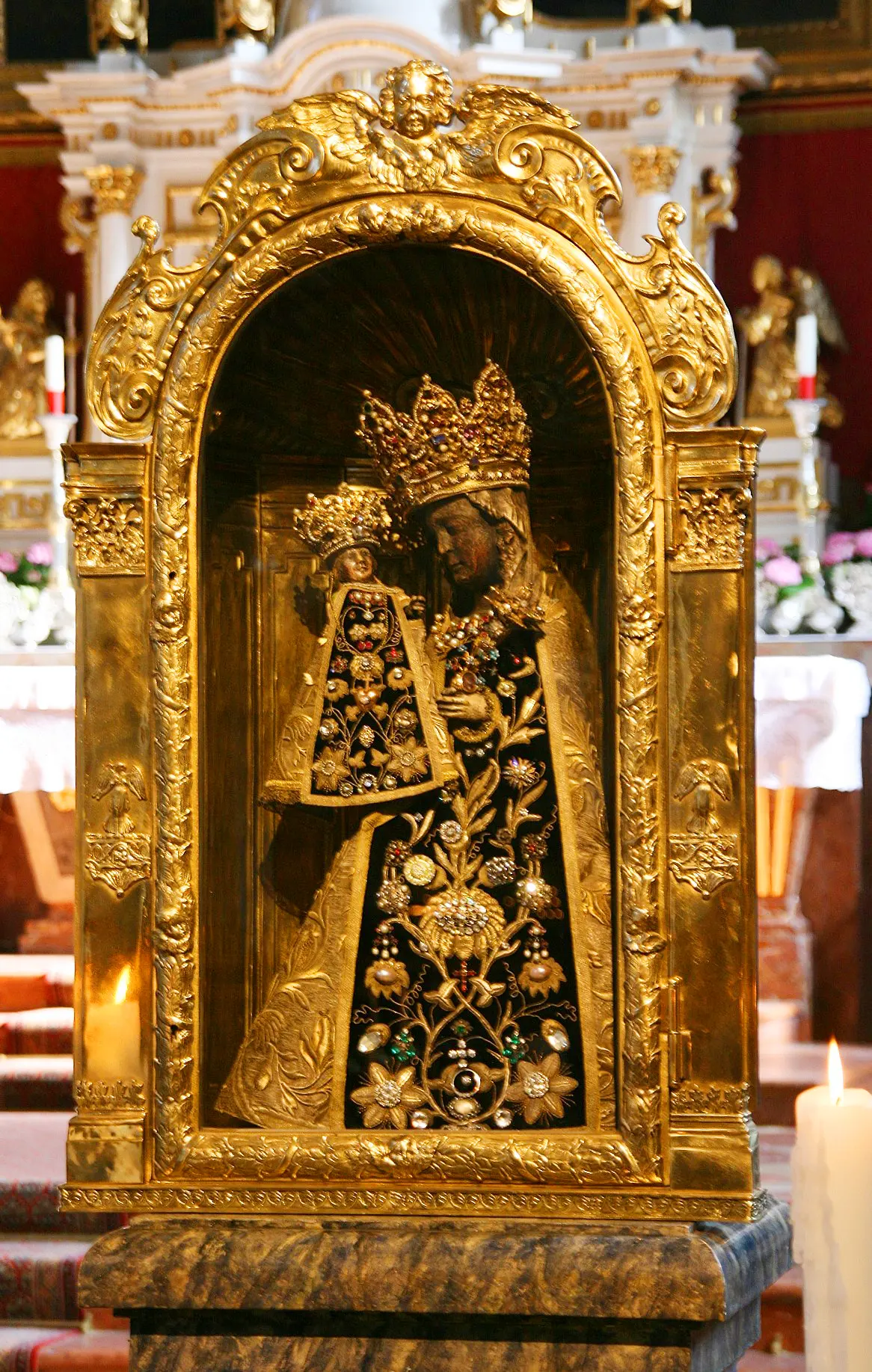
The Black Madonna of Bavaria, in the octagonal chapel pilgrims call the Heart of Bavaria
Understand sacred places, explore living traditions, and learn how to engage respectfully with Pilgrim Map.
Access has not been verified. Check current local guidance before planning a visit.
Altötting, Bavaria, Germany
Visit essentials
A quick read before you go
- Duration
- Two to three hours for the Gnadenkapelle, Stiftskirche, basilica of St.
- Access
- Altötting is in Upper Bavaria, roughly 90 km east of Munich and 100 km west of Salzburg.
Overview
Altötting is Catholic Bavaria's Marian heart. This Upper Bavarian town's central Kapellplatz surrounds the octagonal Gnadenkapelle, or Chapel of Grace, whose eighth- or ninth-century Carolingian core is among Germany's oldest surviving church structures. Inside, silver and hundreds of candles frame an approximately sixty-six-centimetre lindenwood Virgin and Child carved by an unknown South German master between roughly 1300 and 1350.
Its dark surface—whether from original polychromy, oxidising medium and varnish, or more than six centuries of candle smoke—is debated; typologically, it belongs to Europe's Black Madonnas.
The shrine's rise began on 22 May 1489. Chronicles compiled in subsequent decades say a mother brought her three-year-old son, drowned in the Mörnbach, before the statue and he revived. Within weeks came a second well-documented restoration, of a youth crushed by a wagon. Pilgrims surged, and the modest chapel became a major shrine within a year.
Altötting now draws about a million pilgrims annually. Basilicas and Capuchin houses ring the wider Kapellplatz, while silver urns in the chapel walls hold the hearts of Bavarian dukes, electors, and kings—including Ludwig II's, placed here in 1886.
Why this place is sacred
What gives Altötting its concentrated thinness is the smallness and the layering. The Gnadenkapelle's octagonal core is a Carolingian baptismal chapel — its plan is one of the oldest in Germany — and pilgrims have prayed inside it without interruption for more than a millennium. The statue itself, dark and modest, stands at child-height behind a railing of silver, framed by candles whose smoke continues the patina that helped darken her surface.
The arcade encircling the chapel is hung floor to ceiling with painted ex-votos, some dating back to the early sixteenth century — a visible biography of answered prayers, scene by scene, family by family. Set into the inner walls of the chapel are silver urns holding the hearts of Bavarian dukes, electors, and kings, beginning in 1597 and continuing through the Wittelsbach line; the entire dynasty entrusted itself, literally, to Mary's care.
The 1489 child miracle anchors the shrine's identity as a place of consolation for grieving parents, and panel after panel in the arcade carries scenes of children restored, illnesses healed, and accidents survived. Visitors describe a hush on entering even when the Kapellplatz outside is full; for Bavarians the chapel is often a place of homecoming, returned to across decades of personal history.
The octagonal core of the chapel was built as a Carolingian baptistery in the eighth or ninth century, attributed by tradition to Duke Tassilo III of Bavaria. The plan and dimensions are consistent with early-medieval baptismal architecture. Marian veneration centred on the statue developed in the fourteenth century and crystallised after 1489.
The 1489 miracle transformed a baptismal chapel of mainly local importance into a major Marian shrine within a year. Successive Bavarian rulers, beginning seriously in the late sixteenth century, deposited their hearts in the chapel; the arcade and surrounding ensemble of basilicas and Capuchin houses grew up over the next three centuries. Pope Benedict XVI, a Bavarian who carried childhood devotion to Altötting through his entire life, returned in 2006 to celebrate Mass at the Kapellplatz.
Experience and orientation
Most pilgrims approach the Gnadenkapelle by walking the arcade clockwise, reading the painted ex-votos as they go. The earliest panels date from the sixteenth century and the most recent from the past few years; the subjects range from medieval drownings restored to twentieth-century car crashes survived. Walking the full circuit is a meditative discipline in itself, often done while praying the rosary.
The chapel entrance is small; visitors typically queue, and inside the octagonal room the air is hot from candles, the light is low, and the statue stands behind a silver railing in a niche bright with flame. The Bavarian heart-urns line the walls — Ludwig II's silver urn placed here in 1886 is the most recognisable — and the floor is worn from centuries of pilgrim feet. The wider Kapellplatz holds the Stiftskirche, the basilica of St.
Anna, the Capuchin friary with the relics of Brother Konrad of Parzham, and the Jerusalem-Panorama housing a circular 1903 painting of the Crucifixion; a full day of liturgy, treasury, and walking pilgrimage is possible from the central square. Saturday evenings from May to October bring the candlelight procession (Lichterprozession) around the Kapellplatz, one of the most atmospheric devotional gatherings in Bavaria.
Allow at least two to three hours for the Gnadenkapelle, Stiftskirche, basilica of St. Anna, and Capuchin friary; a full day allows participation in liturgy, a visit to the Jerusalem-Panorama, and the treasury (Schatzkammer) with the famous Goldenes Rössl. Saturday evenings May–October are best for the Lichterprozession; 15 August (Assumption) and the following Sunday's Große Wallfahrt bring the largest crowds of the year.
Context and lineage
Chronicles compiled within a generation of the events relate that on 22 May 1489 a three-year-old boy fell into the Mörnbach and drowned. His mother, refusing to give up, carried his body into the Chapel of Grace, laid it on the altar before the statue, and prayed. The boy revived. Eyewitness testimony was collected by the parish priest and submitted to the Bishop of Passau, who approved public veneration.
Within weeks a second event was recorded — a young man crushed beneath a heavily laden wagon was restored after prayer in the chapel — and pilgrim traffic to Altötting surged. By the end of 1489 the modest local chapel had become a major Marian shrine, and the title 'Lourdes of Germany' would later be coined to describe its place in Catholic devotion centuries before Lourdes itself.
The Marian devotion at Altötting belongs to the Latin Church and is administered by the Diocese of Passau through the Stiftspfarrei St. Philippus und Jakobus and the shrine's Wallfahrtsleitung. The wider Kapellplatz includes the Capuchin friary of St. Anna and, alongside the Wittelsbach heart-urn tradition, has been continuously connected to Bavarian dynastic devotion since the late sixteenth century.
Duke Tassilo III of Bavaria
Bavarian duke (r. 748–788) traditionally credited with founding the original octagonal chapel as a baptistery. Architectural evidence supports an eighth- or ninth-century date for the Carolingian core.
The 1489 miracle child
Unnamed three-year-old whose drowning and recorded restoration before the statue triggered the rise of the shrine. Eyewitness depositions were collected and submitted to the Bishop of Passau, who approved public veneration.
Brother Konrad of Parzham
Capuchin lay brother who served as the porter of St. Anna's friary for more than forty years, dispensing kindness to pilgrims at the door. Canonised 1934; his relics are kept in St. Konrad-Kirche across the Kapellplatz.
Pope Benedict XVI (Joseph Ratzinger)
Bavarian-born pope who carried childhood devotion to Altötting through his entire life and returned to the shrine on 11 September 2006 during his apostolic journey to Bavaria. His memoir Milestones describes Altötting as a touchstone of his spiritual formation.
Traditions and practice
The core devotional act is the rosary walked slowly around the kreuzgang arcade, often timed so the visit ends with a candle placed before the statue inside the chapel. Pilgrims commission painted ex-votos through the parish office — a tradition continuous since the early sixteenth century — to give visible witness to answered prayers.
The Männer-Fußwallfahrt, the men's walking pilgrimages, set out each year from Regensburg, Munich, and other Bavarian towns; some groups carry wooden crosses the full distance as a penitential discipline. Veneration of relics of Brother Konrad of Parzham, the Capuchin porter canonised in 1934, takes place at St. Konrad-Kirche across the square.
Multiple Masses are celebrated daily in German and other languages; the shrine maintains a continuous liturgical and pastoral programme through the year. Eucharistic adoration is held in the Stiftskirche; the candlelight procession (Lichterprozession) circles the Kapellplatz on Saturday evenings May through October.
Marian feasts — Annunciation (25 March), Visitation (2 July), Assumption (15 August), Nativity of Mary (8 September), and Immaculate Conception (8 December) — anchor the liturgical year, and the Bavarian bishops' pilgrimage on the Sunday after Assumption is the single largest gathering.
Walk the kreuzgang arcade slowly, reading at least a few of the ex-voto panels in detail; the painted scenes are not background decoration but the texture of the place. Light a candle and place it before the Gnadenbild. If you have a written petition, leave it in the chapel. Saturday evenings in summer offer the most atmospheric experience; weekday afternoons are best for contemplative solitude.
Roman Catholicism
ActiveAltötting is the principal Marian pilgrimage shrine of Bavaria and one of the four most significant in the German-speaking Catholic world. The lindenwood Black Madonna in the Gnadenkapelle is the spiritual heart of Bavaria; its 1489 miracle of a drowned child restored to life triggered the rise of the shrine, and Bavarian dukes, electors, and kings subsequently placed their hearts in silver urns within the chapel.
Daily Masses, rosary, and Marian devotions in the Gnadenkapelle and surrounding churches; candlelight processions around the Kapellplatz; penitential cross-carrying pilgrimages, especially the Regensburger Fußwallfahrt; Marian feasts — Annunciation, Visitation, Assumption (the biggest day), Nativity of Mary, and Immaculate Conception; and the Bavarian bishops' Große Wallfahrt on the Sunday after Assumption.
Perspectives and open questions
Altötting is read as the Marian heart of Bavaria, as one of the four great German-speaking Catholic shrines (alongside Mariazell, Einsiedeln, and Kevelaer), and as a member of the European Black Madonna family. The three readings overlap without collapsing into one another.
Scholarly perspective
Altötting preserves one of the oldest church structures in Germany — a Carolingian octagonal baptistery — and the leading late-medieval Marian shrine of Bavaria. The 1489 child miracle is treated as historically attested in the sense that contemporary depositions exist; theological interpretation remains a matter of faith.
The statue's darkness is most plausibly explained by original polychromy combined with centuries of candle smoke and oxidising varnish rather than a deliberate iconographic 'Black Madonna' programme — though Altötting is now firmly classed within that European devotional family.
Living and traditional perspectives
In Bavarian Catholic devotion, Altötting is Herz Bayerns — the Heart of Bavaria. Mary as Patrona Bavariae is felt to dwell here in a special way; the Wittelsbach hearts buried in her chapel express the conviction that the dynasty's life, and the life of the Bavarian people, is entrusted to her care.
Alternative interpretations
Some Black Madonna writers — Ean Begg, China Galland, and others — read Altötting within a wider thesis of pre-Christian dark-earth-goddess survival. The archaeological record at Altötting itself shows continuous Christian use from the Carolingian period and no excavation evidence has confirmed an earlier pagan substrate.
Open questions
The precise atelier and dating of the statue within the 1300–1350 window remain undetermined, as does the question of whether its current dark surface reflects original polychromy. Whether the Carolingian octagonal core stands on an even earlier Roman or pagan substrate has not been settled by excavation.
Plan your visit
Access and arrival
Altötting is in Upper Bavaria, roughly 90 km east of Munich and 100 km west of Salzburg. Direct train connections from Munich (around 90 minutes) run via Mühldorf. The town is compact and entirely walkable from the railway station to the Kapellplatz; the shrine precinct is fully disability-accessible. Mobile signal in the town centre is reliable. The shrine office (Wallfahrtsleitung) at the Stiftspfarrei can answer specific access questions and arrange ex-voto commissions.
Pilgrim hostels and small hotels cluster around the Kapellplatz; the Wallfahrtsleitung can suggest groups appropriate for organised walking pilgrimages. Book well in advance for 15 August and the following Sunday; rooms are scarce on those dates.
Respectful visit
Modest clothing covering shoulders and knees. Pilgrim Tracht is common and welcomed on feast days; many Bavarian groups wear the lederhosen or dirndl of their home parish.
Permitted in the Kapellplatz and exterior arcade; refrain inside the Gnadenkapelle and during liturgy. No flash near the statue. Tripods and commercial photography require permission.
Candles, written prayer requests, votive offerings, and donations to the shrine's poor box are traditional. Ex-voto plaques are commissioned through the parish office.
Silence inside the Gnadenkapelle. No phone calls in the chapel. Do not cross the line of a procession in motion.
The Gnadenkapelle is small and pilgrim traffic can be heavy on feast days; keep voices low, do not block the central aisle, and step out into the kreuzgang if you need to pause. Phone calls inside the chapel are unwelcome. Avoid 15 August and the following Sunday if you are seeking solitude — the Große Wallfahrt draws crowds of tens of thousands.
Current practical details
Address
Kapellpl., 84503 Altötting, Germany
Phone
Hours
Hours, fees, and access can change — verify on the official source before you travel. Practical details last checked Jun 2026.
Location
Map loads as you approach this section.
Pilgrim reflections
A portrait of encounter, not a score
Pilgrims describe what they felt, how present they could become, and whether the place would shape a journey. There are no stars and no ranking of traditions.
No reviewed reflections yet
The first pilgrims can help describe the character of being here.
Share a reflection
Available after an account-backed “Been there.” Every reflection is reviewed before publication.
Nearby sacred places
Explore other sacred places in the region. Proximity does not establish access or travel time; check each place’s guidance.



Photo gallery
2 curated photos
Share a photo
Help visitors recognize Our Lady of Altötting. Every submission is reviewed before publication.