The parish church of the Assumption (Maria am Berg), Hallstatt
A Gothic church above a lake where the dead are exhumed, their skulls painted with flowers, and returned to community view
Understand sacred places, explore living traditions, and learn how to engage respectfully with Pilgrim Map.
Access has not been verified. Check current local guidance before planning a visit.
Hallstatt, Upper Austria, Austria
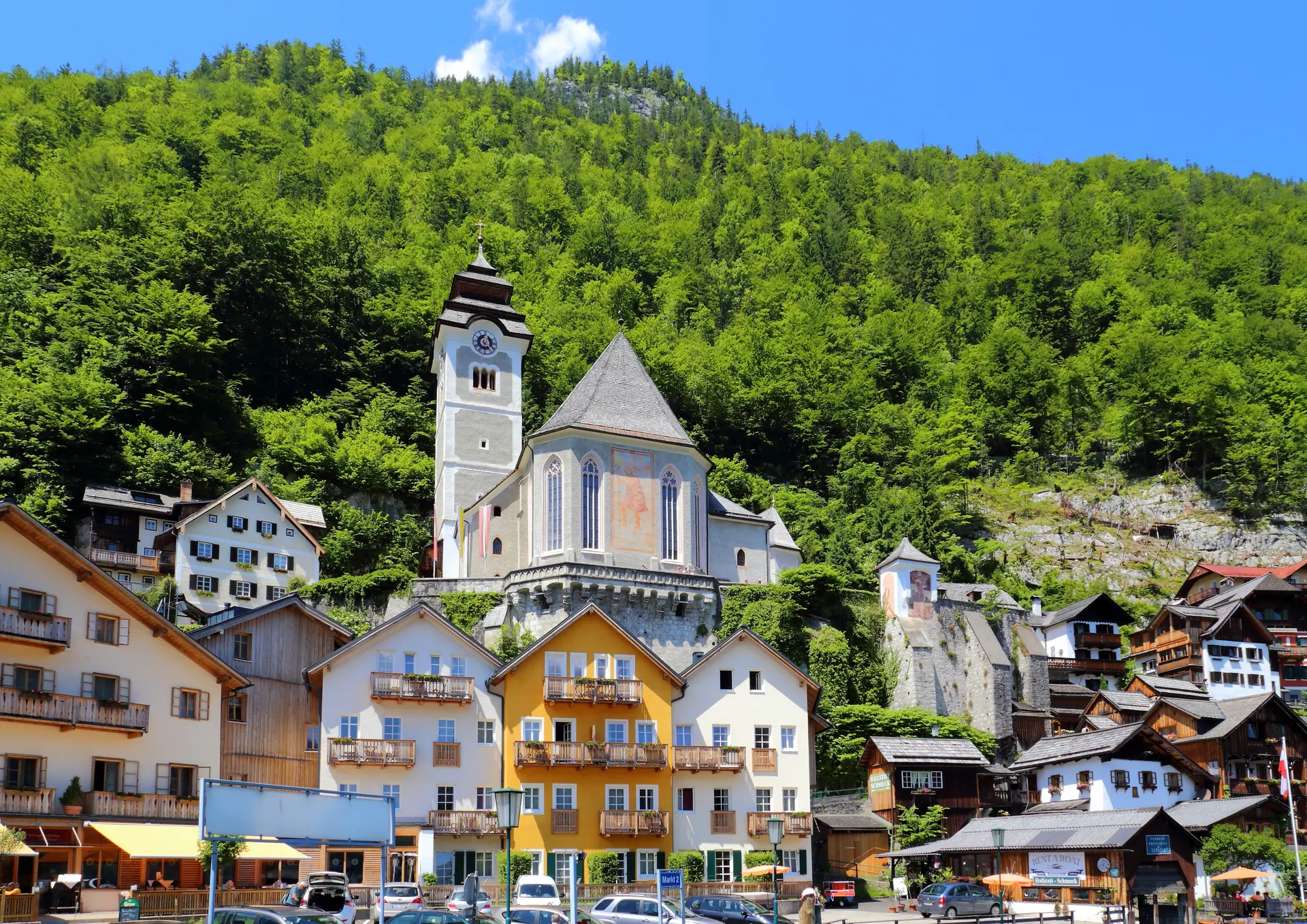
Image of The parish church of the Assumption (Maria am Berg), Hallstatt. Image source · CC-BY-SA-4.0
Visit essentials
A quick read before you go
- Duration
- 30-60 minutes for the church and charnel house.
- Access
- Hallstatt, Upper Austria.
Overview
Hallstatt clings to the narrow strip between the Dachstein mountains and the lake that bears its name. There is not enough ground for the living, let alone the dead. The parish church of the Assumption — Maria am Berg — occupies a steep slope above the village, its Gothic tower the defining element of a skyline that has been photographed more than perhaps any other in Austria.
The church itself is 15th-century Gothic, entered through a south portal dated 1519, its interior carrying frescoes, carved altars, and the accumulated devotional objects of centuries of parish life.
But the site's most distinctive quality lies in the adjacent St. Michael's Chapel, whose lower level houses the Beinhaus — the bone house. Here, over 1,200 skulls are stacked alongside thousands of other bones, the remains of Hallstatt's dead who were exhumed after 10 to 15 years of burial to make room for the newly deceased. Of these, more than 700 skulls have been painted: roses for love, ivy for life, laurels for valour, crosses on the forehead for faith.
Each bears the name of the person it once held and the date of their death. The last skull was painted in 1995.
This is not macabre decoration. It is a practice in which the community kept its dead visible, named, and adorned — refusing the anonymity of mass burial in favour of individual recognition. The painted skulls are portraits in bone, and the charnel house is not a tomb but a gallery of the village's collective memory.
Why this place is sacred
The constraint of geography created the theology. Hallstatt has no room. The lake presses from one side, the mountain from the other, and the village exists in the narrow margin between them. When that margin could no longer hold the accumulating dead, the community devised a practice that refused both options available to them — forget the dead or be overwhelmed by them.
Instead, they exhumed the bones after a decade or so of burial, cleaned and bleached the skulls, and painted them. Not hastily or carelessly, but with the deliberation of people who understood that what they were doing was important. Roses for love. Ivy for life. The name and the dates.
Each skull became a representation of a person the community was choosing to remember, not in the abstract but in the material — handling the bone, applying the paint, returning the result to a shelf where it would be seen by anyone who entered the chapel.
The practice continued into living memory. The thinness here is not ancient or mysterious; it is domestic, tender, and rooted in a community's ongoing refusal to let its dead become invisible.
The church has served as the parish church of Hallstatt since at least the 12th century. The bone house originated as a practical response to limited burial space and evolved into a folk art tradition of remembrance.
From practical necessity (insufficient burial ground) to cultural tradition (bone-painting as folk art) to heritage site (tourist attraction within a UNESCO World Heritage Cultural Landscape). The last bone-painting occurred in 1995, placing the tradition within living memory.
Experience and orientation
The path to Maria am Berg climbs steeply from the village waterfront, passing through a cemetery that offers views across the lake that make the ascent worthwhile before you reach the church. The cemetery itself is small — inevitably — and well-tended, with graves pressed close together in the narrow space between church wall and cliff edge.
The church interior is Gothic in its proportions, with a carved winged altarpiece, frescoes, and stained glass that reward slow attention. But the quality of the space changes when you enter St. Michael's Chapel next door. The upper level contains Gothic stained glass depicting St. Michael holding the Balance of Life — an appropriate guardian for what lies below.
Descend to the charnel house. The skulls are arranged on wooden shelves, the painted ones facing outward. The effect is not what you might expect. It is not grotesque. It is, in its own strange way, beautiful. The floral designs are careful and specific. The names and dates are legible. You are looking at individuals, not specimens.
Each skull was held by someone who knew the person it had been, and the painting was an act of remembrance performed by hands that had known the living face.
The most recent painted skull dates to 1995. The tradition is not ancient history; it is a practice that people alive today remember.
Climb from the village to the church. Enter the church first and sit with the Gothic interior. Then move to St. Michael's Chapel — the upper level with the stained glass, then the lower level with the bone house. Read the names. Notice the different floral designs. Understand that each was painted by someone who remembered.
Context and lineage
Hallstatt's location between mountain and lake left insufficient ground for burial. In the 1700s, the church began exhuming bodies after 10-15 years to make room for new burials. The bones were stacked in the charnel house. Family members began painting the skulls with floral designs, names, and dates — transforming a practical necessity into a tradition of remembrance that continued until 1995.
The bone-painting tradition is unique to the Alpine Catholic communities of the Salzkammergut region. Maria am Berg's charnel house is the most extensive surviving example.
Traditions and practice
Exhumation after 10-15 years of burial, bleaching and cleaning of skulls, hand-painting with floral designs (roses for love, ivy for life, laurels for valour), inscription with name and date of death. The painted skulls were placed on shelves in the charnel house for permanent display.
Regular Catholic parish services. The charnel house is maintained as a cultural heritage site with separate admission. The last skull was painted in 1995.
Visit the charnel house with the awareness that you are in the presence of named individuals. Read the names. Notice the floral designs. Understand the practice as an act of love, not a curiosity.
Roman Catholicism (Alpine charnel house tradition)
ActiveThe bone-painting tradition represents a distinctive Alpine Catholic practice of keeping the dead visible, named, and adorned within the community. The last skull was painted in 1995, placing the tradition within living memory.
Regular parish services. The charnel house is maintained as a heritage site. The bone-painting tradition, while no longer active, defines the site's character.
Perspectives and open questions
Maria am Berg and its charnel house present a community's sustained refusal to let geography dictate the erasure of its dead.
Scholarly perspective
The ossuary is one of the best-preserved examples of the Alpine Catholic charnel house tradition. The bone-painting practice is studied as folk art, as a cultural response to limited burial space, and as evidence of attitudes toward death in Alpine communities.
Living and traditional perspectives
In Catholic understanding, the painted skulls are not merely commemorative but exist within a framework of communion with the dead. The act of painting — naming, dating, adorning — is an expression of the belief that the dead remain part of the community. The roses, ivy, and laurels are not arbitrary decorations but symbolic languages.
Alternative interpretations
The ossuary has attracted interest from those exploring European folk traditions around death, ancestor veneration, and the boundary between the living and the dead. The practice of keeping the dead visible rather than hidden resonates with traditions worldwide.
Open questions
The identity of many of the skull painters is unknown. The exact origins of the bone-painting practice — when it began, who started it, and why floral designs were chosen — are historically uncertain.
Plan your visit
Access and arrival
Hallstatt, Upper Austria. The church is reached via a steep path from the village centre. Hallstatt is accessible by train (Hallstatt station, then ferry across the lake) or by car. Part of the UNESCO World Heritage Cultural Landscape.
Limited but varied accommodation in Hallstatt village. Obertraun and Bad Aussee offer additional options.
Respectful visit
Modest clothing for the church. No specific requirements for the charnel house.
Photography permitted in the charnel house (no flash). Avoid photography during church services.
Candle lighting available in the church.
Do not touch the skulls or bones | Maintain respectful silence in the charnel house | The charnel house has separate admission and hours
The charnel house can be emotionally intense. The skulls are real human remains, named and decorated by people who knew them. Approach with the respect owed to the dead.
Current practical details
Address
Kirchenweg 40, 4830 Hallstatt, Austria
Phone
Hours
Hours, fees, and access can change — verify on the official source before you travel. Practical details last checked Jun 2026.
Location
Map loads as you approach this section.
Pilgrim reflections
A portrait of encounter, not a score
Pilgrims describe what they felt, how present they could become, and whether the place would shape a journey. There are no stars and no ranking of traditions.
No reviewed reflections yet
The first pilgrims can help describe the character of being here.
Share a reflection
Available after an account-backed “Been there.” Every reflection is reviewed before publication.
Nearby sacred places
Explore other sacred places in the region. Proximity does not establish access or travel time; check each place’s guidance.

The Parish Church of the Assumption (Maria am Berg), Hallstatt
Hallstatt, Upper Austria, Austria
0.0 km away

Pilgrimage Church of St Wolfgang
St. Wolfgang im Salzkammergut, St. Wolfgang im Salzkammergut, Upper Austria, Austria
24.6 km away

St Leonhard Pilgrimage Church, Grödig
Grödig, Grödig, Salzburg, Austria
48.7 km away

St. Bartholomew's Church, Berchtesgaden
Königssee, Bavaria, Germany
50.8 km away
Share a photo
Help visitors recognize The parish church of the Assumption (Maria am Berg), Hallstatt. Every submission is reviewed before publication.