The Parish Church of the Assumption (Maria am Berg), Hallstatt
A thousand years of Alpine faith perched above the lake, where the living honor the dead by name
Understand sacred places, explore living traditions, and learn how to engage respectfully with Pilgrim Map.
Access has not been verified. Check current local guidance before planning a visit.
Hallstatt, Upper Austria, Austria

Visit essentials
A quick read before you go
- Duration
- One to two hours allows for a thorough visit to the church interior, the Bone House, and the…
- Access
- Hallstatt sits on the western shore of Lake Hallstatt in the Salzkammergut region of Upper…
Overview
Maria am Berg clings to the steep slope above Hallstatt, its Gothic spire rising against the Dachstein massif and declaring a community's determination to worship on difficult ground.
Christians gathered on this hillside around 1050 AD in an already ancient settlement where salt miners had worked for thousands of years. A Romanesque church stood by 1181; the present late Gothic structure was completed by 1505. Miners rather than nobles or bishops funded its celebrated winged altar by Leonhard Astl, joining faith, material, and collective effort.
The Michaeli Chapel houses the Bone House, one of Europe's most remarkable ossuaries. More than 600 skulls line its shelves, many painted with floral garlands, ivy wreaths, crosses, and the deceased's names and dates. Because steep terrain allowed only a small cemetery, remains were exhumed to make room for later burials. Geographic necessity became a practice of remembrance, preserving named individuals within the community's collective gaze.
The church still holds regular masses for its parish while welcoming thousands to this UNESCO World Heritage village. Stone steps from the village center create a modest ascent from the lakeside bustle to the church and ossuary above.
Why this place is sacred
Several dimensions contribute to the sense of depth at Maria am Berg. The most immediate is physical: the church occupies a position between lake and mountain, between the horizontal world of water and the vertical world of stone. This liminal geography, where human settlement presses against the limits of habitable terrain, has shaped the character of the place for millennia.
The continuity of worship adds its own weight. Nearly a thousand years of prayer, sacrament, and communal gathering have saturated this ground with intention. The 12th-century tower, still embedded in the later Gothic structure, provides a physical anchor for this accumulated history. Stones laid in the Romanesque period continue to bear the weight of the present church, just as the faith of the earliest community continues to inform worship today.
The Bone House introduces a dimension rarely encountered in sacred architecture. The painted skulls do not merely symbolize mortality; they present it directly, with names attached. Visitors stand face to face with individuals who once climbed these same steps, attended mass in this same nave, and looked out over this same lake. The floral motifs painted on the skulls soften without diminishing this confrontation.
Death is present here, but it is decorated, named, and kept within the community rather than hidden away.
The connection to salt mining deepens the site further. Hallstatt's mines have been worked for over seven thousand years, making this one of the longest continuously active mining sites in the world. The miners who funded the winged altar were participants in a tradition stretching back to prehistory. Their faith was not separate from their labor; it grew from the same ground, literally and figuratively.
This integration of work, worship, and community gives Maria am Berg a groundedness that more aristocratic foundations sometimes lack.
The landscape itself participates. The Dachstein Alps frame every view from the churchyard. Lake Hallstatt reflects the church's spire on still mornings. The seasons assert themselves with Alpine directness: snow buries the cemetery in winter, wildflowers soften it in summer. The natural world here is not backdrop but partner, shaping both the architecture and the traditions that have developed around it.
The hillside site was established for Christian worship around 1050 AD, serving the spiritual needs of the salt mining community in one of Europe's oldest continuously inhabited settlements.
From a modest Romanesque church by 1181 to the late Gothic structure completed in 1505, the church grew with its community. The Bone House tradition evolved from practical necessity into a distinctive art of communal remembrance. The 2002 renovation restored the building for contemporary worship and visitation. The 1987 theft of four Gothic paintings and their recovery in Italy in 2017 added a modern chapter to the church's long story.
Experience and orientation
The experience begins with the climb. Stone steps rise from the village center, threading between the close-packed houses that define Hallstatt's narrow footprint. The ascent is not arduous but it is deliberate, each step drawing the visitor upward from the lakeside commerce into a different register. The sounds of the village fade. The angle of sight shifts from horizontal to vertical, from water to stone.
At the top, the church presents its exterior with the modesty typical of Alpine Gothic architecture. The spire is the dominant gesture, rising with a slenderness that seems almost precarious against the massive face of the Dachstein. The churchyard, with its small cemetery pressed against the slope, offers the first of the views that have made this one of the most photographed sites in Austria.
Lake Hallstatt spreads below, framed by mountains on all sides, the village a thin line of structures between water and rock.
Inside, the nave unfolds with proportions that feel intimate rather than grand. Late Gothic churches in Alpine settings tend toward this quality, their scale determined by the communities they serve rather than by episcopal ambition. The eye moves naturally toward the high altar, where Leonhard Astl's winged altarpiece commands attention.
The altar opens to reveal painted panels depicting scenes from the life of the Virgin Mary and the saints, flanked by carved figures rendered with the careful expressiveness of late Gothic craftsmanship. That this work was funded by salt miners rather than aristocrats gives it a particular character. The devotion it represents was not imposed from above but offered from within.
Gothic frescoes and side altars reward closer attention. The overall effect is of a space that has been shaped by centuries of care, each generation adding or restoring according to its means and its understanding. The 2002 renovation refreshed the interior without erasing the patina of age.
The Bone House changes everything. Located in the Michaeli Chapel adjacent to the church, the ossuary is reached through a separate entrance. The space is small, which intensifies its impact. Shelves line the walls, holding over 600 skulls arranged in neat rows. Many are painted with floral garlands, wreaths of ivy or oak leaves, and crosses. Each painted skull bears a name and the dates of birth and death. Some include the occupation or family of the deceased.
The effect is unlike anything else in European sacred architecture. These are not anonymous relics but named individuals. The visitor stands among people who were once as alive as anyone in the room. The floral decorations, far from being macabre, suggest tenderness: someone took the time to honor each skull individually, choosing colors and patterns, inscribing the name with care. The tradition speaks to a community that refused to let its dead become abstractions.
Visitors often describe a period of quiet shock followed by contemplation. The painted skulls provoke questions that do not resolve easily. What does it mean to keep the dead this close? What is lost when, as in most modern cultures, the dead are placed out of sight? The Bone House does not answer these questions. It simply presents the alternative that the Hallstatt community chose.
The return to daylight, with the lake spread below and the mountains rising above, completes the arc. The landscape absorbs whatever the Bone House stirred, offering a context vast enough to hold both beauty and mortality without resolving the tension between them.
The church sits above the village center, reached by climbing stone steps. The nave contains the Leonhard Astl winged altar and Gothic frescoes. The Bone House (Beinhaus) is housed in the adjacent Michaeli Chapel, accessible through a separate entrance with a small admission fee.
Context and lineage
The first Christian community in Hallstatt formed around 1050 AD, establishing a place of worship on the steep mountainside that overlooks the lake. By 1181, a Romanesque church stood here, its tower still surviving within the fabric of the present building. This early community grew in a settlement already profoundly old.
Salt had been extracted from these mountains since at least the Bronze Age, and the Hallstatt culture that takes its name from this village dates to the Iron Age, roughly 800 to 450 BCE. Christianity arrived as the latest chapter in a story stretching back seven millennia.
The late Gothic expansion, completed by 1505, transformed the modest Romanesque structure into the church that stands today. The salt mining community, prosperous from the trade that had sustained Hallstatt since antiquity, funded the construction. Their most significant commission was the winged altar by Leonhard Astl, a master craftsman whose work demonstrates the artistic ambitions of a community that might easily have been dismissed as provincial.
The altar's painted panels and carved figures place it among the notable achievements of late Gothic art in the Alpine region.
The Bone House tradition developed in response to Hallstatt's constrained geography. The steep terrain around the church allowed for only a small cemetery, insufficient for a community spanning centuries. The practice of exhuming remains after a burial period and decorating the skulls with painted motifs transformed necessity into art. The 12th-century Michaeli Chapel became the repository for these honored remains, accumulating over time into one of Europe's most distinctive ossuaries.
The church weathered the religious upheavals of the Reformation, when Protestant and Catholic communities contended for control of Austria's spiritual direction. Hallstatt ultimately remained Catholic, and Maria am Berg continued its role as the parish church without interruption.
In 1987, four Gothic paintings were stolen from the church, a loss that drew attention to the vulnerability of art in smaller churches. The paintings were recovered in Italy in 2017, thirty years later, and returned to Hallstatt. The 2002 renovation restored the church comprehensively, ensuring its continued service to both worshippers and the growing number of visitors drawn to this UNESCO World Heritage site.
Maria am Berg belongs to the Roman Catholic tradition and serves as the parish church of Hallstatt. Its lineage traces through nearly a millennium of continuous Catholic worship, interrupted only briefly during the Reformation period when Protestant influence reached the Salzkammergut region. The church is part of the Diocese of Linz in Upper Austria.
Leonhard Astl
Master craftsman who created the celebrated late Gothic winged altar, funded by the salt miners of Hallstatt
Traditions and practice
The sacramental life of Maria am Berg follows the Catholic liturgical calendar, as it has for nearly a thousand years. Mass is celebrated regularly, marking Sundays and holy days with the rhythms that structure parish life across the Catholic world. The church's dedication to the Assumption of Mary places the feast of August 15 at the center of the liturgical year, a celebration that resonates with particular force in Alpine Catholic communities where Marian devotion runs deep.
The Bone House tradition represents a distinctive local practice that developed outside the formal liturgy but within the broader Catholic understanding of communion with the dead. The painting of skulls with floral garlands, crosses, and identifying inscriptions reflects a theology in which the dead remain part of the community, honored rather than forgotten. The specific conventions of the decoration evolved over centuries, with different periods favoring different motifs and styles.
The practice has largely been discontinued, but the existing collection of over 600 painted skulls is maintained and displayed in the Michaeli Chapel as a testament to this distinctive form of communal remembrance.
Today, Maria am Berg balances its role as an active parish church with its status as one of the most visited landmarks in a heavily touristed village. Regular masses continue to serve the local community, while visitors are welcome to enter the church between services. The Bone House operates as a small museum within the chapel, with a modest entrance fee supporting its preservation.
The church also participates in the broader cultural life of Hallstatt, hosting concerts and events that draw on the acoustic qualities of its Gothic interior. The parish maintains the churchyard cemetery, where burials continue in the limited space available, a living echo of the geographic constraint that gave rise to the Bone House tradition.
Attend mass if the schedule permits, experiencing the church as the worshipping community has for centuries. Outside of services, spend time with the winged altar, allowing its panels to reveal their detail gradually. In the Bone House, resist the impulse to photograph immediately. Stand quietly first. Read the names inscribed on the skulls. Consider that each belonged to someone who lived and worked in this same narrow valley between lake and mountain.
The churchyard offers views across the lake that reward lingering, particularly in early morning or late afternoon light when the mountains cast long shadows across the water.
Christianity (Roman Catholic)
ActiveMaria am Berg has served as the Catholic parish church of Hallstatt for nearly a millennium, anchoring the spiritual life of one of Europe's oldest continuously inhabited settlements. The late Gothic winged altar by Leonhard Astl, funded by the salt mining community, is regarded as an art-historical treasure and a testament to working-class devotion.
Regular masses and sacraments following the Catholic liturgical calendar, community festivals and celebrations, veneration at the altars, parish life supporting the local community, and reception of pilgrims and visitors.
Ossuary (Bone House) Tradition
ActiveThe Bone House in the Michaeli Chapel is one of the most remarkable ossuaries in Europe, housing over 600 painted skulls. The tradition of exhuming remains and decorating skulls with floral motifs, crosses, and inscriptions arose from the scarcity of burial space on the steep terrain. What began as practical necessity became a distinctive art of communal remembrance.
The practice of skull decoration has been largely discontinued, but the collection is carefully maintained and displayed. Visitors view the painted skulls as a contemplation on mortality, community memory, and the relationship between the living and the dead. The ossuary continues to function as a space of reverence within the church grounds.
Perspectives and open questions
Maria am Berg sits at the intersection of art history, Alpine anthropology, Catholic tradition, and the contemplative encounter with mortality. Each perspective reveals different dimensions of a place shaped by geography, faith, and the practical ingenuity of a mountain community.
Scholarly perspective
Art historians recognize the Leonhard Astl winged altar as a significant achievement of late Gothic craftsmanship in the Alpine region. The altar's provenance is notable: funded by the salt mining community rather than aristocratic or ecclesiastical patrons, it represents a relatively rare instance of working-class artistic patronage in the medieval period. The church itself is a representative example of late Gothic Alpine architecture, its proportions and materials shaped by the terrain and climate of the Salzkammergut.
Scholars of mortuary practices regard the Bone House as one of the most important ossuaries in Europe, documenting a distinctive tradition of skull decoration that developed in response to the geographic constraints of mountainous terrain. The practice is attested in several Alpine communities but nowhere as extensively as in Hallstatt.
The UNESCO inscription of the Hallstatt-Dachstein/Salzkammergut Cultural Landscape in 1997 recognized the exceptional testimony this region provides to the interaction between human activity and the Alpine environment over millennia, with Maria am Berg serving as one of the landscape's most visible cultural markers.
Living and traditional perspectives
Within the Catholic understanding, Maria am Berg is the parish church of one of Europe's oldest continuously inhabited settlements, a place where the sacraments have been administered for nearly a thousand years. The church's dedication to the Assumption of Mary reflects the deep Marian devotion characteristic of Alpine Catholic communities, where the Virgin serves as intercessor and protector in a landscape of considerable natural beauty and danger.
The Bone House tradition, while not formally liturgical, sits comfortably within Catholic theology's emphasis on communion with the dead, the prayer for souls in purgatory, and the understanding that death is not separation but transformation. For the Hallstatt community, the painted skulls are not relics of a discontinued practice but a living testimony to the belief that the dead remain part of the parish, honored by name and kept close.
Alternative interpretations
Some interpreters read the church's position at the intersection of mountain, lake, and ancient human settlement as marking a naturally liminal space, a threshold between elemental realms that human cultures have consistently identified as sacred. The Bone House's confrontation with mortality aligns with contemplative traditions across cultures that view death awareness as a catalyst for deeper engagement with life, a practice known in Buddhism as maranasati and in Western philosophy as memento mori.
The salt mining connection invites readings drawing on the symbolic significance of salt across traditions: purification, preservation, the descent into the earth and return, the extraction of essential substance from undifferentiated matter. Whether these interpretive frameworks illuminate or impose meaning on the site remains a matter of individual perspective.
Open questions
Whether a pre-Christian sacred site existed on this specific mountainside remains unclear. Given that Hallstatt has been continuously inhabited for over seven thousand years and the Iron Age culture that bears its name was sophisticated and spiritually developed, some form of earlier sacred use is plausible but undocumented.
The full history of the skull decoration tradition presents another gap: when precisely the practice began, how the artistic conventions evolved over time, when and why it was largely discontinued, and how families and community members understood the practice in different periods are not completely documented. The circumstances of the earliest Christian community's establishment in this remote Alpine settlement also remain a matter of inference rather than recorded history.
Plan your visit
Access and arrival
Hallstatt sits on the western shore of Lake Hallstatt in the Salzkammergut region of Upper Austria (Oberosterreich). The nearest train station, Hallstatt Bahnhof, is across the lake; a ferry connects to the village. By car, Hallstatt is accessible via the B166, though parking is limited and the village itself is largely pedestrian. The church is reached by climbing stone steps from the village center, a short but steep ascent.
The site is part of the Hallstatt-Dachstein/Salzkammergut UNESCO World Heritage Cultural Landscape, inscribed in 1997.
Hallstatt offers guesthouses, hotels, and rental apartments, though accommodation is limited relative to visitor demand. Booking well in advance is advisable during summer months. Staying overnight allows access to the village and church in the quieter early morning and evening hours, when the day-tripper crowds have departed.
Respectful visit
Modest dress covering shoulders and knees, appropriate for an active Catholic church.
Generally permitted in the church and Bone House. Refrain during services. Photograph the ossuary with respect for the human remains on display.
Candles and donations welcome. A small entrance fee applies for the Bone House.
{"Do not touch the decorated skulls or the altarpiece","Maintain silence during masses and services","Remain at the back of the nave or exit during active worship if visiting as a tourist"}
The Bone House contains human remains. While the painted skulls are presented with reverence and artistry, some visitors find the encounter more confronting than expected. The ossuary is not suitable for those deeply uncomfortable with the visible presence of death, and parents should consider the readiness of younger children.
Current practical details
Address
Kirchenweg 40, 4830 Hallstatt, Austria
Phone
Hours
Hours, fees, and access can change — verify on the official source before you travel. Practical details last checked Jun 2026.
Location
Map loads as you approach this section.
Pilgrim reflections
A portrait of encounter, not a score
Pilgrims describe what they felt, how present they could become, and whether the place would shape a journey. There are no stars and no ranking of traditions.
No reviewed reflections yet
The first pilgrims can help describe the character of being here.
Share a reflection
Available after an account-backed “Been there.” Every reflection is reviewed before publication.
Nearby sacred places
Explore other sacred places in the region. Proximity does not establish access or travel time; check each place’s guidance.
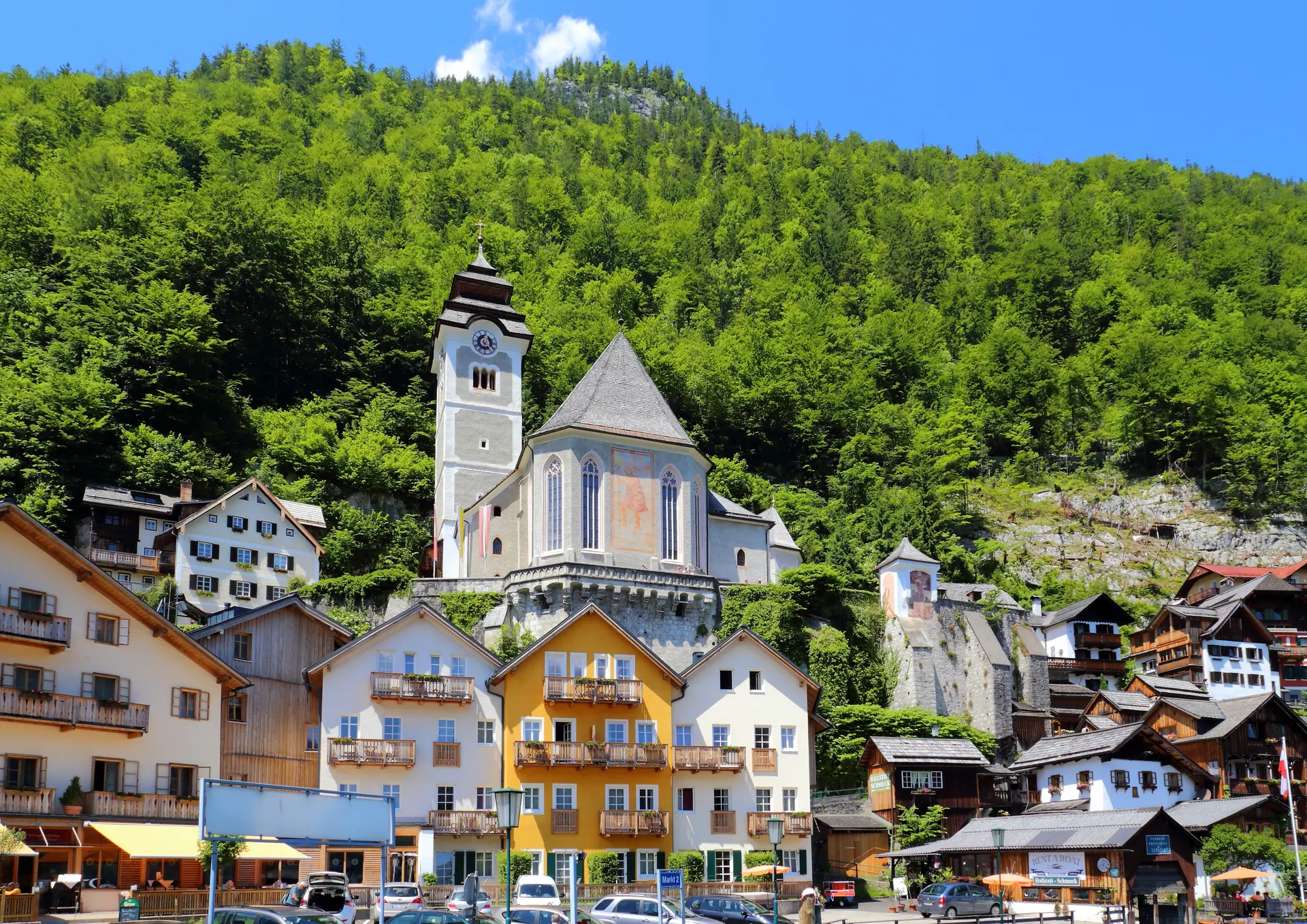
The parish church of the Assumption (Maria am Berg), Hallstatt
Hallstatt, Upper Austria, Austria
0.0 km away

Pilgrimage Church of St Wolfgang
St. Wolfgang im Salzkammergut, St. Wolfgang im Salzkammergut, Upper Austria, Austria
24.6 km away

St Leonhard Pilgrimage Church, Grödig
Grödig, Grödig, Salzburg, Austria
48.7 km away

St. Bartholomew's Church, Berchtesgaden
Königssee, Bavaria, Germany
50.8 km away
Share a photo
Help visitors recognize The Parish Church of the Assumption (Maria am Berg), Hallstatt. Every submission is reviewed before publication.