Oracle at Cape Tainaron (Mataram), Peloponnese, Greece
Where the land ends and the underworld begins, at the southernmost reach of mainland Greece
Understand sacred places, explore living traditions, and learn how to engage respectfully with Pilgrim Map.
Access has not been verified. Check current local guidance before planning a visit.
East Mani Municipal Unit, Peloponnese, Greece
Read the sources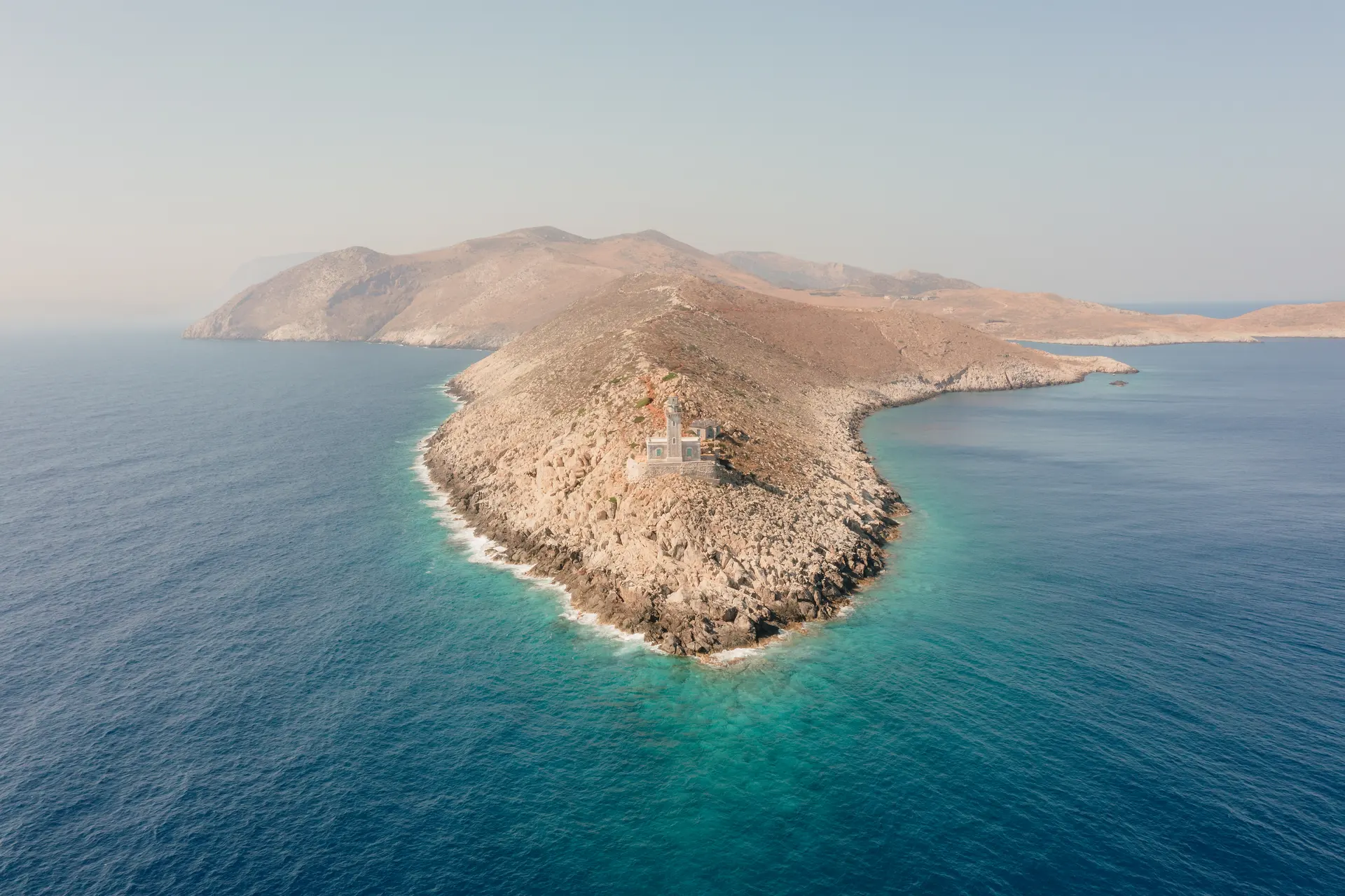
Image of Oracle at Cape Tainaron (Mataram), Peloponnese, Greece. Image source · CC-BY-SA-4.0
Visit essentials
A quick read before you go
- Duration
- Two to three hours for the complete round trip from Kokkinogeia to the lighthouse and back,…
- Access
- Cape Tainaron lies at the southern tip of the Mani Peninsula in Laconia, Peloponnese.
Overview
Cape Tainaron is mainland Greece's southernmost point, where the Peloponnese narrows to a final barren ridge and three seas meet. Its wind carries no scent of trees or soil, only salt and distance.
Ancient Greeks recognized the cape as an entrance to Hades. A cave at its base served as a Necromanteion, where the living descended to the threshold to consult spirits rising from below. Above it, a temple to Poseidon Tainarios anchored the sanctuary in the living world. Heracles entered through the cave to capture Cerberus; Orpheus used it to seek Eurydice.
The temple is now rubble and the cave partially collapsed, with a small Early Christian church on the temple foundations. A lighthouse built in 1822 marks the tip. From Kokkinogeia village, the two-kilometer path crosses a Mani landscape of stone, wind, light, and the memory of Greek understandings of endings.
Why this place is sacred
The concept of a thin place finds its most literal expression at Cape Tainaron. This was not a place where the veil between worlds was merely felt to be permeable. It was a place where a physical passage existed, where a cave opened downward into darkness and the darkness was understood to continue all the way to the realm of the dead.
The thinness here operates on multiple registers. There is the geographic thinness of the land itself, the Mani Peninsula narrowing to a final point where solid ground gives way to open water in three directions. There is the atmospheric thinness of the landscape, stripped of vegetation, shade, and comfort, exposing the walker to unmediated sun and wind.
There is the mythological thinness that made this place one of several Greek sites where heroes crossed the boundary of death and returned: Heracles descending to capture Cerberus, Orpheus descending to retrieve his wife.
But the deepest thinness may be the most ancient. Before the myths were codified and the temple built, someone stood at this promontory and understood that they had reached the end. Not the end of a road or a coastline, but the end of everything familiar. The land stopped. The sea began. Whatever lay beyond was not for the living to know.
The Necromanteion arose from this understanding: that the place where the known world ends is also the place where another world might begin, and that the passage between them, though dangerous, might be navigated by those willing to descend.
The convergence of three seas at the cape's tip was itself significant. The Aegean, the Ionian, and the Mediterranean meet here in visible currents, as though the waters themselves were uncertain about which direction to flow. Ancient mariners feared this confluence. The temple of Poseidon Tainarios served partly as propitiation for those who had to round the cape by sea, asking the god of waters to hold back his power long enough for their passage.
The site served a dual sacred function. The Temple of Poseidon Tainarios, established at least by the Archaic period, provided a sanctuary for the maritime cult of the sea god, protecting sailors who navigated the treacherous waters around the cape. The Necromanteion in the cave below served those who sought to communicate with the dead, descending into the darkness to consult spirits believed to rise from Hades through this opening in the earth.
The Poseidon sanctuary was active from at least the seventh century BC through the Roman period, accumulating dozens of bronze votive offerings that were later excavated from the site. The cave's function as a Necromanteion likely operated alongside the Poseidon cult, though the two traditions addressed different aspects of the same threshold: Poseidon governed the horizontal boundary of sea and land, while the oracle governed the vertical boundary of surface and underworld.
The arrival of Christianity transformed but did not erase the site's significance. The small church of Agioi Asomitoi, the Holy Bodiless Powers, was built directly atop the Poseidon temple foundations in the fifth or sixth century AD. The dedication to bodiless powers echoes the site's ancient association with spirits and the immaterial. The 1822 lighthouse added a modern function, but its purpose mirrors the ancient one: to mark the boundary, to warn those who approach the edge.
Experience and orientation
The path begins at the end of the road in Kokkinogeia, the last village at the tip of the Mani. There is a small parking area and usually a few other cars. The trail is marked but not maintained to any particular standard. It follows the spine of the cape as the land narrows, the sea visible on both sides and growing closer with each step.
The landscape here has been reduced to fundamentals. There are no trees. There is very little vegetation of any kind. The ground is stone and dry earth, pale under the sun. The wind comes from every direction, and there is nothing to block it. In summer, the heat is direct and inescapable. In spring and autumn, the air carries a clarity that makes the sea look closer than it is.
About halfway along the path, the remains of a Roman-era house appear, its mosaic floor still partially visible. The geometric patterns in colored stone seem incongruous in this stark setting, a reminder that people once lived here permanently, not as visitors but as residents of the edge. Farther on, the path passes the entrance to the cave.
This is the place the ancients identified as the gate to Hades, the opening through which Heracles descended to wrestle Cerberus and through which Orpheus descended, lyre in hand, to plead for the return of Eurydice.
The cave itself is partially collapsed and may not be safely entered. This does not diminish the encounter. Standing at the mouth, looking into the darkness that descends below the cape, the body understands what the myths describe. There is a below. The earth is not solid all the way through. Something continues downward beyond what the eye can follow. The ancient Greeks did not need to invent the underworld.
They found it here, in the observable fact of a cave that went deeper than anyone could see.
Above the cave, on the hilltop, stand the ruins of the Poseidon temple, barely distinguishable from the surrounding stone. The Early Christian church of Agioi Asomitoi sits on its foundations, a small whitewashed structure that can be entered. Inside, the silence is different from the silence outside: compressed, sheltered, interior. The shift from the wind-scoured path to this small enclosed space mirrors the ancient transition from the world of the living to the world below.
The lighthouse at the cape's tip is the final destination. Built in 1822, it stands sixteen meters tall on a promontory twenty meters above the sea. The three seas are visible from here, their currents meeting in lines of color and foam. Looking south, there is no more land. The next solid ground is the coast of North Africa, hundreds of kilometers away.
This is what 'the end of the world' felt like before the world was fully mapped: not a line on a chart but a physical experience of arrival at the place where everything known runs out.
The walk from Kokkinogeia to the lighthouse and back takes two to three hours, depending on how much time is spent at the cave, the church, and the lighthouse. There is no shade anywhere on the path. Carry more water than you think you need. Sturdy footwear is essential; the path is uneven and rocky. Late afternoon offers the most dramatic light, but allow enough daylight to return safely.
The cave entrance may be roped off or visibly unsafe; respect any barriers. The church is usually open and worth entering for the contrast between its interior stillness and the exposed landscape outside.
Context and lineage
The cape's identity as an entrance to Hades predates any single founding moment. The association likely arose from the convergence of geography and observation: a cave that descended into darkness at the very point where the land ended and the sea began. The Greeks, attuned to the symbolic registers of landscape, recognized this as a place where the boundary between worlds was not metaphorical but physical.
The myths that crystallized around this recognition are among the most enduring in Western culture. Heracles, as the twelfth and most dangerous of his labors, descended through this cave to capture Cerberus, the three-headed hound who guarded the entrance to the realm of the dead. He succeeded through strength and the favor of Athena and Hermes, dragging the beast to the surface before returning it to its post.
Orpheus, the musician whose art could move stones and tame wild animals, entered through the same cave to retrieve his wife Eurydice, who had died from a serpent's bite. His music so moved Hades and Persephone that they agreed to release her, on one condition: he must not look back at her until they had both returned to the world above. He looked back. He lost her.
These are not merely stories. They are the Greek attempt to articulate the human relationship with death: that it can sometimes be confronted, that the boundary can sometimes be crossed, but that what is lost to the underworld is rarely recovered, and never without cost. Cape Tainaron was the place where these truths were given a physical address.
The site belongs to the tradition of ancient Greek religion, specifically the cults of Poseidon and the chthonic practices associated with Necromanteion oracles. Cape Tainaron was one of several Greek sites identified as entrances to the underworld, alongside the more excavated Necromanteion at Ephyra in Epirus and the cave at Lake Avernus near Naples. The Spartan state and the communities of the Mani administered the sanctuary during the Classical period.
The transition to Christianity in the fifth and sixth centuries produced the church of Agioi Asomitoi on the temple foundations, a dedication to 'Holy Bodiless Powers' that preserved something of the site's association with the immaterial world. No continuous religious practice connects the ancient cult to the present.
Heracles
The hero who descended through the cave at Cape Tainaron to capture Cerberus, the multi-headed hound guarding the entrance to Hades, as the final and most perilous of his twelve labors. His successful return demonstrated that the boundary of death could be crossed by those with divine strength and favor.
Orpheus
The legendary musician who entered the underworld through this cave to retrieve his wife Eurydice from death. His failure to resist looking back, and the permanent loss that followed, became the defining Greek myth about the limits of human power at the threshold between life and death.
Pausanias
The second-century AD Greek geographer whose Description of Greece provides one of the most important ancient accounts of Cape Tainaron, documenting the Poseidon sanctuary, the cave, and the local traditions associating the site with the entrance to Hades.
Strabo
The Greek geographer and historian who recorded the cape's significance in his Geography, noting its temple of Poseidon and the tradition of the cave as a passage to the underworld, contributing to the literary record that preserved the site's mythological identity.
Poseidon Tainarios
The aspect of Poseidon specifically associated with this cape, worshipped as the lord of the treacherous seas that converge at the southern tip of the Peloponnese. His temple atop the cave created a layered sacred geography: the sea god above, the underworld below.
Traditions and practice
The Oracle of the Dead at Cape Tainaron operated as a Necromanteion, a site where the living could communicate with the spirits of the departed. The specific procedures at this site are not as well documented as those at the Necromanteion of Ephyra, but the general practice of Greek necromancy involved preparation rituals, offerings to chthonic deities, and a descent into darkness where the spirits of the dead were believed to rise and answer questions posed by the living.
The consultation required courage: to enter the cave was to approach the actual boundary of death.
The Poseidon cult operated on the hilltop above the cave. Worshippers brought bronze votive offerings, many of which were excavated from the site in later centuries. Maritime communities depended on the god's favor for safe passage around the cape, where three seas met and currents made navigation perilous. The offerings were practical appeals: keep our ships whole, bring our sailors home.
The two practices, the oracle below and the temple above, formed a complementary sacred geography. Poseidon governed the horizontal threshold of sea and shore, the boundary that sailors crossed. The Necromanteion governed the vertical threshold of earth and underworld, the boundary that the dead crossed. Together, they consecrated the cape as a place where every kind of passage between worlds was possible.
No active worship or formal ritual takes place at Cape Tainaron today. The site functions as an archaeological and hiking destination, visited primarily by those drawn to its mythology, its landscape, or the lighthouse at its tip. Yet the walk itself has acquired something of the character of pilgrimage.
Visitors often describe the experience in language that echoes the ancient accounts: a sense of arriving at the end of the world, of standing at a threshold, of confronting something that words do not easily contain. The absence of organized spiritual practice has not emptied the site of its capacity to provoke encounter with the numinous.
Walk slowly. The path from Kokkinogeia to the lighthouse is only two kilometers, but it was never meant to be traversed quickly. Allow the landscape to work on you. Notice how the ground narrows, how the vegetation disappears, how the sea grows closer on both sides. At the cave entrance, pause. You do not need to enter the cave to feel what it meant: darkness below the surface, extending beyond sight, and the ancient conviction that the darkness was populated.
At the church, step inside and let the silence settle. At the lighthouse, stand at the tip and look south into the open sea. This is the end. There is nowhere further to go. Let that fact register in the body before turning back.
Ancient Greek Religion — Cult of Poseidon Tainarios
HistoricalCape Tainaron was a major sanctuary of Poseidon in his aspect as Tainarios, the lord of the seas around the southernmost point of mainland Greece. The temple stood on the hilltop above the cave, and maritime communities brought bronze votive offerings seeking safe passage around the dangerous cape where three seas converge.
Ancient Greek Necromancy — Oracle of the Dead
HistoricalThe cave at Cape Tainaron served as a Necromanteion, one of several Greek oracles where the living could communicate with the dead. The site was believed to be a literal entrance to Hades, the realm of the dead, and was associated with the mythological descents of Heracles and Orpheus.
Perspectives and open questions
Cape Tainaron can be understood as a geological endpoint, a mythological threshold, a archaeological site, or a landscape of psychological encounter. Each perspective illuminates something the others miss.
Scholarly perspective
The archaeological and literary evidence for Cape Tainaron's sacred function is substantial. Pausanias, writing in the second century AD, describes the Poseidon sanctuary and the local tradition of the cave as an entrance to Hades, though he notes with characteristic skepticism that the cave he saw did not appear to lead underground. Strabo similarly records the temple and the mythological associations.
Archaeological excavation has recovered dozens of bronze votive offerings from the temple site, confirming active worship from at least the Archaic period. The scholarly debate centers on whether the site functioned as a true Necromanteion, with organized rituals of consultation with the dead, or whether its association with the underworld was primarily mythological, a product of its extreme geography and its role in the Heracles and Orpheus narratives.
The more extensively excavated Necromanteion at Ephyra provides evidence of physical infrastructure designed for necromantic ritual; at Tainaron, the evidence is more literary than architectural.
Living and traditional perspectives
For the people of the Mani, Cape Tainaron has always been the end of the world. The Maniots, fierce, independent, never fully conquered by Ottomans or Venetians, inhabited a landscape that taught them about limits: the limits of fertile land, of water, of the tolerance of neighbors. The cape, where their peninsula comes to its final point, was the physical embodiment of that teaching.
The association with the underworld was not feared but integrated into a worldview that included death as a constant companion. The Mani's tradition of blood feuds, its tower architecture built for defense against neighbors, its lamentation songs performed by women over the dead, all belong to a culture that lived in proximity to death's threshold long before the ancient myths gave it a name.
Alternative interpretations
Some contemporary visitors experience Cape Tainaron as a place of earth energy, drawing on the idea that the convergence of three seas and the meeting of land and water create a natural energetic vortex. Others approach the site through the lens of depth psychology, reading the descent into the cave as a metaphor for the journey into the unconscious, the katabasis that appears in mythologies worldwide as a necessary passage toward self-knowledge.
The landscape's severity, stripped of comfort and ornament, supports this reading: the walk to the cape removes distractions one by one until the visitor arrives at the edge with nothing between themselves and the fundamental questions of ending and beginning.
Open questions
The exact nature and procedures of necromantic consultation at Cape Tainaron remain poorly understood. Unlike the Necromanteion at Ephyra, where excavation revealed rooms that may have served as preparation chambers and an underground vault where consultants may have encountered the dead, the cave at Tainaron has not yielded comparable architectural evidence. Whether this means the rituals were simpler, or that the evidence has been lost to collapse and erosion, is unknown.
The extent of the cave system itself is uncertain: partial collapse has sealed passages that may once have extended much deeper underground. The relationship between the Poseidon cult on the hilltop and the Necromanteion in the cave below, whether these were separate priesthoods serving different functions or aspects of a single integrated sanctuary, is not resolved by surviving sources.
Plan your visit
Access and arrival
Cape Tainaron lies at the southern tip of the Mani Peninsula in Laconia, Peloponnese. The nearest village is Kokkinogeia, reached by a narrow road from Lagia. The nearest town of any size is Gerolimenas, approximately 15 km north, which has a few guesthouses and tavernas. Areopoli, the main town of the Mani, is 30 km north and serves as the regional hub with more services. The roads through the Mani are narrow, winding, and slow.
There is no public transport to the trailhead. A car is essential. The 2 km path from the parking area at Kokkinogeia to the lighthouse is flat to gently undulating, over rocky terrain. It is not formally maintained but is well-trodden and easy to follow. There are no facilities along the path: no water, no shade, no toilets. Bring everything you need. Mobile phone signal is intermittent.
The nearest accommodation is in Gerolimenas (15 km), a small fishing village with a handful of guesthouses and two tavernas. Vatheia (10 km) has a restored tower guesthouse. Areopoli (30 km) offers more options including hotels, rooms, and restaurants. The Mani is a region of small-scale, often family-run hospitality. Booking in advance is recommended in summer. In winter, many establishments close.
Respectful visit
No formal dress code applies. Practical hiking clothing is appropriate. Sturdy closed-toe shoes are essential for the rocky, uneven path. Sun protection is critical in spring and summer: hat, sunscreen, and light long-sleeved layers. Wind can be strong; a light windbreaker is useful even in warm months.
Photography is freely permitted throughout the site. The landscape, ruins, cave entrance, church, and lighthouse are all open to documentation. The most striking photographs tend to come from the lighthouse area, where the convergence of three seas is visible, and from the approach to the cave, where the dark opening in the earth contrasts with the bright stone landscape.
No offerings are expected or traditional in the contemporary context. The ancient practice of bronze votive dedications to Poseidon has no modern equivalent at this site. If you wish to mark your visit with some form of intention, do so inwardly. Do not leave objects, flowers, or other materials at the ruins or cave entrance.
Do not enter the cave if it appears unstable, blocked, or roped off. Do not climb on the archaeological ruins. Do not remove any material from the site, including stones, pottery fragments, or natural specimens. There are no opening hours or admission fees; the site is accessible at all times. Use good judgment about daylight when planning your return.
The cave is partially collapsed and may be unsafe to enter. Do not attempt to explore it beyond the visible entrance. The path is exposed to sun and wind with no shelter; dehydration and sunstroke are real risks in summer. The site is remote, with limited mobile signal in places. The archaeological ruins are unguarded; do not remove stones, pottery fragments, or any other material from the site.
Current practical details
Address
Ανατολική Μάνη Ακρωτήριο Ταιναρο Anatoliki Mani, Anatoliki Mani 230 71, Greece
Hours
Hours, fees, and access can change — verify on the official source before you travel. Practical details last checked Jun 2026.
Location
Map loads as you approach this section.
Pilgrim reflections
A portrait of encounter, not a score
Pilgrims describe what they felt, how present they could become, and whether the place would shape a journey. There are no stars and no ranking of traditions.
No reviewed reflections yet
The first pilgrims can help describe the character of being here.
Share a reflection
Available after an account-backed “Been there.” Every reflection is reviewed before publication.
Nearby sacred places
Explore other sacred places in the region. Proximity does not establish access or travel time; check each place’s guidance.

Sanctuary of Artemis Orthia
Sparta, Laconia, Peloponnese, Greece
77.6 km away

Temple of Apollo Epicurius at Bassae
Bassae, Oichalia, Messenia, Peloponnese, Greece
127.0 km away
Sanctuary of Asklepios at Epidauros
Epidauros, Peloponnese, Greece
144.6 km away

Sanctuary of Apollo Maleatas
Epidauros, Mount Kynortion, Argolis, Peloponnese, Greece
145.1 km away
References
Sources consulted for this page. Source categories describe the publication, not a guarantee that every claim is verified. Traditional accounts and outside interpretations may differ.
- 01Cape Matapan & Taenarum — Gateway to Hades — Heritage Daily — Heritage DailyacademicArchaeological and historical analysis
- 02Cape Tainaron: In search of a lighthouse near the Gates of Hades — Sofia's KaleidoscopeguideDetailed hiking guide with mythological context
- 03Cape Tainaron: Journey's End — Greece Insiders — Greece InsidersguideCultural travel guide
- 04Cape Matapan Caves — Atlas Obscura — Atlas ObscuraguideFocus on the cave and underworld mythology
- 05Cape Tainaro in Greece: Where the Land Ends and Legends Begin — Greek ReporternewsContemporary feature with historical background
- 06Cape Tainaron, the Mythical Gate to Hades — Hellas Holiday — Hellas HolidayguideTourism guide with archaeological details
Share a photo
Help visitors recognize Oracle at Cape Tainaron (Mataram), Peloponnese, Greece. Every submission is reviewed before publication.