Chrysoskalitissa Monastery
A whitewashed monastery on a cliff above the Libyan Sea, guarding a golden step only the faithful can see
Understand sacred places, explore living traditions, and learn how to engage respectfully with Pilgrim Map.
Access has not been verified. Check current local guidance before planning a visit.
Chrisoskalitissa, Crete, Greece
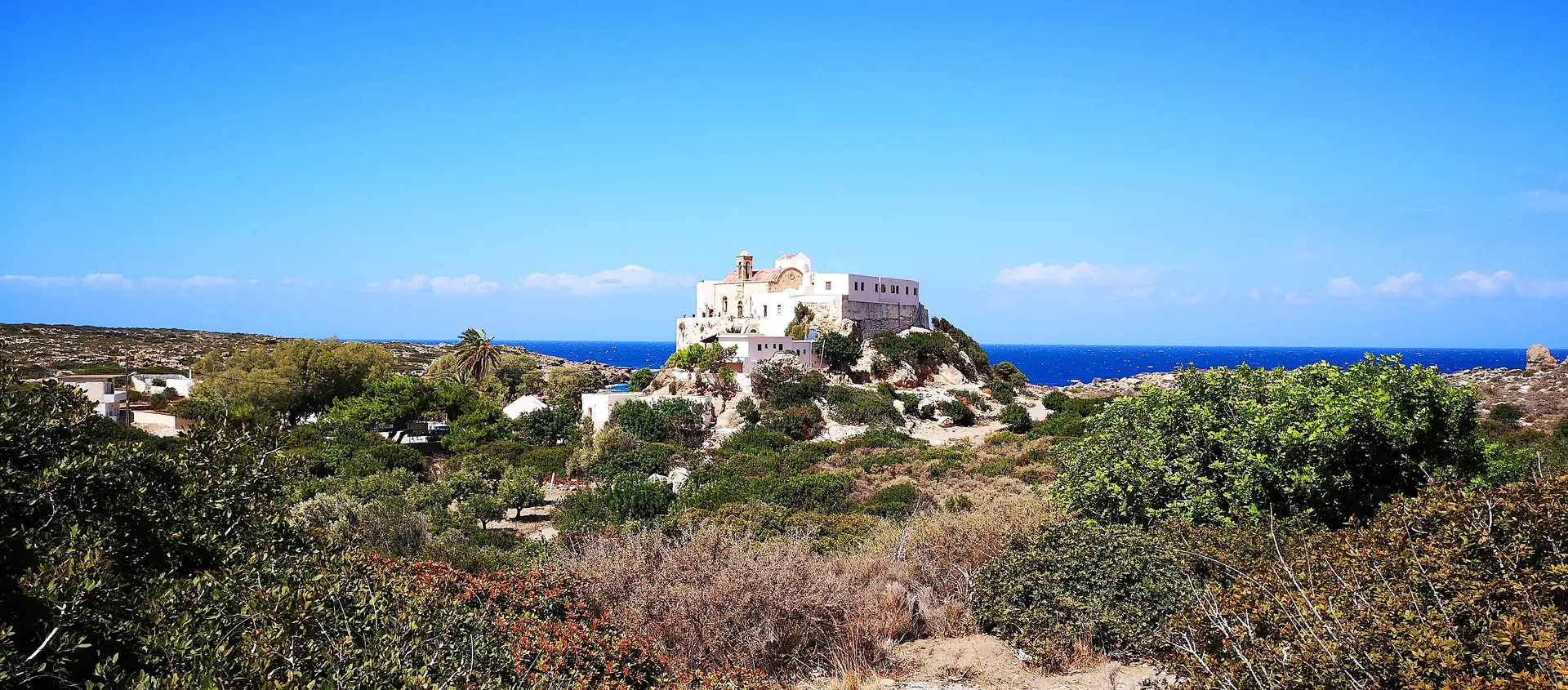
Image of Chrysoskalitissa Monastery. Image source · CC-BY-4.0
Visit essentials
A quick read before you go
- Duration
- Thirty minutes to an hour for the church, museum, and views.
- Access
- Located 72 km southwest of Chania, approximately 1.5 hours by car.
Overview
Chrysoskalitissa's staircase has ninety steps—or ninety-eight, depending on the count—and legend says the final step appears gold only to those of pure faith. Even smiling visitors slow down to look.
At Crete's southwestern edge, the small monastery occupies and enters a wind- and salt-shaped coastal promontory above the Libyan Sea, facing North Africa, with western Cretan mountains, olives, and wild thyme behind. A handful of monks tend gardens, welcome visitors, and maintain Orthodox daily liturgy.
The current church dates to 1894, but the foundation reaches through Ottoman occupation and Venetian rule and, according to tradition, the eighth- and ninth-century Iconoclast period, when a farmer found a Virgin Mary icon hidden in a rock niche to prevent its destruction. The rescued icon grounds the monastery, centuries of prayer, staircase, and golden-step story.
Neither Meteora nor Mount Athos in scale or wealth, Chrysoskalitissa is a small community holding Europe's cliff edge through invasions, massacres, occupation, and erosion. Its golden step invites attention to what hides in plain sight.
Why this place is sacred
The quality of Chrysoskalitissa as a threshold place arises from a convergence of geography, time, and story that no single element would produce alone.
The setting comes first. The monastery occupies a rock promontory on the most remote stretch of Crete's coastline, thirty-five meters above the sea. To reach it, you drive over an hour from Chania through increasingly spare terrain, the villages thinning, the road narrowing, until the monastery appears on its cliff like something that grew from the stone rather than being built upon it. This remoteness is not incidental.
Orthodox monastic tradition has always sought the edge: the desert, the mountaintop, the cliff above the water. These are places where the distractions of the world fall away and the essential questions become unavoidable.
The second layer is duration. The earliest tradition places a sacred presence here in the Iconoclast period, when an icon of the Virgin Mary was hidden in the rock to protect it from imperial iconoclasts who would have destroyed it. Whether the date is precisely right matters less than what the story preserves: the idea of a sacred object concealed in the earth, waiting for the faithful to discover it.
This is an archetypal pattern, the hidden treasure, the buried holy thing, and its association with this particular cliff gave the site a resonance that has lasted over a thousand years. The Venetian census of 1637 documents the monastery's existence. Ottoman taxes diminished it. The 1824 massacre at nearby Elafonisi swept the region in blood. World War II brought German occupation and British bombing. Through all of this, the monastery endured.
The third layer is the staircase itself. The ascent of ninety or more steps functions as a liminal passage, a physical transition from the secular ground below to the sacred precinct above. Pilgrimage traditions worldwide employ this device: the sacred mountain, the temple stairs, the labyrinth path. At Chrysoskalitissa, the passage is given an additional charge by the legend of the golden step.
The idea that one of the steps is gold, visible only to the devout, transforms the ascent from exercise into test. It asks the climber to attend, to look carefully, to consider what might be present but unseen.
The fourth layer is the view. From the monastery terrace, the Libyan Sea extends to the horizon, uninterrupted. There is no land between this cliff and Libya. The scale of the sea, combined with the elevation and the silence, creates a visual field that invites the gaze outward and, in doing so, turns it inward. Visitors consistently report a sense of stillness that the proximity of the tourist beach at Elafonisi, just five kilometers away, makes all the more striking.
Archaeological evidence of Minoan habitation in the surrounding area suggests that humans have recognized this coast as significant for four thousand years. Whether that significance was sacred in a sense the Minoans would have recognized, we cannot know. What is clear is that the monastery inherits a long human attention to this particular meeting of land and sea.
The monastery was founded to house and venerate an icon of the Virgin Mary discovered hidden in a rock niche, believed to have been concealed during the Byzantine Iconoclast period (726-842 AD) when imperial authorities ordered the destruction of religious images. A farmer, finding the icon, established the site as a place of Marian devotion. The monastery thus began as an act of recovery, a community formed around something sacred that had been preserved through an era of destruction.
The earliest documented form of the monastery appears in the 1637 Venetian census under the name Panagia Gounoskalitissa, suggesting the community was already well established by the time written records reached this remote coast. During Ottoman rule, heavy taxation forced the Patriarch to sell monastery estates and, according to one account, the original golden step itself. The monastery declined but did not disappear. In 1855, a monk named Manassis Glynias undertook a significant renovation, rebuilding the guesthouse, cells, and warehouses.
In 1894, the original church, which had been carved into the rock, was replaced by the current structure, inaugurated on August 15 by Bishop Dorotheos Klonaris. In 1900, Chrysoskalitissa was annexed to the larger Monastery of Odigitria Gonia. The twentieth century brought further upheaval: conversion to a nunnery in 1940, German occupation during World War II, the expulsion of the nuns, and the monastery's use as a military outpost. Since 1944, monks have inhabited the monastery continuously.
Today, a small community maintains the liturgical cycle, the agricultural grounds, and the welcome of visitors and pilgrims.
Experience and orientation
The approach is itself a preparation. From Chania, the road winds southwest through the foothills, past villages with plane trees and kafeneia, past greenhouses and olive groves, into country that grows progressively more open and austere. The last stretch follows a road that narrows as the coast approaches, and then the monastery appears: a compact white mass on a rocky headland above the sea, its walls catching the light against the deep blue of the Libyan Sea below.
Parking is at the base of the cliff. The staircase begins immediately, and with it, the transition. The steps are stone, worn smooth by feet and weather. They rise steeply, winding around the rock, and with each turn the view expands: the coast stretching north, the sea deepening below, the scrub-covered hills behind. It takes five to ten minutes, depending on pace. The legend of the golden step does its work whether or not you take it literally.
You find yourself looking at the stairs more carefully than you otherwise would, attending to the surface, the color, the texture. The legend converts a physical ascent into an act of attention.
At the top, the monastery opens onto a terrace with panoramic views. The whitewashed walls glow in the Cretan sunlight. The katholikon, the main church, is modest in scale but richly decorated inside with icons, gilded ornament, and the quiet accumulation of centuries of worship. The icon of the Virgin Mary, the one tradition says was found hidden in the rock, is housed here. There is a small ecclesiastical museum displaying Byzantine and Renaissance-era icons and religious artifacts.
The atmosphere depends greatly on when you arrive. On a summer midday, tourist buses from Elafonisi beach bring visitors in swimwear who may treat the monastery as a scenic viewpoint. Arrive early in the morning or in the shoulder seasons, and the place reveals its deeper character. The monks go about their work. The church is open and quiet. The sea stretches to the horizon, and the only sounds are wind and the occasional call of a seabird.
In these moments, Chrysoskalitissa becomes what it has always been: a place of withdrawal, a point of stillness at the edge of the land.
The contrast with Elafonisi, just five kilometers south, is stark and instructive. The beach draws thousands of visitors for its pink sand and turquoise lagoon. The monastery draws a different kind of attention entirely. Visiting both in a single day creates a kind of dialogue between pleasure and contemplation, between the beauty of the natural world and the human impulse to consecrate a particular place within it.
Arrive in the morning, before 10:00 AM, to experience the monastery in relative quiet. The afternoon heat and tourist traffic from Elafonisi peak between 11:00 AM and 3:00 PM. Wear comfortable shoes for the staircase and bring a covering for shoulders and legs, as modest dress is required inside. Allow forty-five minutes to an hour for the visit, more if you wish to sit with the view or attend to the church in silence.
Context and lineage
The founding story of Chrysoskalitissa is a story of concealment and revelation. During the Byzantine Iconoclast period (726-842 AD), when imperial decree ordered the destruction of religious images throughout the empire, a farmer on the remote southwestern coast of Crete discovered an icon of the Virgin Mary hidden in a crevice in the rock.
Whoever had placed it there, perhaps a monk or a faithful layperson, had chosen this cliff above the sea as the icon's hiding place, trusting the remoteness to protect what the authorities would have destroyed.
The discovery of the icon became the foundation of the monastery. A community gathered around the sacred image, building first a simple shrine carved into the rock and eventually the monastery that stands today. The name itself encodes a deeper story. Chrysoskalitissa means 'of the golden step,' from chrysos (gold) and skalas (step).
According to the most widespread version of the legend, the last of the steps leading to the monastery is made of gold, visible only to those whose faith is genuine. Other accounts say the golden step was a literal artifact, sold by the Patriarch to pay Ottoman taxes, or that monastery treasures were hidden beneath a step during the Ottoman conquest.
These variants need not be reconciled. Together, they form a composite that says something true about the monastery's character: this is a place where the sacred has been hidden, discovered, lost, and sought again across the centuries. The golden step, whether literal gold, a test of faith, or a story told to sustain hope during occupation, carries the same meaning. Something of value is present here, if you know how to look.
Chrysoskalitissa belongs to the Greek Orthodox monastic tradition of Crete, a branch of Eastern Orthodoxy shaped by the island's distinctive history of Venetian and Ottoman rule. The monastery is under the jurisdiction of the Metropolis of Kissamos and Selinos, the westernmost diocese of the Church of Crete. In 1900, it was annexed to the Monastery of Odigitria Gonia, a larger and better-known house near Kolymvari, establishing a relationship of dependency that connects Chrysoskalitissa to a broader network of Cretan monasticism.
The monastery's dedication to the Dormition of the Theotokos places it within the widespread tradition of Marian devotion that is central to Greek Orthodox piety, particularly in Crete, where the Virgin is venerated with special intensity.
Manassis Glynias
Monk from Askifou who undertook a major renovation of the monastery in 1855, rebuilding the guesthouse, monk cells, and warehouses. His work preserved the community during a period of Ottoman-era decline and ensured that the monastery survived to see its church rebuilt four decades later.
Bishop Dorotheos Klonaris
Bishop of Kissamos who inaugurated the new church on August 15, 1894, the feast of the Dormition. The current katholikon, replacing the earlier structure carved into rock, was completed in just three months under his pastoral authority.
The unnamed farmer (traditional)
The figure from the monastery's origin tradition who discovered the icon of the Virgin Mary hidden in a rock crevice during the Iconoclast period. His act of discovery is understood as the founding moment of the monastery, though his name is lost to history.
The nuns of 1940-1941
When the monastery was converted to a nunnery in 1940, a community of women occupied the site until the German invasion of Crete in 1941 led to their expulsion. Their brief tenure represents one of the few periods of female monastic presence in the monastery's recorded history.
The bee swarm of 1824 (traditional)
Not a human figure, but a presence central to the monastery's survival narrative. When Ottoman-Egyptian forces approached the deserted monastery after the Easter massacre at nearby Elafonisi, a swarm of bees nesting in the shrine's niche reportedly attacked and drove them away, saving the monastery from looting and destruction.
Traditions and practice
The liturgical life of Chrysoskalitissa follows the daily cycle of Orthodox worship: Orthros (matins), the Divine Liturgy, Vespers, and Compline. The resident monks maintain this cycle in the katholikon, the main church dedicated to the Holy Trinity and the Dormition of the Virgin Mary. The rhythm is shaped by the Orthodox fasting calendar, with its alternation of feast and fast, abundance and austerity.
The foundational relic of the monastery is the icon of the Virgin Mary discovered in the rock during the Iconoclast period. Veneration of this icon is not a historical curiosity but an ongoing devotional practice. Pilgrims and monks approach the icon with the gestures of Orthodox piety: a bow, a kiss, a whispered prayer. The icon is understood not as a painting but as a point of contact with the person it represents.
The annual feast of the Dormition (August 15), known in Greek as the Dekapendavgoustos, is the spiritual high point of the monastery's year. The feast commemorates the falling asleep of the Virgin Mary and her bodily assumption into heaven. At Chrysoskalitissa, this feast draws large gatherings of pilgrims and locals to a celebration that is simultaneously liturgical and communal, sacred and festive.
The monastery's patronal feast has been observed here for centuries, binding the local community to the monastery in a relationship of mutual sustenance.
The monks of Chrysoskalitissa maintain a small agricultural operation, growing crops and producing handicrafts. They welcome visitors to the church and the ecclesiastical museum, offering guided tours when requested. Pilgrims who wish to stay overnight may request accommodation in available monastery cells, though availability is limited and arrangements should be made in advance.
The monastery exists in a state of productive tension with the tourist economy of the Elafonisi coast. Thousands of beachgoers pass nearby each summer, and a portion of them visit the monastery. The monks navigate this reality with hospitality and quiet firmness, welcoming visitors while maintaining the sacred character of their home.
For visitors approaching Chrysoskalitissa as more than a scenic detour, the staircase is the first practice. Climb it slowly. Count the steps if you wish, but more important is the quality of attention you bring to the ascent. The physical effort, the rising view, the narrowing of the world to stone and sky: these are the elements of pilgrimage, available to anyone willing to receive them.
Inside the church, pause before the icon of the Virgin Mary. You need not be Orthodox or even religious to appreciate what this image represents: centuries of devotion directed at a single point, the accumulated weight of all the prayers spoken before it. Sit with the silence if the church is quiet. Light a candle if the gesture feels right.
From the terrace, let the view do its work. The sea extends without interruption to the south. There is nothing to accomplish here, nothing to optimize. The place asks only for your presence.
Greek Orthodox Christianity
ActiveChrysoskalitissa is dedicated to the Holy Trinity and the Dormition of the Virgin Mary (Theotokos). Its sacredness is rooted in the discovery of an icon of the Virgin Mary hidden in a rock niche, believed to date from the Byzantine Iconoclast period (726-842 AD). The site has sustained Orthodox worship, prayer, and monastic life for centuries, surviving Ottoman occupation, the 1824 Elafonisi massacre era, and World War II. It is a male monastery under the jurisdiction of the Metropolis of Kissamos and Selinos, the westernmost diocese of the Church of Crete.
Perspectives and open questions
Chrysoskalitissa can be understood as a fortress of faith on a cliff, as a repository of Cretan resilience, as an architectural response to landscape, or as a meditation on the relationship between seeing and believing. Each perspective illuminates something the others leave in shadow.
Scholarly perspective
Historical scholarship situates Chrysoskalitissa within the broader pattern of Cretan Orthodox monasticism, a tradition shaped by successive waves of foreign rule. The first documentary evidence, the 1637 Venetian census listing the monastery as Panagia Gounoskalitissa, establishes a secure terminus ante quem, though the tradition of earlier origins is not implausible given the widespread practice of concealing icons during the Iconoclast period.
The architecture of the current structure, a whitewashed complex on a cliff with its 1894 katholikon, reflects the practical and aesthetic conventions of Cretan monasteries: fortress-like construction suited to periods of insecurity, and a simplicity of exterior that contrasts with interior richness. The nearby archaeological evidence of Minoan habitation confirms that the southwestern coast of Crete attracted human settlement millennia before the Christian era, though no direct connection between Minoan activity and the monastery site has been established.
Living and traditional perspectives
In Cretan Orthodox understanding, Chrysoskalitissa is a place under divine protection, evidenced by the preservation of the icon through the Iconoclast period and the monastery's miraculous survival through the bee swarm of 1824. The golden step legend, in all its variants, carries a theological weight: the idea that sacred reality is accessible to perception conditioned by faith.
The Dormition feast on August 15 is not simply a religious observance but a communal event that binds the scattered population of western Crete to a shared identity rooted in faith and landscape. The monastery embodies the Cretan spirit of endurance, the stubborn persistence of a community that has survived every force that sought to diminish or destroy it.
Alternative interpretations
For visitors approaching from outside the Orthodox tradition, Chrysoskalitissa offers a different kind of encounter. The dramatic cliff-edge setting, the liminal threshold of the staircase, and the vast sea horizon all evoke what might be called natural spirituality: the sense that certain landscapes, by their elemental character, invite contemplation regardless of religious framework.
The golden step legend, stripped of its specifically Christian context, becomes a parable about attention and receptivity, about whether the world reveals itself to those who approach it with care. The monastery's position overlooking the Libyan Sea toward Africa places it at a geographic and symbolic edge, a frontier where Europe looks outward into vastness.
Open questions
Several aspects of Chrysoskalitissa resist resolution. The exact founding date remains uncertain; the Iconoclast-era tradition is plausible but unverifiable. The relationship between the original monastery of St. Nicholas mentioned in some sources and the current Marian dedication is not documented. Whether the golden step was ever literal gold, a spiritual metaphor, or a later accretion to the monastery's identity cannot be determined. The sources disagree on whether the staircase has ninety or ninety-eight steps.
Whether the site held pre-Christian sacred significance, as the nearby Minoan remains might suggest, remains an open question that may never be answered.
Plan your visit
Access and arrival
Located 72 km southwest of Chania, approximately 1.5 hours by car. Follow signs toward Elafonisi; the monastery is 5 km north of the beach. No public transport runs directly to the monastery. A few daily buses operate from Chania to Elafonisi beach (approximately 2 hours travel time), from which the monastery is 5-6 km by road. A rental car is the most practical option. Free parking is available at the base of the cliff.
The staircase of 90 to 98 steps must be climbed to reach the monastery; there is no alternative access. This may present a significant challenge for visitors with mobility limitations. Open daily approximately 9:00 AM to 7:00 PM. Admission fee approximately 2 EUR. Mobile phone signal may be limited in this remote area of southwestern Crete.
Pilgrims may request to stay overnight in available monastery cells, though this should be arranged in advance and cannot be guaranteed. The nearest commercial accommodations are in the villages of Elafonisi and Kefali, approximately 5-10 km away. Chania, 72 km northeast, offers the full range of accommodations. If combining a visit to Chrysoskalitissa with Elafonisi beach, several small hotels and rental rooms operate in the immediate area during the summer season.
Respectful visit
Modest dress is strictly required. Shoulders and legs must be covered. Swimsuits, tank tops, shorts, and short skirts are not permitted. A loose scarf or towel can serve as a covering for visitors coming from the beach. Dark or neutral colors are preferred but not required.
Photography is generally permitted in the outdoor areas, the main church hall, and the ecclesiastical museum. Photography is not allowed during church services. Avoid intrusive or disrespectful photography, especially near icons, the altar area, or worshippers at prayer. Flash photography may be restricted near icons and delicate artifacts. Always defer to the monks' guidance on what is appropriate.
Candles can be lit in the church as an act of devotion. Donations are appreciated and support the small monastic community. A modest admission fee of approximately two euros is charged at the entrance.
Respectful silence and behavior are expected throughout the monastery grounds. Do not disturb monks at prayer or work. Visitors should understand that this is an active monastery, not a tourist attraction. Smoking and loud behavior are not appropriate anywhere in the complex.
This is an active monastery, not a museum or a scenic viewpoint. The monks who live here have given their lives to prayer and community. Visitors who treat the site as merely another tourist stop miss its purpose and may inadvertently disrupt the life of the community. If you are arriving from Elafonisi beach, take a moment to adjust your bearing before ascending. The transition from beach to monastery is not only physical.
Current practical details
Address
Kissamos 730 12, Greece
Hours
Hours, fees, and access can change — verify on the official source before you travel. Practical details last checked Jun 2026.
Location
Map loads as you approach this section.
Pilgrim reflections
A portrait of encounter, not a score
Pilgrims describe what they felt, how present they could become, and whether the place would shape a journey. There are no stars and no ranking of traditions.
No reviewed reflections yet
The first pilgrims can help describe the character of being here.
Share a reflection
Available after an account-backed “Been there.” Every reflection is reviewed before publication.
Nearby sacred places
Explore other sacred places in the region. Proximity does not establish access or travel time; check each place’s guidance.


Photo gallery
3 curated photos
Share a photo
Help visitors recognize Chrysoskalitissa Monastery. Every submission is reviewed before publication.