Olympia
Birthplace of the Olympic Games, where athletic contest was worship and the body met the divine
Understand sacred places, explore living traditions, and learn how to engage respectfully with Pilgrim Map.
Access has not been verified. Check current local guidance before planning a visit.
Municipal Unit of Archea Olympia, West Greece, Greece
Read the sources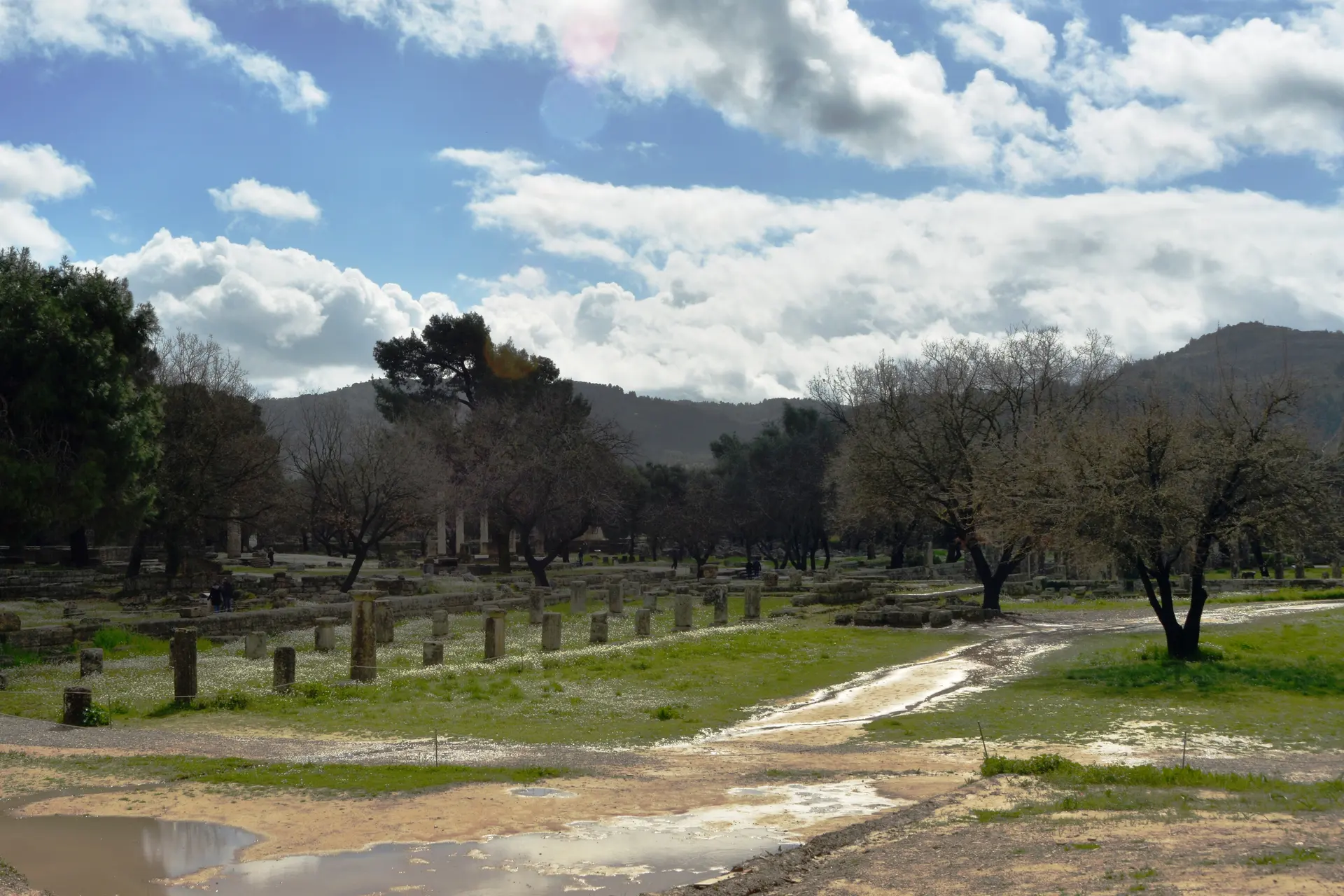
Image of Olympia. Image source · CC-BY-SA-4.0
Visit essentials
A quick read before you go
- Duration
- Three to four hours for the archaeological site and museum combined is a minimum.
- Access
- Olympia is located in Elis, in the western Peloponnese, approximately 300 km from Athens (about…
Overview
Olympia's quiet ruins occupy a pine-and-olive valley where the Kladeos meets the Alpheios River. This peaceful landscape once held the ancient world's most important sanctuary and drew tens of thousands of competitors, pilgrims, and spectators from across the Greek world.
For more than eleven centuries, physical excellence here became worship: athletes offered their effort to Zeus, and spectators witnessed a sacred act. The Games' Sacred Truce—the ekecheiria, when all Greek states laid down their weapons—was perhaps the ancient world's most remarkable act of collective reverence. Phidias's seated chryselephantine Zeus, housed in the great temple dominating the Altis, ranked among the Seven Wonders.
Earthquakes and imperial edicts brought down the temples, and river silt covered the ruins, but Olympia was never entirely forgotten. Systematic excavation since 1829 has revealed one of the most complete pictures we have of a Panhellenic sanctuary. Now a UNESCO World Heritage Site, Olympia is also where the Olympic flame is lit before every modern Games, in a Temple of Hera ceremony that carries fire from the ancient valley to stadiums worldwide.
Why this place is sacred
What makes a place thin — permeable to something beyond the ordinary — is not always dramatic. Sometimes it is the quiet accumulation of intention across centuries. Olympia was a sacred precinct for more than eleven hundred years. Generation after generation of Greeks came to this valley not merely to watch athletes run and wrestle but to participate in an act of worship that placed the human body at the center of the divine encounter.
The Altis, the sacred grove that formed the heart of the sanctuary, was a temenos — a space cut off from the profane world and dedicated entirely to the gods. Within its boundaries stood temples, altars, treasuries, and statues in a density that visitors described as overwhelming. The Great Altar of Zeus, built from the accumulated ash of centuries of sacrifice, rose to a height of seven meters — a monument constructed entirely from the residue of devotion.
But the thinness of Olympia lies not only in its religious architecture. It lies in the idea that animated the place: that the striving of the body could be an offering, that the pursuit of excellence was itself a form of prayer, and that this pursuit required the suspension of conflict. The Sacred Truce was not metaphor. It was practice.
Messengers called spondophoroi traveled across Greece announcing the truce, and for its duration — initially one month, eventually three — all hostilities ceased. Wars paused. Armies withdrew. The sacred made room for itself in the world.
Today the ruins are quiet. The temples are columns and foundations. The stadium is an open field. But the thinness persists in the way the landscape holds its history — in the enormous fallen column drums of the Temple of Zeus that visitors can touch, in the stone starting blocks still visible in the stadium, in the tunnel through which athletes walked from the changing rooms to the arena, the same passage that visitors walk today.
Olympia was established as a sanctuary of Zeus, king of the Olympian gods, with cult activity dating to at least the tenth century BC. The site served as the premier Panhellenic sacred precinct — a place where all Greeks, regardless of city-state allegiance, could worship together. The Olympic Games, traditionally dated to 776 BC, emerged as the central expression of this worship: athletic competition understood as an offering to Zeus, accompanied by sacrifice, oath-taking, and the proclamation of sacred peace.
From its origins as a regional cult site, Olympia grew to become the most important gathering place in the Greek world. City-states built treasuries in the Altis to display their wealth and devotion. The Temple of Zeus, completed in 457 BC, housed Phidias's colossal chryselephantine statue — a work of such power that ancient visitors reported feeling themselves in the presence of the god.
The Games expanded from a single footrace to a five-day festival of athletics, sacrifice, and cultural competition. Roman emperors appropriated and eventually suppressed the site; Theodosius I abolished the pagan festivals in 393 AD, and Theodosius II ordered the temples destroyed in 426 AD. Earthquakes in 522 and 551 AD completed the physical destruction, and river sediment buried the ruins for centuries. French and then German excavators, beginning in 1829 and 1875 respectively, gradually uncovered the site.
In 1936, Carl Diem introduced the Olympic flame-lighting ceremony at the Temple of Hera, creating a modern ritual that connects the ancient sanctuary to the contemporary Olympic movement. UNESCO inscribed the site in 1989.
Experience and orientation
Begin at the Altis, the sacred precinct. The path enters through pine trees into a landscape of ruins that are immediately legible and persistently mysterious. The Temple of Zeus is the first overwhelming presence — not because the building stands, but because its fallen columns communicate scale in a way that standing columns do not. The drum of a single column lies on its side at a height taller than most visitors. You can place your hand on the fluting.
The stone is warm. The temple that once held one of the Seven Wonders of the Ancient World is now a field of massive cylinders toppled by earthquake and time, and somehow this is more eloquent than restoration could ever be.
Nearby, the Temple of Hera — the Heraion — is older and smaller, its columns a mix of stone replacements from different centuries. This is where the Olympic flame is lit before each modern Games. A simple altar marks the spot where the High Priestess uses a parabolic mirror to focus the sun's rays and ignite the torch. There is nothing theatrical about the site between ceremonies.
It is simply an ancient temple with an altar, and that simplicity is part of its power.
Walk past the Philippeion, the circular memorial built by Philip II of Macedon after his victory at Chaeronea, and past the row of treasury foundations that line the terrace above the Altis. Each treasury once held offerings from a different city-state — Megara, Gela, Syracuse, Cyrene — a marble testament to the pan-Hellenic reach of this place.
Then come to the tunnel. The krypte esodos, the vaulted passage that connects the sanctuary to the Stadium, is the most concentrated moment at Olympia. The passage is narrow, stone-walled, partially roofed. You walk through it as athletes walked through it — leaving the sacred precinct and entering the arena. The transition is physical and unmistakable. The enclosed darkness of the passage gives way to the open field of the Stadium, and the scale shifts suddenly from intimate to vast.
The Stadium held 45,000 spectators. No seats remain — they sat on the embankments — but the space itself communicates its capacity. The stone starting blocks, grooved for the runners' toes, survive at the western end.
Stand in the Stadium. The embankments rise on either side. The running surface stretches 192 meters — one stadion, the unit of measurement that gave us the word. Try to hold in mind that this was not secular space. The athletes who ran here were making an offering. The spectators who watched were witnessing worship.
The Archaeological Museum, a short walk from the site, deserves as much time as the ruins themselves. The pediment sculptures from the Temple of Zeus — the battle of the Lapiths and Centaurs, the chariot race of Pelops — are among the finest surviving works of Greek sculpture. The Nike of Paionios descends from heaven on her pedestal. The collection of ancient bronzes is the richest in the world.
And in a separate room, the workshop of Phidias: the molds, tools, and a small cup inscribed with the words 'I belong to Phidias' — perhaps the most personal artifact from the ancient world.
Allow a full morning or afternoon: at least three to four hours for the site and museum combined. Enter early if visiting in summer to avoid the midday heat. The site is expansive and mostly unshaded. Carry water. Walk through the Altis first, then the Stadium, then the Museum. Do not rush the athletes' tunnel — it is the moment where past and present overlap most completely. In the Museum, the Temple of Zeus pediment sculptures reward sustained attention.
Context and lineage
The mythological origins of Olympia weave several threads. In one account, Heracles founded the Olympic Games in honor of his father Zeus after completing his twelve labors, measuring out the stadium with his own feet and planting the sacred olive tree from which victory wreaths would be cut, brought from the land of the Hyperboreans.
In another tradition, Zeus himself established the site's sacred character by defeating his father Kronos in a wrestling match at Olympia, claiming dominion over the cosmos at this very spot.
The most humanly resonant origin story belongs to Pelops, the hero whose name gave the Peloponnese its own. Pelops arrived at Olympia to win the hand of Hippodamia, daughter of King Oinomaos, who challenged each suitor to a chariot race and killed those he defeated. Through courage, cunning, or divine favor — the sources disagree — Pelops won the race and the bride.
The chariot race at the Olympics commemorated this founding contest, and the Pelopion, a sacred enclosure within the Altis, honored Pelops with chthonic rites that predated the worship of Zeus.
Archaeologically, the site shows cult activity from the tenth century BC, with the earliest dedications — bronze figurines of horses, warriors, and cattle — suggesting worship of a deity associated with fertility and pastoral life before Zeus claimed primacy.
Olympia's sacred lineage begins with pre-Olympian cult activity in the tenth century BC and extends through the establishment of the Olympic Games in 776 BC. For over eleven centuries, the site served as the supreme sanctuary of Zeus and the gathering point for all Greeks during the quadrennial festival. The Roman period brought appropriation and decline; the Christian era brought suppression and destruction. Earthquakes and river sediment sealed the site for centuries.
The modern lineage begins with French excavations in 1829 and German systematic work from 1875, continuing to this day. The flame ceremony, inaugurated in 1936, created a new ritual continuity — carrying fire from the ancient altar to the modern Games, linking Olympia's past to a global present. UNESCO inscription in 1989 formalized the site's universal significance.
Phidias
The Athenian sculptor who created the chryselephantine (gold and ivory) statue of Zeus at Olympia around 435 BC. Seated on an elaborate throne inside the Temple of Zeus, the statue rose nearly 13 meters and was counted among the Seven Wonders of the Ancient World. Ancient visitors reported that beholding the statue was to stand in the presence of the god himself. Phidias's workshop was discovered during excavations, complete with his tools and a cup bearing his name.
Libon of Elis
The architect who designed the Temple of Zeus, completed between 470 and 457 BC. The largest Doric temple in the Peloponnese — measuring 64 by 28 meters with 13 columns on the long sides and 6 on the short — it was the architectural masterpiece that housed Phidias's statue and defined the sacred landscape of the Altis for nearly a millennium.
Ernst Curtius
The German archaeologist and classical scholar who, beginning in 1875, led the systematic excavation of Olympia on behalf of the German Archaeological Institute. His methodical approach — mapping, documenting, and preserving rather than treasure-hunting — set a standard for archaeological practice and revealed the sanctuary's full plan for the first time in over a thousand years.
Carl Diem
The German sports administrator who conceived the Olympic flame relay for the 1936 Berlin Olympics, creating the ceremony in which the flame is lit at the Temple of Hera at Olympia using a parabolic mirror and carried by runners to the host city. Despite the ceremony's politically fraught origins, it became the modern world's most recognizable ritual link to the ancient sanctuary.
Emperor Theodosius I
The Roman emperor who, in 393 AD, issued an edict abolishing pagan festivals throughout the empire, ending over a thousand years of Olympic Games. His decree marked the formal break between Olympia's sacred function and its subsequent fate as an abandoned, and eventually buried, ruin.
Traditions and practice
The Olympic Games were not primarily an athletic event. They were a religious festival dedicated to Zeus, and every element of the five-day program was saturated with sacred significance. On the first day, athletes swore an oath before the statue of Zeus Horkios, standing on slices of boar's flesh and pledging to compete fairly. Judges and trainers took a parallel oath.
The second day saw the hecatomb — the sacrifice of one hundred oxen on the Great Altar of Zeus, an enormous structure built entirely from the compacted ash of previous sacrifices, rising seven meters above the ground.
The athletic contests themselves occupied the central days: the stadion footrace, the diaulos (double stadion), the dolichos (long distance), wrestling, boxing, the pankration, the pentathlon, and chariot and horse racing in the hippodrome. Victors did not receive prizes of monetary value. They received an olive wreath cut from the sacred tree said to have been planted by Heracles, and they were crowned in a ceremony that took place at the Temple of Zeus.
To be crowned at Olympia was to receive the highest honor the Greek world could confer.
The Sacred Truce, proclaimed before each festival by heralds called spondophoroi, forbade all military operations that might interfere with travel to and from Olympia. The truce was respected across the Greek world for centuries — a remarkable demonstration of the sacred's capacity to interrupt the political.
The Olympic flame-lighting ceremony is Olympia's sole living ritual. Before each modern Olympic Games, a group of women dressed as ancient priestesses gathers at the Temple of Hera. The High Priestess invokes Apollo and uses a parabolic mirror to focus the sun's rays onto a torch. The flame ignites, is transferred to a runner, and begins its journey to the host city.
The ceremony is choreographed and official, yet it retains a quality that exceeds its staging: real fire from a real sun at a real ancient altar, sent across the world to light the cauldron of the Games. It is the closest thing the modern world has to a pan-Hellenic ritual.
Ongoing archaeological research and conservation, conducted primarily by the German Archaeological Institute, represent another form of sustained practice at the site — the careful, disciplined uncovering of what time has buried.
Walk the athletes' tunnel slowly. This is not a corridor but a threshold — the passage between the sacred precinct and the arena, between preparation and performance. Pay attention to the moment when the enclosed stone gives way to open sky and the Stadium appears. This is the experience every ancient athlete had.
In the Stadium, stand at the stone starting blocks. Place your feet where runners placed theirs. The grooves are shallow, worn by centuries of bare feet. Consider that the runners who stood here understood their effort as worship — not metaphorically, but literally.
At the Temple of Hera, find the flame altar. Stand quietly. Whether or not a ceremony is taking place, you are standing at the point where the ancient and modern Olympic traditions meet in actual fire.
In the Museum, spend time with the pediment sculptures of the Temple of Zeus. The east pediment shows the moment before the chariot race of Pelops — figures standing in absolute stillness before an act of total commitment. The west pediment shows the battle of the Lapiths and Centaurs — the struggle between civilization and chaos. Between these two pediments, the whole meaning of Olympia is contained.
Ancient Greek Religion — Cult of Zeus
HistoricalOlympia was the supreme Panhellenic sanctuary of Zeus, king of the Olympian gods. The Altis contained the most concentrated collection of temples, altars, and treasuries in the Greek world. The Temple of Zeus housed the chryselephantine statue by Phidias — one of the Seven Wonders. The Olympic Games, held every four years from 776 BC to 393 AD, were a religious festival to Zeus in which athletic competition was understood as worship.
Ancient Greek Religion — Cult of Hera
HistoricalThe Temple of Hera (Heraion) is the oldest temple at Olympia. Hera, wife of Zeus, was worshipped alongside him at the sanctuary. The Heraia — athletic games for women — were held at a separate time from the men's Olympics. The Heraion is now the site of the modern Olympic flame-lighting ceremony.
Modern Olympic Flame Ceremony
ActiveBefore each modern Olympic Games, the Olympic flame is lit at the Temple of Hera at Olympia using a parabolic mirror to focus sunlight. This ceremony, introduced by Carl Diem for the 1936 Berlin Olympics, has become the most recognizable ritual link between the ancient sanctuary and the modern world. Despite the politically fraught context of its origin, the ceremony transcends its history to function as a genuine transmission of sacred fire from the ancient site to the global present.
Perspectives and open questions
Olympia can be understood as an archaeological site, a cultural monument, a birthplace of an ideal, or a place where the sacred expressed itself through the body. Each perspective reveals something the others miss.
Scholarly perspective
Archaeological and historical consensus recognizes Olympia as one of the two most important Panhellenic sanctuaries, alongside Delphi. The German Archaeological Institute's excavations, ongoing since 1875, have produced one of the most thoroughly documented sites in the ancient world. Scholarly understanding emphasizes the primarily religious character of the Olympic Games — a corrective to the modern tendency to see them as a purely athletic tradition.
The Temple of Zeus and its chryselephantine statue by Phidias represented the height of Classical Greek religious art and architecture.
Living and traditional perspectives
For modern Greeks, Olympia is the birthplace of the Olympic ideal — the pursuit of arete, excellence, not for personal glory but in service of something greater. The continued lighting of the Olympic flame at Olympia before each modern Games maintains a connection between contemporary Greece and the deepest layer of its heritage. The flame ceremony is not mere pageantry; it is experienced as a genuine transmission, a living thread between the ancient sanctuary and the modern world.
Greek archaeological and cultural authorities treat Olympia as one of the nation's most significant heritage sites, a status reflected in ongoing investment in conservation and presentation.
Alternative interpretations
Some visitors and writers interpret Olympia through the lens of embodied spirituality — the idea that the ancient Greeks understood something about the relationship between physical effort and sacred experience that the modern world has largely lost. The concept of the Sacred Truce resonates with contemporary peace movements as evidence that sacred authority could, at its best, interrupt political violence.
The unity of athletics and worship at Olympia has influenced modern movements that understand physical practice — yoga, martial arts, endurance sport — as a form of contemplation.
Open questions
The exact appearance of the chryselephantine Zeus — one of the Seven Wonders — is known only from coins, gems, and literary descriptions. No fragment of the statue has ever been identified with certainty. The precise rituals of the Mysteries of Pelops, a chthonic cult at the Pelopion that predated the worship of Zeus, are only partially documented.
How the Sacred Truce was enforced across hundreds of independent city-states — many of them at war — remains one of the most remarkable and incompletely explained achievements in the ancient world. And the question of whether the traditional date of 776 BC for the first Games reflects historical reality or later mythologizing continues to generate scholarly debate.
Plan your visit
Access and arrival
Olympia is located in Elis, in the western Peloponnese, approximately 300 km from Athens (about 4 hours by car via the motorway through Corinth and Patras). KTEL bus service runs from Athens to Pyrgos, with connecting buses to Olympia. Summer hours are typically 8:00 AM to 8:00 PM; winter hours 8:30 AM to 3:30 PM. Combined admission ticket covers site and museum. The museum is fully accessible; the archaeological site has uneven terrain with limited wheelchair-friendly paths. Mobile signal available.
The town of Olympia has full services including medical facilities, ATMs, and restaurants.
The modern town of Olympia, adjacent to the archaeological site, offers a range of hotels and guesthouses at all price levels. For a more immersive experience, staying overnight allows an early-morning visit to the site at opening. Pyrgos, the nearest city (20 km west), has additional accommodation options. Coastal resorts along the Ionian Sea at Kaiafas and Zacharo are 30-40 km west.
Respectful visit
No formal dress code. Comfortable walking shoes are essential — the site is extensive and the terrain uneven. In summer, sun protection is critical: hat, sunscreen, lightweight clothing. In winter, layers and waterproof footwear are advisable.
Photography is freely permitted throughout the archaeological site. In the Archaeological Museum, photography without flash is allowed. Tripods may be restricted during busy periods. No drone photography without special permit.
Not applicable. Olympia is an archaeological site, not an active place of worship. No offerings should be left at the ruins.
Stay on designated paths. Do not climb on ruins, columns, or temple foundations. Do not remove stones, pottery fragments, or any material from the site. The Stadium starting blocks and other fragile features should be observed but not touched. Guided tours and educational groups should follow site management instructions.
The flame-lighting ceremony, held before each Olympic and Paralympic Games, is an official event with restricted access. It is not open to general visitors. Check the Olympic cycle if you hope to witness a ceremony from a distance. The archaeological site is exposed to sun and heat in summer; carry water and wear sun protection. Do not climb on ruins or remove any material from the site.
Current practical details
Address
Πρ.Κονδύλη και, Χ.Κοσμοπούλου 1, Archea Olimpia 270 65, Greece
Phone
Hours
Hours, fees, and access can change — verify on the official source before you travel. Practical details last checked Jun 2026.
Location
Map loads as you approach this section.
Pilgrim reflections
A portrait of encounter, not a score
Pilgrims describe what they felt, how present they could become, and whether the place would shape a journey. There are no stars and no ranking of traditions.
No reviewed reflections yet
The first pilgrims can help describe the character of being here.
Share a reflection
Available after an account-backed “Been there.” Every reflection is reviewed before publication.
Nearby sacred places
Explore other sacred places in the region. Proximity does not establish access or travel time; check each place’s guidance.

Temple of Apollo Epicurius at Bassae
Bassae, Oichalia, Messenia, Peloponnese, Greece
33.2 km away

Sanctuary of Artemis Orthia
Sparta, Laconia, Peloponnese, Greece
94.2 km away
Mycenae
Municipal Unit of Mykines, Peloponnese, Greece
99.6 km away

Monastery of Saint Gerasimos, Kefalonia
Omala, Kefalonia, Ionian Islands, Greece
108.6 km away
References
Sources consulted for this page. Source categories describe the publication, not a guarantee that every claim is verified. Traditional accounts and outside interpretations may differ.
- 01Archaeological Site of Olympia — UNESCO World Heritage Centre — UNESCOofficialOfficial UNESCO listing
- 02Temple of Zeus, Olympia — Smarthistory — SmarthistoryacademicArt history academic resource
- 03Olympia | History & Facts — Britannica — Encyclopaedia BritannicaacademicAuthoritative encyclopedic source
- 04Olympic History — Olympics.com — International Olympic CommitteeofficialIOC official history
- 05The Lighting of the Olympic Flame — World Heritage Journeys — World Heritage Journeys of EuropeofficialDetails of the flame-lighting ceremony
- 06Archaeological Museum of Olympia — Ancient Olympia MuseumguideOfficial museum site
- 07Olympia, Greece — Wikipedia — Wikipedia contributorsencyclopediaComprehensive overview
Share a photo
Help visitors recognize Olympia. Every submission is reviewed before publication.