Oinoanda
Where an ancient philosopher carved his cure for human suffering into a city's walls — 299 fragments of Epicurean wisdom in Lycian mountain stone
Understand sacred places, explore living traditions, and learn how to engage respectfully with Pilgrim Map.
Access has not been verified. Check current local guidance before planning a visit.
Muğla, Turkey
Read the sources
Visit essentials
A quick read before you go
- Duration
- 3–4 hours total: 40–60 minutes for the ascent, 90–120 minutes on site, 30–40 minutes for…
- Access
- From İncealiler village, off the Fethiye–Antalya highway via Seki.
Overview
In the second century AD, the wealthy elderly Diogenes of Oenoanda believed most humanity suffered unnecessarily because Epicurus's four-centuries-old cure was not widely known. He paid to carve it across the rear wall of his city's public stoa in letters readable from across the square. Covering an estimated 260 square metres, the inscription addressed mortality, pleasure, fear of the gods, and the good life. It explicitly welcomed strangers as a gift to anyone passing through.
Oinoanda is not sacred in the conventional sense: no deity was worshipped here and no historical pilgrimage route reached it. Yet for someone carrying existential anxiety, a two-thousand-year-old philosophical prescription addressed to future generations can feel like a text waiting for them.
The city occupied a hilltop in the Kibyratis region of present-day southwestern Turkey. Its walls stand up to ten metres in places, and the marble agora floor remains underfoot. Archaeologists have recovered 299 inscription fragments; scholars estimate that fewer than half the original total have been found, and excavation continues.
Why this place is sacred
The thinness of Oinoanda — if that term can be applied to a place associated not with divinity but with philosophy — arises from the directness of the encounter it enables. Diogenes wrote in the inscription that he was motivated by compassion for 'the vast majority of people' who suffered needlessly. He was old and ill. He could have left his money to his family or his city's building projects.
Instead he endowed something that could not be housed or sold: a public statement about the nature of happiness, addressed explicitly to future generations.
Two thousand years later, those future generations can stand on the marble floor of the agora where the stoa once stood, hold a photograph of a recovered fragment, and read those words. The temporal compression this produces is extraordinary. Most ancient texts reach us through chains of copying, translation, and scholarly mediation. At Oinoanda the text is still partly in the wall. The stones are still there, in the ground, waiting to be found.
The Epicurean philosophy itself deepens the experience: Epicurus taught that the fear of death was the root of most human suffering — because it made people pursue power, wealth, and status as shields against mortality. Diogenes' inscription addresses this directly. Standing in the ruins of a city that no longer exists, contemplating a wall inscription that was meant for people who have long since died, a visitor encounters the Epicurean argument in lived form rather than abstract proposition.
The inscription was commissioned by Diogenes of Oenoanda as a public philosophical monument — a gift to citizens, visitors, and future generations — containing the core of Epicurean teaching on happiness, freedom from fear of the gods and death, and the proper understanding of pleasure. The city itself served as a market and administrative centre for the Kibyratis tetrapolis.
The inscription was carved in the 2nd century AD. The city declined and was eventually abandoned, probably in Late Antiquity. The inscription stones were broken apart and reused in later construction, or fell with the collapsing walls. Systematic scholarly attention began in 1884 when the epigraphist J.J. Coulton discovered fragments. Excavations since 1997, intensified under the German Archaeological Institute from 2009, continue to recover new fragments and revise understanding of the inscription's original scope.
Experience and orientation
The approach matters. From İncealiler village a waymarked path climbs through pine forest for approximately 500 metres — steep enough that most visitors stop to catch breath, not steep enough to deter anyone in reasonable health. The forest closes around the path, the sounds of the village recede, and by the time the first city wall appears, the walker has been sufficiently separated from ordinary time to receive what comes next.
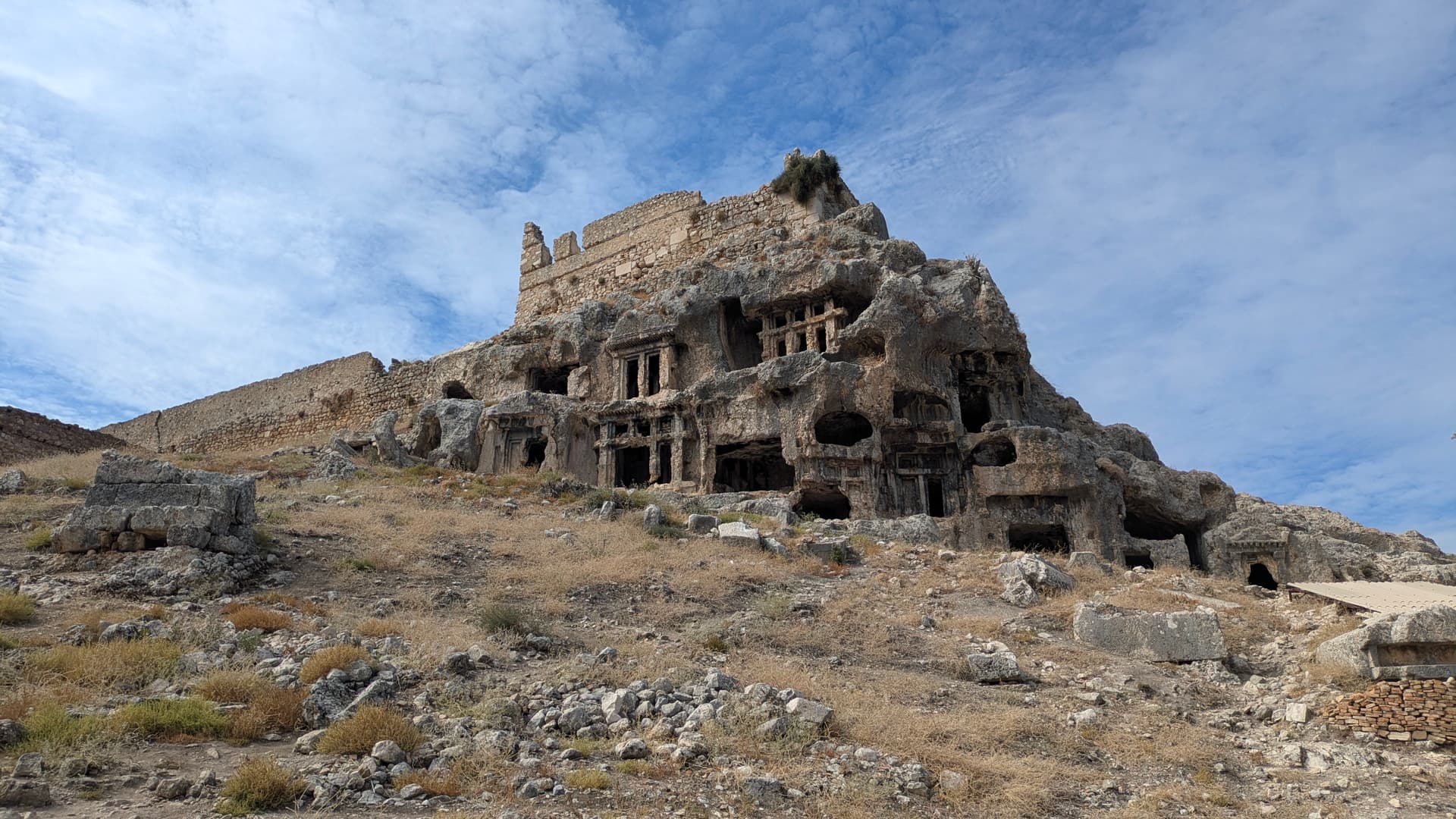
The city wall is still substantial — up to ten metres in places. Entering through a gap, the ground levels onto the marble floor of the agora. The Esplanade, as excavators call it, is open to the sky with long views southeast across the Eşen Valley. In spring the surrounding hills are green; in summer the scrub and rock are dry and the cicadas audible from within the walls.
The inscription stones are encountered gradually as you move through the site. Some are in situ, partially legible. Some are visible where they fell, incorporated into later rubble walls. The most significant fragments have been documented and are reproduced in scholarly publications that a prepared visitor can carry.
To read even a fragment of Diogenes' text here — 'I wish to use this stoa to put on display publicly the medicines that bring salvation' — is to encounter a voice that was specifically intending this encounter with you.
The site has no facilities, no signage to speak of, no cafe, no ticket booth. The level of solitude on most visits is considerable. The lack of interpretive infrastructure places the full weight of the experience on preparation — visitors who arrive having read about Diogenes and Epicurean philosophy receive a qualitatively different encounter than those who arrive without context.
Arrive from İncealiler village on the waymarked path. Allow 30–45 minutes for the ascent. On the hilltop, begin at the main agora (Esplanade) where the stoa originally stood, then move through the remaining structures — bathhouse, theater, walls — before returning via the same path. Carry the Smith/Martin fragment catalogue or a photocopy of key fragments if possible.
Context and lineage
The city was founded by colonists from Termessos, according to inscriptions, and became one of the four cities of the Kibyratis tetrapolis alongside Kibyra, Balboura, and Bubon. It occupied a defensible highland position with access to fertile valley land and commanded a route through the mountains of what is now Muğla Province. Under Roman rule it enjoyed a period of prosperity typical of such secondary Anatolian cities — substantial public buildings, city walls, agora, baths, theater, and aqueduct.
In the 2nd century AD the elderly Diogenes, describing himself as unwell and near death, undertook an act without parallel in the ancient world: he paid for the entire rear wall of the city's stoa to be inscribed with Epicurean philosophy. The inscription is organised into sections on ethics, physics (the nature of the universe), and the nature of old age. It includes letters to named individuals, polemic against rival philosophical schools, and direct addresses to the reader.
Its estimated original length was 65–80 metres; scholars have recovered 299 fragments and believe fewer than half the total survive.
Hellenistic city founded by Termessian colonists → member of the Kibyratis tetrapolis → Roman period flourishing (1st–3rd century AD) → Diogenes inscription commissioned (2nd century AD) → city decline and abandonment (Late Antiquity) → first scholarly attention (19th century) → systematic excavation from 1997 → ongoing DAI excavation
Diogenes of Oenoanda
2nd-century AD Epicurean philosopher and wealthy citizen who commissioned and funded the great stoa inscription, intending it as a public gift to citizens, visitors, and future generations
J.J. Coulton
British archaeologist who directed early systematic excavations at the site beginning in 1997, significantly advancing scholarly understanding of the city plan
Martin Ferguson Smith
Principal epigraphist whose editions and translations of the Diogenes inscription constitute the primary scholarly resource for all subsequent work
German Archaeological Institute (DAI)
Institution directing excavations from 2009 onward that have continued to recover new inscription fragments and document the city plan
Traditions and practice
In antiquity, Oinoanda maintained temples and the full apparatus of Graeco-Roman civic religion. These practices are long extinct. The city also had an oracle tradition — a spring associated with divination — though this is not well documented. The inscription itself was not a religious monument but a philosophical one.
Excavation campaigns by the German Archaeological Institute run annually in summer months. Academic scholars visit to study the inscription fragments, some of which remain in situ while others have been moved to the Fethiye Museum. Enthusiasts of Epicurean and Stoic philosophy increasingly make informal pilgrimages to the site.
Arrive having read at least one substantial account of the Diogenes inscription — Martin Ferguson Smith's translations are available in scholarly editions, and several accessible summaries exist. The experience of reading a fragment in situ, or tracing the approximate location of the stoa wall against the recovered plan, depends on this preparation.
On the agora floor, face where the stoa stood — its rear wall rose behind the colonnade, visible from the open square. Consider that this is where anyone who came to buy or sell, to conduct business, to meet their neighbours, would have been confronted by the inscription. It was not in a temple or a library. It was in the most public space in the city.
Sit on a stone in the agora and read from the inscription: 'Do not avoid entering our city if you are a stranger. For we shall welcome you generously.' These words were carved here for you. Allow that directness to land.
Epicurean Philosophy
HistoricalOinoanda preserves the largest known ancient philosophical inscription, commissioned in the 2nd century AD by Diogenes of Oenoanda to spread Epicurean teachings on happiness, freedom from fear of death and the gods, and the nature of the good life. 299 fragments are known; the inscription originally covered approximately 260 square metres of stoa wall.
No living practice. The inscription is studied by classical scholars and visited by modern Epicurean enthusiasts. Academic editions and translations make the text accessible to non-specialists.
Archaeological and Scholarly
ActiveOngoing excavation by the German Archaeological Institute recovers new inscription fragments and documents the city plan. Oinoanda is one of the most important sites for Hellenistic and Roman period epigraphy in the Mediterranean world.
Annual excavation campaigns; fragment documentation; epigraphic study; publication in international classical journals.
Perspectives and open questions
Oinoanda is understood differently depending on whether one approaches it as a classical archaeologist, an Epicurean philosophical tradition, or a visitor seeking direct encounter with ancient wisdom. Each angle illuminates something the others miss.
Scholarly perspective
For classical scholars, Oinoanda is a site of exceptional importance because of a single text. The Diogenes inscription is the most extensive surviving body of Epicurean writing — Epicurus' own major works are lost in their original form, and knowledge of Epicurean philosophy depends heavily on secondary sources. What Diogenes carved here, including direct quotations from and discussions of Epicurus and other Epicurean thinkers, provides irreplaceable primary evidence.
The ongoing recovery of new fragments continues to revise scholarly understanding of Epicurean ethics, physics, and rhetoric. The city's archaeology is secondary to this textual significance.
Living and traditional perspectives
No living religious tradition is associated with the site. The Epicurean philosophical school, to which Diogenes belonged, understood itself not as a religion but as a therapy — a systematic practice for reducing suffering through correct understanding of nature and human psychology. Modern practitioners of Epicurean philosophy, a growing community internationally, treat the site with something approaching pilgrimage devotion.
Alternative interpretations
Some readers of the inscription have noted that Diogenes' stated motivation — compassion for the suffering of the majority, combined with a willingness to spend his wealth on a gift to future generations — shares structural features with certain Buddhist and Bodhisattva ideals. This cross-traditional reading is not mainstream scholarship but is not without textual basis in the inscription itself.
Open questions
The total original extent of the inscription remains unresolved: scholars estimate 65–80 metres in length across the stoa wall, but fewer than half the estimated fragments have been recovered. Significant portions may still be buried or may have been destroyed in post-antique stone robbing. The full text — which scholars believe included a substantial section on old age still not recovered — may never be reconstructed.
Plan your visit
Access and arrival
From İncealiler village, off the Fethiye–Antalya highway via Seki. Drive to İncealiler, park at the village, follow waymarked path uphill to the site. No admission fee. No facilities at site or on the approach path. Bring water, food, and sun protection. Mobile phone signal is unreliable at the site — inform someone of your itinerary before ascending. No emergency services accessible without descending to the village.
No accommodation in İncealiler village. Nearest options in Seki (~10 km) or Fethiye (~50 km). Day trip from Fethiye or Ölüdeniz is feasible. Camping is possible in the surrounding forest if self-sufficient.
Respectful visit
No religious dress requirements. Sturdy footwear is essential given the steep approach and uneven terrain across the hilltop.
Permitted throughout. Do not touch inscription stones while photographing. Raking light (early morning or late afternoon) makes carved letters more legible in photographs.
Not applicable.
Do not touch, trace, or lean against inscription stones. Do not move any stone fragment. Stay on established paths through the site. Do not remove any material.
The 500-metre ascent is steep and requires sturdy footwear. The site is fully exposed and offers no shade in summer — carry sufficient water. Inscription stones are irreplaceable; do not touch or lean against them. The site has no mobile signal in most areas.
Location
Map loads as you approach this section.
Pilgrim reflections
A portrait of encounter, not a score
Pilgrims describe what they felt, how present they could become, and whether the place would shape a journey. There are no stars and no ranking of traditions.
No reviewed reflections yet
The first pilgrims can help describe the character of being here.
Share a reflection
Available after an account-backed “Been there.” Every reflection is reviewed before publication.
Nearby sacred places
Explore other sacred places in the region. Proximity does not establish access or travel time; check each place’s guidance.


References
Sources consulted for this page. Source categories describe the publication, not a guarantee that every claim is verified. Traditional accounts and outside interpretations may differ.
- 01Oenoanda - Wikipedia — Wikipedia contributorsencyclopediaMain reference for history, inscription, and excavation
- 02In Search of a Philosopher's Stone — Archaeology MagazineacademicFeature on Diogenes inscription; July/August 2015
- 03Epicurean Inscription at Oinoanda — Durham Centre for Ancient and Medieval PhilosophyacademicAcademic project studying the inscription fragments
- 04Diogenes of Oenoanda - Wikipedia — Wikipedia contributorsencyclopediaBiography and philosophical context of the inscription's author
- 05The Epicurean Inscription of Diogenes of Oinoanda: Ten Years of New Discoveries and Research — Bryn Mawr Classical ReviewacademicScholarly review covering new fragment discoveries through 2016
- 06Ancient Lycian City of Oinoanda — Lycian MonumentsguideSite description and practical visitor notes
- 07OINOANDA - slowtravelguide — Slow Travel GuideguideDetailed visitor access and terrain description
- 08Oioanda Ancient City — ArticHaeologyguideOverview of site structures and history
Pilgrim glossary
- Bodhisattva
- An enlightened being who postpones full nirvana to help others toward awakening.
Share a photo
Help visitors recognize Oinoanda. Every submission is reviewed before publication.