Nysa
Where Dionysus was raised and Strabo learned to read the world
Understand sacred places, explore living traditions, and learn how to engage respectfully with Pilgrim Map.
Access has not been verified. Check current local guidance before planning a visit.
Aydın, Turkey
Read the sources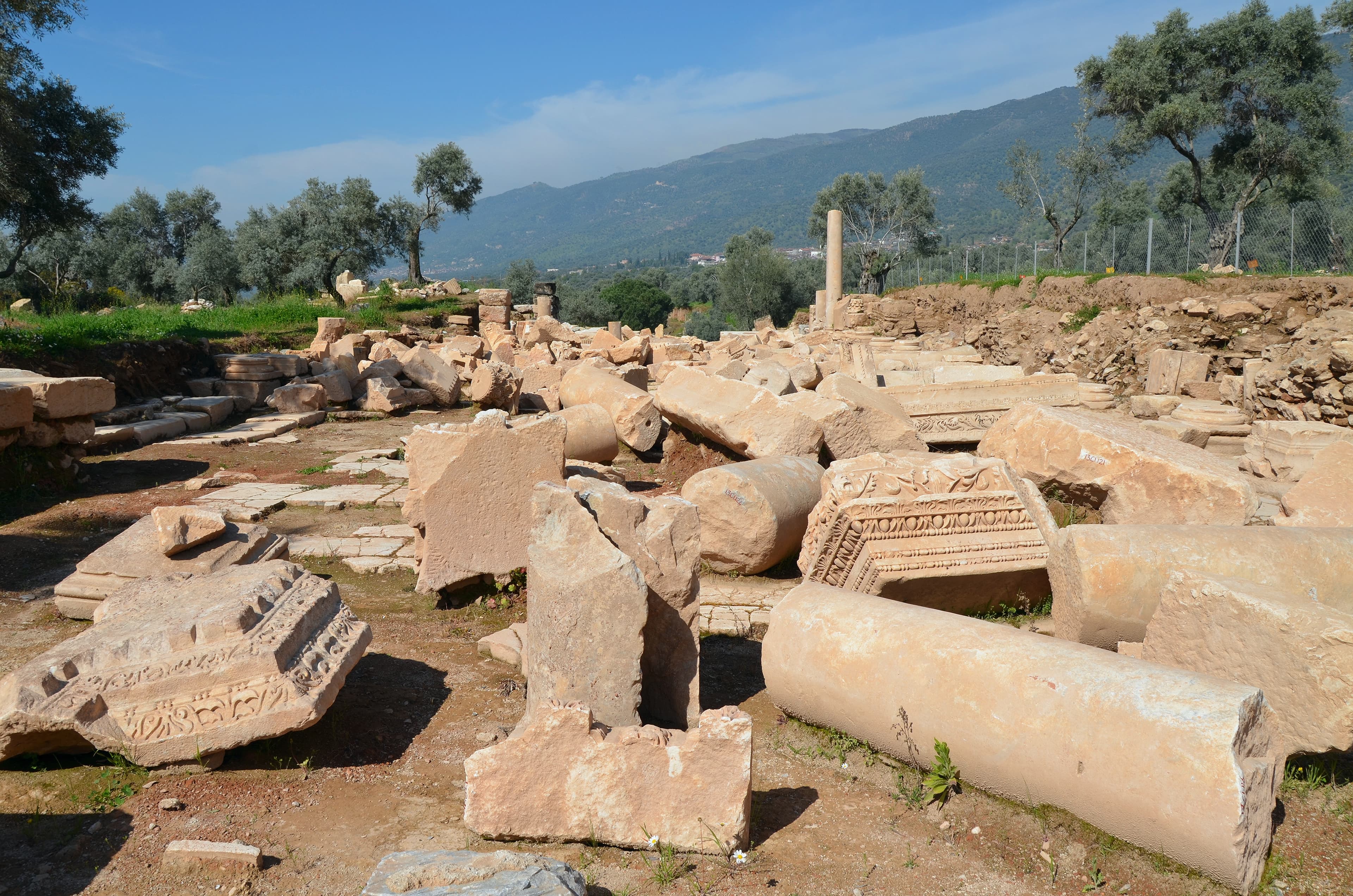
Image of Nysa. Image source
Visit essentials
A quick read before you go
- Duration
- 2–4 hours for a thorough visit covering the theater, gorge, library, and stadium.
- Access
- Nysa is located in Sultanhisar district, Aydın Province, approximately 50 km east of Ephesus…
Overview
Nysa joins dramatic landscape to dense mythological inheritance. Its name comes from the sacred mountain valley where Greek myth says nymphs secretly nursed the infant Dionysus; Homer mentions Nysa in the Iliad. By choosing it, the Maeander valley city's founders claimed a place in the primordial sacred geography of the god of wine, transformation, and the crossing between life and death.
Exceptional even among western Turkey's well-preserved ancient cities is the natural gorge cutting through Nysa's urban fabric. Engineers built through it: a vaulted tunnel carried the main road beneath the chasm while a bridge spanned it above. The ravine gives the city an otherworldly character, as though built at the edge between worlds.
The geographer Strabo studied here under the philosopher Aristodemus, so one foundational text of ancient geographical knowledge was partly shaped in this valley. Nysa's library is second only to Ephesus's Celsus Library for preservation in Turkey, making intellectual and sacred heritage inseparable. The theatre's Dionysiac friezes, still vivid after two thousand years, express the city's conscious pride in divine patronage.
Why this place is sacred
The mythological name 'Nysa' appears in Homer's Iliad, referring to the hidden mountain valley where divine nymphs raised the infant Dionysus after his miraculous double birth. When Antiochus I Soter named this city in the third century BCE — ostensibly for his wife Nysa — the mythological resonance was deliberate and understood.
A city bearing this name was placing itself within one of antiquity's foundational sacred geographies: the concealed, fertile, liminal valley where a god was born to the world in secret.
Dionysus was not merely a deity of festivity. In his chthonic dimension — as lord of transformation, intoxication, ecstatic release, and the dissolution of boundaries between the living and the dead — he presided over the deepest psychological and spiritual thresholds. At Nysa, this character was reinforced by the worship of Hades and Kore alongside him, making the sacred complex a genuine engagement with the underworld triad.
The city's coins bear his image; the theater's friezes portray him in processional glory. He was not an ornamental patron but the city's lived identity.
The gorge deepens this sacred character in ways that photographs fail to convey. Natural ravines in the ancient world were consistently understood as entries to the chthonic realm — places where the earth opened and the boundary with what lay beneath became permeable. The engineers who tunneled beneath it and bridged above it were not just solving a logistical problem; they were incorporating an axis mundi into the city's structure, a vertical threshold at its center.
The scholarly tradition adds another layer of sacred meaning. Strabo's presence here under Aristodemus suggests that Nysa was understood as a place of genuine philosophical formation, where the disciplines of mind and the presence of sacred mystery coexisted without contradiction — as they did for the ancient world in ways the modern separation of knowledge from sacred experience tends to obscure.
Civic-religious center under divine patronage of Dionysus, with Hades and Kore also venerated; also a center of Homeric scholarship and philosophical education.
From Hellenistic foundation through Roman civic flourishing, Nysa gradually shifted from active Dionysiac religious life toward Christian episcopal administration in the Byzantine period, before a final abandonment following Tamerlane's sacking in 1402 CE. Active archaeological excavation since 1990 represents the site's current life as a heritage and scholarly landscape.
Experience and orientation
Approach from the modern road through Sultanhisar and the site reveals itself gradually — the theater first, its tiered seats climbing the hillside above the Maeander plain, then the outlines of the library, the agora colonnades, the stadium's long curve. Unlike Ephesus, which processes visitors through a well-managed corridor, Nysa asks you to navigate at your own pace, to discover the gorge by walking toward it rather than being directed there.
The theater is where most visitors anchor their time, and rightly so. The Dionysiac friezes on its stage building are among the best-preserved examples of ancient theatrical religious art in Turkey — faces, foliage, processional figures that retain their original intention as sacred images, not merely decorative motifs.
Sit in the upper tiers on a spring morning when the valley is still cool and the Maeander plain below holds a light mist, and the scale of what the theater once contained — twelve thousand people gathered for a performance dedicated to the god who presided over the dissolution of ordinary consciousness — becomes imaginatively accessible.
The gorge demands unhurried attention. Walk to its edge and then into it, following the ancient road through the vaulted tunnel. Notice how the temperature shifts, how the sound changes, how the light narrows. The corbelled bridge overhead and the tunnel beneath were not merely engineering solutions; they were acts of symbolic architecture, placing the civic road at the crossing point between upper and lower worlds. Spend time here before moving on to the library.
The library structure — erected in the second century CE, contemporaneous with the Celsus Library at Ephesus — retains enough of its facade and interior organization to suggest the scale of its intellectual ambition. Strabo's education here was not incidental to Nysa's identity; knowledge and sacred mystery occupied the same civic landscape, taught by the same teachers.
Enter from the main archaeological access road near Sultanhisar. The theater is the first major structure encountered and serves as the natural starting point. From there, the gorge, library, and stadium form a loose circuit of approximately 2–3 km. Wear sturdy footwear; some paths are uneven. The site is open-air with minimal shade; bring water.
Context and lineage
Nysa was founded around the third century BCE by Antiochus I Soter, king of the Seleucid Empire, through a process of synoecism — the forced or voluntary merger of three pre-existing settlements: Athymbra (which had Bronze Age occupation), Hydrelos, and a third unnamed community. The king named the new city for his wife Nysa, but chose a name already laden with mythological resonance: in Greek tradition, Nysa was the sacred mountain valley where the nymphs secretly raised the infant Dionysus.
Multiple sites in the ancient world claimed this name, each asserting a connection to the god's origin; Antiochus's choice was culturally strategic as well as personal.
The city flourished under Hellenistic, then Roman, governance, reaching its architectural peak in the second century CE when the theater was enlarged to twelve thousand seats and the great library was constructed. The geographer Strabo was educated here under the philosopher Aristodemus — a detail Strabo records himself — making Nysa a documented site of the intellectual formation that produced one of antiquity's most important geographical texts. The city became a Christian bishopric under Byzantine rule.
It was sacked by Tamerlane in 1402 CE, after which it was not resettled.
Bronze Age Anatolian settlement at Athymbra → Hellenistic synoecism as Nysa under Seleucid rule (3rd c. BCE) → Pergamene Kingdom period → Roman civic expansion and architectural peak (2nd c. CE) → Byzantine Christianity and bishopric (4th–13th c. CE) → abandonment after Timurid sacking (1402 CE) → modern archaeological excavation (1990–present)
Antiochus I Soter
Seleucid king who founded Nysa through synoecism of three earlier settlements; named the city for his wife
Aristodemus
Philosopher-teacher at Nysa; tutor to the geographer Strabo
Strabo
Greek geographer who studied at Nysa under Aristodemus; his Geography is one of the foundational texts of ancient geographical knowledge
Vedat İdil
Led archaeological excavations at Nysa from 1990 to 2010, establishing the modern systematic study of the site
Volker Michael Strocka
Directed the excavation and study of the Nysa library building from 2002 to 2006
Serdar Hakan Öztaner
Current excavation director at Nysa since 2017, continuing the systematic study of the site's Hellenistic and Roman layers
Traditions and practice
The primary religious practice at Nysa was the Dionysiac tradition — theatrical performances dedicated to the god, civic processions, ritual wine consumption, and worship at the temenos sanctuary. The Dionysiac theater was not merely a venue for entertainment; performance in honor of Dionysus was a sacred act, a form of collective ritual in which the audience participated in the god's story through the tragic and comic re-enactment of human experience at its limits.
The theater's friezes depicting Dionysiac processions underscore this sacred function.
Alongside Dionysus, the cult of Hades and Kore (Persephone) was practiced — a chthonic triad that engaged with the underworld, the cycle of death and renewal, and the mysteries of the boundary between the living and the dead. The scholarly tradition was itself a form of sacred practice in the Hellenistic world: philosophical education under teachers like Aristodemus was understood as the cultivation of the soul alongside the cultivation of the mind.
No active religious practice takes place at Nysa. The site is managed as an open-air archaeological park by Turkish cultural authorities. Ongoing excavation by teams from Ankara University represents the site's primary active tradition — the scholarly engagement with its layers of meaning continues, though through different methods than Strabo employed.
Walk to the theater first and give it more time than your instinct suggests. The friezes on the stage building — the Dionysiac processional figures — deserve close examination before you step back to take in the whole sweep of the seating. Let the scale settle: twelve thousand people gathering here for performances dedicated to the god of transformation.
From the theater, follow the ancient road toward the gorge rather than bypassing it. The tunnel beneath the chasm is one of the most architecturally distinctive features of any ancient site in western Turkey — walk through it slowly and notice the quality of the silence inside. Then find a path to the edge of the gorge and look down; this is where the city's chthonic character becomes physically palpable.
At the library, resist the impulse to document it quickly. Sit within what remains of the reading hall and consider that this is where the habits of geographical mind that produced Strabo's understanding of the known world were formed. The library and the Dionysiac theater standing within a few hundred meters of each other is not accidental; it is a spatial statement about the ancient understanding that contemplative knowledge and sacred mystery belonged to the same civic landscape.
Dionysiac Mystery Religion
HistoricalDionysus was the tutelary deity of Nysa; the city's coins, theater friezes, and mythological name all express his patronage. The divine triad of Dionysus, Hades, and Kore addressed ecstatic transformation, underworld transition, and sacred rebirth — a comprehensive theology of the soul's journey through dissolution and renewal.
Theatrical performances as sacred acts; civic processions; ritual wine consumption; sanctuary worship at the temenos; possible mystery-religion initiatory rites (extent uncertain)
Hellenistic-Roman Scholarly Tradition
HistoricalNysa's reputation as a center of Homeric scholarship and philosophical education gave it a second kind of sacred status in the ancient world — the city where wisdom was cultivated alongside divine worship. Strabo's education under Aristodemus is the most documented instance of a broader tradition of philosophical formation at the site.
Philosophical study and public discourse; library use; engagement with Homeric textual scholarship; gymnasium education as cultivation of mind and body in the Greek civic-sacred tradition
Byzantine Christianity
HistoricalNysa became a Christian bishopric and remained a center of ecclesiastical administration through the Byzantine period, overlaying its Hellenistic-Roman sacred identity with a new institutional religious framework.
Church services, episcopal governance, Christian community organization
Archaeological Heritage
ActiveSystematic excavation since 1990 under the direction of successive teams from Ankara University has progressively revealed the scale and sophistication of Nysa's Hellenistic, Roman, and Byzantine layers. The library excavation (2002–2006) significantly enhanced understanding of the city's intellectual heritage.
Academic excavation and documentation; conservation of standing structures; public heritage tourism and site interpretation
Perspectives and open questions
Nysa occupies a relatively modest position in the standard ancient-sites itinerary of western Turkey — overshadowed by Ephesus and Pamukkale — but its scholarly, mythological, and architectural dimensions invite perspectives that range well beyond its apparent scale.
Scholarly perspective
For archaeologists and ancient historians, Nysa is significant primarily as an exceptionally well-documented example of Hellenistic-Roman urban design in Asia Minor. The city's unusual topography — the gorge, tunnel, and bridge — represents a sophisticated engineering response to natural obstacles. The library and theater are among the best-preserved structures of their type in Turkey. Strabo's documented education here makes Nysa a rare site with explicit ancient textual testimony to its intellectual life.
Current excavations continue to refine understanding of the Hellenistic foundation and the layers of Roman civic expansion.
Living and traditional perspectives
In ancient religious understanding, Nysa's name was not merely nominal but cosmological. To live in a city named after Dionysus's sacred nursery was to inhabit a mythologically charged landscape — a place where the origin story of the god of ecstasy, transformation, and the dissolution of ordinary consciousness was written into the streets. The Dionysiac-Hades-Kore divine triad addressed the full spectrum of human experience including death, underworld transition, and rebirth.
The gorge was not just topography but a sacred feature of the city's design.
Alternative interpretations
Some scholars engaged with archaeoastronomical and sacred geography approaches note that the gorge at Nysa, like similar features at other ancient sacred sites, may have held specific ritual significance beyond its engineering function. The gorge's orientation and the positioning of the tunnel relative to the theater and sanctuary zones have not been systematically studied from this angle.
The chthonic associations of the Dionysus-Hades-Kore triad, combined with the physical presence of a deep earth-crack at the city's center, invite questions about intentional sacred geography that conventional archaeology has not yet fully addressed.
Open questions
The full extent of the Dionysiac sanctuary complex remains unexcavated. How the mystery-religion dimensions of Dionysiac worship were practiced at Nysa — whether there were initiatory rites, nocturnal ceremonies, or oracle functions — is not documented. The pre-Hellenistic sacred landscape of Athymbra, the Bronze Age settlement the city replaced, is poorly understood. Whether the gorge held specific ritual functions before the Hellenistic foundation is unknown.
Plan your visit
Access and arrival
Nysa is located in Sultanhisar district, Aydın Province, approximately 50 km east of Ephesus along the D585 highway (Aydın–Denizli road). Turn north at Sultanhisar; the site is signposted from the main road. The site requires walking on unpaved paths; private or rental transport is recommended. Mobile phone signal is generally available in the Sultanhisar area. Entry fee and opening hours: check with the Turkish Ministry of Culture and Tourism (muze.gov.tr) for current details, as these change seasonally.
The nearest accommodation options are in Sultanhisar town (basic facilities) or Aydın city (wider range). Kusadası (near Ephesus) offers extensive tourist infrastructure approximately 60 km west and is a common base for visiting multiple Maeander valley sites. No on-site accommodation.
Respectful visit
No specific dress requirements; comfortable outdoor clothing and sturdy closed footwear are appropriate for the uneven terrain.
Photography is permitted throughout the open-air site. The theater friezes and library facade are the most frequently photographed elements. There are no restrictions on photography for personal use.
No offerings are applicable or expected at this secular archaeological site.
Remain on established paths; do not cross barriers into active excavation zones; do not touch, climb, or sit on ancient stonework; do not remove any material from the site.
Active excavation zones are cordoned off during dig seasons; respect barriers. The gorge edges can be unstable; do not approach unfenced drop-offs. The site has minimal shade and can be very hot in summer; carry water. Some paths are unpaved and uneven.
Location
Map loads as you approach this section.
Pilgrim reflections
A portrait of encounter, not a score
Pilgrims describe what they felt, how present they could become, and whether the place would shape a journey. There are no stars and no ranking of traditions.
No reviewed reflections yet
The first pilgrims can help describe the character of being here.
Share a reflection
Available after an account-backed “Been there.” Every reflection is reviewed before publication.
Nearby sacred places
Explore other sacred places in the region. Proximity does not establish access or travel time; check each place’s guidance.


References
Sources consulted for this page. Source categories describe the publication, not a guarantee that every claim is verified. Traditional accounts and outside interpretations may differ.
- 01Nysa on the Maeander — Wikipedia contributorsencyclopediaComprehensive overview of history, geography, and archaeology
- 02Nysa on the Maeander — Turkish Archaeological NewsacademicSpecialist archaeological site database
- 03Nysa — Livius.orgacademicAncient history reference including Strabo's account
- 04The sanctuary of Nysa — Livius.orgacademicPrimary source translation — Philostratus on the sanctuary
- 05Nysa on the Maeander – following hadrian photography — Following HadrianguideDetailed photographic and descriptive visitor account
- 06Nysa on the Maeander: An introduction to its History and Coinage — Aeternitas NumismaticsacademicNumismatic and religious iconographic analysis including Dionysus cult coins
- 07Nysa Ancient Site — Slow Travel GuideguidePractical visitor guide with site description
- 08Nysa on Meander Ancient City — ArticHaeologySource contextIllustrated historical overview
Share a photo
Help visitors recognize Nysa. Every submission is reviewed before publication.