Nidaros Cathedral
Norway's national sanctuary, built over the grave of a saint-king at the end of a thousand-year pilgrimage road
Understand sacred places, explore living traditions, and learn how to engage respectfully with Pilgrim Map.
Access has not been verified. Check current local guidance before planning a visit.
Trondheim, Trøndelag, Norway
Read the sources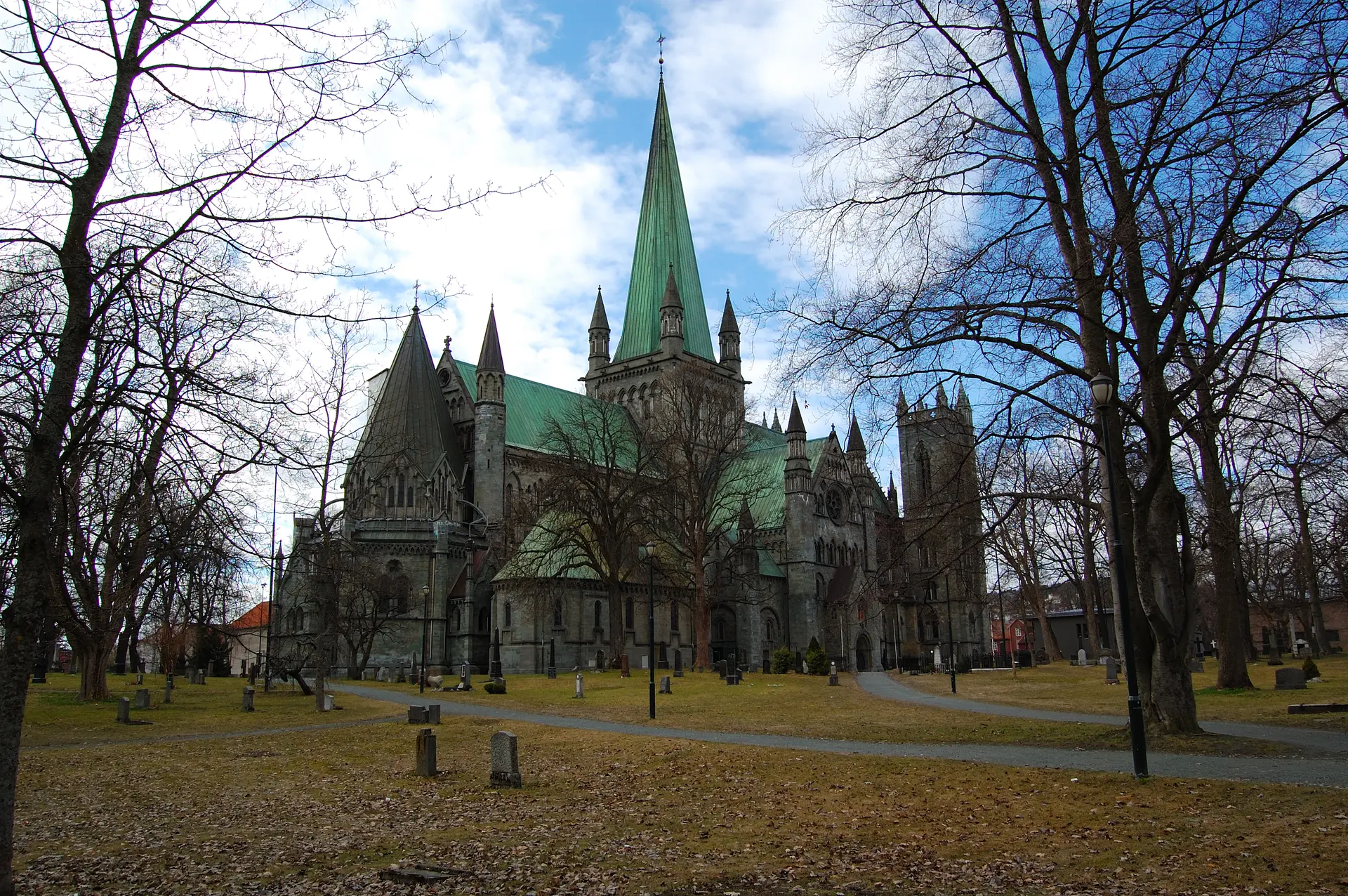
Image of Nidaros Cathedral. Image source · CC-BY-SA-3.0
Station 8 of 8
Gudbrandsdalsleden — Oslo to NidarosVisit essentials
A quick read before you go
- Duration
- Half a day when including the tower climb, the Archbishop's Palace, and the Crown Regalia Museum…
- Access
- Nidaros Cathedral is located at Bispegata 11, 7013 Trondheim, Norway, at coordinates 63.427…
Overview
Pilgrims walking to Trondheim arrive not at a museum but at a living church of services, hymns, candles, and continuous worship since the eleventh century. Nidaros is the world's northernmost medieval Gothic cathedral. It was built over the burial place of King Olav II Haraldsson, killed at the Battle of Stiklestad in 1030. Within a year his exhumed body was found incorrupt, and a healing spring rose from his grave. For five centuries St.
Olav's cult drew pilgrims across Northern Europe, and the cathedral over his tomb became Scandinavia's most important church.
The Reformation ended Catholic pilgrimage in 1537: the silver shrine was melted down and the relics dispersed or hidden. After four centuries of fires and neglect, pilgrimage revived in the late twentieth century. Today thousands walk the St. Olav Ways each year—nine routes totaling three thousand kilometres—all converging on the Octagon, the cathedral's architectural heart, where St. Olav's grave once lay.
This is a place shaped by accumulated devotion rather than a surviving relic or shrine. The Gothic nave borrows proportions from Westminster Abbey and Lincoln Cathedral at a latitude where summer light lingers past midnight. The west front's seventy-six sculpted saints and apostles were added during a century of restoration. Somewhere within or near the cathedral, St. Olav's bones remain in a location unknown since 1568. The mystery endures, and pilgrims keep coming.
Why this place is sacred
The idea of thin places, locations where the membrane between ordinary and sacred experience feels permeable, finds strong expression at Nidaros Cathedral. Several factors account for this.
The first is continuity. Worship has been conducted at this site since the eleventh century. The wooden chapel built by King Olav Kyrre over his uncle's grave gave way to stone, and the stone cathedral has stood through fires, reformation, and restoration. Nearly a thousand years of prayer, song, grief, and celebration have passed through this space. Such accumulated devotion is not a metaphysical claim but a historical fact, and it shapes the atmosphere in ways visitors consistently register.
The second factor is pilgrimage itself. For those who walk the St. Olav Ways, the experience of arriving at the Octagon, the area above St. Olav's original burial site, carries the weight of weeks of walking. The body arrives before the mind catches up. Pilgrims who have walked the 643-kilometre route from Oslo describe the final approach through Trondheim as both ordinary and overwhelming. The cathedral does not appear dramatically on a hilltop.
It sits in the city, among streets and shops, and yet when pilgrims step through the doors, many report a shift they did not anticipate.
The third factor is the architecture itself. The Gothic style was developed to create experiences of transcendence, and the builders of Nidaros understood this. The Octagon, with its early Gothic vaulting and flying buttresses drawn from English models, creates a sense of enclosure and elevation simultaneously. The rose window on the west front, depicting the Last Judgement in stained glass designed by Gabriel Kielland, transforms afternoon light into something the eye reads as sacred.
The two organs, especially the 1738 Baroque instrument by Joachim Wagner, fill the nave with sound that resonates in the chest as much as the ear.
Finally, there is the mystery of St. Olav's remains. The silver shrine was destroyed during the Reformation, its ninety-five kilograms of silver, one hundred and seventy jewels, and golden plates confiscated by Danish authorities. The saint's bones were moved in 1568 to an unknown location within or near the cathedral. Multiple searches have failed to find them. This absence creates a paradox: the entire cathedral exists because of a burial, yet the burial itself cannot be located.
For some visitors, this unresolved quality intensifies rather than diminishes the sense of the sacred.
The cathedral was built to house the shrine of St. Olav and serve as the seat of the Catholic Archdiocese of Nidaros, established in 1152. As metropolitan church, it held authority over Norway, Iceland, Greenland, the Isle of Man, the Orkneys, the Shetland Islands, the Faroe Islands, and the Hebrides. The building served simultaneously as pilgrimage destination, seat of ecclesiastical power, and national sanctuary. Norwegian kings were crowned here, binding spiritual and political authority to a single site.
The site's sacred character has evolved through several distinct phases. The initial phase centred on the cult of St. Olav and Catholic pilgrimage, lasting from approximately 1030 to 1537. The Reformation transformed the cathedral into a Lutheran church, ending pilgrimage and relic veneration while maintaining continuous worship. The nineteenth and twentieth centuries brought a monumental restoration that lasted over 130 years, itself becoming a kind of national devotion. The late twentieth century saw the revival of pilgrimage on the St.
Olav Ways, now ecumenical and open to seekers of all traditions. Throughout these transformations, the cathedral has maintained its role as Norway's coronation and consecration church, linking each new monarch to the site where the nation's patron saint was buried.
Experience and orientation
The west front is where most visitors first encounter the cathedral. It is a wall of sculpted stone, assembled over nearly eight decades of restoration work, displaying apostles, saints, biblical kings, and allegorical figures in seventy-six niches. At the centre, the rose window designed by Gabriel Kielland depicts the Last Judgement. Above the gable, sculptor Kristofer Leirdal's Christ Triumphant relief presides over the composition.
On the northwest tower, his Archangel Michael statue looks out over the city, reportedly modelled on the face of Bob Dylan, an incongruous detail that delights some visitors and puzzles others.
Stepping inside, the nave unfolds in High Gothic proportions that recall the great English cathedrals. Construction of this section began in 1248 under Archbishop Sigurd Eindridesson, and the influence of Westminster Abbey and Lincoln Cathedral is evident in the clustered columns, pointed arches, and ribbed vaulting. The scale is large enough to feel spacious but not so vast as to overwhelm. Light enters through clerestory windows and the great rose window, shifting through the day as the sun moves.
The progression toward the Octagon is the spatial and spiritual heart of the experience. This octagonal chapter, built between 1183 and 1220 under Archbishop Oystein Erlendsson, marks the believed location of St. Olav's original burial. Its Early Gothic design, featuring Scandinavia's first flying buttresses, may have drawn inspiration from the Corona of Canterbury Cathedral. For pilgrims completing the St. Olav Ways, reaching this spot represents the end of the road. Many pause here in silence. Some weep.
The combination of physical exhaustion, historical weight, and architectural beauty creates conditions that visitors describe as deeply affecting.
The crypt, accessible during visiting hours, holds a collection of medieval tombstones dating from the twelfth century, reassembled from fragments found during restoration. The space is quieter and more intimate than the nave above, carrying a different quality of age.
Two organs serve the cathedral. The larger Steinmeyer organ dates from 1930 and was rebuilt in 2014. The smaller Baroque organ, built by Joachim Wagner between 1738 and 1740 and restored by Jurgen Ahrend in 1993-1994, is considered one of the finest historical organs in Scandinavia. When either is played during services, the sound fills the stone nave with a resonance that vibrates in the body.
For those willing to climb 172 steps, the tower offers views across Trondheim, the Nidelva river, and the Trondheimsfjord. Access is weather-dependent and requires an additional fee.
The cathedral sits in central Trondheim at Bispegata 11, roughly a ten-minute walk from the main square. The adjacent Archbishop's Palace houses the Crown Regalia Museum and original medieval sculptures from the cathedral facade. The Pilgrim Centre is located nearby and serves as the hub for pilgrimage information and Olav Letter certificates. Most visitors enter through the west front. Guided tours in English and Norwegian are offered daily during high season, from May through August, and year-round for pre-arranged groups.
Context and lineage
The founding narrative begins with blood. On July 29, 1030, King Olav II Haraldsson fell at the Battle of Stiklestad, fighting to reclaim his throne and advance Christianity in Norway. His body was secretly buried in a sandbank beside the Nidelva river in Trondheim. According to medieval accounts, approximately one year later the coffin was opened and the king's body was found incorrupt, appearing as though he had just died, with hair and nails that had continued to grow.
A spring with healing properties arose from the burial place. These signs were taken as proof of sanctity. Bishop Grimketel canonized Olav in 1031, and pilgrims began arriving to seek healing at his tomb.
King Olav Kyrre, Olav's nephew, built the first wooden chapel over the burial site sometime during his reign from 1066 to 1093. Around 1070, construction of a stone cathedral began. Over the following two centuries, successive archbishops expanded the building from a modest Romanesque structure into the Gothic cathedral that stands today.
In 1152, the church was designated as the seat of the Catholic Archdiocese of Nidaros, granting it metropolitan authority over a vast ecclesiastical province stretching from Norway to Greenland.
The shrine of St. Olav became the centrepiece of the cathedral and the focus of pilgrimage. A silver reliquary, so large that sixty men were required to carry it in annual processions, housed the saint's remains. Miracles multiplied. Pilgrims from across Scandinavia and beyond made the difficult passage to Trondheim, establishing the pilgrimage roads that would later be revived as the St. Olav Ways.
The spiritual lineage of Nidaros Cathedral passes through two distinct traditions. The Catholic lineage, from the canonization of St. Olav in 1031 through the Reformation in 1537, established the cathedral as Northern Europe's foremost pilgrimage destination and the seat of an archdiocese spanning the North Atlantic. The Lutheran lineage, from 1537 to the present, maintained continuous worship while transforming the building's theological character.
The pilgrimage tradition, suppressed for four centuries, was revived in the late twentieth century as an ecumenical practice. Today the cathedral holds these layers without contradiction: it is simultaneously a Lutheran parish church, a national monument, a pilgrimage destination, and the consecration church of the Norwegian monarchy. Each generation has added meaning without erasing what came before.
St. Olav (Olav II Haraldsson)
Archbishop Oystein Erlendsson
Bishop Grimketel
Gabriel Kielland
Heinrich Ernst Schirmer and Christian Christie
Traditions and practice
In the medieval period, pilgrimage to St. Olav's shrine was the defining practice of the cathedral. Pilgrims journeyed from across Scandinavia and Europe to reach Trondheim, often walking for weeks. Upon arrival, they venerated the silver reliquary containing the saint's remains, sought healing at the sacred spring near the burial site, and attended masses offered for their intentions. The annual Olsok celebration on July 29, St. Olav's feast day, was the high point of the liturgical year.
The reliquary was carried in procession through the city, requiring sixty men to bear its weight. Coronations of Norwegian kings took place in the cathedral, binding political authority to spiritual sanction. These Catholic practices ended with the Reformation in 1537, when Danish authorities confiscated the shrine and its ninety-five kilograms of silver, one hundred and seventy jewels, and golden plates.
The cathedral holds regular Lutheran worship services including Sunday services, Tuesday morning prayer, weekday midday prayer from Monday through Friday, and evening vespers. Baptisms, confirmations, weddings, and funerals mark the passages of ordinary life within its walls. The annual Olavsfestdagene festival, held in late July around Olsok, has grown into a major church and cultural event with over 180 programmes including concerts, exhibitions, religious services, and a historic market. The midnight mass on St.
Olav's Eve, July 28, followed by an all-night vigil lasting until six in the morning, offers a particularly concentrated contemplative experience. Royal consecration ceremonies continue, though the last formal coronation took place in 1906 when King Haakon VII and Queen Maud were crowned. Subsequent monarchs have been consecrated or blessed rather than crowned.
The revived pilgrimage on the St. Olav Ways draws thousands of walkers each year. The nine routes, totaling approximately three thousand kilometres, all converge on Nidaros Cathedral. The main route, the Gudbrandsdalsleden, runs 643 kilometres from Oslo to Trondheim. Pilgrims who walk the final one hundred kilometres with documented stamps at hostels and churches receive the Olav Letter, a certificate acknowledging their pilgrimage. The tradition is explicitly ecumenical and open to people of all faiths and motivations.
Those seeking a contemplative experience at Nidaros Cathedral have several approaches to consider. Attending a weekday midday prayer service, free of charge, offers an encounter with the space in its intended use, filled with the sound of spoken prayer and organ music rather than the shuffle of tourism. Sitting quietly in the nave between services allows the architecture to work as it was designed to, drawing the eye upward and stilling the mind.
Walking slowly from the nave toward the Octagon traces the path that medieval pilgrims followed to reach the shrine of St. Olav. Standing in the Octagon and acknowledging the burial site beneath, the hidden bones, the healing spring now lost, the million prayers offered here, allows the accumulated weight of the place to register. Those visiting during Olavsfestdagene might attend the midnight mass and vigil on St.
Olav's Eve for an immersion in the liturgical life of the cathedral at its most intense.
Church of Norway (Evangelical Lutheran)
ActiveNidaros Cathedral is the seat of the Bishop of Nidaros and serves as the cathedral of the Diocese of Nidaros. It holds the status of Norway's national sanctuary and is the traditional location for the consecration of Norwegian monarchs. Along with Var Frue Church, it forms the Nidaros og Var Frue parish. Since the Reformation in 1537, the cathedral has served continuous Lutheran worship, maintaining the building's role as an active church through nearly five centuries of Protestant practice.
Regular Sunday worship services, Tuesday morning prayer, weekday midday prayer from Monday through Friday, evening vespers, baptisms, confirmations, weddings, funerals, and special seasonal services. The cathedral hosts the annual Olavsfestdagene church and cultural festival and serves as the venue for royal consecration ceremonies.
Roman Catholic (historical)
HistoricalThe cathedral was established as the seat of the Catholic Archdiocese of Nidaros in 1152, granting it metropolitan authority over Norway, Iceland, Greenland, the Isle of Man, the Orkneys, the Shetland Islands, the Faroe Islands, and the Hebrides. For five centuries it was the most important Catholic pilgrimage site in Northern Europe, built over the tomb of St. Olav. The shrine drew pilgrims from across Scandinavia and the wider Christian world.
Medieval practices centred on pilgrimage to St. Olav's silver shrine, veneration of relics, annual procession of the reliquary through Trondheim, healing rituals at the sacred spring near Olav's burial site, masses for pilgrims, and coronation of Norwegian kings. The Olsok celebration on July 29 was the liturgical high point of the year. These Catholic practices ended with the Reformation in 1537, when the shrine was destroyed and its contents confiscated.
Christian Pilgrimage (ecumenical, revived)
ActiveThe medieval pilgrimage tradition to Nidaros has been revived since the late twentieth century. The St. Olav Ways comprise nine routes totaling approximately three thousand kilometres, all leading to Nidaros Cathedral. The main route, the Gudbrandsdalsleden, runs 643 kilometres from Oslo to Trondheim. A Pilgrim Centre operates near the cathedral, and pilgrims who walk the last one hundred kilometres with documented stamps receive the Olav Letter.
Walking the pilgrimage routes, collecting stamps at pilgrim hostels and churches along the way, arriving at the Octagon to complete the pilgrimage, and receiving the Olav Letter certificate. The tradition is explicitly ecumenical and open to people of all faiths and motivations. Some pilgrims walk for religious reasons, others for personal reflection, physical challenge, or connection with landscape and history. The practice welcomes all intentions without hierarchy.
Perspectives and open questions
Nidaros Cathedral sits at the intersection of several interpretive frameworks: religious history, architectural scholarship, national identity, and pilgrimage studies. Each illuminates different aspects of the site's significance, and none alone captures the full picture. The cathedral invites the visitor to hold multiple perspectives simultaneously, recognising that a place shaped by nearly a thousand years of human devotion resists simple summary.
Scholarly perspective
Historians and architectural scholars recognise Nidaros Cathedral as one of the most important medieval church buildings in Scandinavia and a significant example of Gothic architecture with demonstrable English influence. The cult of St. Olav is understood as a complex phenomenon that merged genuine popular devotion, political legitimisation of the Norwegian monarchy, and the assertion of an independent Norwegian church province.
The cathedral's construction phases, from Romanesque transepts to Early Gothic Octagon to High Gothic nave, are well-documented and reflect evolving architectural influences from England, France, and the wider European Gothic tradition. Archaeological evidence confirms the site's continuous sacred use from the eleventh century. The 130-year restoration programme, begun in 1869 and declared complete in 2001, is studied as a major project in heritage conservation, raising questions about authenticity and reconstruction that remain relevant to preservation practice worldwide.
Living and traditional perspectives
Within Norwegian Christian understanding, Nidaros Cathedral is inseparable from the story of St. Olav and the Christianisation of Norway. The cathedral is understood as Norway's national sanctuary, the place where spiritual and national identity converge. The Church of Norway teaches that Olav's martyrdom and the miracles at his grave reflect genuine divine action, and the cathedral stands as a witness to that understanding. The revived pilgrimage on the St.
Olav Ways is embraced by the church as a legitimate spiritual practice, ecumenical in character and open to all. The cathedral's role in royal consecration reinforces the understanding that Norwegian sovereignty carries a spiritual dimension rooted in St. Olav's legacy.
Alternative interpretations
Some visitors approach the cathedral through alternative spiritual frameworks. Earth-energy practitioners have noted the site's powerful atmospheric qualities and speculated about its location on lines of telluric force, though this interpretation is not supported by mainstream scholarship. The story of St. Olav's incorrupt body and healing spring is sometimes cited in esoteric literature as evidence of the site's inherent sacred power predating Christianity.
The reported detail that sculptor Kristofer Leirdal modelled his Archangel Michael statue on the face of Bob Dylan has taken on a quasi-mythic dimension for some visitors, blending art, celebrity, and the sacred in ways the cathedral's original builders could not have anticipated.
Open questions
Several aspects of Nidaros Cathedral's story remain genuinely unresolved. The exact location of St. Olav's remains has been unknown since 1568, when they were moved from the destroyed shrine to an undisclosed location within or near the cathedral. Multiple searches have failed to locate them. Whether the site held pre-Christian sacred significance, perhaps as a Norse gathering place or sacred grove, is not definitively established.
The precise architectural inspiration for the Octagon's design remains debated; Canterbury Cathedral's Corona is the leading theory, but octagonal shrine chapels have a long independent tradition. The healing spring that reportedly arose from St. Olav's burial site is no longer visible, and whether it still flows underground is unknown. These mysteries are not failures of scholarship but honest limits of the historical record, and they contribute to the cathedral's enduring capacity to provoke wonder.
Plan your visit
Access and arrival
Nidaros Cathedral is located at Bispegata 11, 7013 Trondheim, Norway, at coordinates 63.427 degrees north, 10.397 degrees east. The cathedral sits in central Trondheim, approximately ten minutes on foot from the main square. Trondheim is served by Trondheim Airport Vaernes with connections to Oslo and other European cities. Direct trains from Oslo take approximately seven hours. The cathedral is fully accessible at ground level. Tower access requires climbing 172 steps and is not available to those with mobility limitations.
An entrance fee is required for sightseeing visits; worship services are free to attend.
Trondheim offers a full range of accommodation from hostels to hotels. Pilgrims arriving on the St. Olav Ways can find specific pilgrim-oriented accommodation through the Pilgrim Centre. The city centre places most hotels within walking distance of the cathedral.
Respectful visit
Modest dress is appreciated. Shoulders and knees should be covered. There is no strict enforcement, but respectful attire reflects awareness that this is an active place of worship.
Photography is generally permitted without flash. During services and special events, cameras should be put away. Visitors should observe any posted signage restricting photography in specific areas.
No specific offering traditions exist for visitors. Candle-lighting stations may be available. Donations are welcome and support the ongoing maintenance of the cathedral.
Visitors should maintain quiet and respectful behaviour throughout. The cathedral may close without notice for special church events. Tower access is weather-dependent and may be restricted. Sightseeing visits require a paid entrance ticket, but attendance at worship services is free.
Nidaros Cathedral is an active place of worship. Visitors entering during services should do so quietly and with awareness that they are in the presence of a praying congregation. Sightseeing visits outside of service times require a paid entrance ticket. The cathedral may close for special church events and ceremonies without advance public notice. Tower access depends on weather conditions and is not available to those unable to climb 172 steps.
Current practical details
Address
Kongsgårdsgata 2, 7013 Trondheim, Norway
Phone
Hours
Hours, fees, and access can change — verify on the official source before you travel. Practical details last checked Jun 2026.
Location
Map loads as you approach this section.
Pilgrim reflections
A portrait of encounter, not a score
Pilgrims describe what they felt, how present they could become, and whether the place would shape a journey. There are no stars and no ranking of traditions.
No reviewed reflections yet
The first pilgrims can help describe the character of being here.
Share a reflection
Available after an account-backed “Been there.” Every reflection is reviewed before publication.
Nearby sacred places
Explore other sacred places in the region. Proximity does not establish access or travel time; check each place’s guidance.

Tautra Monastery Ruins
Tautra / Frosta, Tautra / Frosta, Trøndelag, Norway
19.5 km away
Leirfall rock carvings
Stjordal, Trøndelag, Norway
38.5 km away

Munkeby Monastery Ruins
Munkeby / Levanger, Munkeby / Levanger, Trøndelag, Norway
57.1 km away

Stiklestad Church
Stiklestad / Verdal, Stiklestad / Verdal, Trøndelag, Norway
70.7 km away
References
Sources consulted for this page. Source categories describe the publication, not a guarantee that every claim is verified. Traditional accounts and outside interpretations may differ.
- 01Nidaros Cathedral - Official Website (Nidarosdomen) — Nidaros Cathedral / Nidaros domkirkes restaureringsarbeiderofficialOfficial cathedral website with visitor information, history, and service schedules
- 02Nidaros Cathedral - Visit Trondheim — Visit TrondheimSource contextOfficial Trondheim tourism site with visitor information and historical overview
- 03Nidaros Cathedral history - Visit Trondheim — Visit TrondheimSource contextDetailed historical timeline from the official Trondheim tourism site
- 04St. Olav - Nidarosdomen — Nidaros CathedralofficialOfficial cathedral page about the spiritual and historical significance of St. Olav
- 05Nidaros Cathedral - The pilgrim destination — Pilegrimsleden (National Pilgrim Centre)Source contextOfficial Norwegian pilgrimage organization with details on St. Olav Ways and pilgrimage tradition
- 06Pilgrimage on the St. Olav Ways - Visit Norway — Visit NorwaySource contextOfficial Norwegian tourism site with pilgrimage route details
- 07Olavsfestdagene - Official Festival Website — OlavsfestdageneSource contextOfficial festival site with event listings including cathedral vigil and services
- 08Nidaros Cathedral GPS Coordinates — LatLong.netofficialGPS coordinates: 63.427471°N, 10.396607°E
- 09Church Services - Nidaros Cathedral — Nidaros CathedralofficialOfficial service schedule including regular and special services
- 10Nidaros Cathedral - Wikipedia — Wikipedia contributorsencyclopediaComprehensive article with architectural, historical, and cultural details; well-referenced
- 11St. Olav's shrine - Wikipedia — Wikipedia contributorsencyclopediaDetailed article on the shrine's history, the silver reliquary, Reformation destruction, and miracles
- 12Olavsfestdagene - Wikipedia — Wikipedia contributorsencyclopediaDetails on the annual church and cultural festival held around Olsok (St. Olav's Day)
- 13Nidaros Cathedral West Front - Wikipedia — Wikipedia contributorsencyclopediaDetailed article on the west front sculptures, rose window, and restoration history
- 14The Complete Guide to Trondheim's Nidaros Cathedral — Life in NorwayguideComprehensive English-language guide with visitor practicalities and historical context
- 15Everything You Need to Know When Visiting Nidaros Cathedral — The Hidden NorthguideVisitor guide with practical information including tower tours, crypt, and photography
- 16Nidaros Cathedral - Sacred Destinations — Sacred DestinationsguideSacred site guide with architectural details and spiritual significance
- 17Trondheim's Nidaros Cathedral and the mysteries of St Olav — Raven GuidesguideDetailed narrative of St. Olav's story and its connection to the cathedral
- 18Nidaros Cathedral: A Monument to Norway's Spiritual and Cultural Heritage — History ToolsSource contextScholarly-oriented overview of the cathedral's multi-layered significance
- 19Architecture For Eternity - Explore Trøndelag — Explore TrøndelagSource contextRegional tourism site with architectural and cultural context
- 20Pilgrim's Route (Norway) - Wikipedia — Wikipedia contributorsencyclopediaDetails on the historical pilgrimage route from Oslo to Trondheim
Share a photo
Help visitors recognize Nidaros Cathedral. Every submission is reviewed before publication.