Bølareinen
A life-size Stone Age reindeer carved into a Norwegian cliff face over five thousand years ago
Understand sacred places, explore living traditions, and learn how to engage respectfully with Pilgrim Map.
Access has not been verified. Check current local guidance before planning a visit.
Steinkjer, Trøndelag, Norway
Read the sources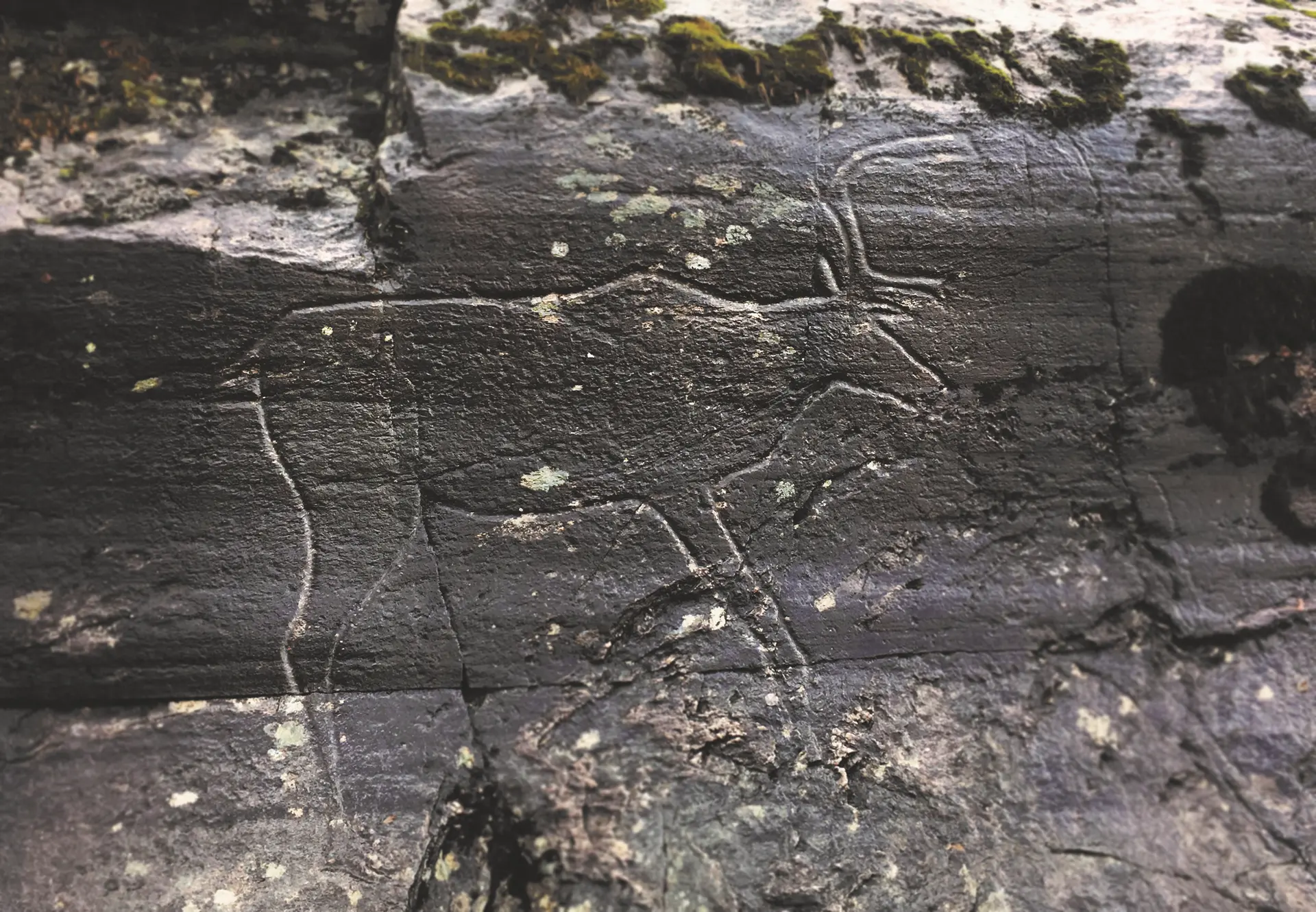
Image of Bølareinen. Image source · CC-BY-SA-4.0
Visit essentials
A quick read before you go
- Duration
- One and a half to two hours, including the Bølastien hiking loop of approximately 3.9 kilometres…
- Access
- Located on the southeast side of Snåsavatnet along County Road 763, near Stod in Steinkjer…
Overview
Bølareinen appears life-size on the rock: one hundred and eighty centimetres long and one hundred and thirty-six centimetres tall, with fine contour lines that may depict fur. More than five thousand years separate its makers from today's viewers. Carved around 3400 to 3200 BCE, when Snåsa Lake belonged to Trondheim Fjord and water stood thirty-five to forty metres higher, it occupied a threshold where the Bøla River met the fjord and a waterfall roared during floods.
Scholars call it probably Norway's best-known petroglyph and one of the country's finest rock carvings.
Stone Age meanings likely involved hunting, ritual, and spiritual relationships with depended-upon animals. South Sámi interpretation, grounded in traditional territory and reindeer knowledge, understands the figure as an aaltoe, a reindeer cow, or a staajne, a typically infertile cow with certain male physical traits. Since 2017, Saemien Sijte, the South Sámi Museum and Cultural Centre, has managed Bøla so Indigenous perspectives stand beside archaeological ones.
The stone reindeer and reindeer central to Sámi spiritual life continue one conversation across five thousand years.
Why this place is sacred
The concept of thin places, locations where the boundary between ordinary experience and something older or deeper seems to narrow, finds expression at Bølareinen through several converging elements.
The first is temporal depth. To stand before this carving is to encounter a human act more than five thousand years old, rendered with a precision and sensitivity that resists the comfortable assumption of primitive simplicity. The contour lines are deliberate, possibly depicting fur. The proportions are accurate. Whoever carved this reindeer knew the animal intimately, not as abstraction but as a living presence in their world. That intimacy survives in the stone.
The second element is landscape. The Bøla River runs beside the rock face. During flood season, a waterfall forms nearby, its roar filling the valley. When the carvings were made, this was a shoreline: the fjord reached the base of the cliff. The carvers chose a place where water met land, where the sound of falling water could saturate the air.
Scholars have noted that waterfall sites in Scandinavia were associated with shamanistic practice, places where the boundary between mundane and spirit worlds was understood as permeable.
The third element is continuity. Most prehistoric rock art sites have lost their living cultural context. At Bølareinen, the South Sámi connection creates an unbroken line between ancient reverence for the reindeer and a living indigenous culture in which reindeer remain central to spiritual, economic, and cultural identity. This is not a frozen monument. It is a place where an ongoing relationship between humans and the natural world can be read in a single carved figure.
The life-size scale contributes its own effect. Visitors do not look at a miniature or a symbol. They stand before a reindeer rendered at the scale of encounter, the scale at which a hunter would have seen the animal in life. Something about this one-to-one relationship between image and animal creates an uncanny sense of presence, as if the boundary between representation and the thing itself has been deliberately blurred.
Evidence suggests the Bøla carvings served purposes connected to hunting magic, the ritual invocation of prey animals through their depiction. The life-size scale, the strategic location at a river-fjord junction, and the waterfall setting all point toward intentional ritual use rather than decoration. The carvers belonged to the veideristninger tradition of Scandinavian hunter's rock art, a tradition distinct from the later jordbruksristninger, or agricultural rock art.
The presence of additional figures, including bear, elk, and seabird, suggests a broader cosmological programme rather than a single act of representation.
For millennia, the carvings existed within a landscape that changed around them. The fjord receded as land rose after the last ice age, leaving the rock face far above the current waterline. The site's meaning shifted as cultures changed. The precise date when the original ritual significance was last actively practised remains unknown. In 1842, local farmer Benjamin Vikran rediscovered the reindeer figure, beginning its modern history.
Subsequent archaeological documentation by Gustaf Hallström in 1907, further research by Agnes Schulz and Gutorm Gjessing, and the discovery of additional figures in 1969 and 2001 gradually revealed Bølareinen as a complex multi-figure site rather than a solitary carving. The transfer of management to Saemien Sijte in 2017 marked a significant shift, centering South Sámi cultural authority at a site within traditional Sámi territory.
A 2025 upgrade added accessible paths, updated interpretation panels covering both archaeological and Sámi cultural history, and new measures to protect the carvings.
Experience and orientation
The site sits on the southeast side of Snåsa Lake, along County Road 763, within a nature park that has been developed with accessibility in mind. Good parking, prepared paths, and wheelchair-accessible routes mean that reaching the carvings does not require the kind of physical trial that some prehistoric sites demand. What the site asks of visitors is not endurance but attention.
The approach along the Bøla River provides a natural transition. Water accompanies you. The sound of the river, louder during spring flood, creates an acoustic environment that differs from the ordinary silence of a museum. This is the same water that the carvers heard. During flood season, when the waterfall becomes substantial, the sound intensifies into something immersive, a quality that scholars have linked to the shamanistic associations of waterfall sites across Scandinavia.
When the rock face comes into view, the reindeer is unmistakable. At 180 by 136 centimetres, it occupies the stone at the scale of the living animal. The contour lines, approximately two centimetres wide, trace the body with a confidence that speaks of deep familiarity. Visitors often report a double recognition: first the form of the animal, then the staggering age of the carving. The distance between these two realisations is where the experience lives.
Beyond the famous reindeer, the rock face holds approximately thirty figures divided into four groups. A bear. An elk. A long-necked seabird approximately fifty centimetres long. And the Bølamannen, discovered only in 2001: a human figure 148 centimetres tall, standing on a 127-centimetre ski, holding a thick staff, drawn in profile in a single continuous line. This figure adds a human dimension to what might otherwise feel purely animal. Someone was here.
Someone who skied, who held a staff, who carved or was carved alongside the animals.
The interpretation panels, updated in 2025, offer both archaeological context and South Sámi cultural perspectives. During summer months, Bøla Café, operated by Saemien Sijte, provides local food products and a cultural gathering point. The café transforms the visit from a solitary encounter with ancient stone into something warmer, an opportunity to engage with the living culture that stewards this place.
For those wanting to extend their time, the Bølastien hiking loop covers approximately 3.9 kilometres with 154 metres of ascent, circling through the nature park landscape. The trail offers wider views of Snåsa Lake and the surrounding mountains, placing the rock art within its geographical context.
Most visitors arrive by car along County Road 763, approximately twenty kilometres northeast of Steinkjer city centre, near Stod in Steinkjer Municipality. The site is signposted. From the parking area, prepared paths lead to the rock face. Interpretation panels provide context in multiple languages. During summer, Bøla Café offers refreshments and cultural atmosphere. The Bølastien hiking trail begins and ends at the site.
Saemien Sijte, the South Sámi Museum and Cultural Centre, is located in Snåsa approximately thirty kilometres further along the lake and provides deeper context for the Sámi cultural connection.
Context and lineage
The Bøla carvings carry no founding narrative in the conventional sense. No text survives from the people who made them. What survives is the stone itself and what archaeology can read from it. The carvings were made during the late Stone Age, approximately 3400 to 3200 BCE, when the rock face stood at the water's edge. The Trondheim Fjord extended inland to what is now Snåsa Lake, with water levels thirty-five to forty metres higher than the present.
The Bøla River flowed into the fjord at this point, and a waterfall formed nearby. The carvers chose a location where water, land, and vertical stone converged. Whether they understood this convergence in terms we would recognise as sacred remains an open question. What is clear is that the location was not accidental.
The deliberate placement at a river-fjord junction, the life-size scale of the main figure, and the care of the carving all indicate that this was a place of particular significance to the community that created it.
The lineage at Bølareinen is both broken and continuous. The specific beliefs of the Stone Age carvers are lost. No written record survives. The language they spoke, the rituals they performed, the cosmology that gave meaning to the act of carving a life-size reindeer beside a waterfall, all are genuinely unknown. Yet the thread connecting humans and reindeer in this landscape has never been entirely severed.
The South Sámi people, whose traditional territory includes this site, have maintained a relationship with reindeer that is spiritual, cultural, and economic. When Saemien Sijte reads the Bøla reindeer as an aaltoe or staajne, they bring traditional knowledge of reindeer biology and behaviour that has been maintained across millennia. This is not a claim of direct descent from the Stone Age carvers, nor need it be.
It is a recognition that the human-reindeer relationship in this landscape is older than any single culture, and that the South Sámi carry a living version of that relationship into the present.
Benjamin Vikran
Gustaf Hallström
Gutorm Gjessing
Kalle Sognnes
Saemien Sijte
Traditions and practice
The exact rituals performed at the Bøla site are not known with certainty. Scholarly interpretation points toward several possibilities. The depiction of prey animals at life-size scale at a strategic location near a river-fjord junction is consistent with hunting magic, the ritual invocation of animals through sympathetic representation. The waterfall setting aligns with sites across Scandinavia where shamanistic practice has been proposed, places where the sound of rushing water facilitated trance states.
In Sámi religious tradition, the deity Tjatseolmai, ruler of water, was believed to dwell near sites with running water. The bear figure at Bøla may represent this deity, though direct evidence linking the specific Bøla site to Tjatseolmai worship has not been established.
The broader veideristninger tradition, to which these carvings belong, appears to reflect a worldview in which animals held spiritual significance beyond their role as prey, in which the boundaries between human, animal, and spirit were more fluid than modern Western categories allow.
Saemien Sijte's management of the site since 2017 represents the primary form of ongoing cultural engagement. The museum operates Bøla Café during summer months, creating a space where South Sámi cultural life intersects with the ancient carvings. The 2025 site upgrade, part of the Bergkunstreisen (Rock Art Trail) educational project, included interpretation panels that present Sámi cultural history alongside archaeological findings.
While no organised spiritual ceremonies take place at the site, the South Sámi relationship with reindeer remains a living tradition in the region, expressed through herding, festivals, and cultural practice throughout Saepmie, the traditional South Sámi territory.
Stand before the reindeer and take time to register its scale. This is not a miniature or a photograph. It is the size of the animal itself, carved by someone who knew the reindeer as a living presence. Notice the contour lines, the care with which the body was traced. Let your eye follow the form slowly rather than taking it in at a glance.
Listen to the water. The Bøla River runs beside the rock face, and during spring flood the waterfall intensifies. The sound that fills the valley now is the same sound the carvers heard. If the waterfall is active during your visit, consider spending time near it, letting the roar of water occupy your attention. Scholars have proposed that this sound was itself part of the site's significance, a quality that facilitated altered states of awareness.
Seek out the other figures on the rock face. The bear, the elk, the seabird, and the Bølamannen, the skier figure discovered only in 2001, each add dimension to the experience. The Bølamannen in particular, a human figure on skis holding a staff, reminds you that this was not an animal world alone. Humans were here, moving through this landscape on skis five thousand years ago, their presence recorded alongside the animals they depended upon.
If Bøla Café is open, consider stopping in. The café, operated by Saemien Sijte, offers an opportunity to engage with the living culture that stewards this place. The South Sámi perspective, in which the reindeer is not an artefact but a cultural relative, adds a dimension that archaeological interpretation alone cannot provide.
Stone Age Hunter-Gatherer Animism
HistoricalThe Bøla carvings belong to the veideristninger tradition of Scandinavian hunter's rock art, dating to approximately 3400 to 3200 BCE. The carvers were part of late Stone Age communities in central Trøndelag who depended on hunting and gathering. Their artistic output, depicting reindeer, bear, elk, and seabird, suggests a worldview in which animals held deep spiritual significance beyond their role as prey. The life-size scale of the main reindeer figure and the deliberate placement at a river-fjord junction point toward ritual intention rather than simple documentation.
Scholars propose that the carvings were connected to hunting magic, the ritual invocation of prey animals through sympathetic representation. The waterfall setting is consistent with sites used for shamanistic practice in Scandinavia, where the sound of rushing water was understood to facilitate trance states. The presence of multiple animal species alongside a human figure suggests a complex programme of ritual activity rather than a single act.
South Sámi Cultural Heritage
ActiveThe site lies within Saepmie, the traditional South Sámi cultural area, and holds significance within Sámi cultural identity. In South Sámi interpretation, the reindeer figure is understood as either an aaltoe or a staajne, reflecting deep traditional knowledge of reindeer biology and behaviour maintained across millennia. Reindeer are central to Sámi spiritual, cultural, and economic life. The Bøla site represents a visible connection between the ancient human-reindeer relationship documented in stone and the living Sámi relationship with the same animal.
Saemien Sijte has managed the Bøla site since 2017, ensuring that Sámi perspectives are presented alongside archaeological interpretations. The museum operates Bøla Café at the site during summer, serving as a cultural meeting point. The 2025 site upgrade included updated interpretation panels about Sámi cultural history. More broadly, the Sámi relationship with reindeer is expressed through herding, festivals, and cultural practices throughout the South Sámi territory.
Archaeological and Conservation Stewardship
ActiveSince Benjamin Vikran's discovery of the reindeer figure in 1842, a continuous tradition of archaeological research and conservation has developed around the Bøla site. This tradition has progressively revealed the complexity of the site, from a single carving to approximately thirty figures in four groups, and has placed it within the broader context of Scandinavian rock art studies.
Gustaf Hallström's 1907 survey established the first systematic documentation. Gutorm Gjessing's 1936 overview incorporated Bøla within the veideristninger classification. The discovery of additional petroglyphs in 1969 and the Bølamannen in 2001 expanded understanding of the site. Kalle Sognnes's 2011 Acta Archaeologica publication represents the most thorough academic treatment. The 2025 site upgrade, part of the Bergkunstreisen Rock Art Trail project, reflects ongoing investment in preservation and public interpretation.
Perspectives and open questions
Bølareinen invites multiple readings without resolving into a single narrative. Archaeological scholarship establishes what can be known from material evidence. South Sámi cultural knowledge offers a living indigenous perspective. Broader interpretive frameworks connect the site to circumpolar shamanic traditions. What remains genuinely unknown is substantial, and that uncertainty is itself part of the site's character. A life-size reindeer carved into stone five thousand years ago resists simple explanation. It asks to be encountered rather than decoded.
Scholarly perspective
Archaeological consensus places the Bøla carvings securely within the veideristninger tradition of Scandinavian hunter's rock art, dating to approximately 3400 to 3200 BCE through shoreline dating. At the time of creation, the rock face stood at the water's edge where the Bøla River entered the Trondheim Fjord.
Archaeologist Kalle Sognnes of NTNU has published the most extensive academic work on the site, investigating what he termed 'the case of the lone reindeer,' examining the ecological, archaeological, and aesthetic implications of the carvings. The broader scholarly community has moved from straightforward 'hunting magic' interpretations toward more nuanced understandings involving territorial marking, cosmological expression, and possible shamanistic practice.
The discovery of additional figures since 1969, expanding the known corpus from a single reindeer to approximately thirty figures in four groups, has significantly reshaped understanding of the site as a complex cultural landscape rather than an isolated carving. The Bølamannen, the skier figure found in 2001, remains particularly enigmatic, its purpose and relationship to the animal figures a matter of ongoing scholarly discussion.
Living and traditional perspectives
The South Sámi community, through Saemien Sijte's stewardship of the site since 2017, offers an indigenous perspective rooted in living cultural knowledge. In Sámi understanding, the reindeer figure is read as either an aaltoe, a reindeer cow, or a staajne, a typically infertile reindeer cow that shares some physical characteristics with male reindeer. This interpretation reflects traditional knowledge of reindeer biology and behaviour that has been maintained across millennia of Sámi reindeer herding culture.
Reindeer are central to Sámi spiritual identity, embedded in the spiritual and cultural fabric of Sámi life in ways that extend far beyond herding. The broader Sámi perspective connects rock art sites near waterfalls to the water deity Tjatseolmai, believed to inhabit places near running water, and to the noaidi, or shamanic, tradition. The site exists within Saepmie, the traditional South Sámi cultural area, and the Sámi reading of the carvings represents living cultural knowledge rather than archaeological reconstruction.
Alternative interpretations
Some visitors and alternative heritage interpreters view the Bøla carvings through the lens of broader circumpolar shamanic traditions, seeing the life-size reindeer as evidence of an animistic spirituality in which the boundaries between human and animal, material and spiritual, were deliberately crossed through artistic creation. The waterfall setting reinforces this reading for those who understand natural features as markers of spiritual potency.
These interpretations, while not supported by specific material evidence at the Bøla site, draw on documented shamanic traditions across northern Eurasia and reflect frameworks through which contemporary seekers engage with monuments whose original meaning has been partially lost.
Open questions
Substantial questions remain open. The relationship between the reindeer and the other figures on the rock face, whether they were carved simultaneously or added over centuries, has not been resolved. The Bølamannen skier figure, discovered as recently as 2001, resists confident interpretation: does it represent a hunter, a shaman, a mythological figure, or something without modern equivalent? The significance of the staff the figure holds remains unclear.
Whether the bear figure represents Tjatseolmai, the Sámi water deity, as some scholars have proposed, or carries a different meaning entirely, cannot be determined from the evidence available. The contour lines on the reindeer, widely interpreted as depicting fur, might represent body painting, ritual markings, or something else altogether. And the most fundamental question persists: what was it about this particular rock face, at this particular waterfall, that compelled people to carve here over what may have been centuries?
The answer, if one existed in the minds of the carvers, has not survived the millennia.
Plan your visit
Access and arrival
Located on the southeast side of Snåsavatnet along County Road 763, near Stod in Steinkjer Municipality, Trøndelag county. From Steinkjer, follow County Road 763 signposted toward Snåsa, Bølareinen, and Stod. The site is approximately twenty kilometres from Steinkjer city centre. Good parking facilities are available. Prepared paths with wheelchair accessibility lead to the carvings. Coordinates are approximately 64.146 degrees north, 11.938 degrees east. The site forms part of the Bergkunstreisen Rock Art Trail educational project managed by Trøndelag County Council.
Steinkjer, approximately twenty kilometres to the southwest, offers the widest range of accommodation including hotels, guesthouses, and camping. Snåsa, approximately thirty kilometres northeast along the lake, provides a smaller selection closer to Saemien Sijte. The Bøla Café at the site itself offers refreshments during summer but not overnight accommodation.
Respectful visit
No specific dress code applies. Comfortable outdoor clothing and sturdy footwear are recommended for the nature park paths and the Bølastien hiking loop. Weather-appropriate layers are advisable given the variability of Norwegian conditions, even in summer. Rain gear is worth carrying at any time of year.
Photography is permitted and encouraged. The rock face is vertical and visible from the prepared viewing paths, offering good conditions for documentation. Natural light varies significantly with weather and season, affecting the visibility of the carved lines. Overcast conditions sometimes provide better contrast for photographing the carvings than direct sunlight.
Leaving offerings at the site is not appropriate. This is a protected heritage monument, and objects placed on or near the rock face can cause damage or attract biological growth. Respect for the site is best expressed through careful observation and responsible behaviour rather than material gesture.
Stay on designated paths. Do not touch, chalk, or apply substances to the rock carvings. Do not climb on the rock face. Do not remove any natural or archaeological material from the site. The site is freely accessible year-round, but facilities including Bøla Café are seasonal, typically operating during summer months.
The rock carvings are irreplaceable. Do not touch, scratch, or apply any substance to the rock surface. Stay on designated paths to protect both the carvings and the surrounding environment. The site holds cultural significance for the South Sámi community; approach with the same respect you would bring to any place of cultural importance. Weather in central Norway can shift rapidly; dress in layers and bring rain protection.
Current practical details
Address
Stodvegen 2496, 7717 Steinkjer, Norway
Hours
Hours, fees, and access can change — verify on the official source before you travel. Practical details last checked Jun 2026.
Location
Map loads as you approach this section.
Pilgrim reflections
A portrait of encounter, not a score
Pilgrims describe what they felt, how present they could become, and whether the place would shape a journey. There are no stars and no ranking of traditions.
No reviewed reflections yet
The first pilgrims can help describe the character of being here.
Share a reflection
Available after an account-backed “Been there.” Every reflection is reviewed before publication.
Nearby sacred places
Explore other sacred places in the region. Proximity does not establish access or travel time; check each place’s guidance.


References
Sources consulted for this page. Source categories describe the publication, not a guarantee that every claim is verified. Traditional accounts and outside interpretations may differ.
- 01The Bølareins Kingdom - Rock carvings in Steinkjer — Visit InnherredguideOfficial regional tourism site with visitor access details, 2025 site upgrade information, and cultural context
- 02Bølareinen Nature Park - Visit Norway — Visit NorwayguideOfficial Norway tourism site listing with practical visitor information
- 03The case of the lone reindeer: The Bøla rock art site in Trøndelag, Norway — Kalle SognnesacademicAcademic paper investigating ecological, archaeological, and aesthetic implications of the site. Published in Acta Archaeologica.
- 04The Bøla Rock Art Site In Trøndelag, Norway: Introduction - Acta Archaeologica Vol. 82 — Kalle Sognnes (ed.)academicAcademic journal article (2011) with scholarly introduction to the site and its significance within Scandinavian rock art research
- 05Saemien Sijte - South Sami Museum and Cultural Centre — Saemien Sijte / Visit NorwayofficialOfficial listing for the South Sámi museum that manages the Bølareinen site since 2017
- 06Bøla - Saemien Sijte — Saemien SijteofficialOfficial museum page for their management of the Bøla site
- 07Bøla Cafe - Visit Innherred — Visit InnherredguideInformation about the café operated by Saemien Sijte at the rock art site
- 08Bølareinen Nature Park - Visit Innherred — Visit InnherredguideRegional tourism listing with nature park visitor facilities
- 09Bølareinen - Wikipedia — Wikipedia contributorsencyclopediaComprehensive English Wikipedia article with detailed factual information, academic references, and Sámi cultural interpretation
- 10Rock carvings in Central Norway - Wikipedia — Wikipedia contributorsencyclopediaRegional context for veideristninger tradition, shamanistic interpretations, and Tjatseolmai water deity connection
- 11Ancient Trønder people carved exceptional petroglyphs — Norwegian SciTech NewsacademicScience journalism covering Trøndelag rock art research with dating and cultural context
- 12Bøla Petroglyphs — Anders Gjesdal OliversenblogDetailed visitor account and photography blog with site descriptions
- 13The Bøla Reindeer - Kulmin — KulminblogCultural heritage blog with interpretation and contextual information
- 14Bolarein [Bøla Rock Art Site] Carving - The Megalithic Portal — The Megalithic Portal contributorsofficialHeritage database listing with site classification
- 15Bølareinen rock carvings of Steinkjer - AroundUs — AroundUsofficialProvides GPS coordinates (64.14590°N, 11.93820°E) but incorrectly labels carvings as Bronze Age
Share a photo
Help visitors recognize Bølareinen. Every submission is reviewed before publication.