Necropolis of Pranu Mutteddu
Sardinia's greatest menhir landscape, where standing stones mark the ancestors
Understand sacred places, explore living traditions, and learn how to engage respectfully with Pilgrim Map.
Access has not been verified. Check current local guidance before planning a visit.
Goni, South Sardinia, Italy
Read the sources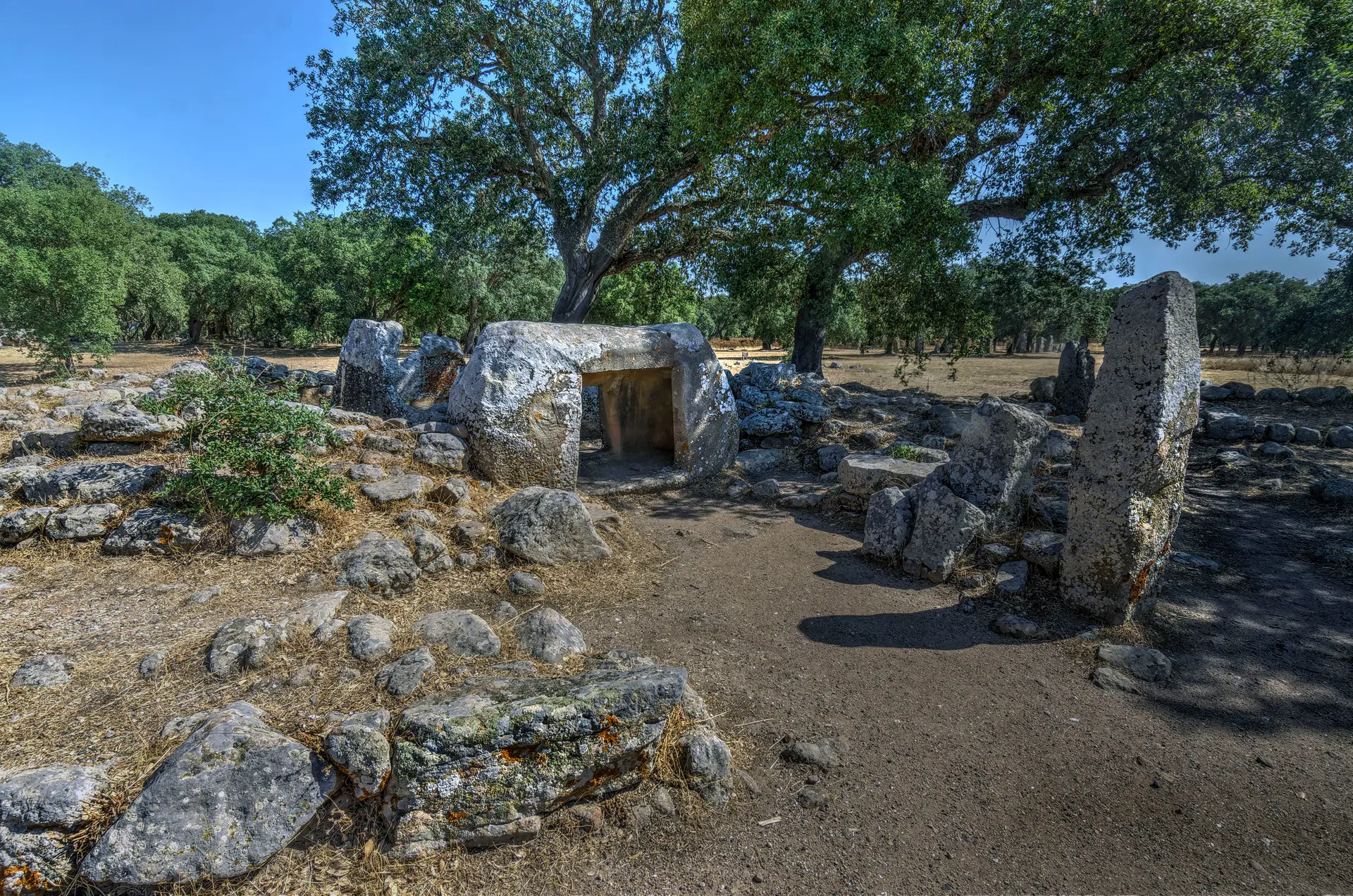
Image of Necropolis of Pranu Mutteddu. Image source · CC-BY-2.0
Visit essentials
A quick read before you go
- Duration
- 2-3 hours for the extensive park
- Access
- From Goni, follow signs to Pranu Mutteddu.
Overview
Approximately sixty menhirs stand across 200,000 square meters at Pranu Mutteddu, Sardinia's largest prehistoric sacred landscape and highest concentration of standing stones. Around 3200–2800 BCE, the Ozieri culture arranged them in pairs, small groups, rows, and one spectacular assembly of twenty.
These local-sandstone stones, reaching 2.5 meters, are 'protoanthropomorphic': ogival shapes with flat fronts and convex backs suggest human bodies without depicting them explicitly. Their placement near tombs suggests a relationship between stones as ancestral representations and burials as physical remains.
The arrangement points to ancestor veneration through standing stones. Menhirs made visible what tombs contained—the departed remaining present in the landscape and participating in community life.
Why this place is sacred
The approximately sixty menhirs of Pranu Mutteddu represent the Ozieri culture's understanding of ancestors and their continued presence. The stones are not aniconic (without representation) but protoanthropomorphic—their ogival shape, flat front face, and convex back evoke the human body without depicting specific features. They suggest rather than show, represent without portraying.
The association with tombs confirms the ancestor cult interpretation. Menhirs stand in pairs near burial cists, in small groups around megalithic circles, in rows that may mark processional paths. The pattern is consistent: standing stones appear where the dead lie. They may be representations of the ancestors themselves—vertical presences that maintained the dead in the landscape of the living.
The spectacular group of twenty menhirs gathered together suggests collective ritual. Whether marking a particularly significant burial, commemorating a group, or serving some ceremony we cannot reconstruct, this assembly demonstrates that menhir placement was not random but meaningful.
The 200,000 square meter extent transforms Pranu Mutteddu from site to landscape. This is Sardinia's largest prehistoric sacred geography—a territory defined by the Ozieri relationship between stone and bone, between vertical markers and horizontal remains. Walking through it requires hours; understanding it requires acknowledgment that we encounter not individual monuments but integrated system.
The tombs themselves display variety that suggests evolution over time. Funeral chambers in megalithic circles, stone cists, chambers in boulders, drywall constructions—the Ozieri people used multiple forms to house their dead. One tomb's 14-meter stepped circular structure, surrounded by a 35-meter larger circle with entrance menhir, demonstrates exceptional investment for an exceptional individual.
The Ozieri culture—named after the cave where it was first identified—represents the high point of Sardinian Neolithic civilization. Their creation of Pranu Mutteddu places ancestor veneration at the center of their spirituality: the dead were not abandoned but represented, not forgotten but raised as standing stone.
Neolithic necropolis with highest menhir concentration in Sardinia. Protoanthropomorphic standing stones representing ancestors. Megalithic circles and stone cists for burial. Ozieri culture ancestor cult.
3200-2800 BCE: Ozieri culture creates necropolis. Early Chalcolithic: Some continued use. Since 1980: Excavations by Enrico Atzeni.
Experience and orientation
The approach to Pranu Mutteddu leads through the Gerrei countryside of southern Sardinia, near the small town of Goni. The landscape is rural, agricultural, the kind of terrain that the Ozieri culture would recognize five thousand years after they raised their stones.
The 200,000 square meters cannot be absorbed in a glance. This is Sardinia's most extensive prehistoric sacred site, requiring time to explore, to trace the patterns of menhir placement, to understand the relationship between standing stones and buried dead.
The menhirs appear in varied groupings. Pairs suggest couples or companions; small groups indicate families or communities; the spectacular assembly of twenty speaks of collective significance we cannot fully decode. The stones themselves are protoanthropomorphic—ogival forms suggesting the human body without depicting it, made of local sandstone and reaching up to 2.5 meters.
The tombs vary in form and scale. Megalithic circles enclose funeral chambers. Stone cists contain individual burials. Chambers cut into large boulders or built with drywall add variety. One exceptional tomb preserves a stepped circular structure 14 meters in diameter, surrounded by a 35-meter circle with entrance menhir—the most elaborate burial monument in the necropolis.
The pattern becomes clear with exploration: menhirs mark where ancestors lie. The standing stones are not random but associated, not decorative but representational. The Ozieri people raised them to maintain the presence of the dead—to make visible in stone what remained buried in earth.
Hours can be spent walking Pranu Mutteddu. The territory invites contemplation of what ancestor veneration meant to Neolithic Sardinians—how they understood the relationship between living and dead, how they used stone to maintain connections that death might otherwise sever.
Pranu Mutteddu is located near Goni in the Gerrei region of southern Sardinia. The 200,000 square meter archaeological park contains approximately 60 menhirs, multiple tombs, and walking paths.
Context and lineage
Around 3200-2800 BCE, the Ozieri culture—the most important civilization of the Sardinian Neolithic—created a sacred landscape near what is now Goni. They raised approximately sixty menhirs, protoanthropomorphic stones whose ogival forms suggested the human body. They built tombs in megalithic circles, stone cists, and carved chambers. The menhirs marked where ancestors lay—standing representations of the buried dead. One spectacular group of twenty menhirs indicates collective ritual; one stepped circular tomb of 14 meters demonstrates exceptional investment.
The result was Sardinia's largest prehistoric sacred site: 200,000 square meters of ancestor veneration.
Created by Ozieri culture of Sardinian Neolithic. No descendant tradition preserves original practices.
Enrico Atzeni
Traditions and practice
Ancestor veneration through protoanthropomorphic menhirs. Burials in megalithic circles and stone cists. Collective rituals at menhir groups.
Archaeological park visitation.
Allow 2-3 hours for the extensive park. Observe how menhirs relate to tombs. Consider the protoanthropomorphic forms and what they suggest about ancestor representation. Visit the group of twenty menhirs.
Ozieri Culture Ancestor Cult
HistoricalPranu Mutteddu represents the Ozieri culture's ancestor veneration through approximately 60 protoanthropomorphic menhirs associated with tombs. The standing stones may represent the ancestors themselves—vertical presences maintaining the dead in the landscape of the living.
No longer practiced. Archaeological evidence indicates menhir placement near tombs and collective rituals at menhir groupings.
Perspectives and open questions
Pranu Mutteddu offers encounter with Sardinia's highest menhir concentration—a 200,000 square meter sacred landscape where standing stones mark the ancestors of the Ozieri culture.
Scholarly perspective
Sardinia's highest menhir concentration (~60) and largest prehistoric site (200,000 sq m). Ozieri culture (3200-2800 BCE). Protoanthropomorphic menhirs associated with tombs suggest ancestor cult. Excavations by Enrico Atzeni since 1980.
Living and traditional perspectives
No living tradition preserves Ozieri culture practices.
Alternative interpretations
The menhirs have attracted interest in ancestor worship and the prehistoric understanding of the human body as represented in stone.
Open questions
The specific meaning of menhir placement. The rituals at the group of twenty. The identity of those whose tombs the menhirs mark.
Plan your visit
Access and arrival
From Goni, follow signs to Pranu Mutteddu. Car recommended.
Accommodations in Muravera and southern Sardinia.
Respectful visit
No dress code. Comfortable walking shoes essential for extensive site.
Photography permitted.
None; archaeological site.
Respect archaeological structures | Stay on paths
The site is extensive (200,000 sq m). Wear comfortable walking shoes. Bring water in summer.
Current practical details
Address
SP23, 09040 Goni CA, Italy
Hours
Hours, fees, and access can change — verify on the official source before you travel. Practical details last checked Jun 2026.
Location
Map loads as you approach this section.
Pilgrim reflections
A portrait of encounter, not a score
Pilgrims describe what they felt, how present they could become, and whether the place would shape a journey. There are no stars and no ranking of traditions.
No reviewed reflections yet
The first pilgrims can help describe the character of being here.
Share a reflection
Available after an account-backed “Been there.” Every reflection is reviewed before publication.
Nearby sacred places
Explore other sacred places in the region. Proximity does not establish access or travel time; check each place’s guidance.

References
Sources consulted for this page. Source categories describe the publication, not a guarantee that every claim is verified. Traditional accounts and outside interpretations may differ.
- 01Necropolis of Pranu Mutteddu | Italia.it — Italia.itofficialOfficial Italian tourism
- 02Goni, Menhir and Megalithic Burials by Pranu Muttedu | SardegnaCultura — Regione SardegnaofficialOfficial cultural heritage
- 03Prehistoric Compound of Pranu Mutteddu | IDESE — Italian Ministry of CultureofficialOfficial cultural heritage database
- 04Necropolis of Pranu Muttedu - Wikipedia — Wikipedia contributorsencyclopediaArchaeological overview
Share a photo
Help visitors recognize Necropolis of Pranu Mutteddu. Every submission is reviewed before publication.