Nuraghe Arrubiu
The Red Giant rises from the Sardinian plateau, a Bronze Age citadel of twenty-one towers
Understand sacred places, explore living traditions, and learn how to engage respectfully with Pilgrim Map.
Access has not been verified. Check current local guidance before planning a visit.
Arrolli/Orroli, South Sardinia, Italy
Read the sources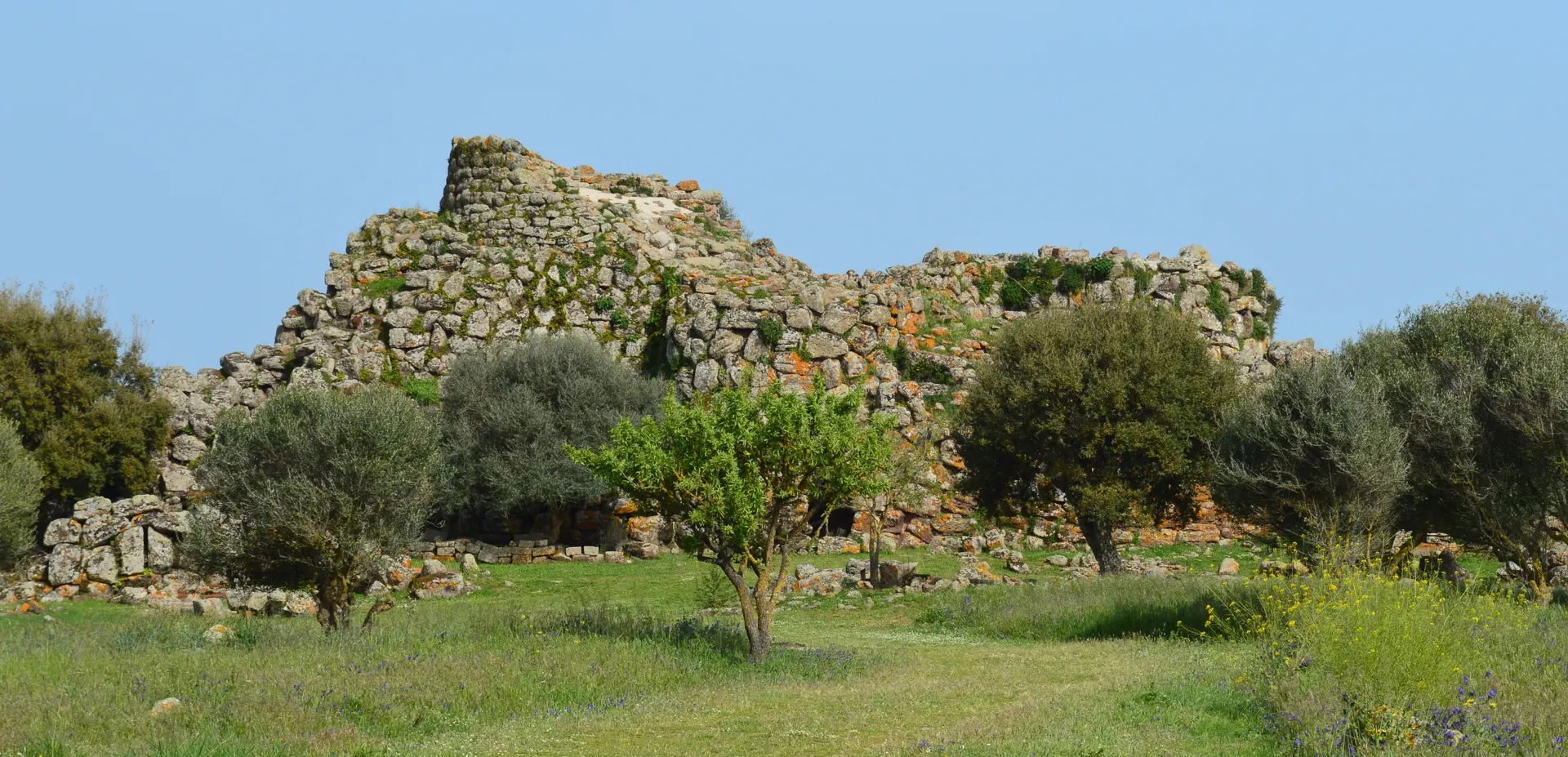
Image of Nuraghe Arrubiu. Image source · CC-BY-SA-4.0
Visit essentials
A quick read before you go
- Duration
- 1.5-2 hours for guided tour of the nuraghe, plus additional time for the museum and nearby…
- Etiquette
- Respect the archaeological site through careful movement, following guide instructions, and…
Overview
Nuraghe Arrubiu is the largest expression of a civilization that left no written word but spoke through stone. Built approximately 3,400 years ago near present-day Orroli in south-central Sardinia, its twenty-one towers included a central keep perhaps twenty-five meters high. Nuragic builders stacked precisely shaped basalt without mortar; red lichen now gives Arrubiu its name.
Small bronze nuraghe models found at temple sites across Sardinia suggest sacred significance beyond military function. Nuragic religion appears to have centered on water cults and ancestral veneration, and possibly lunar and solar worship. Arrubiu's sophisticated hydraulic systems connected its builders to sacred water.
Abandoned around the ninth century BC after a catastrophic collapse, the complex was later reoccupied by Roman settlers, who established wine production within its ancient walls. Visitors now pass through corridors where Bronze Age priests may have processed and chambers that held rituals now lost. Excavation continues to recover the Red Giant's story.
Why this place is sacred
Something shifts in the perception when standing before Nuraghe Arrubiu. The sheer scale of the structure—once the tallest nuraghe in Sardinia—creates an immediate sense of encountering something beyond ordinary human accomplishment. This is architecture as spiritual statement, built by people who understood that the sacred requires physical manifestation to be properly honored.
The Nuragic civilization appears to have constituted a theocracy, with religious and political authority intertwined. Their towers were not merely defensive but served as symbols of communal identity and cosmic connection. The discovery of miniature bronze nuraghi at temple sites confirms that these structures themselves were considered sacred, worthy of representation as votive offerings.
Water played a central role in Nuragic spirituality. The hydraulic systems at Arrubiu connected its inhabitants to the purifying, life-giving element that their sacred wells elevated to divine status. To walk these corridors is to move through spaces designed for ritual purposes that remain partially obscure but unmistakably present.
The ninth-century BC collapse that forced abandonment was catastrophic, yet the site retained its power. Romans returned centuries later, drawn by something more than strategic location. The ninth-century BC fibula found in a niche suggests that ritual offerings continued even as the structure declined.
Three thousand years of accumulated human presence leave traces that sensitive visitors can perceive. The red-lichened stones hold memory. The corridors echo with footsteps that have fallen silent but never entirely ceased.
Built approximately 14th century BC as a multifunctional center combining defensive, administrative, and ritual functions. The Nuragic people practiced water cults, ancestral veneration, and ceremonies involving bronze offerings.
Abandoned around 9th century BC after major collapse. Reoccupied during Roman period (2nd century BC - 5th century AD) for wine production. Systematic archaeological excavation began in 1981. Included on UNESCO Tentative List in 2020 as part of 'Nuragic monuments of Sardinia.'
Experience and orientation
Approach Nuraghe Arrubiu from the access road off SP10, and the structure reveals itself gradually—first the outer walls, then the central towers rising above the Sardinian plateau. The red lichen that gives the nuraghe its name becomes visible only as you draw closer, transforming gray basalt into something organic, almost living.
The guided tour is mandatory, and this is appropriate. Without expert interpretation, the complex layout of twenty-one towers, connecting corridors, and ritual chambers would overwhelm rather than enlighten. Your guide walks you through the architectural evolution, points out construction techniques that have survived thirty-four centuries, and explains current archaeological understanding of how these spaces were used.
Enter the central tower, once rising perhaps twenty-five meters above the plain. The corbelled ceiling demonstrates sophisticated engineering that required no mortar—each stone placed with precision that modern architects still admire. The darkness inside creates intimate space; this was interior sacred architecture long before Gothic cathedrals.
Notice the hydraulic systems, the niches where offerings were placed, the corridors that connected chambers like neural pathways through a stone brain. The Romans who came later for wine production added their own traces, but the Nuragic presence dominates.
The adjacent museum displays artifacts recovered from excavations: pottery, bronze implements, the material culture of a sophisticated civilization. The Tomba dei Giganti della Spada (Giants' Tomb of the Sword) lies nearby, connecting Arrubiu to the broader sacred landscape.
Allow the experience to work slowly. The Nuragic people built for eternity, and their creation rewards patient attention.
Located near Orroli in south-central Sardinia. Take SP10 toward Escalaplano; at km 9, turn left onto the access road. Cagliari-Elmas Airport is approximately 85 km away. Guided tours are required during opening hours; check locally for current schedules. Allow 1.5-2 hours for the nuraghe tour plus additional time for the museum.
Context and lineage
The Nuragic civilization developed in isolation on Sardinia, creating a unique culture that lasted over a millennium. Their most distinctive achievement was the construction of nuraghi—stone towers built without mortar using sophisticated corbelling techniques. Over 7,000 nuraghi dot the Sardinian landscape, but none matched Arrubiu in scale and complexity.
Constructed in the fourteenth century BC, Arrubiu began with a central tower that may have risen twenty-five to thirty meters. Over time, the complex grew to include four additional towers in a quadrilobe formation, then an outer ring of towers, eventually reaching twenty-one. The name 'Arrubiu' (red in Sardinian) refers to the red lichen that now covers the basalt stones.
The Nuragic people maintained trade connections with Mycenaean Greece—pottery fragments confirm Mediterranean commerce. Yet their culture remained distinctively Sardinian, centered on water cults, ancestor veneration, and the construction of these enigmatic towers.
Around the ninth century BC, catastrophic collapse forced abandonment. The cause remains debated—earthquake, attack, or structural failure. Centuries later, Romans reoccupied the site for wine production, adding their own layer to the accumulated history.
Archaeological excavation began in 1981 and continues today, gradually revealing more of Arrubiu's secrets. In 2020, the site was included on UNESCO's Tentative List as part of the 'Nuragic monuments of Sardinia,' recognition of its outstanding universal value.
Built by the Nuragic civilization (14th-9th century BC), reoccupied by Romans (2nd century BC-5th century AD), now managed as an archaeological site by the cooperative Is Janas with support from Italian cultural authorities.
The Nuragic Builders
Creators
Traditions and practice
The Nuragic people practiced water rituals at sacred wells, offered bronze figurines (bronzetti) depicting worshippers and warriors, and held communal feasts at sanctuary sites. Ceramic vessels were ritually destroyed after ceremonies. The sophistication of hydraulic systems at Arrubiu suggests water rituals were performed within the nuraghe complex itself.
Archaeological tours provide the primary mode of contemporary engagement. Guides from the cooperative Is Janas combine scientific accuracy with cultural pride, presenting the site as living heritage rather than dead stones. The ongoing excavations mean that understanding continues to evolve.
Approach the site with awareness that you are entering a space designed for sacred purposes. Take the guided tour to understand what you are seeing. Notice the precision of the stonework, the play of light through ancient doorways, the red lichen that clothes the stones. If time permits, visit the adjacent museum and the nearby Giants' Tomb. Allow the accumulated presence of three millennia to work on your perception.
Nuragic Religion
HistoricalThe Nuragic civilization practiced a complex religion that scholars believe may have constituted a theocracy. Their spirituality centered on water cults, ancestral veneration, and possibly lunar and solar deities. The nuraghi themselves became sacred symbols, with small bronze models found at temple sites suggesting they held deep religious meaning. Nuraghe Arrubiu, as the largest such structure, likely held particular importance in Nuragic cosmology.
Rituals included offerings at sacred wells, communal feasting at sanctuaries, and the deposition of bronze figurines (bronzetti) as votive offerings. Ceramic vessels were ritually destroyed at the conclusion of ceremonies. Water played a central liturgical role, with elaborate hydraulic systems enabling sacred water rituals.
Perspectives and open questions
Nuraghe Arrubiu can be understood as an architectural achievement, as evidence of a sophisticated Bronze Age civilization, as a sacred site expressing Nuragic spiritual beliefs, or as testimony to human aspiration across millennia.
Scholarly perspective
Archaeologists recognize Arrubiu as the largest and one of the most complex Nuragic structures, with an original height of 25-30 meters and 21 towers total. The discovery of Mycenaean pottery confirms Mediterranean trade connections. Scholarly understanding has evolved from viewing nuraghi purely as fortifications to recognizing their multifunctional nature including significant ritual dimensions.
Living and traditional perspectives
Modern Sardinians maintain deep cultural connection to their Nuragic heritage. The cooperative Is Janas (named for the legendary Sardinian fairies) presents the site with both scientific accuracy and cultural pride. The Sardinian name 'Arrubiu' reflects ongoing local relationship with the monument.
Alternative interpretations
Some alternative researchers propose connections between nuraghi and megalithic traditions elsewhere in Europe, suggesting shared astronomical knowledge or spiritual concepts. These interpretations remain outside mainstream archaeology but reflect genuine wonder at Nuragic achievements.
Open questions
The precise religious beliefs and cosmology of the Nuragic people remain partially reconstructed from material evidence alone. The exact cause of the ninth-century BC abandonment is debated. The full extent of unexcavated portions of the complex remains unknown. The specific rituals performed within tower chambers and the meaning of bronzetti iconography continue to generate scholarly discussion.
Plan your visit
Access and arrival
Accommodation available in Orroli and surrounding towns. Agriturismi (farm stays) offer authentic Sardinian hospitality.
Respectful visit
No specific requirements. Comfortable walking shoes recommended for uneven terrain.
Photography is permitted throughout the site.
This is an archaeological site; leaving objects or offerings is not permitted. Respect can be shown through careful attention and genuine interest.
Guided tours required during opening hours. Some areas remain off-limits due to ongoing excavations. Do not remove or disturb stones or artifacts. Stay on designated paths.
Guided tours are required—independent exploration is not permitted. Some areas remain under excavation. The terrain is uneven; wear comfortable walking shoes.
Current practical details
Address
località Su Pranu, 09061 Orroli CA, Italy
Phone
Hours
Hours, fees, and access can change — verify on the official source before you travel. Practical details last checked Jun 2026.
Location
Map loads as you approach this section.
Pilgrim reflections
A portrait of encounter, not a score
Pilgrims describe what they felt, how present they could become, and whether the place would shape a journey. There are no stars and no ranking of traditions.
No reviewed reflections yet
The first pilgrims can help describe the character of being here.
Share a reflection
Available after an account-backed “Been there.” Every reflection is reviewed before publication.
Nearby sacred places
Explore other sacred places in the region. Proximity does not establish access or travel time; check each place’s guidance.

References
Sources consulted for this page. Source categories describe the publication, not a guarantee that every claim is verified. Traditional accounts and outside interpretations may differ.
- 01Nuraghi as Ritual Monuments in the Sardinian Bronze and Iron Ages — De GruyteracademicAcademic paper on nuraghi as ritual monuments
- 02Nuragic monuments of Sardinia - UNESCO World Heritage Centre — UNESCOSource contextUNESCO tentative list entry for Nuragic monuments
- 03Nuraghe Arrubiu - Sardegna Turismo — Sardegna TurismoofficialOfficial regional tourism site
- 04Nuraghe Arrubiu - IDESE — Italian Ministry of CultureofficialItalian government cultural heritage database
- 05Pleiades Place Resource: Nuraghe Arrubiu — Pleiades ProjectacademicAcademic gazetteer of ancient places
- 06Nuragic civilization - Wikipedia — Wikipedia contributorsencyclopediaGeneral reference with citations
- 07Archaeological Tour of the Nuraghe Arrubiu in Orroli — Veronika's AdventureguideFirst-hand visitor account with practical details
- 08Italy Review - Nuraghe Arrubiu — Italy ReviewguideTravel guide with archaeological context
Photo gallery
3 curated photos
Share a photo
Help visitors recognize Nuraghe Arrubiu. Every submission is reviewed before publication.