Nasca - El Árbol
Part ofLíneas de Nazca
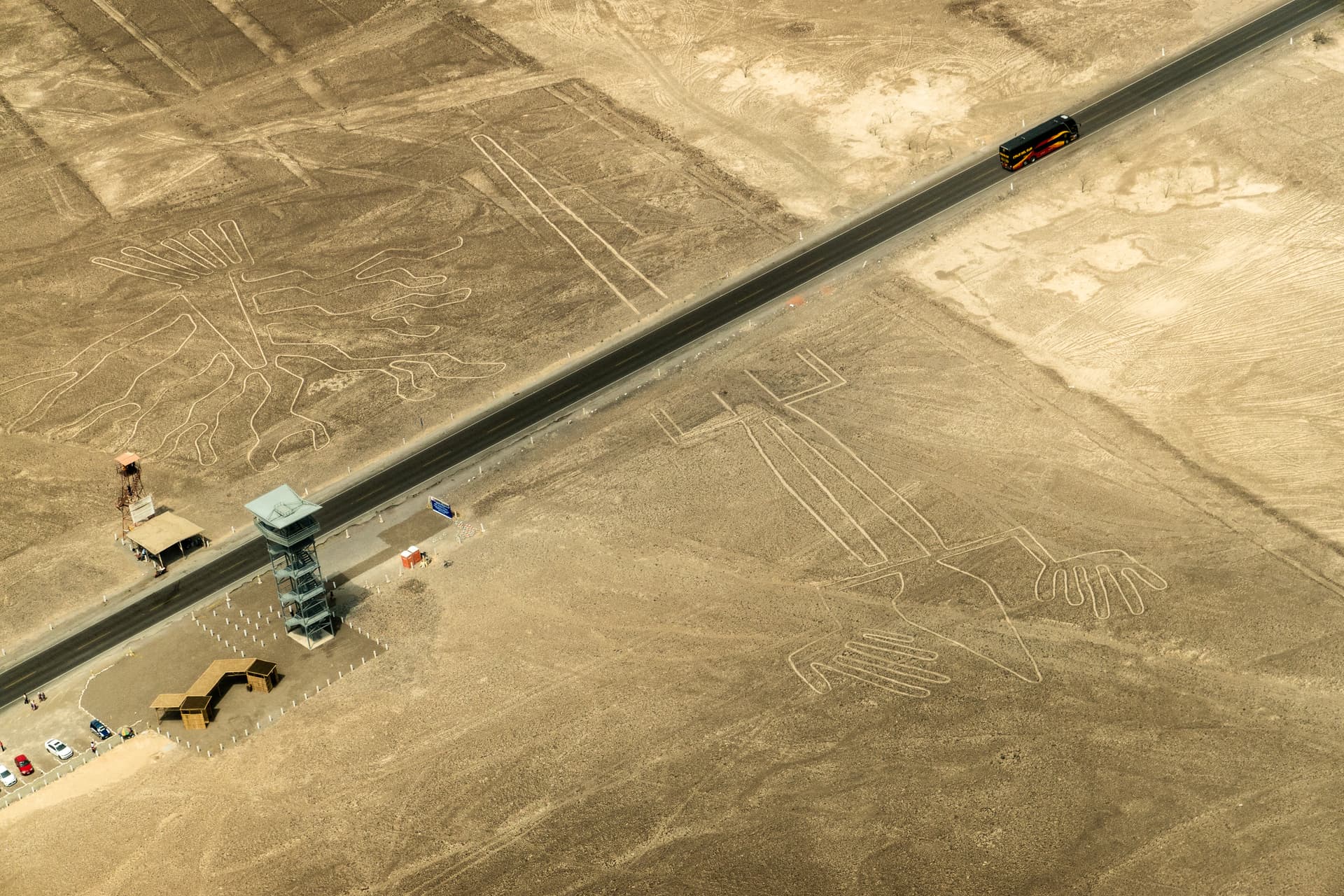
A flourishing tree drawn in desert gravel, visible from the roadside tower where the ancient and the modern intersect
Understand sacred places, explore living traditions, and learn how to engage respectfully with Pilgrim Map.
Access has not been verified. Check current local guidance before planning a visit.
Nazca, Ica, Peru
Read the sources
Image of Nasca - El Árbol. Image source · CC-BY-SA-4.0
Visit essentials
A quick read before you go
- Duration
- 15-30 minutes at the Mirador; also visible during 30-35 minute scenic flights.
- Access
- Mirador tower on the Panamericana Sur, 20 km north of Nazca.
Overview
The Tree geoglyph consists of a short, thick trunk that splits and expands into numerous large branches decorated with smaller twig-like extensions in a lush, flourishing pattern. It is one of only two geoglyphs visible from the Mirador observation tower alongside the Panamericana Sur highway.
The tree likely symbolises fertility and growth in the arid Nazca landscape — a vision of abundance in a place defined by its absence. Its branching form echoes the river systems that sustained the Nazca people, and some scholars have noted similarities to the huarango tree, a native species vital to the desert ecosystem. Drawn in a place where almost nothing grows, the Tree transforms absence into presence.
Why this place is sacred
A tree drawn in a desert where almost nothing grows. The geoglyph transforms absence into presence — not by planting but by clearing, revealing the lighter ground beneath the dark surface as though the tree were always there, waiting to be uncovered. Its branches reach outward in every direction, a pattern of proliferation etched into a landscape of scarcity.
The tree is an image of what water makes possible, inscribed in a place where water is the rarest and most sacred thing.
Created as part of the Nazca sacred landscape connected to water worship, agricultural fertility, and communication with sky-dwelling deities.
Created between 500 BC and 500 AD. Largely forgotten after the Nazca civilisation's decline. Rediscovered through aerial observation in the twentieth century. Now protected as part of the UNESCO World Heritage Site.
Experience and orientation
The Tree is visible from the Mirador observation tower on the Panamericana Sur highway, making it one of the most accessible geoglyphs. From twelve metres up, the branching pattern spreads across the desert floor with a clarity that rewards long looking. In late afternoon light, the contrast between the cleared lines and the dark surface is at its strongest.
The Tree and the nearby Hands form a pair — one organic, one human — that together suggest the relationship between nature and the people who depended upon it.
Visit the Mirador in late afternoon for the strongest light contrast. Begin with the Tree, tracing the trunk upward to where it splits into its canopy of branches. Then turn to the Hands beside it. The pairing is not accidental.
Context and lineage
The geoglyphs were part of religious practices involving worship of deities associated with water and fertility. The lines functioned as sacred paths and the figurative designs as offerings visible to the gods above.
Created by the Nazca and Paracas cultures over nearly a millennium. No direct cultural continuity exists between the ancient Nazca and present-day communities.
Paul Kosok
First researcher of the Nazca Lines from the air (1940-41)
Maria Reiche
German mathematician who devoted her life to studying and preserving the lines (1946-1998)
Johan Reinhard
Archaeologist who advanced the water worship theory (1985)
Traditions and practice
The Nazca people conducted ritual processions along the lines, leaving offerings at intersections.
Protected by Peru's Ministry of Culture. Academic research continues.
Approach with patience and silence. Allow time for the scale and intention to register.
Nazca culture religion
HistoricalThe tree likely symbolises fertility and growth in the arid Nazca landscape.
Ritual processions, offerings at line intersections, ceremonies at Cahuachi.
Archaeoastronomy
ActiveOngoing study continues to reveal new insights through AI-assisted analysis and archaeological excavation.
Academic research by international institutions.
Perspectives and open questions
The Tree geoglyph invites contemplation about fertility, abundance, and the act of invoking growth in a barren landscape.
Scholarly perspective
Part of a sacred landscape connected to water worship and ritual procession.
Living and traditional perspectives
No living tradition directly descends from the Nazca culture.
Alternative interpretations
The Nazca Lines have attracted alternative theories reflecting genuine wonder at their scale.
Open questions
Why images were created that their makers could never fully see remains the central mystery.
Plan your visit
Access and arrival
Mirador tower on the Panamericana Sur, 20 km north of Nazca. Entrance fee approximately S/ 2.
Nazca town offers budget to mid-range accommodations.
Respectful visit
Sun protection essential.
Permitted from the Mirador and aircraft.
Do not leave anything on the desert surface.
Walking on the lines is strictly prohibited | No vehicles on the desert surface | No unauthorised drone flights
Walking on the geoglyphs is strictly prohibited. The marks are extraordinarily fragile.
Current practical details
Address
PE-1S, 11350, Peru
Hours
Hours, fees, and access can change — verify on the official source before you travel. Practical details last checked Jun 2026.
Location
Map loads as you approach this section.
Pilgrim reflections
A portrait of encounter, not a score
Pilgrims describe what they felt, how present they could become, and whether the place would shape a journey. There are no stars and no ranking of traditions.
No reviewed reflections yet
The first pilgrims can help describe the character of being here.
Share a reflection
Available after an account-backed “Been there.” Every reflection is reviewed before publication.
Nearby sacred places
Explore other sacred places in the region. Proximity does not establish access or travel time; check each place’s guidance.


References
Sources consulted for this page. Source categories describe the publication, not a guarantee that every claim is verified. Traditional accounts and outside interpretations may differ.
- 01Lines and Geoglyphs of Nasca and Palpa - UNESCO — UNESCOofficialOfficial UNESCO listing
- 02Nazca Lines | Britannica — Encyclopaedia BritannicaencyclopediaAuthoritative reference
- 03Nazca lines - Wikipedia — Wikipedia contributorsencyclopediaOverview including individual geoglyph descriptions
- 04Nazca Lines - Hands and Tree - Megalithic Portal — Megalithic PortalSource contextDescription of Tree and Hands geoglyphs visible from Mirador
Share a photo
Help visitors recognize Nasca - El Árbol. Every submission is reviewed before publication.