Mt. Saint. Elias, border of Canada and U.S.
A living spirit in Tlingit tradition, rising from tidewater to sky at the edge of the world's largest non-polar icefield
Understand sacred places, explore living traditions, and learn how to engage respectfully with Pilgrim Map.
Access has not been verified. Check current local guidance before planning a visit.
Yukon, Canada
Read the sources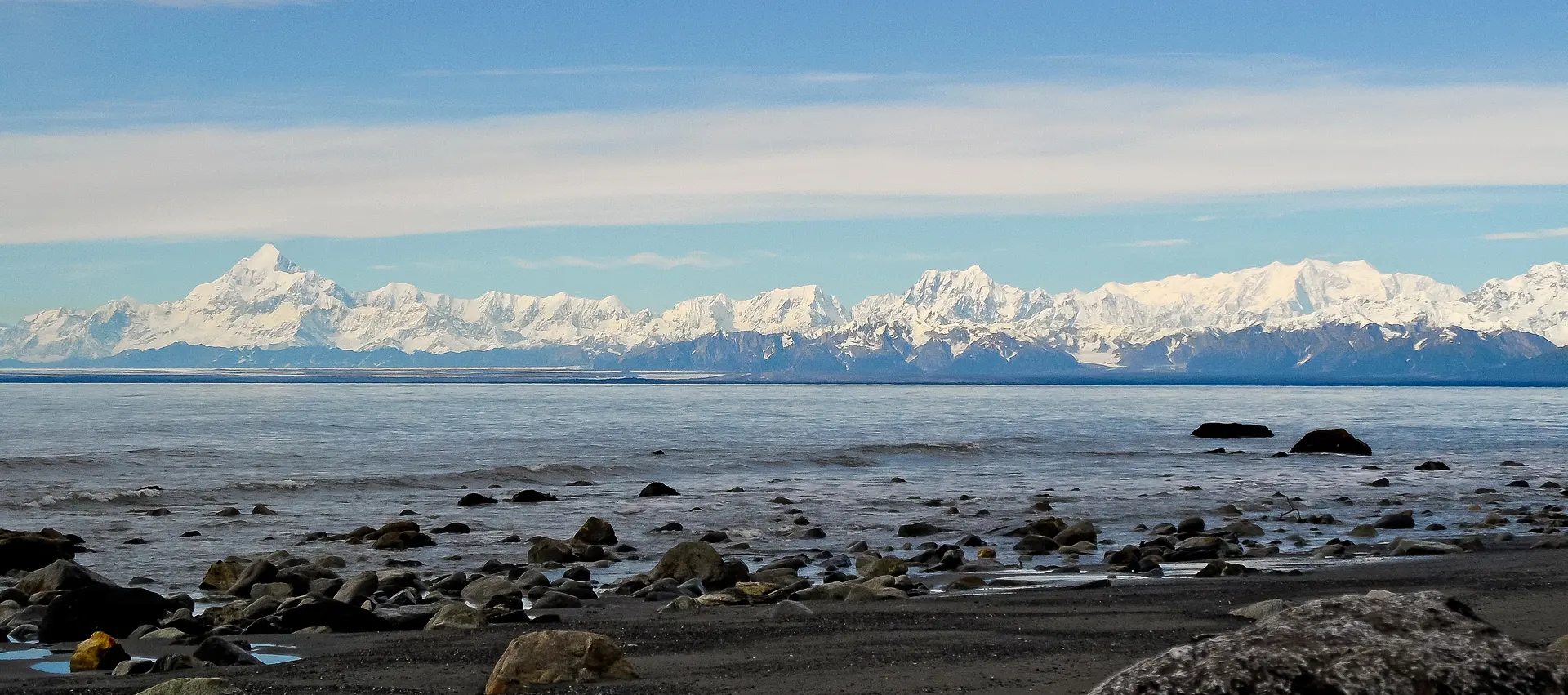
Image of Mt. Saint. Elias, border of Canada and U.S.. Image source · CC-BY-SA-2.0
Visit essentials
A quick read before you go
- Duration
- A flightseeing tour from Yakutat offers a powerful 1-2 hour aerial experience.
- Etiquette
- Approach Was'eitushaa as a sacred landscape, not a scenic destination.
Overview
Where the Pacific meets the Saint Elias Range, Mount Saint Elias forms one of Earth's most dramatic vertical landscapes. From Icy Bay tidewater to its 18,008-foot summit, it spans a height few places match. Glaciers pour into the sea, the world's largest non-polar icefield spreads behind it, and Yakutat Tlingit have read clouds forming and breaking across its ridges for generations.
For Tlingit people, Was'eitushaa is not scenery but a living sacred being: a male spirit with will and wisdom who watches the land and communicates with attentive people. The Kwaashk'ikwaan clan followed the mountain during ancestral migration from the Copper River to Yakutat Bay. It became a leading crest in regalia, songs, and the Mountain House sub-lineage's name. Speaking Was'eitushaa acknowledges a people-place relationship predating European names and boundaries.
Vitus Bering's expedition supplied the European name in 1741 after sighting the peak near the Prophet Elijah's feast day. Two national parks and a transboundary UNESCO World Heritage Site of over 24 million acres now overlay the Tlingit reality that this presence is not a possession; it belongs to itself.
Most encounter Was'eitushaa from Yakutat on clear days, boats in Icy Bay, or small planes among the peaks. It reveals itself on its own terms. Emerging from clouds, its scale resets proportion; wearing summit clouds like a hat, Tlingit say it announces a storm. It has been watched, honored, and listened to for thousands of years.
Why this place is sacred
Consider the vertical. Mount Saint Elias rises 18,008 feet, and its base begins not in high desert or mountain foothills but at tidewater -- the edge of the Pacific Ocean. Ten miles separate the summit from the sea. This creates a gradient of such intensity that the mountain generates its own weather, pulling moisture from the ocean and wrapping itself in storms that can last for weeks.
The Tlingit practice of reading the mountain's cloud formations is not folklore; it is meteorology grounded in thousands of years of observation.
This is what thinness looks like at geological scale. The Pacific plate collides with the North American plate here with enough force to produce one of the most tectonically active regions on Earth. The mountains are still rising. The glaciers are still carving. The icefields behind the peak constitute the largest non-polar ice mass in the world. Nothing here is static. The landscape is in constant, slow, violent transformation.
The Tlingit understanding goes further. Was'eitushaa is not merely impressive terrain -- it is a being with presence, will, and the capacity to communicate. When the mountain wears a flat cloud streaming from its summit, a storm approaches. When clouds trail to the side, fair weather follows. This is the mountain speaking, and the Tlingit listen. The relationship is one of reciprocity: respect is given, and guidance is returned.
The Kwaashk'ikwaan clan's migration story places Was'eitushaa at the center of their identity. The mountain guided them from the Copper River to Yakutat Bay. It did not simply mark the way -- in Tlingit understanding, it called them to their homeland. A sub-lineage took the name Mountain House, binding their identity to this peak across generations. The mountain appears on regalia and in songs, not as decoration but as acknowledgment of a living relationship.
For those who approach from outside this tradition, the thinness of the place registers differently but no less powerfully. The sheer scale dismantles ordinary reference points. The silence of the surrounding wilderness -- broken only by ice calving, wind moving through passes, and water running beneath glaciers -- creates a sensory environment stripped of human noise. The remoteness itself becomes a threshold. To reach this place requires leaving behind roads, towns, and the infrastructure of daily life.
What remains is stone, ice, water, sky, and whatever you brought with you.
Was'eitushaa's sacred significance to the Yakutat Tlingit is not a matter of historical record because it precedes history. The mountain has been a foundational landmark of Tlingit identity since the time of the ancestral migration, when the Kwaashk'ikwaan clan followed its presence from the Copper River basin to Yakutat Bay. According to Tlingit oral tradition, the mountain is a living male spirit -- strong, intelligent, protective of those who show respect.
It served as a guide not merely in the navigational sense but as a spiritual presence that drew a people to their homeland.
The mountain's role as a weather oracle is part of this original relationship. Reading its cloud formations was and remains a practice of communication with a being, not simple observation of atmospheric conditions. The Tlingit did not need to climb the mountain to maintain this relationship. The mountain spoke from its height, and the people listened from theirs.
The European encounter with the mountain began in 1741, when Bering's expedition sighted the peak from the sea and named it for the Prophet Elijah. This layered a Christian naming tradition onto a landscape already thick with Tlingit meaning. The mountain acquired a second identity in European cartography, but the Tlingit relationship continued without interruption.
The first ascent in 1897 by the Duke of Abruzzi's expedition introduced mountaineering to the peak. The three-month approach from Seattle and the technical difficulty of the climb established Mount Saint Elias as one of the great challenges of North American mountaineering. Yet the mountain's reputation among climbers as one of the most hostile environments on the continent only confirms what the Tlingit have always known: Was'eitushaa is a being of immense power that demands respect.
Anthropologist Frederica de Laguna's fieldwork at Yakutat between 1949 and 1954, published as the three-volume Under Mount Saint Elias in 1972, brought Tlingit cultural knowledge into the academic record. The establishment of Kluane National Park Reserve in 1972, Wrangell-St. Elias National Park in 1980, and the UNESCO World Heritage inscription beginning in 1979 placed the mountain within frameworks of international conservation.
The NPS now officially recognizes the Tlingit name Was'eitushaa and the mountain's cultural and spiritual significance, a development that reflects growing institutional respect for indigenous sacred geography.
Experience and orientation
There is no easy approach. Yakutat, the nearest town, is accessible only by air or water. You cannot drive there. This remoteness is not an obstacle to the experience; it is the beginning of it. By the time you reach Yakutat, you have already left behind the connected world.
On a clear day, Was'eitushaa is visible from Yakutat, seventy miles to the northwest. It appears as a white pyramid above the horizon, enormous and distant, dominating the skyline even at that range. Locals will tell you that clear views are not guaranteed -- the mountain makes its own weather, and days can pass with the peak hidden in cloud. When it does appear, the effect is not gradual.
The mountain is simply there, suddenly, filling a portion of the sky you did not expect to be filled.
Flightseeing tours from Yakutat offer the most dramatic encounter. Small planes climb into the Saint Elias Range and thread between peaks and glaciers, bringing you close enough to see the mountain's ridges, its icefalls, and the vast glacial system that flows from its flanks. From the air, the scale becomes visceral. The Malaspina Glacier alone -- fed by the mountain's ice -- is larger than the state of Rhode Island. The mountain rises above all of it.
Boat excursions to Icy Bay and Taan Fjord place you at the base of the vertical, looking up from sea level at eighteen thousand feet of rock and ice. The Tlingit name Was'eitushaa -- often translated as 'mountain behind Icy Bay' or 'mountain at the head of Icy Bay' -- becomes geographic reality here. This is the mountain's front door, and you are very small.
What visitors report consistently is a resetting of internal scale. The mountain does not inspire the kind of admiration you feel at a well-composed vista. It produces something closer to disorientation -- a recognition that your sense of proportion was calibrated for a smaller world. The silence of the surrounding wilderness deepens this.
The sounds that reach you -- ice calving from glaciers, wind in the passes, water beneath the ice -- belong to processes that operate on timescales human attention cannot hold.
The Tlingit tradition of weather reading becomes tangible here. When clouds form at the summit and stream flat across the peak, you can see what the elders mean when they say the mountain is wearing a hat. The storm follows. When clouds trail off to the side, the weather holds. Whether or not you share the Tlingit understanding of the mountain as a communicating spirit, you will find it difficult to watch these patterns without feeling addressed.
Yakutat, Alaska is the primary access point, reached by Alaska Airlines flights from Juneau, Cordova, and Anchorage. No road connects Yakutat to the highway system. From Yakutat, flightseeing tours and boat excursions provide the most direct encounters with the mountain. On the Canadian side, Haines Junction, Yukon, on the Alaska Highway approximately 100 miles from Whitehorse, serves as the gateway to Kluane National Park and Reserve.
The Da Ku Cultural Centre in Haines Junction houses the visitor centre and provides First Nations cultural context. The mountain itself has no facilities, no trails, and no road access. Wilderness self-sufficiency is required for any backcountry travel.
Context and lineage
The Kwaashk'ikwaan clan tells of a migration from the Copper River basin to Yakutat Bay, guided by the towering presence of Was'eitushaa. The mountain was not simply a waypoint; it was a guide and a spiritual presence that drew the people to their homeland. Upon arrival, the mountain became one of the clan's most important crests -- a heraldic emblem appearing in regalia, songs, and ceremony. One sub-lineage took the name Mountain House, binding their identity to the peak itself.
The European naming story is different in character but has its own resonance. On July 16, 1741, Vitus Bering's expedition sighted the mountain from the sea during the Second Kamchatka Expedition. The feast day of the Prophet Elijah -- known as Elias in Greek -- was approaching on July 20, and the mountain received the prophet's name in the Russian Orthodox tradition of naming geographic features for the saint of the day.
Elijah, in the Hebrew Bible, was a prophet who challenged false gods, was fed by ravens in the wilderness, and was taken up to heaven in a chariot of fire. Whether Bering himself named the mountain or later cartographers applied the name remains a matter of historical debate.
The sacred significance of Was'eitushaa belongs primarily to the Yakutat Tlingit, specifically the Kwaashk'ikwaan clan (also known as K'ineix Kwaan). The broader Tlingit cultural tradition recognizes the mountain's importance, and the Ahtna Athabascan people of the Copper River Basin maintain their own connections to the Saint Elias Range, though specific Ahtna practices related to this peak are less documented.
The European engagement with the mountain -- from Russian explorers to Italian mountaineers to American and Canadian park managers -- represents a parallel but fundamentally different lineage, one concerned with naming, measuring, climbing, and conserving rather than with the reciprocal spiritual relationship the Tlingit maintain.
Kwaashk'ikwaan clan of the Yakutat Tlingit
The clan whose ancestral migration was guided by Was'eitushaa and for whom the mountain remains one of their most important crests. The Mountain House sub-lineage takes its name directly from the peak.
Frederica de Laguna
Archaeologist and anthropologist who conducted fieldwork at Yakutat from 1949 to 1954. Her three-volume Under Mount Saint Elias (1972) is the definitive ethnographic study of Yakutat Tlingit history and culture, documenting the clan migration story, the spiritual significance of the mountain, and the cultural traditions of the people who have lived in its presence.
Vitus Bering
Danish-born Russian explorer who led the 1741 Second Kamchatka Expedition. His crew's sighting of the mountain from the sea produced the European name and initiated the long process of colonial cartography in the region.
Prince Luigi Amedeo, Duke of the Abruzzi
Led the first ascent on July 31, 1897, with a large Italian expedition that included photographer Vittorio Sella. The three-month, 1,200-mile approach from Seattle became a landmark in mountaineering history.
Vittorio Sella
Mountain photographer who accompanied the 1897 first ascent, documenting the climb through photographs developed in a makeshift darkroom tent on the mountain. His images remain among the earliest visual records of the peak.
Traditions and practice
The most distinctive traditional practice associated with Was'eitushaa is weather reading. The Tlingit observe the mountain's cloud formations as a form of communication with the mountain spirit. A flat cloud streaming from the summit -- the mountain wearing a hat -- signals an approaching storm. Clouds trailing to the side indicate fair weather. This practice is not ornamental folklore; it is practical knowledge grounded in thousands of years of observation, and it continues among Tlingit elders today.
The mountain also features prominently in clan crest traditions. Was'eitushaa is one of the most important crests of the Kwaashk'ikwaan clan, appearing in regalia, songs, and ceremonial contexts. These are not representations of the mountain but acknowledgments of a relationship -- the mountain as clan ancestor, guide, and protector. The oral history of the ancestral migration from the Copper River to Yakutat Bay, with Was'eitushaa as the guiding presence, is transmitted across generations as a foundational narrative of identity.
The mountain's extreme physical inaccessibility -- no roads, no trails, approaches only by bush plane or boat to remote glacial terrain -- means that the Tlingit relationship with Was'eitushaa has never depended on physical contact with the summit. The reciprocity between people and mountain operates through attention, respect, and the continuity of cultural practice.
The Yakutat Tlingit Tribe maintains cultural stewardship of the region and the spiritual relationship with Was'eitushaa. Oral traditions, songs, and clan ceremonies continue to honor the mountain's significance. The NPS collaborates with the Yakutat Tlingit Tribe on ethnographic studies and cultural recognition, and the Tlingit name Was'eitushaa is increasingly used alongside the European name in official contexts -- a shift that reflects growing institutional respect for indigenous sacred geography.
Weather reading from the mountain's cloud patterns continues as a living practice among Tlingit elders, linking contemporary observation to the ancestral understanding of the mountain as a communicating being.
Visitors cannot participate in Tlingit ceremonies or cultural practices. What you can do is approach with informed reverence. Learn the name Was'eitushaa before you arrive, and use it. Understand that you are entering a sacred landscape, not a recreational destination.
If you view the mountain from Yakutat, from a boat, or from a plane, take time to watch the clouds. Notice the patterns the Tlingit have observed for generations. Let the scale of the place work on you without rushing to interpret or narrate the experience. The mountain communicates through its presence, and the appropriate response is attentive silence.
If conditions allow a clear view, sit with it. The mountain may be visible for only a short time before clouds return. The Tlingit relationship with Was'eitushaa is built on patience and attention -- qualities that serve any visitor well in this landscape.
Yakutat Tlingit (Kwaashk'ikwaan / K'ineix Kwaan)
ActiveWas'eitushaa is understood as a living male spirit with will, wisdom, and the capacity to communicate. The mountain guided the Kwaashk'ikwaan clan during their ancestral migration from the Copper River to Yakutat Bay and became one of their most important crests. The Mountain House sub-lineage takes its name from the peak. The mountain appears in regalia, songs, and clan ceremonies as an acknowledgment of a living relationship.
Weather reading from the mountain's cloud formations remains a living practice -- a form of communication with the mountain spirit. Clan crest traditions continue to honor the mountain in regalia and ceremony. Oral history transmission preserves the migration story and spiritual significance across generations. The Yakutat Tlingit Tribe maintains cultural stewardship of the region.
Ahtna Athabascan
ActiveThe Ahtna people of the Copper River Basin have traditional connections to the broader Saint Elias Range, with occupation of the region dating back thousands of years. Their traditional territory includes lands now within Wrangell-St. Elias National Park and Preserve.
Specific Ahtna practices related to Mount Saint Elias itself are not well-documented in publicly available sources. Their cultural connections to the broader landscape are established through ethnographic research and NPS studies.
Russian Orthodox / European Christian (naming tradition)
HistoricalThe European name commemorates the Prophet Elijah (Elias in Greek), a figure revered across Christianity, Judaism, and Islam. The mountain was named by or after Bering's 1741 expedition, near the feast day of Saint Elias (July 20). The naming reflects the Russian Orthodox practice of dedicating geographic discoveries to the saint of the day.
No active Christian religious practices are associated with the mountain. The naming is a historical artifact of Russian exploration in Alaska.
Scholarly and Conservation Stewardship
ActiveFrederica de Laguna's ethnographic work (1949-1954, published 1972) established the academic understanding of Yakutat Tlingit culture and the mountain's sacred significance. The NPS and Parks Canada maintain the transboundary UNESCO World Heritage Site and collaborate with indigenous communities on cultural recognition and stewardship.
Ongoing ethnographic research, including work by Douglas Deur and Thomas Thornton. NPS official recognition of the Tlingit name Was'eitushaa and the mountain's cultural significance. Parks Canada and NPS co-management of the World Heritage Site with attention to indigenous cultural values.
Perspectives and open questions
Was'eitushaa invites at least three ways of understanding: as a sacred being in Tlingit cosmology, as one of the most dramatic geological formations on Earth, and as a place where the extreme conditions of the natural world push human perception toward something resembling the spiritual. These perspectives do not compete. They describe different aspects of the same encounter.
Scholarly perspective
Geologically, Mount Saint Elias rises at the collision zone of the Pacific and North American tectonic plates, one of the most tectonically active regions on Earth. The Saint Elias Mountains are among the youngest and most rapidly uplifting ranges in the world. The combination of extreme elevation and ocean proximity produces massive glaciation; the icefields behind the peak are the largest non-polar ice mass on the planet.
The mountain's vertical relief -- 18,008 feet rising just ten miles from tidewater at Taan Fjord -- represents one of the most dramatic topographic gradients on Earth. This gradient drives the mountain's self-generating weather systems and contributes to the extreme difficulty of mountaineering on the peak.
Ethnographically, Frederica de Laguna's three-volume Under Mount Saint Elias (1972) remains the definitive study of Yakutat Tlingit history and culture. Based on field research from 1949 to 1954, it documents the clan migration stories, the spiritual significance of the mountain, and the cultural practices of the Yakutat Tlingit in extensive detail. More recent ethnographic work by Douglas Deur, Thomas Thornton, and others has continued to document Tlingit connections to the park lands.
The mountain's elevation has been reported as both 18,008 feet (5,489 m) and 18,077 feet (5,510 m) in different sources; 18,008 feet is the most widely cited figure. It is the second-highest peak in both Canada and the United States.
Living and traditional perspectives
For the Yakutat Tlingit, Was'eitushaa is a living male spirit with will, wisdom, and agency. The mountain communicates through weather patterns, protects those who show respect, and carries the memory of the ancestral migration that brought the Kwaashk'ikwaan clan from the Copper River to Yakutat Bay. It is one of the clan's most important crests, appearing in regalia, songs, and ceremonies.
The mountain demands respectful behavior. In Tlingit understanding, it is not a resource to be exploited or a challenge to be conquered but a sacred being to be honored. Tlingit oral traditions understand the broader landscape -- glaciers, bays, rivers -- as populated by spiritual presences with their own gender, will, and significance. Was'eitushaa exists within this web of spiritual relationships, the most prominent being in a landscape of beings.
The Ahtna Athabascan people of the Copper River Basin maintain their own connections to the broader Saint Elias Range, though specific Ahtna spiritual traditions related to this peak are less well-documented in publicly available sources.
Alternative interpretations
Some visitors and spiritual seekers are drawn to the mountain's position at the intersection of tectonic, glacial, and oceanic forces -- a convergence that evokes concepts of the 'thin place' where the boundary between physical and spiritual worlds becomes permeable. The European naming connection to the Prophet Elijah, a figure associated with divine fire, ascent to heaven, and encounters with God on mountaintops, creates a cross-cultural resonance with themes of elevation and transcendence.
These connections are worth noting but should not be conflated with the Tlingit understanding. The Tlingit relationship with Was'eitushaa is specific, grounded in clan history, oral tradition, and thousands of years of reciprocal attention. External spiritual interpretations, however sincerely felt, do not substitute for or supplement that tradition.
Open questions
The full depth of Tlingit oral traditions about Was'eitushaa remains partially inaccessible to outside researchers. Much is held within clan knowledge and may not be publicly shared. Frederica de Laguna's three-volume monograph, based on fieldwork conducted over seventy years ago, captured extensive material, but the full text requires library consultation, and much has likely been transmitted within the community outside the anthropological record.
The specific ceremonial and spiritual practices associated with the mountain throughout thousands of years of Tlingit presence are largely undocumented in public sources. The relationship between the Tlingit spiritual understanding of glaciers as gendered beings and the mountain spirit of Was'eitushaa remains an area of cultural knowledge not fully described in available literature.
The full archaeological record of human presence in the region lies partly beneath glacial ice, only now being revealed as glaciers retreat -- an ironic consequence of the same climate change that threatens the landscape the Tlingit have known.
Plan your visit
Access and arrival
Basic lodging and food services are available in Yakutat, Alaska. Haines Junction, Yukon, offers additional accommodation options. There are no facilities of any kind in the vicinity of the mountain. Backcountry travel requires complete wilderness self-sufficiency including bear-proof food storage.
Respectful visit
Standard outdoor and wilderness gear appropriate for subarctic conditions. Even flightseeing and boat excursions require warm layers, wind protection, and rain gear. Conditions can change rapidly. No specific religious attire is required.
Photography of the mountain, glaciers, and surrounding landscape is permitted and encouraged from viewing points, boats, and aircraft. Do not photograph Tlingit cultural sites, artifacts, or ceremonies without explicit permission. The broader landscape is a sacred homeland, and that awareness should inform how and why you photograph.
There is no visitor offering tradition at Was'eitushaa. The most respectful offering is knowledge -- learning the Tlingit name, understanding its meaning, and carrying that awareness into your encounter with the mountain. Leave no trace in the wilderness.
Mountaineering expeditions require permits from Parks Canada (Kluane side) or NPS (Wrangell-St. Elias side) | Backcountry travel requires registration with park authorities | Leave No Trace principles are mandatory throughout both parks | Do not disturb cultural or archaeological sites | Do not photograph Tlingit cultural sites or ceremonies without permission | Maintain safe distances from wildlife, especially bears | Recognize that the landscape is Tlingit traditional territory
Do not approach Tlingit cultural sites, artifacts, or ceremonial places without permission. Do not treat the mountain or its surrounding landscape as a backdrop for adventure content. The Tlingit understanding of Was'eitushaa as a living being deserves the same respect you would give to any sacred site of any tradition. For mountaineers: the peak has one of the highest failure rates of any major North American summit, and conditions can deteriorate without warning.
The mountain demands respect in every sense of the word.
Current practical details
Address
Mt St Elias
Hours, fees, and access can change — verify on the official source before you travel. Practical details last checked Jun 2026.
Location
Map loads as you approach this section.
Pilgrim reflections
A portrait of encounter, not a score
Pilgrims describe what they felt, how present they could become, and whether the place would shape a journey. There are no stars and no ranking of traditions.
No reviewed reflections yet
The first pilgrims can help describe the character of being here.
Share a reflection
Available after an account-backed “Been there.” Every reflection is reviewed before publication.
Nearby sacred places
Explore other sacred places in the region. Proximity does not establish access or travel time; check each place’s guidance.

SG̱ang Gwaay Llnagaay
Haida Gwaii, Haida Gwaii, British Columbia, Canada
1089.0 km away
Sproat Lake Petroglyphs, BC
Port Alberni, British Columbia, Canada
1588.4 km away

Petroglyph Provinical Park, BC
Nanaimo, British Columbia, Canada
1642.7 km away

International Buddhist Temple
Richmond, Richmond, British Columbia, Canada
1677.0 km away
References
Sources consulted for this page. Source categories describe the publication, not a guarantee that every claim is verified. Traditional accounts and outside interpretations may differ.
- 01Mount St. Elias - Was'eitushaa (National Park Service) — National Park Service, Wrangell-St. Elias National Park & PreserveofficialOfficial NPS page recognizing the Tlingit name and cultural significance; confirms sacred status and clan connections
- 02Wrangell-St. Elias NPS - Spiritual significance tweet/post — Wrangell-St. Elias National Park & Preserve (NPS social media)officialNPS official account stating Was'eitushaa has 'enormous cultural and spiritual significance to the Yakutat Tlingit and is part of their sacred homelands'
- 03Kluane / Wrangell-St. Elias / Glacier Bay / Tatshenshini-Alsek - UNESCO World Heritage Centre — UNESCO World Heritage CentreofficialOfficial UNESCO listing page with inscription details, criteria, and description of Outstanding Universal Value
- 04Under Mount Saint Elias: The History and Culture of the Yakutat Tlingit (Parts One, Two, Three) — Frederica de LagunaacademicDefinitive three-volume ethnographic monograph (1972), Smithsonian Contributions to Anthropology Volume 7; field data from 1949-1954. The primary scholarly reference on Yakutat Tlingit culture
- 05Mount Saint Elias | Alaska, Yukon, Canada | Britannica — Encyclopaedia BritannicaSource contextAuthoritative encyclopedia entry with geographic and historical facts
- 06Mount St. Elias | The Canadian Encyclopedia — The Canadian EncyclopediaSource contextCanadian perspective on the mountain's significance, border location, and exploration history
- 07First Ascent of Mount Saint Elias (NPS) — National Park Service, Wrangell-St. Elias National Park & PreserveofficialOfficial NPS account of the 1897 Duke of Abruzzi expedition
- 08Yakutat Tlingit Ethnographic Study (NPS) — National Park ServiceofficialNPS ethnographic documentation of Yakutat Tlingit connections to Wrangell-St. Elias lands
- 09Kluane National Park and Reserve - Parks Canada Visitor Centre — Parks CanadaofficialOfficial visitor information for the Canadian side of the mountain
- 10Your guide to the Yukon's Kluane National Park | Destination Canada — Destination CanadaSource contextCanadian tourism authority guide to Kluane access and activities
- 11Kluane-Wrangell-St. Elias-Glacier Bay-Tatshenshini-Alsek: World Heritage Site (NPS) — National Park ServiceofficialNPS overview of the transboundary World Heritage Site
- 12Yakutat Tlingit and Wrangell-St. Elias National Park and Preserve: An Ethnographic Overview and Assessment — Douglas Deur, Thomas Thornton et al.academicAcademic ethnographic study of Tlingit connections to the park lands
- 13Expedition Magazine - Frederica de Laguna and Her Reunion Under Mount Saint Elias — Penn MuseumSource contextPenn Museum account of de Laguna's fieldwork and the Yakutat Tlingit cultural traditions
- 14Alaska Native Heritage at Wrangell-St. Elias (NPS) — National Park ServiceofficialNPS documentation of Alaska Native connections to park lands dating back 13,000 years
- 15Mount Saint Elias - Wikipedia — Wikipedia contributorsSource contextComprehensive overview with citations; good starting point for facts, elevations, climbing history, and indigenous names
- 16Mount Saint Elias - All About America — All About AmericaSource contextDetailed description of Tlingit spiritual beliefs about Was'eitushaa as a living male spirit, weather forecasting traditions, Mountain House sub-lineage
- 17Mount Saint Elias - The Armchair Mountaineer — The Armchair MountaineerSource contextDetailed mountaineering information including weather conditions, failure rates, and expedition logistics
- 18Spectacular views of Mount Saint Elias | Yakutat Bay Adventures — Yakutat Bay AdventuresSource contextLocal tour operator with viewing and access information from Yakutat
- 19Sea to Summit on Mt. St. Elias | Ascent Magazine — Ascent BackcountrySource contextMountaineering publication describing the sea-to-summit route and extreme conditions
- 20Saint of the Day - 20 July - St Elias the Prophet — anastpaul.comSource contextInformation on the Christian saint after whom the mountain is named
- 21Mount Saint Elias - WorldAtlas — WorldAtlasSource contextGeographic overview with details on vertical relief, glaciers, and weather
Share a photo
Help visitors recognize Mt. Saint. Elias, border of Canada and U.S.. Every submission is reviewed before publication.