Sproat Lake Petroglyphs, BC
Where Nuu-chah-nulth ancestors carved the house of the Transformer at the edge of land and water
Understand sacred places, explore living traditions, and learn how to engage respectfully with Pilgrim Map.
Access has not been verified. Check current local guidance before planning a visit.
Port Alberni, British Columbia, Canada
Read the sources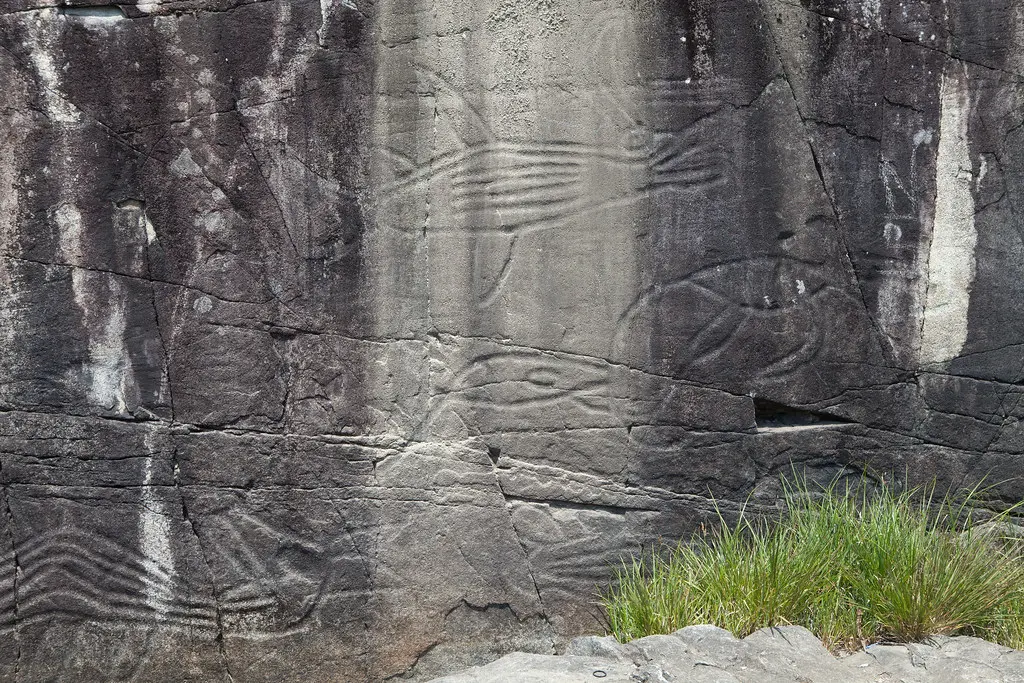
Image of Sproat Lake Petroglyphs, BC. Image source
Visit essentials
A quick read before you go
- Duration
- 30 to 60 minutes for a focused visit to the petroglyphs.
- Etiquette
- K'ak'awin is a sacred Indigenous site on unceded Hupacasath territory.
Overview
On the north shore of Sproat Lake, thirteen kilometres from Port Alberni, a smooth rock face rises from the water. Nine figures are carved into its surface. They have been here for what may be three thousand years, though no one can say precisely how long. The Hupacasath First Nation, whose unceded traditional territory this is, know the place as K'ak'awin, the Nuu-chah-nulth word for killer whale.
The rock face is the house of Kwatyat, the Transformer. In Nuu-chah-nulth oral tradition, Kwatyat is the culture hero who gave living beings and landscapes the forms they carry today. The c'isaaath people describe the petroglyphs as carved by Kwatyat himself, the creator of all things who had the power of transforming himself into anything. What visitors see at K'ak'awin is not decoration but cosmology made permanent in stone.
The nine figures depict beings that exist between worlds. The orca bridges human and spirit realms. The seawolf, a hybrid creature bearing characteristics of both wolf and whale, embodies the connection between land and sea. The Lightning Snake, Haietlik, links sky and ocean as a manifestation of lightning associated with the Thunderbird.
An origin story relates that after a great tsunami, a killer whale became trapped in the lake, binding the deep ocean to this freshwater place in the mountains of Vancouver Island.
The carvings occupy a liminal zone at the water's edge, sometimes partially submerged depending on seasonal lake levels. Their position is not incidental. They mark a boundary, a place where one element meets another, where transformation is possible. Anthropologist Franz Boas studied them in 1889, proposing they were made by rubbing wet sand against the rock with wooden sticks. Gilbert Malcolm Sproat described them in 1868, the first Western written account.
But the Hupacasath knew this place long before either man arrived, and they know it still. The petroglyphs are not relics of a vanished culture. They belong to a living people who keep the stories of Kwatyat alive and advocate fiercely for the protection of this site against vandalism and neglect.
Why this place is sacred
The petroglyphs occupy a precise kind of boundary. The rock face is neither fully on land nor in the water. Depending on the season, the lake rises to wash the lower carvings or recedes to expose them entirely. This fluctuation is not a problem to be managed but a feature of the place. The carvings were made at the water's edge because the water's edge is where transformation happens.
Consider what is depicted. Not a single figure among the nine represents an ordinary animal. The orca, K'ak'awin, is the name-giver of the site, a creature that moves between worlds, the largest predator in the sea yet a being of intelligence and social complexity that Nuu-chah-nulth tradition recognizes as kin.
The seawolf is a creature that does not exist in Western taxonomy: part wolf, part whale, a being that fuses the characteristics of the land's most powerful predator with those of the ocean's. The Lightning Snake, Haietlik, is lightning made serpentine, the force that connects Thunderbird in the sky to the creatures below. Each figure bridges a divide.
The rock itself is a kind of bridge. In Nuu-chah-nulth understanding, it is the house of Kwatyat, the Transformer who reshaped the world. To stand before it is to stand before the dwelling place of the power that made things as they are.
The story of the trapped killer whale adds another layer: a great tsunami once drove an orca from the open ocean into this mountain lake, collapsing the boundary between coast and interior, salt and fresh, the vast Pacific and this quiet inland water.
Franz Boas, visiting in 1889, saw the carvings through the lens of early anthropology. He measured, sketched, theorized about technique. What he could not easily measure was the quality of attention the place commands. The short forest walk from the parking area, the sudden opening to the lakeshore, the rock face with its figures watching from the waterline: something shifts.
The accumulated presence of thousands of years of meaning, the knowledge that Hupacasath ancestors stood exactly here and understood something about this rock that you can only partially glimpse, produces a quality of stillness that is the site's deepest offering.
The precise spiritual and ceremonial function of the petroglyphs is not fully understood by Western scholarship and may be privileged knowledge within the Hupacasath community. What can be said is that the carvings are expressions of Nuu-chah-nulth cosmology, depicting beings of spiritual power at a location identified as the dwelling place of the Transformer.
The rock face served as a site where the relationship between the human community and the supernatural forces governing the natural world was made visible and permanent.
The broader Sproat Lake area functioned as a place of spiritual use, hunting, and plant gathering for the Kleh-koot-aht people, ancestors of the Hupacasath specifically associated with this territory. Their name for Sproat Lake was Kleh-koot, meaning a long stretch of level land. A seasonal village on the Sproat River included a longhouse where potlatches were held in winter, alongside salmon fishing and smoking, berry gathering, and deer hunting.
The petroglyphs existed within this web of seasonal life, not as an isolated curiosity but as one expression of a people's relationship with their territory.
For thousands of years, the petroglyphs existed within the living context of Hupacasath territory, known and understood by the people who made them and their descendants. The first Western documentation came with Gilbert Malcolm Sproat in 1868, in his book Scenes and Studies of Savage Life. Franz Boas followed in 1889, bringing the tools of early anthropology to the site and suggesting the carvings were made by rubbing wet sand against the rock with wooden sticks.
He identified one figure as a manned canoe with a missing prow.
The establishment of Sproat Lake Provincial Park brought protection but also a change in the site's relationship to the broader world. What had been part of a living cultural landscape became, in the eyes of the settler state, a provincial park attraction. The Hupacasath First Nation has worked consistently to reassert the cultural significance of K'ak'awin and to ensure the site is treated with respect.
Vandalism has been an ongoing concern. Spray painting, bottle breaking, and other forms of disrespect have occurred at the site, causing distress to the Hupacasath community. The Heritage Conservation Act protects all rock art in British Columbia, making damage a criminal offense. BC Parks and the Hupacasath collaborate on site awareness and protection. The carvings themselves are fading with time, and visitors consistently note that they are harder to see than in historical photographs.
This gradual disappearance adds urgency to the question of stewardship.
Experience and orientation
From Sproat Lake Provincial Park's main parking and day-use area, follow the trail left, eastward along the lakeshore. The roughly half-kilometre walk is flat and manageable, winding through coastal forest with the lake between the trees. Parking lot, picnic tables, and car doors give way to quiet before the rock face appears. The floating dock offers close viewing without touching the stone.
Let your eyes adjust: weather and water have faded the petroglyphs, so they reward patience rather than a quick glance and photograph. As nine figures resolve, notice the orca that names the place; the seawolf fusing wolf and whale in Nuu-chah-nulth imagination; the Lightning Snake, Haietlik; the manned canoe identified by Boas; and uncertain hybrid forms resisting easy categories. Together they address the seen and unseen worlds.
They sit at the waterline, not high on a cliff or deep in a cave. The lake is calm on most days, and clear water may reflect the mountains while forest rises behind you; hands may have worked here three millennia ago, rubbing wet sand with wooden sticks to wear forms into stone. Open to the elements, the carvings are slowly returning to unmarked rock.
We see less than visitors a century ago and more than visitors may see a century hence. This impermanence is not a conservation failure but a fact of stone and time, making presence here a form of witness. On weekdays, especially in the shoulder season, you may be alone with water against the dock and birds in the forest.
The quiet is not empty but full, layered with the presence of what has been here longer than any living person can remember. Read the interpretive signage, allow time, and simply look.
The petroglyph site is within Sproat Lake Provincial Park, 13 km northwest of Port Alberni on Highway 4. From the main parking lot, follow the trail left (east) along the lakeshore for approximately 0.5 km to the floating dock. The trail is flat and suitable for most fitness levels. Plan 30 to 60 minutes for a visit, longer if you wish to absorb the setting.
The petroglyphs are most visible when water levels are low and lighting angles cast shadows on the carvings. Morning light tends to provide good viewing conditions. Midday sun can create glare off the water.
Context and lineage
The Nuu-chah-nulth oral tradition tells that K'ak'awin records how, after a very large tsunami, a killer whale became trapped in Sproat Lake. The rock face where the petroglyphs are carved is the house of Kwatyat, the culture hero and Transformer of the Nuu-chah-nulth peoples. Kwatyat has the power to transform surrounding elements and is said to have given living beings and landscapes the form they have today. In Northwest Coast cultures, the Transformer is often represented as a raven.
The c'isaaath First Nation describe the petroglyphs as carved by the deity Kwatyat himself, who was the creator of all things and had the power of transforming himself into anything. This attribution places the carvings not as human art but as the work of a supernatural being, an understanding that fundamentally alters how one encounters the rock face. You are not looking at something people made. You are looking at something the Transformer left behind.
K'ak'awin belongs to the Nuu-chah-nulth cultural tradition, specifically to the Hupacasath First Nation, one of fourteen Nuu-chah-nulth nations on the west coast of Vancouver Island. The Hupacasath (historically known as the Opetchesaht) trace their connection to this territory back millennia. The broader Nuu-chah-nulth peoples share a language family and cultural framework within which the cosmological beings depicted at K'ak'awin hold meaning.
Today the site sits within Sproat Lake Provincial Park, managed by BC Parks, but the cultural authority over its interpretation rests with the Hupacasath, who continue to keep the associated traditions alive.
Kwatyat (the Transformer)
The Nuu-chah-nulth culture hero and creator figure who, in oral tradition, carved the petroglyphs and gave living beings and landscapes their present forms. The rock face at K'ak'awin is known as the house of Kwatyat.
The Kleh-koot-aht people
The specific Nuu-chah-nulth group associated with Sproat Lake (Kleh-koot, meaning a long stretch of level land), ancestors of the present-day Hupacasath First Nation who maintained seasonal village life and spiritual practices in this territory.
Gilbert Malcolm Sproat
First Western writer to document the petroglyphs, in his 1868 book Scenes and Studies of Savage Life. The lake and surrounding area bear his name, a colonial overlay on Hupacasath territory.
Franz Boas
Anthropologist who studied the petroglyphs in 1889, proposing they were carved using wooden sticks to rub wet sand against the rock. He identified individual figures including a manned canoe with a missing prow. His work brought the site to international scholarly attention.
Hupacasath First Nation (contemporary)
The living stewards of K'ak'awin who maintain oral traditions connected to the site, advocate for its protection against vandalism, and work with BC Parks on site awareness. The petroglyphs remain on their unceded traditional territory.
Traditions and practice
The creation of the petroglyphs was itself a significant spiritual act, though the specific rituals that may have accompanied it are not publicly known. In Nuu-chah-nulth tradition, rock art sites are associated with places of spiritual power. The carvings at K'ak'awin depict beings central to the cosmological system: the orca, the seawolf, the Lightning Snake, and other figures whose hybrid nature suggests the boundary between ordinary and supernatural.
The broader Kleh-koot-aht tradition at Sproat Lake included a seasonal round of activities deeply interwoven with spiritual life. A winter longhouse on the Sproat River hosted potlatches, the ceremonial gatherings that structured social, political, and spiritual relations among the Nuu-chah-nulth peoples. Salmon fishing and smoking, blackberry picking, and deer hunting each had their season and, within the broader Nuu-chah-nulth framework, their ceremonial dimensions. The petroglyphs were one element in a landscape of spiritual practice, not an isolated monument.
The Hupacasath First Nation maintains oral traditions and cultural knowledge connected to K'ak'awin. They actively work with BC Parks on site awareness and protection. The Tseshaht and Hupacasath First Nations have broader programs to share heritage and re-ignite traditions in the Alberni Valley. Specific current ceremonial practices at the petroglyph site are not publicly documented, and this discretion deserves respect.
The Hupacasath's ongoing advocacy for the protection of the site, including their opposition to vandalism and their efforts to ensure the petroglyphs are treated with reverence, is itself a form of living practice.
Stand on the floating dock and give the rock face your full attention. The carvings are faded. They will not announce themselves. Let your eyes move slowly across the stone, waiting for the figures to emerge from the surface. This patience is not a burden but a practice.
When a figure resolves, hold it in your gaze. Consider that someone stood at this rock face, perhaps three thousand years ago, and used wet sand and a wooden stick to wear this shape into stone. The work was slow. The intent was not casual. What you are seeing is the residue of sustained, purposeful attention directed at making the unseen visible.
Notice the water. The way it touches the rock, rises and falls with the season, sometimes covering the lower carvings. The petroglyphs live at this boundary. They were placed here because this is where one thing becomes another, where the fixed categories of land and water dissolve. The hybrid creatures in the carvings, wolf becoming whale, lightning becoming serpent, repeat this dissolution at the level of meaning.
If you know something about Nuu-chah-nulth cosmology before you arrive, the experience deepens. Read about Kwatyat, the Transformer. Understand that in the tradition of the people whose territory this is, the rock face is not merely carved but inhabited by a power that reshapes reality. Your encounter with faded lines on stone sits within a framework of meaning far larger than what the eye alone can perceive.
Before you leave, stand quietly for a moment. Acknowledge that you are a visitor on unceded Hupacasath territory, that these carvings belong to a living people, and that the act of looking carries responsibility.
Nuu-chah-nulth (Hupacasath First Nation)
ActiveThe petroglyphs are central to Hupacasath heritage. K'ak'awin is the house of Kwatyat, the culture hero and Transformer of the Nuu-chah-nulth peoples. The carvings depict spiritually significant beings including the orca, seawolf, and Lightning Snake, all deeply woven into Nuu-chah-nulth cosmology. The Sproat Lake area has been a place of spiritual use, hunting, and plant gathering for the Hupacasath for centuries and continues to hold this significance.
The Hupacasath maintain oral histories and stories connected to the petroglyphs and the Kwatyat tradition. They actively work with BC Parks on site awareness and protection. The Tseshaht and Hupacasath First Nations have broader programs to share heritage and re-ignite traditions in the Alberni Valley. Specific ceremonial practices at the petroglyph rock are not publicly documented and may be privileged cultural knowledge.
Archaeological and Scholarly Study
ActiveK'ak'awin is recognized as one of the finest rock art sites in British Columbia and was among the first to be formally studied in Canada. The site has been a focus of scholarly interest since Franz Boas's 1889 research, contributing to the understanding of Pacific Northwest Coast Indigenous art and spirituality.
Contemporary scholarship on K'ak'awin increasingly involves collaboration with the Hupacasath First Nation. Research has moved from the external classification methods of Boas's era toward models that recognize Indigenous knowledge as authoritative. Ongoing concerns include documentation of the petroglyphs' condition, monitoring of fading and erosion, and conservation assessment.
Heritage Conservation and Stewardship
ActiveThe protection of K'ak'awin involves both provincial heritage law and Indigenous advocacy. All rock art in British Columbia is protected under the Heritage Conservation Act. BC Parks manages the site within Sproat Lake Provincial Park. The Hupacasath First Nation are the primary advocates for the site's respectful treatment.
BC Parks maintains the trail, floating dock, and interpretive signage. The Hupacasath work with BC Parks on site awareness and respond to incidents of vandalism. Conservation challenges include the natural fading of the petroglyphs, the effects of water level fluctuation, and the impact of visitor behavior.
Perspectives and open questions
K'ak'awin is understood differently depending on who is looking. For the Hupacasath First Nation, it is the house of the Transformer on their unceded territory, a living sacred site. For archaeologists, it is one of the finest rock art sites in British Columbia, subject to ongoing study. For visitors, it is an encounter with deep time and a cosmology that understood the world differently than Western frameworks allow. These perspectives do not need to be reconciled.
They can be held together, each illuminating something the others miss.
Scholarly perspective
Scholars recognize K'ak'awin as one of the most significant rock art sites in British Columbia. The site was among the first to be formally studied in Canada, with Franz Boas conducting research in 1889 and publishing his findings in 1891. Boas proposed that the carvings were made using wooden sticks to rub wet sand against the rock, creating smooth depressions. He identified individual figures including a manned canoe with a missing prow.
The petroglyphs are generally dated to within the last 3,000 years based on regional rock art chronologies, though exact dating is difficult. The broader Alberni Valley shows evidence of at least 8,000 years of Indigenous habitation. The figures are understood to depict mythological and spiritually significant beings from the Nuu-chah-nulth cosmological system. Hybrid beings dominate, making precise identification of some figures an ongoing challenge.
Contemporary scholarship is increasingly informed by collaboration with the Hupacasath First Nation and respect for Indigenous knowledge systems. The academic understanding of K'ak'awin has moved from Boas's era of external classification toward a more collaborative model that recognizes the Hupacasath as the primary authorities on the site's meaning.
Living and traditional perspectives
For the Hupacasath First Nation, K'ak'awin is the house of Kwatyat, the Transformer and culture hero of the Nuu-chah-nulth peoples. Kwatyat shaped the world into its present form and has the power to transform surrounding elements. The c'isaaath tradition holds that the petroglyphs were carved by Kwatyat himself. This is not metaphor. Within the Nuu-chah-nulth worldview, the rock face bears the direct mark of the creative power that shaped reality.
The name K'ak'awin connects the site to the story of a great tsunami that trapped a killer whale in the lake. The carvings depict beings that embody the interconnection of different realms: the seawolf bridges land and sea, the Lightning Snake bridges sky and ocean, and the orca connects the human and spirit worlds. The Sproat Lake area has been a place of spiritual use for the Hupacasath for centuries, and this significance continues.
The full cultural meaning of the petroglyphs may be privileged knowledge held within the Hupacasath community. What is shared publicly represents what the Nation chooses to make available. This boundary deserves respect. The Hupacasath keep this heritage alive in stories and in their ongoing effort to protect K'ak'awin from damage and disrespect.
Alternative interpretations
Some visitors and alternative researchers approach the petroglyphs as evidence of ancient spiritual practices, drawn by the liminal water-edge location, the depiction of hybrid beings, and the association with a Transformer deity. The tsunami origin story has attracted interest from those studying geological events encoded in Indigenous oral traditions, particularly in relation to the Cascadia Subduction Zone and its history of megathrust earthquakes.
However, no significant body of alternative or esoteric interpretation specific to this site was identified in the research. The most meaningful approach to K'ak'awin is through the traditions of the people to whom it belongs.
Open questions
Several genuine mysteries surround K'ak'awin. The exact age of the petroglyphs has never been precisely determined. Not all nine figures have been definitively identified, and the hybrid nature of the depicted beings makes interpretation resistant to simple categorization. The precise spiritual and ceremonial function of the petroglyphs, whether they served as narrative, prayer, territorial marker, vision quest aid, or some combination, is not fully understood by Western scholarship.
The tsunami origin story raises questions about whether it encodes a real geological event. The Cascadia Subduction Zone has produced megathrust earthquakes and tsunamis at irregular intervals, and Indigenous oral traditions across the Pacific Northwest have been found to preserve accurate accounts of such events. Whether additional petroglyphs exist beneath the current water line of the lake is also unknown.
And the full meaning of what is carved here may be held as privileged knowledge by the Hupacasath, understood by those who carry the tradition but not available to outsiders. Some things are not lost. They are simply not for everyone to know.
Plan your visit
Access and arrival
Port Alberni, 13 km southeast, offers a range of accommodation from motels to bed and breakfasts. Sproat Lake Provincial Park has two campgrounds for those wishing to stay closer to the site. The Pacific Rim Highway (Highway 4) connects to Tofino and Ucluelet, approximately 1.5 hours west, where additional lodging options are available.
Respectful visit
Standard outdoor clothing appropriate for Pacific Northwest conditions. The trail is a short forest walk, so sturdy footwear is advisable. Dress in layers, as lake-edge conditions can be cool even in summer. Rain gear is sensible from October through May.
Photography is permitted from the floating dock. Do not climb on the rocks or touch the petroglyphs to take photographs. Avoid directing flash at the rock carvings. Be mindful that this is a sacred Indigenous site and approach photography as documentation of a place that is not yours, rather than as collection of personal images.
No information is available about traditional offerings at this site. Do not leave objects on or near the petroglyphs, as any added material could contribute to degradation of the rock art.
Do not touch, climb on, or deface the petroglyphs | Do not use chalk, paint, or any substance to trace or highlight the carvings | Do not attempt to make rubbings or molds | Do not throw objects at the rock face | Stay on the designated trail and floating dock | All rock art in British Columbia is protected by law under the Heritage Conservation Act | Do not leave objects, offerings, or litter at the site | Damaging the petroglyphs is a criminal offense
Do not touch, climb on, or deface the petroglyphs. Do not use chalk, paint, or any substance to trace or highlight the carvings. Do not attempt to make rubbings. All rock art in British Columbia is protected under the Heritage Conservation Act, and damaging the petroglyphs is a criminal offense. Past vandalism including spray painting and bottle breaking has caused real harm to the site and distress to the Hupacasath community. The carvings are irreplaceable and already fading.
Your restraint is a form of respect.
Current practical details
Address
Ash Main, Kleecoot, BC V9Y 9B8, Canada
Hours, fees, and access can change — verify on the official source before you travel. Practical details last checked Jun 2026.
Location
Map loads as you approach this section.
Pilgrim reflections
A portrait of encounter, not a score
Pilgrims describe what they felt, how present they could become, and whether the place would shape a journey. There are no stars and no ranking of traditions.
No reviewed reflections yet
The first pilgrims can help describe the character of being here.
Share a reflection
Available after an account-backed “Been there.” Every reflection is reviewed before publication.
Nearby sacred places
Explore other sacred places in the region. Proximity does not establish access or travel time; check each place’s guidance.

Petroglyph Provinical Park, BC
Nanaimo, British Columbia, Canada
74.1 km away
Walbran Valley
Duncan, British Columbia, Canada
105.2 km away

International Buddhist Temple
Richmond, Richmond, British Columbia, Canada
131.7 km away

Abbotsford Sikh Temple
Abbotsford, Abbotsford, British Columbia, Canada
191.8 km away
References
Sources consulted for this page. Source categories describe the publication, not a guarantee that every claim is verified. Traditional accounts and outside interpretations may differ.
- 01K'aka'win / Sproat Lake - Images on Stone (Musee de la civilisation du Quebec) — Images dans la pierre / Musee de la civilisationofficialAcademic-quality digital exhibit with detailed cultural and archaeological context; includes Hupacasath perspectives and Kwatyat mythology
- 02Sproat Lake Park - BC Parks — BC ParksofficialOfficial provincial park authority page with access and facility information
- 03Great Central Lake petroglyph misinterpreted by early explorers - Ha-Shilth-Sa Newspaper — Ha-Shilth-Sa NewspaperSource contextNuu-chah-nulth newspaper article providing Indigenous perspective on regional petroglyph sites
- 04Hupacasath (Opetchesaht) - The Canadian Encyclopedia — The Canadian EncyclopediaSource contextAuthoritative reference on Hupacasath First Nation history and traditional territory
- 05Hupacasath First Nation - Traditional Territory — Hupacasath First NationofficialFirst Nation's own website describing their traditional territory including Sproat Lake
- 06K'ak'awin - Sproat Lake Petroglyphs - A Walk and a Lark — A Walk and a LarkSource contextDetailed visitor account with historical and cultural context; references Franz Boas, Kwatyat, and conservation concerns
- 079 Prehistoric Petroglyphs at Sproat Lake Provincial Park, BC — Life's Incredible JourneySource contextVisitor guide with descriptions of the nine carvings, photographs, and practical access information
- 08Sproat Lake Provincial Park - Wikipedia — Wikipedia contributorsSource contextGeneral overview of the park and petroglyphs with references to Hupacasath First Nation
- 09Sproat Lake Petroglyphs Rock Art - The Megalithic Portal — The Megalithic PortalSource contextArchaeological database entry with coordinates and basic site description
- 10Petroglyphs at Sproat Lake Provincial Park - Archiqoo — ArchiqooSource contextArchaeological site database with cultural context and Franz Boas research details
- 11Tseshaht, Hupacasath First Nations share heritage, re-ignite traditions - ZenSeekers — ZenSeekersSource contextArticle on shared heritage of Tseshaht and Hupacasath First Nations in the Alberni Valley
- 12Explore the Beauty of Sproat Lake - Alberni Valley Tourism — Alberni Valley TourismSource contextTourism authority page with visitor information for Sproat Lake area
- 13K'ak'awin Petroglyph, Sproat Lake Provincial Park, BC - BRMB Maps — BRMB MapsSource contextMapping resource with coordinates for the petroglyph site
- 14Sproat Lake Petroglyphs Map - Mapcarta — Mapcarta / OpenStreetMapSource contextGeolocation data for the petroglyph site derived from OpenStreetMap
- 15Petroglyphs at Sproat Lake - TripAdvisor — TripAdvisor contributorsSource contextVisitor reviews providing practical tips on access, viewing conditions, and experience
Share a photo
Help visitors recognize Sproat Lake Petroglyphs, BC. Every submission is reviewed before publication.