Walbran Valley
Ancient cedars older than cathedrals, standing in a forest that remembers everything
Understand sacred places, explore living traditions, and learn how to engage respectfully with Pilgrim Map.
Access has not been verified. Check current local guidance before planning a visit.
Duncan, British Columbia, Canada
Read the sources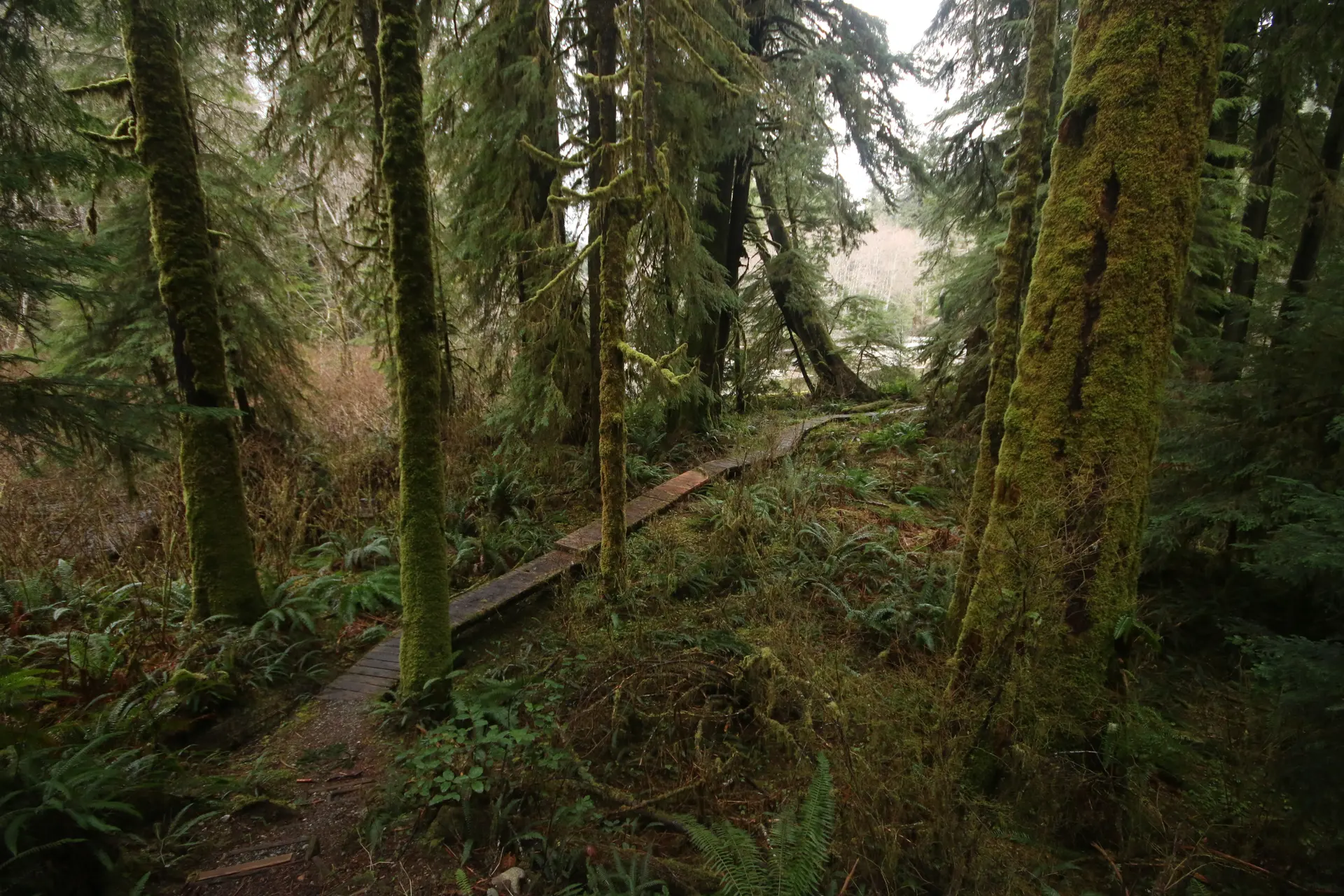
Image of Walbran Valley. Image source · CC-BY-SA-4.0
Visit essentials
A quick read before you go
- Duration
- A day trip is possible but requires allowing four hours of driving each way from Victoria plus…
- Access
- From Victoria, allow approximately four hours via active logging roads.
Overview
The journey is part of what the Walbran demands: four hours from Victoria on deteriorating logging roads, past fresh clearcuts, then across Walbran Creek into another order of time.
Western red cedars reach five meters across and Sitka spruces ninety-five meters high. Trees germinated while the Roman Empire still expanded remain alive and growing, their canopies sheltering species found nowhere else on Earth. Conservation biologists describe the Central Walbran as some of the world's most significant remaining old-growth temperate rainforest.
This is Pacheedaht First Nation territory, not merely organisms to catalogue. Elder Bill Jones calls the forest their sanctuary, where their spirits connect to the land; the Pacheedaht relationship with these trees reaches time immemorial, beyond Western historical categories.
Other visitors describe physical silence beneath the canopy and a scale that recalibrates their size, lifespan, and significance—a cathedral built by no human hands. Yet tension remains unresolved. The valley's most ecologically rich portion lies outside the provincial park, unprotected as logging roads advance. For over thirty years people have blockaded, been arrested, and in one case died to protect it, giving the landscape a moral weight shaped by sacrifice.
Why this place is sacred
Stand at the base of the Castle Giant -- a western red cedar over five meters in diameter, somewhere between 1,200 and 1,500 years old -- and something shifts in your sense of proportion. This tree was already centuries old when the Norman conquest reshaped England. It has been growing through the rise and fall of empires, through plagues and renaissances, through the entire modern era, and it is still here, still adding rings, still reaching.
The quality of thinness in the Walbran has several interlocking sources. The most immediate is the sheer temporal depth of the living forest. Old-growth temperate rainforest of this kind takes a thousand years to develop its full complexity. The trees you walk among are not individuals so much as pillars of an ecosystem that has been building itself since before the medieval period.
The canopy above you holds soil mats sixty meters in the air where hundreds of species live their entire lives, suspended between earth and sky in a world that fifteen years of research has only begun to catalogue.
Then there is the silence. Not the silence of absence but the silence of deep absorption -- the sound of an ecosystem so densely alive that it swallows noise. Visitors describe this consistently: the moment you step from the logging road into the old growth, the acoustic world changes. Your breathing becomes audible. The drip of moisture from the canopy becomes the loudest rhythm.
The remoteness contributes. The four-hour drive on rough logging roads, past clearcuts, past active industrial operations, functions as a kind of approach ritual. You cannot arrive casually. The journey strips away the ease of tourism and replaces it with intention. By the time you reach the bridge over Walbran Creek, you have already invested something of yourself.
For the Pacheedaht, the thinness here is not metaphorical. Elder Bill Jones describes the forest as the place where spirits connect to the land. The trees, water, and wildlife form an interconnected web of being in which the sacred is not located at specific points but pervades the whole. This understanding -- that the forest is not backdrop to the sacred but is itself sacred -- may be the deepest teaching the Walbran offers visitors willing to receive it.
The Walbran Valley has been part of Pacheedaht and Ditidaht traditional territory since time immemorial. The forest was not established for a purpose in the Western sense; it grew over millennia through ecological succession, shaped by climate, geology, and the stewardship of the peoples who lived within it. For the First Nations, the forest is inseparable from cultural identity, ceremony, and spiritual practice.
The modern recognition of the valley as a place of pilgrimage and conservation significance dates to the late 1980s, when Randy Stoltmann publicized the old-growth forests of the Carmanah-Walbran region.
The meaning of the Walbran has deepened through layers of human engagement. The Pacheedaht and Ditidaht relationship with the forest predates European contact by millennia and continues in the present, though specific ceremonial practices are appropriately held within the communities.
Modern history introduced a new dimension. When industrial logging threatened the valley in the late 1980s and early 1990s, the resulting War in the Woods transformed the Walbran from a place known primarily to First Nations and loggers into a symbol of the larger struggle between extraction and preservation. The blockades, tree-sits, and arrests of the 1990s gave the valley a quality of moral witness that it had not previously held for non-Indigenous people.
The creation of Carmanah Walbran Provincial Park in 1995 protected parts of the watershed but left the most ecologically significant areas outside the boundary. This unresolved status -- protected enough to be known, unprotected enough to be threatened -- has kept the valley in a state of active tension that persists today. The 2021-2022 Fairy Creek blockades, on adjacent Pacheedaht territory, renewed attention. The 2024-2025 disputes over logging in the Upper Walbran have intensified it further.
Through all of this, the trees have continued growing. The forest operates on a timescale that renders human politics fleeting. That contrast between the urgency of the political situation and the patience of the ancient cedars is itself part of what visitors encounter here.
Experience and orientation
The experience begins on the logging roads. Hours of rough gravel, washboard, and potholes, past clearcuts in various stages of regrowth, past active logging operations with their dust and machinery. This is not scenic driving. It is a transit through the consequences of resource extraction that sharpens your attention for what survives at the other end.
When you reach the bridge over Walbran Creek, the world changes. The volunteer-built visitor centre marks the threshold. Cross the bridge and the forest closes around you. The temperature drops. The light softens to a filtered green-gold. The sound of the creek becomes the baseline, and above it, an enormous quiet settles.
The trails built by Friends of Carmanah Walbran lead through the old growth on cedar boardwalks that protect the fragile root systems beneath your feet. Walk slowly. The forest rewards patience, not speed. The Emerald Loop offers a brief introduction. The Upper Falls Boardwalk leads to the cascade above emerald pools. The Harriet Nahanee Memorial Trail, named for the Pacheedaht woman who gave her life for this forest, takes you deeper.
But it is Castle Grove that most visitors describe as the transformative encounter. Here the cedars reach their full expression -- trunks over four and five meters across, bark furrowed into deep channels by centuries of weather, root systems that have been working the same soil since before the Magna Carta. The Castle Giant stands at the terminus of the trail, and people respond to it in ways they often struggle to articulate. Some fall silent. Some weep.
Some simply stand and stare, recalibrating their sense of what a living being can be.
The canopy above holds worlds you cannot see. Sixty meters overhead, suspended soil mats harbor hundreds of species -- mosses, liverworts, insects, organisms documented in fifteen years of research and still incompletely understood. The knowledge that an unseen ecosystem floats above your head, a hidden forest within the forest, adds a dimension of mystery that photographs cannot convey.
The absence of cell service is part of the experience. Without the option of documenting and sharing in real time, you are left with the unfamiliar task of simply being present. Many visitors describe this forced disconnection as one of the most valuable aspects of the visit.
The Walbran asks you to slow down long before you reach the forest. Let the long drive be preparation rather than obstacle. Use the hours on the logging road to shed the pace of ordinary life.
When you arrive at the bridge, pause before crossing. Read the interpretive signs. Understand where you are: on Crown land, outside the park boundary, in a place that exists largely because volunteers have kept it accessible and activists have kept it standing.
Choose your trail according to your time and energy, but give Castle Grove priority if you can manage the two-hour return walk. Move at the pace the forest sets, not the pace your schedule demands. Stop frequently. Look up. Let the scale of the trees work on your sense of proportion.
At the Castle Giant, resist the impulse to photograph immediately. Stand at its base and look up along the trunk until it disappears into the canopy. Place your hand against the bark if you wish -- this tree has been touched by rain and wind for over a thousand years. Your hand will not harm it. But let the contact be an act of attention, not collection.
If you camp overnight, the forest at dawn and dusk offers something the day visit cannot: the changing of light through the canopy, the voices of birds in the early morning, the deepening silence as darkness settles. The Walbran at night, with no artificial light and no cell signal, offers a quality of darkness most people in the modern world have never experienced.
Context and lineage
The Pacheedaht and Ditidaht First Nations have inhabited and stewarded the Carmanah and Walbran valleys since time immemorial. The specific creation narratives and origin stories relating to the valley are held within these communities and are not publicly documented, which is appropriate for Indigenous cultural knowledge.
What is publicly known is that the relationship between these peoples and the forest predates European contact by millennia and encompasses cultural identity, ceremony, and spiritual practice in ways that do not separate the sacred from the everyday.
The valley's modern story as a place of broader public significance begins in 1988, when conservationist Randy Stoltmann and the Western Canada Wilderness Committee discovered and publicized the Carmanah Giant, a massive Sitka spruce that drew national attention to what was being lost to industrial logging. The revelation that forests of this age and grandeur still existed -- and were being cut -- catalyzed a movement that would reshape British Columbia's environmental politics.
The War in the Woods that erupted across Vancouver Island in the early 1990s made the Walbran one of its central battlegrounds. Blockades, tree-sits, hunger strikes, and international demonstrations converged here. In 1993, the protests at nearby Clayoquot Sound drew approximately 12,000 people and resulted in 856 arrests -- the largest act of civil disobedience in Canadian history at that time. The Walbran Valley was, in the words of one conservation organization, ground zero for the movement.
The human relationship with the Walbran Valley extends beyond the reach of recorded history. Pacheedaht and Ditidaht First Nations have been present as stewards and inhabitants since time immemorial. Their practices of bark harvesting, land-based ceremony, and ecological knowledge represent a lineage of care that predates European contact by thousands of years.
The conservation lineage begins in the late 1980s with Stoltmann's discovery and runs through the War in the Woods, the creation of the provincial park, and the formation of organizations like the Ancient Forest Alliance and Friends of Carmanah Walbran. The Friends group, which has built and maintained trails, boardwalks, campsites, and a visitor centre in the Central Walbran since 2012, represents a form of stewardship that carries forward the protective impulse of the earlier movement.
These two lineages -- Indigenous stewardship and conservation activism -- sometimes converge and sometimes diverge. Elder Bill Jones's work bridges both. The Pacheedaht council's periodic support for managed logging reflects a different understanding of stewardship. The tension between these positions is honest and unresolved, and the valley carries it without simplification.
Elder Bill Jones
Pacheedaht Elder and conservation advocate
Born around 1940, Elder Bill Jones has spent his life advocating for the protection of old-growth forests in Pacheedaht territory. He describes the Walbran as his sanctuary for practicing culture and religion. In 2021, he received the Eugene Rogers Environmental Award from the Wilderness Committee. He has taken legal action against his own First Nation's elected council to prevent logging in the valley, reflecting a profound commitment to the forest's sacred status that transcends political structures.
Harriet Nahanee
Indigenous rights activist and environmental defender
A Pacheedaht woman (1935-2007), residential school survivor, and lifelong activist who was on the front lines of Walbran forest protection in the 1990s. She died on February 24, 2007, after being jailed for environmental protest at Eagleridge Bluffs at the age of 71. The Harriet Nahanee Memorial Trail in the Central Walbran, opened in 2016, honors her legacy. Her story embodies the interweaving of indigenous rights, environmental justice, and personal sacrifice.
Randy Stoltmann
Conservationist and author
The conservationist who discovered the Carmanah Giant Sitka spruce in 1988, catalyzing the public campaign that would eventually lead to the creation of Carmanah Walbran Provincial Park. His work brought national and international attention to the old-growth forests of Vancouver Island. He died in 1994, before the park was formally established.
Ken Wu
Conservation leader
Former executive director of the Western Canada Wilderness Committee's Victoria chapter, later co-founder and executive director of the Ancient Forest Alliance. Named the Tolkien Giant cedar in the Central Walbran. Has been a leading voice for Walbran protection for decades, documenting the valley's monumental trees and campaigning for permanent protection.
Traditions and practice
The Pacheedaht First Nation maintains cultural and spiritual practices in the Walbran Valley that include communion with the land, traditional bark harvesting from culturally significant trees, and ceremonies that connect community members to their territory. Specific details of these practices are not publicly documented, which is appropriate for Indigenous cultural knowledge.
Elder Bill Jones has described the forest as his sanctuary for practicing culture and religion, and his public statements convey a relationship with the trees that is both physical and spiritual -- a connection to the land that is inseparable from identity.
The Ditidaht First Nation also maintains deep cultural connections to the Carmanah Walbran area as part of their ancestral territory. Their specific practices, like those of the Pacheedaht, are held within the community.
The Central Walbran has become a destination for what might be called secular pilgrimage -- people traveling significant distances, enduring difficult access, to spend time among ancient trees for reasons they describe variously as spiritual, therapeutic, or simply necessary. Forest bathing, the practice of extended immersive presence in a forest environment, finds here one of its most powerful settings in North America.
The scale and age of the trees, the absence of cell service, and the dampened silence beneath the canopy create conditions that seem to dissolve the ordinary boundaries between self and environment.
Volunteer stewardship has become its own form of practice. Friends of Carmanah Walbran organizes convergence weekends, typically in late summer, that combine trail maintenance with educational gatherings. For many participants, the physical work of maintaining boardwalks and clearing trails is an act of devotion to the forest rather than merely a task.
The naming and documentation of individual monumental trees -- the Castle Giant, the Tolkien Giant -- functions as a kind of witness, asserting the individuality and significance of beings that industrial forestry would reduce to board feet.
Enter the forest as you would enter any place that has been held sacred for a very long time. Move slowly. Breathe deliberately. Let the pace of the forest become your pace rather than imposing your own.
At the base of the Castle Giant, allow yourself to simply stand. Place your hand against the bark if you feel moved to. Consider that this tree has been alive for over a thousand years, drawing water from the same soil, reaching toward the same sky, through centuries of weather and change. Let that fact settle into your body, not just your mind.
Find a place to sit along the trail where you can be still for ten or fifteen minutes. Close your eyes. Let the sounds of the forest arrive without seeking them out: the drip of water from the canopy, birdsong, the creak of wood under its own weight, the creek below. Notice what happens when you stop moving through a place and allow it to move through you.
If you camp overnight, step outside your tent before dawn. The forest in the predawn darkness holds a quality of stillness that the day does not offer. Wait for the first birdsong. Let the light come slowly.
The most profound practice the Walbran offers is simply this: being present, without agenda, in a place that was ancient before you were born and will continue long after you are gone.
Pacheedaht First Nation
ActiveThe Walbran Valley lies within Pacheedaht traditional territory. For Elder Bill Jones and other Pacheedaht members, the ancient forests represent sacred ground -- a sanctuary for practicing culture and religion. The trees hold both physical and spiritual importance. The relationship between the Pacheedaht and this forest extends to time immemorial, predating European contact by millennia.
Traditional practices include connection to the land through ceremony, bark harvesting from culturally significant trees, and the transmission of ecological knowledge across generations. Specific ceremonial details are appropriately held within the community and are not publicly documented.
Ditidaht First Nation
ActiveThe Carmanah Walbran Provincial Park and surrounding areas are within traditional Ditidaht ancestral territory. The Ditidaht have deep cultural connections to the coastal forests and waterways of this region that predate European contact.
Specific practices are held within the community and are not publicly documented.
Nature Spirituality and Forest Pilgrimage
ActiveThe Walbran Valley has become a pilgrimage destination for people seeking spiritual renewal through immersion in one of the last intact old-growth temperate rainforests. The extraordinary age of the trees, the cathedral-like quality of the canopy, and the profound silence create conditions widely reported as conducive to contemplation, awe, and a sense of connection to something far larger than oneself.
Silent walking meditation among ancient trees, contemplative sitting at the base of monumental cedars, forest bathing as extended immersive presence, nature photography as contemplative practice, journaling, and multi-day camping for sustained immersion in the forest environment.
Conservation Stewardship
ActiveFor over thirty years, environmental activists have treated the protection of the Walbran as a moral imperative. The tradition includes the War in the Woods blockades of the 1990s, the Fairy Creek movement of 2021-2022, and the ongoing campaigns of the Ancient Forest Alliance, Wilderness Committee, and Friends of Carmanah Walbran. The naming of the Harriet Nahanee Memorial Trail honors a Pacheedaht woman who died after being jailed for environmental protest.
Volunteer trail building and maintenance, educational convergence gatherings, tree naming and documentation, forest defense blockades, advocacy for policy change, and public awareness campaigns. Friends of Carmanah Walbran has maintained trails, boardwalks, campsites, and a visitor centre since 2012.
Perspectives and open questions
The Walbran Valley holds meaning across multiple frameworks that do not always agree with one another. Ecology describes it as globally irreplaceable habitat. Indigenous knowledge names it as sacred ground. Conservation politics treats it as a test case for old-growth policy. Visitors experience it as a place of personal transformation. Each perspective illuminates something genuine; none encompasses the whole.
Scholarly perspective
Conservation biologists and ecologists recognize the Walbran Valley as containing some of the most significant remaining old-growth temperate rainforest in the world. Fifteen years of canopy research have documented species found nowhere else -- organisms living in suspended soil mats sixty meters above the forest floor that cannot exist in younger forests. The BC government's own 2020 old-growth strategic review identified the protection of remaining ancient forests as urgent, though implementation has been slow.
The valley also functions as a case study in the intersection of Indigenous rights, conservation policy, and resource economics. The Pacheedaht First Nation's internal disagreement -- between Elder Bill Jones's position that the forest is sacred and inviolable and the elected council's periodic support for managed logging -- reflects tensions that scholars of Indigenous governance and environmental policy study closely.
Ecologically, the 252 documented species, the near-record-size cedars, the intact watershed, and the canopy ecosystem represent a complexity that second-growth forests cannot replicate within human timescales. What has taken a thousand years to develop cannot be rebuilt by planting seedlings.
Living and traditional perspectives
For the Pacheedaht, as articulated by Elder Bill Jones, the forest is not a resource to be managed but sacred ground. The trees, water, and wildlife form an interconnected web of being in which human identity is embedded rather than separate. The concept of the forest as sanctuary -- as a place where spirits connect to the land -- reflects a relationship of reciprocity and kinship with the living world that predates European frameworks of ownership and extraction.
The Ditidaht maintain their own deep cultural connections to the Carmanah Walbran area as part of their ancestral territory. The specifics of both communities' spiritual relationship with the valley are appropriately held within the communities rather than documented for outside consumption.
What can be said from publicly available statements is that the Indigenous perspective understands the forest as alive in a richer sense than Western ecology typically allows -- as populated by relatives rather than specimens, as a place of spiritual encounter rather than merely biological interest.
Alternative interpretations
The Walbran Valley is increasingly recognized within nature spirituality, deep ecology, and forest bathing communities as a site of profound contemplative power. The concept of thin places -- locations where the boundary between the everyday and the numinous feels permeable -- is frequently invoked by visitors. Some describe experiencing the forest as sentient or conscious, or report a tangible quality of presence among the ancient cedars that resists rational explanation.
The conservation activism tradition has developed its own quasi-spiritual dimension. The naming of monumental trees, the dedication of trails to fallen defenders, the vigils and blockades conducted among the ancient cedars -- these carry a ceremonial quality for many participants that blurs the boundary between political action and sacred practice.
These frameworks exist alongside, not within, the Indigenous traditions that hold the site sacred. They are not endorsed by traditional practitioners. Yet the consistency with which visitors from diverse backgrounds report experiences of awe, temporal displacement, and connection to something larger than themselves suggests that the forest is doing something that no single interpretive framework fully captures.
Open questions
The full extent of the canopy ecosystem remains incompletely understood. Fifteen years of research have documented hundreds of unique species living in suspended soil mats sixty meters above the ground, but researchers acknowledge that much remains undiscovered. What other organisms inhabit this hidden forest within the forest?
The exact age of the oldest trees has not been definitively established. Estimates for the Castle Giant range from 1,200 to 1,500 years, and some sources suggest trees in the valley may exceed 2,000 years. Without core sampling, which would damage the trees, precise dating remains uncertain.
The full scope of Pacheedaht and Ditidaht cultural and spiritual relationship with the valley extends far beyond what is publicly documented. Deeper knowledge is held within the communities, as is appropriate.
Whether the forest will survive the current political moment is genuinely unknown. The land-use planning process between First Nations and the BC government remains unresolved as of early 2026. The outcome will determine whether the Central Walbran's old growth stands for another thousand years or becomes another clearcut.
Plan your visit
Access and arrival
From Victoria, allow approximately four hours via active logging roads. The primary route follows South Shore Road from Lake Cowichan past Honeymoon Bay to Caycusse Main logging road, then McClure Main, then Walbran Main, with a final turn down a narrow spur road to the bridge and trailhead. An alternative route runs via Port Renfrew. Both traverse active industrial logging roads with rough gravel, potholes, and washboard surfaces. A 4WD or high-clearance vehicle is strongly recommended.
Roads may be gated during active logging. Check Friends of Carmanah Walbran (friendsofcarmanahwalbran.com) for current road conditions. Parking is available on both sides of the Walbran Bridge. No entrance fee. All camping is free. Mobile phone signal is unavailable at the site. The nearest communities with signal and emergency services are Lake Cowichan and Port Renfrew, each approximately two hours away by logging road.
The Central Walbran has volunteer-maintained campsites with fire rings on both sides of the bridge, a covered cooking area with a dish-washing sink, and a few outhouses. There is no potable water -- bring your own or filter from the creek. No electricity or charging facilities. The nearest lodging is in Lake Cowichan or Port Renfrew, each approximately two hours away. Bring all food, water, and supplies.
A full tank of fuel is essential as there are no services near the trailhead. Contact Friends of Carmanah Walbran (friendsofcarmanahwalbran.com) for current trail and facility conditions. No phone or email is publicly listed; communication is through their website and social media.
Respectful visit
Sturdy waterproof hiking boots with good ankle support are essential. The trails can be muddy, root-covered, and uneven even in summer. Full rain gear is necessary year-round -- the valley receives heavy rainfall and conditions can change within an hour. Layered clothing accommodates the cool, damp forest environment. Long sleeves and pants protect against brush and insects. No special religious or cultural dress requirements apply.
Photography of the forest, trees, trails, and waterfalls is welcome. Images from the Walbran have been instrumental in building public support for protection, and documenting what exists here serves the cause of preservation. However, if you encounter First Nations members conducting cultural practices, do not photograph them without explicit permission. Respect the privacy of other visitors in contemplative moments. Leave No Trace applies to photography equipment and setups -- tripods and gear should not damage the forest floor or boardwalks.
There is no established offering tradition for general visitors. The most meaningful contributions are to support conservation efforts through donations to organizations like the Ancient Forest Alliance or Friends of Carmanah Walbran, to practice Leave No Trace rigorously, and to stay on established trails and boardwalks. If you feel moved to leave something, leave your support for the organizations that maintain and protect this place.
Stay on established trails and boardwalks at all times. Pack out all garbage; there is no waste collection. Do not carve, cut, or damage any trees, whether living or dead. Campfires are permitted in designated areas only, using existing fire rings. No motorized vehicles beyond the parking area. If encountering First Nations members engaged in cultural practices, maintain respectful distance and do not interrupt. Be aware of active logging roads on approach and yield to industrial traffic.
If you encounter Pacheedaht or Ditidaht members engaged in cultural practices, give them space and privacy. Do not photograph them, approach them, or attempt to join their activities. Their practices in this forest predate your presence by millennia and are not for public participation.
The forest floor and root systems are ecologically fragile. Stay on established trails and boardwalks. Off-trail travel damages the very things you came to experience.
Be wary of romanticizing Indigenous spirituality. The Pacheedaht relationship with this forest is not a resource for your personal spiritual development. You can learn from the principle that the forest is sacred -- that it is populated by relatives rather than resources -- without appropriating specific practices or frameworks.
The conservation situation is active and politically complex. The Pacheedaht First Nation holds internal disagreements about logging and stewardship. Approach this complexity with humility rather than judgment.
Location
Map loads as you approach this section.
Pilgrim reflections
A portrait of encounter, not a score
Pilgrims describe what they felt, how present they could become, and whether the place would shape a journey. There are no stars and no ranking of traditions.
No reviewed reflections yet
The first pilgrims can help describe the character of being here.
Share a reflection
Available after an account-backed “Been there.” Every reflection is reviewed before publication.
Nearby sacred places
Explore other sacred places in the region. Proximity does not establish access or travel time; check each place’s guidance.

Petroglyph Provinical Park, BC
Nanaimo, British Columbia, Canada
43.4 km away

International Buddhist Temple
Richmond, Richmond, British Columbia, Canada
58.1 km away
Sproat Lake Petroglyphs, BC
Port Alberni, British Columbia, Canada
105.2 km away

Abbotsford Sikh Temple
Abbotsford, Abbotsford, British Columbia, Canada
106.7 km away
References
Sources consulted for this page. Source categories describe the publication, not a guarantee that every claim is verified. Traditional accounts and outside interpretations may differ.
- 01Central Walbran Valley Campaign — Ancient Forest AllianceSource contextPrimary conservation organization campaigning for Walbran protection; detailed ecological and historical data
- 02Walbran Valley — Wilderness CommitteeSource contextLong-standing conservation organization with direct involvement in Walbran campaigns since 1990s
- 03Save the Walbran Valley: Ancient forests forever! — Wilderness CommitteeSource contextDetailed conservation advocacy with biodiversity statistics
- 04Carmanah Walbran Park — BC ParksofficialOfficial provincial park information including ecology and access
- 05Friends of Carmanah Walbran — Friends of Carmanah WalbranSource contextNon-profit group that maintains trails, campsites, and visitor infrastructure in the Central Walbran since 2012
- 06Driving Instructions to the Central Walbran — Friends of Carmanah WalbranSource contextDetailed driving directions and road condition guidance
- 07The Walbran Valley's Castle Grove - Canada's Finest Old-Growth Cedar Forest — Ancient Forest AllianceSource contextDetailed documentation of Castle Grove cedars with measurements and ecological significance
- 08Conservationists Measure Near Record-Size Cedar in the Endangered Central Walbran Valley — Ancient Forest AllianceSource contextMeasurements of the Tolkien Giant cedar; BC Big Tree Registry reference
- 09How the Walbran Blockade Echoes Another Famous Stand in the Forest — The TyeenewsAnalysis connecting Walbran protests to broader War in the Woods history
- 10Islands in the Sky: Chopping Ancient Walbran Valley Forest Spells Extinction for Treetop Species — Ancient Forest AllianceSource contextCanopy ecosystem research and unique species documentation
- 11Elder Bill Jones wins 2021 Eugene Rogers Environmental Award — Wilderness CommitteeSource contextRecognition of Elder Bill Jones's conservation work
- 12Conservationists decry lack of progress 5 years after B.C.'s old-growth logging review — CBC NewsnewsReporting on BC old-growth policy and its impact on Walbran
- 13Carmanah Walbran Provincial Park - Wikipedia — Wikipedia contributorsencyclopediaGeneral overview with establishment dates, area, and First Nations territory information
- 14Walbran Valley: Hike an Ancient Forest — Chris Istace / Mindful ExplorerguideDetailed first-person hiking guide with trail descriptions, directions, and experiential observations
- 15A Complete Guide to Carmanah Walbran Provincial Park, Vancouver Island — Off Track TravelguideComprehensive visitor guide with access and practical information
- 16It's time to prepare for war: Forest defenders in ancient Walbran valley ready for RCMP raid — Ricochet MedianewsJournalism covering 2025 protests and Elder Bill Jones quotes on sacred significance
- 17In B.C., an elder is taking his own Nation to court to save the ancient forests — Ricochet MedianewsDetailed coverage of Elder Bill Jones and the Pacheedaht internal dispute over logging
- 18From Fairy Creek to the Walbran Valley, the fight for ancient forests persists — Canada's National ObservernewsContemporary conservation context linking Fairy Creek and Walbran movements
- 19Harriet Nahanee - Wikipedia — Wikipedia contributorsencyclopediaBiographical information on Harriet Nahanee, indigenous rights activist connected to Walbran
- 20An Old Growth Battlefield — British Columbia MagazineSource contextHistorical overview of Walbran as a conservation battleground
- 21Hiking in the Walbran Valley — Seek to Sea MoreguideFirst-person hiking account with trail details
- 22Hike Castle Grove of the Upper Walbran River Valley — The OutboundguideHiking guide with Castle Grove trail details
- 23The Tolkien Giant of the Central Walbran Valley — Vancouver Island MagazineSource contextFeature on the Tolkien Giant cedar with measurements
- 24Defending 2,000-Year-Old Forests w/ Elder Bill Jones and Will O'Connell — Community Environmental Legal Defense Fund (CELDF)spiritualInterview with Elder Bill Jones about spiritual connection to the forest
Share a photo
Help visitors recognize Walbran Valley. Every submission is reviewed before publication.