Tamanowas Rock Santuary, Washington
Where Coast Salish seekers have sought spirit power for ten thousand years
Port Townsend, Washington, United States
Visit essentials
Before you go
- Address
- Chimacum, WA 98325, USA
- Duration
- The main trail to the rock takes approximately 30 minutes to an hour, depending on pace and time…
- Etiquette
- This is privately owned sacred land of the Jamestown S'Klallam Tribe.
Overview
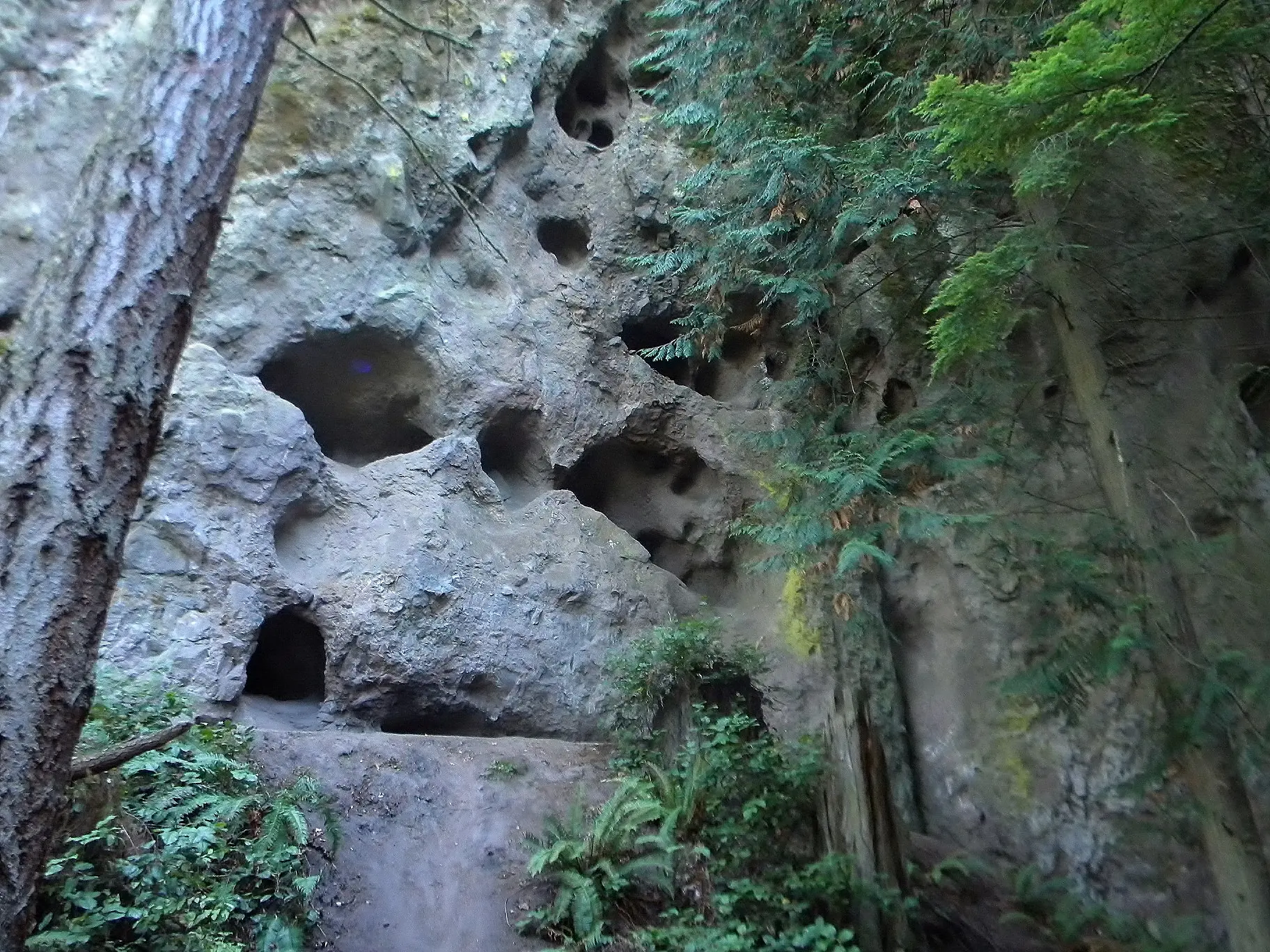
Tamanowas means spirit power. For the S'Klallam people and Coast Salish neighbors, this 150-foot volcanic formation in Washington's Olympic Peninsula forests is where humans seek connection with the spirit world. Gas bubbles trapped in cooling lava 43 million years ago formed caves used for the isolation and fasting required by vision quests.
For over ten thousand years, seekers have accumulated prayers and intentions here. Young people fasted three days in its crevices before walking to nearby Anderson Lake for ritual cleansing. Tribes came from as far as the Lummi Nation near present-day Bellingham, recognizing a place where the boundary between worlds grows thin.
The Jamestown S'Klallam Tribe bought the land in 2012, returning it to Indigenous stewardship after generations of uncertain protection. The sanctuary admits quiet visitors while remaining available for continuing tribal ceremonies. It is not a museum of past spirituality but living sacred ground, and the tribe asks everyone who enters to treat it accordingly.
Why this place is sacred
The Klallam word tamanowas denotes spirit power, the force that aided individuals throughout their lives in activities ranging from hunting to healing, from trade to ceremony. This power was not abstract. It manifested through guardian spirits encountered during the vision quest, a practice in which young people isolated themselves in natural settings to receive spiritual guidance.
Tamanowas Rock was among the most significant sites for this practice. The rock's caves, carved by gases escaping from volcanic rock 43 million years ago, provided natural isolation chambers. Here, seekers could fast for days without disturbance, waiting for the guardian spirit that would accompany them through life. The caves created conditions of sensory reduction, darkness, and separation from ordinary existence that appear across traditions as prerequisites for spiritual encounter.
But the rock's power was understood as more than geological convenience. Tribes throughout the Coast Salish world recognized this place. The S'Klallam, the Chimakum before them, the Lummi traveling from the north, all acknowledged something present here that could not be found elsewhere. This convergent recognition across distinct peoples, maintained over thousands of years, suggests either shared cultural transmission or independent encounter with the same phenomenon.
When the Jamestown S'Klallam Tribe describes the site as instrumental in defining, maintaining, and enhancing their cultural practices, they speak not of history but of ongoing relationship. The thinness here is not a relic. It is renewed with each ceremony the tribe conducts.
The rock served as a primary site for Coast Salish vision quests, the practice through which individuals sought their guardian spirits. The caves provided isolation for three-day fasts, after which seekers would walk to Anderson Lake for ritual purification. The site was also used by ceremonial societies, including groups known to early settlers as Blackface (S'Klallam) and Redface (Lummi), whose specific practices were kept sacred.
Use of the rock extends back approximately ten thousand years, beginning with the Chimakum people whose territory this was. When the Chimakum were absorbed into neighboring tribes, the S'Klallam continued the site's sacred function. European settlement disrupted traditional use, and the land passed through private hands with uncertain protection. A 1990s development threat catalyzed preservation efforts, leading to a coalition of the tribe, state parks, and a land trust.
The tribe's 2012 purchase restored indigenous stewardship, and 2015 brought National Register listing. Today the site operates as a sanctuary with limited public access, while active ceremonial use by the tribe continues.
Experience and orientation
The approach matters. Walking the trail from the small parking area along Anderson Lake Road, you move through second-growth forest, wetlands, and the ecological diversity of the Olympic Peninsula lowlands. Birds call. The path rises and falls. Nothing announces what waits ahead.
Then the rock appears. One hundred fifty feet of dark volcanic stone, rising from the forest floor with a presence that stops most visitors in their tracks. The scale defies expectation. Caves and crevices mark its face, the same openings where seekers once spent days in fasting and prayer. You cannot climb this rock, not because a sign prohibits it, but because doing so would violate something you feel immediately upon seeing it.
The silence here is particular. Not the absence of sound but its transformation. Visitors consistently report a listening quality, as though the space itself attends to what you bring. The forest sounds continue, but they seem to occur at a remove, leaving a stillness at the center.
Knowing the history changes the encounter. To stand before caves where people have sought guardian spirits for ten thousand years is to occupy space charged with accumulated intention. The prayers of countless seekers have saturated these stones. Whether you frame this as psychological effect, spiritual reality, or something for which we lack adequate vocabulary, the experience remains consistent across visitors of varied backgrounds.
The tribe asks that visitors not create their own ceremonies here. This is not a generic power spot available for any spiritual appropriation. It belongs to the S'Klallam people, who have specific relationships and protocols with this place. What visitors can do is walk quietly, sit in contemplation, and allow the encounter without needing to add to it.
Approaching this site as indigenous sacred land under active tribal stewardship provides the appropriate frame. You are a guest on ceremonial grounds, not a tourist at an attraction. The tribe has generously opened the sanctuary for quiet visits; this openness is not a right but an invitation. Arrive with the disposition you would bring to any place of worship belonging to a tradition not your own.
Context and lineage
The rock itself emerged 43 million years ago through a volcanic process called slab window volcanism, which produces a rare type of rock called adakite or dacite. The caves that make the rock spiritually significant formed when gas bubbles became trapped in cooling lava. Geologists note the unusual composition, but for the peoples who came to use it, the rock's significance lay not in its formation but in its function.
The Chimakum people, whose name gives nearby Chimacum its designation, were likely the first to recognize the rock as sacred. They used it as a lookout for hunting mastodon in the prehistoric era, a practical function intertwined with spiritual practice. Successful hunting required spirit power, and the rock provided both vantage and vision.
When the Chimakum were absorbed into neighboring tribes, the S'Klallam inherited stewardship of the site. Their name for the rock denotes its purpose: a place to seek tamanowas, the spirit power that would guide an individual through life. From this inheritance emerged the practices that continued into recorded history and persist today.
The sacred lineage of Tamanowas Rock passes from the Chimakum to the S'Klallam through absorption and continuation rather than formal transmission. The Port Gamble S'Klallam absorbed Chimakum people directly, carrying forward the relationship with this place. Today, three S'Klallam tribes, Jamestown, Port Gamble, and Lower Elwha, maintain connection to the site, along with other Coast Salish peoples including the Lummi Nation.
The Jamestown S'Klallam Tribe holds ownership and primary stewardship, ensuring the site remains available for tribal use across all connected peoples.
Chimakum People
Original stewards who first established the rock's sacred use approximately 10,000 years ago. The tribe was later absorbed into the S'Klallam and Skokomish peoples.
Jamestown S'Klallam Tribe
Current owners and stewards of the sanctuary since 2012. The tribe protects the site while maintaining it as active ceremonial grounds.
Jefferson Land Trust
Conservation organization that facilitated the purchase and holds conservation easement on the property.
Traditions and practice
The vision quest was the central practice at Tamanowas Rock. Young people would enter the caves to fast for three days, seeking encounter with a guardian spirit. This spirit, once received, would accompany and aid the individual throughout their life in activities ranging from hunting and fishing to healing and ceremony. The relationship was not symbolic but lived, an ongoing partnership between human and spirit.
After the fast, the seeker would walk to nearby Anderson Lake for a cleansing bath, completing the ritual cycle. The transition from darkness to water, from isolation to purification, marked the integration of the vision received.
The site also served ceremonial societies. Settlers recorded the presence of groups they called Blackface, a S'Klallam fraternal-spiritual organization, and Redface, a Lummi equivalent. These societies conducted ceremonies at the rock, the specific nature of which was kept from outsiders. The names refer to ceremonial paint or masks rather than any physical characteristic.
The Jamestown S'Klallam Tribe continues to use the sanctuary for ceremonies. The specific nature of these practices is not disclosed publicly. The tribe reserves the right to close the property during ceremonial periods, and visitors should respect any closure notices they encounter.
The site's listing on the National Register of Historic Places as a Traditional Cultural Property affirms its ongoing cultural significance. This designation recognizes not merely historical importance but continuing use by the community for whom it has meaning.
Visitors are welcome for quiet, contemplative activities. Walking the trails slowly and sitting in silence before the rock allow the encounter to develop without forcing it. Birders find the sanctuary rich in species. Those seeking more than scenic appreciation might simply arrive with openness, without agenda, allowing the place to communicate what it will.
There is value in knowing you stand where seekers have stood for ten thousand years. You need not perform ceremony to participate in that continuity. Your attention, your respect, your willingness to be present without demanding an experience, these are offerings appropriate for any visitor.
S'Klallam Ancestral Practice
ActiveFor the three S'Klallam tribes, Jamestown, Port Gamble, and Lower Elwha, Tamanowas Rock represents continuous sacred relationship spanning thousands of years. The site is not merely historically important but actively instrumental in tribal cultural practice today.
The tribe conducts ceremonies at the site, the specific nature of which is not publicly disclosed. Traditional practices centered on vision quests in the caves, involving three-day fasts followed by purification in Anderson Lake. The historical Blackface society, a S'Klallam ceremonial organization, held ceremonies at the rock.
Coast Salish Vision Quest Tradition
ActiveThe vision quest, through which individuals sought guardian spirits, was a foundational practice across Coast Salish peoples. Tamanowas Rock was among the most significant sites for this practice, recognized across tribal boundaries.
Young people entered the caves to fast, typically for three days, seeking a vision or dream in which a guardian spirit would reveal itself. This spirit would then accompany the individual through life, providing power for hunting, fishing, healing, and ceremony. The fast concluded with a ritual cleansing bath in nearby Anderson Lake.
Chimakum Heritage
HistoricalThe Chimakum people, for whom nearby Chimacum is named, were likely the first to recognize and use the rock as sacred, approximately ten thousand years ago. Their traditions established the site's sacred character.
The Chimakum used the rock as a lookout for hunting mastodon in the prehistoric era, a practical function intertwined with spiritual practice. Specific Chimakum ceremonies are not documented, though they likely resembled the vision quest practices of related Coast Salish peoples.
Lummi Nation Connection
ActiveThe Lummi Nation, located near present-day Bellingham approximately 100 miles north, recognized Tamanowas Rock as a place of power and traveled to conduct ceremonies there. This cross-tribal pilgrimage demonstrates the site's significance beyond local S'Klallam territory.
The Lummi participated through a ceremonial society known to settlers as Redface, described as benevolent in character. The specific ceremonies conducted were kept sacred and are not publicly documented.
Perspectives and open questions
Tamanowas Rock occupies a distinctive position in the landscape of sacred sites: indigenous owned, actively used for ceremony, yet open to respectful visitors. This combination is rare. Most indigenous sacred sites in the United States are either closed to outsiders or managed by non-indigenous agencies. The tribe's decision to permit limited public access while maintaining ceremonial use offers a model of shared space uncommon in our polarized relationship with indigenous heritage.
Scholarly perspective
Archaeological and geological scholarship has documented the rock's significance through multiple lenses. Geologists identify the formation as a rare example of adakite or dacite produced by slab window volcanism 43 million years ago, an unusual process that makes the rock compositionally distinctive. Archaeologists and anthropologists recognize ten thousand years of sacred use, though the oral nature of Coast Salish tradition means much knowledge remains undocumented in academic sources.
The site's 2015 listing on the National Register of Historic Places as a Traditional Cultural Property reflects scholarly recognition of ongoing cultural significance. This was only the third such designation in Washington State, following Snoqualmie Falls and Mount Saint Helens, placing Tamanowas Rock among the most officially recognized sacred sites in the region.
Living and traditional perspectives
For the S'Klallam peoples, Tamanowas Rock is not primarily a historical artifact or geological curiosity but a living relationship maintained across generations. The name tamanowas, spirit power, indicates function rather than description. This is the place where that power can be sought and sometimes found.
The tribe describes the site as instrumental in defining, maintaining, and enhancing S'Klallam cultural practices. This language resists the past tense. The practices continue. The ceremonies are conducted. The relationship persists. Tribal ownership since 2012 ensures that these traditions can continue without interference from external development pressures or management regimes that might not understand the site's requirements.
Open questions
Several aspects of Tamanowas Rock's sacred history remain undocumented. The specific practices of the ceremonial societies known to settlers as Blackface and Redface were kept secret and have not been disclosed. Original Chimakum oral traditions related to the rock were largely lost when the tribe was absorbed into neighboring peoples. Whether the caves ever contained petroglyphs or other markers remains unknown. The full extent of inter-tribal pilgrimage networks centered on the rock has not been mapped.
These gaps represent not academic limitation but the proper boundaries of sacred knowledge, some of which was never intended for general transmission.
Plan your visit
Access and arrival
Port Townsend, approximately 10 miles northeast, offers the widest range of accommodations from historic hotels to bed-and-breakfasts. The smaller communities of Chimacum and Port Hadlock provide closer options. No facilities exist at the sanctuary itself.
Respectful visit
No specific dress code applies, though practical footwear for forest trails with some elevation gain is recommended. Dress appropriately for Pacific Northwest weather, which can change quickly.
Photography is permitted but should be conducted with awareness of the site's sacred character. Do not photograph any tribal ceremonies if you encounter them. Photographing the rock itself and the surrounding forest raises no concerns, but consider whether your focus on documentation might prevent the direct encounter the site offers.
Do not leave offerings, dig, paint, or alter the rock or surrounding area in any way. The tribe has not invited offerings from visitors, and leaving objects would constitute unauthorized alteration of sacred space.
{"No rock climbing under any circumstances","No motorized vehicles","No horses or bicycles","No pets","No hunting","No camping or fires","No taking of flora and fauna","No tree cutting","No rock painting or graffiti","No personal ceremonies or rituals without tribal permission","Respect all closure notices during tribal ceremonies"}
The tribe explicitly asks that visitors not create their own forms of ceremony in the sanctuary without permission. This is S'Klallam sacred space, not a generic spiritual resource available for appropriation. Creating personal rituals here, leaving offerings, or conducting practices from other traditions would be disrespectful to the tribe's relationship with this place.
Do not climb the rock. This prohibition is not merely regulatory but reflects the site's sacred character. The caves where vision seekers once fasted are not climbing routes. The rock painting and graffiti that previously desecrated the site caused genuine grief to the tribal community.
Current practical details
Address
Chimacum, WA 98325, USA
Phone
Hours
Hours, fees, and access can change — verify on the official source before you travel. Practical details last checked Jun 2026.
Location
Map loads as you approach this section.
Pilgrim reflections
A portrait of encounter, not a score
Pilgrims describe what they felt, how present they could become, and whether the place would shape a journey. There are no stars and no ranking of traditions.
No reviewed reflections yet
The first pilgrims can help describe the character of being here.
Share a reflection
Available after an account-backed “Been there.” Every reflection is reviewed before publication.
Nearby sacred places
Explore other sacred places in the region. Proximity does not establish access or travel time; check each place’s guidance.
Snoqualmie Falls, Oregon
Snoqualmie, Washington, United States
89.2 km away
Walbran Valley
Duncan, British Columbia, Canada
107.8 km away

Abbotsford Sikh Temple
Abbotsford, Abbotsford, British Columbia, Canada
119.9 km away

International Buddhist Temple
Richmond, Richmond, British Columbia, Canada
125.9 km away
Share a photo
Help visitors recognize Tamanowas Rock Santuary, Washington. Every submission is reviewed before publication.