Mt. Meili Xue
The highest unclimbed peak over 6,000 meters, where a warrior god remains undisturbed
Understand sacred places, explore living traditions, and learn how to engage respectfully with Pilgrim Map.
Access has not been verified. Check current local guidance before planning a visit.
Zogang County, Tibet Autonomous Region, China

Visit essentials
A quick read before you go
- Duration
- One day minimum for Feilai Temple sunrise viewing and Mingyong Glacier.
- Access
- Deqin County, Diqing Tibetan Autonomous Prefecture, Yunnan Province.
Overview
There is one summit in the world that humanity has chosen not to reach. Kawagebo, at 6,740 meters the highest peak of the Meili Snow Mountains, stands on the Yunnan-Tibet border between the Mekong and Salween rivers, and no human has ever stood on its top. Not because the mountain cannot be climbed. Because the mountain must not be climbed.
For the Tibetan communities of the Khampa region, Kawagebo is not a peak to be conquered. It is the palace of a warrior god — a deity converted to Buddhism by Padmasambhava in the eighth century, who became a protector of the Dharma. His summit is his throne. To set foot on it is sacrilege.
In January 1991, a joint Sino-Japanese expedition of seventeen climbers was buried by an avalanche at Camp III on the northwest face. All perished. Tibetan villagers had held ceremonies opposing the climb and predicted the disaster. Bodies were not recovered until 1998, when glacial movement deposited remains at the base of Mingyong Glacier. In 2001, Yunnan Province enacted a permanent climbing ban.
The ban transformed Kawagebo from a mountaineering challenge into something else entirely: a statement about what deserves to remain beyond human reach. In a world that has mapped every surface and climbed every summit of note, this mountain's inviolate status carries a weight that extends far beyond Tibetan theology.
Thousands of Tibetan pilgrims complete the outer kora — a six-to-thirteen-day circumambulation of the entire massif over passes above 4,800 meters — every year. During the Year of the Sheep, which occurs every twelve years, the numbers swell to tens of thousands. The next Year of the Sheep falls in 2027. The kora is one of the most demanding and rewarding pilgrimages in the Tibetan Buddhist world.
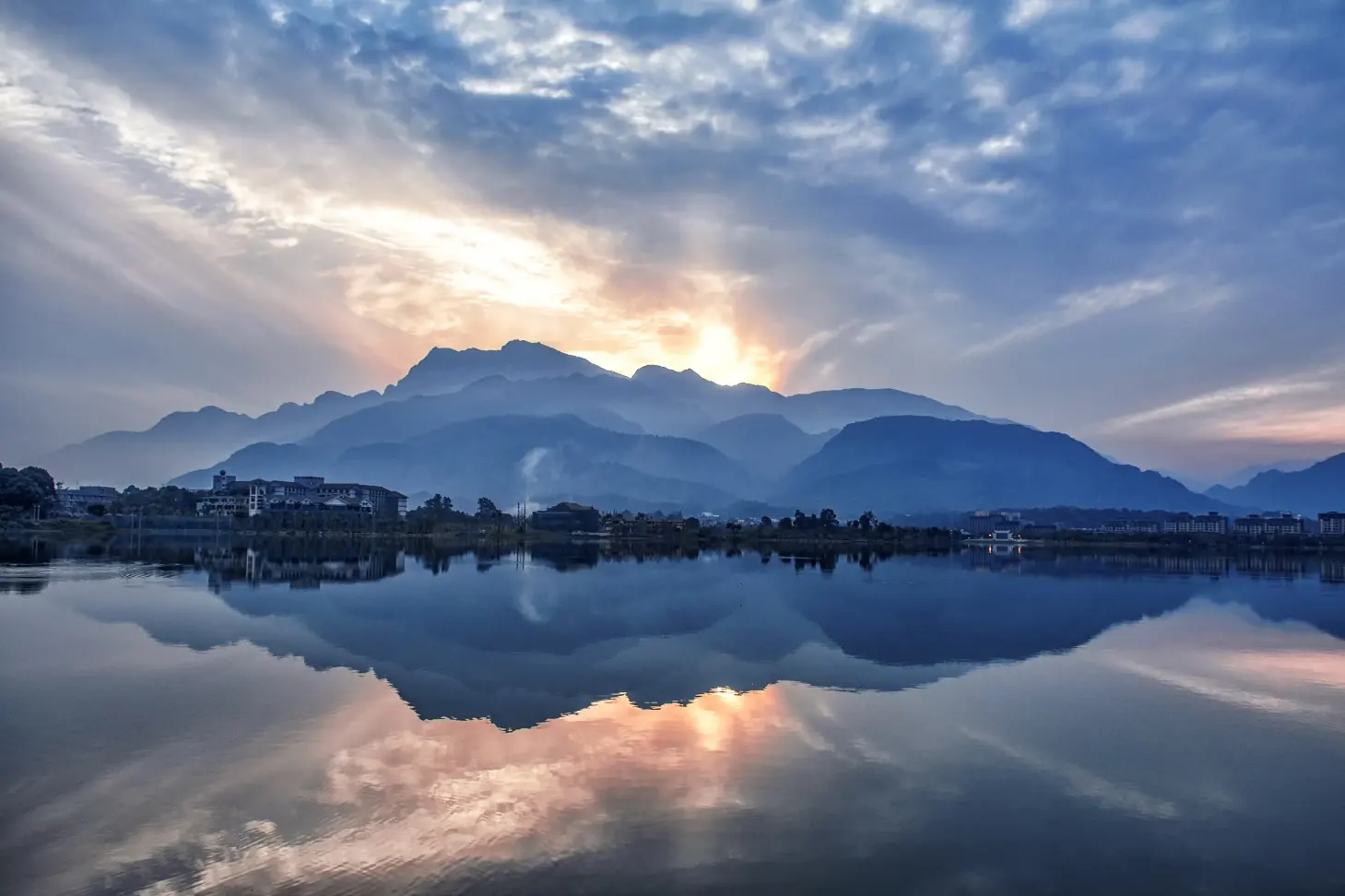
For those who come simply to see, the sunrise over Kawagebo from Feilai Temple is among the most transcendent sights in Asia. The golden pyramid of the summit emerges from clouds, lit from behind, and for a few minutes the mountain reveals itself before the clouds close again. The Tibetans read these clearings as the deity's mood. When Kawagebo shows his face, he is pleased.
Why this place is sacred
The thinness at Kawagebo is inseparable from prohibition. This is a place where something that could be done — climbing to the summit — has been forbidden, and the prohibition itself generates sacred power. The mountain's unclimbed status is not an absence. It is a presence — the presence of a boundary that the human world has chosen to respect.
The 1991 disaster functions as the mountain's most recent and most dramatic intervention in human affairs. Seventeen climbers died in circumstances that the Tibetan community had specifically predicted. The fact that bodies did not appear for seven years — emerging from Mingyong Glacier far from the avalanche site, carried by glacial movement — added a dimension of uncanny precision to the mountain's response. The god returned the bodies when and where he chose.
The kora pilgrimage generates a different quality of thinness — the accumulated devotion of thousands of pilgrims circumambulating the massif over high passes, chanting mantras, burning juniper, and prostrating at sacred sites. The Year of the Sheep kora, when merit is believed to be multiplied, intensifies this accumulation. The trail fills with Tibetans from across the Khampa region, many in traditional dress, some performing prostrations for the entire circuit.
The sunrise view from Feilai Temple adds a visual dimension that is difficult to overstate. The Meili Snow Mountains present a wall of ice and rock, with Kawagebo's pyramid summit the highest point. When dawn light strikes the summit while the lower mountain is still in shadow, the peak appears to float — a golden form detached from earth. The Tibetans call this jiri — the moment the mountain god reveals himself.
Kawagebo's sacred significance predates Buddhism in Tibet, rooted in the pre-Buddhist Tibetan tradition of mountain deity worship. The warrior deity Kawagebo was incorporated into Buddhist cosmology after Padmasambhava's legendary conversion in the eighth century. The mountain's purpose, in the living tradition, is to serve as the dwelling of a protector deity — a place where divine power resides and where the boundary between human and divine must be maintained through reverence.
The mountain's sacred status was dramatically reinforced by the 1991 disaster and the subsequent climbing ban. What had been a local Tibetan belief became an internationally recognized case in the intersection of mountaineering, indigenous rights, and sacred landscape protection. The climbing ban transformed Kawagebo from a contested site — where external ambition confronted local belief — into a symbol of the possibility that some places are more valuable untouched.
Experience and orientation
The road from Shangri-La to Deqin is itself a pilgrimage of sorts — five to six hours of highway winding through the Mekong River gorge, climbing from 3,200 meters to over 4,200 meters at the Baima Snow Mountain pass before descending to Deqin. The landscape is vast, vertical, and sparsely inhabited.
Feilai Temple, a small monastery ten kilometers from Deqin, sits at the primary viewing point for the Meili Snow Mountains. The experience here is fundamentally about waiting. You arrive in darkness before dawn. The mountains are invisible. Coffee or butter tea from a guesthouse warms the hands. Then, if the weather cooperates, the peaks begin to emerge — first as darker shapes against a lightening sky, then as the sun strikes Kawagebo's summit and the mountain blazes gold against blue.
The moment lasts minutes. Clouds may close before or after. The Tibetans understand this uncertainty as part of the encounter: the mountain reveals itself on its own terms.
Mingyong Glacier descends from Kawagebo's east face to approximately 2,700 meters — one of the lowest-latitude glaciers in the Northern Hemisphere. The hike to the glacier viewpoint passes through forest and along moraines. This is where the 1991 expedition's bodies emerged in 1998, carried by the glacier's slow movement. Standing here, the mountain looms overhead with an intimacy and scale that the distant viewing at Feilai Temple cannot provide.
Yubeng Village, a hidden Tibetan settlement beneath Kawagebo's south face, requires a two-day trek from the Xidang trailhead. The village has no road access — supplies arrive by mule. A sacred waterfall above the village is a pilgrimage destination in its own right. The isolation, the proximity to the mountain, and the simple hospitality of the guesthouses create an experience of immersion in the mountain's presence.
The outer kora, for those with the fitness and the commitment, is the full encounter. Six to thirteen days of walking around the entire massif, crossing passes above 4,800 meters, sleeping in basic shelters or camping. The trail passes through deep river valleys, alpine meadows, and glacial moraines. During the Year of the Sheep, the trail is shared with thousands of Tibetan pilgrims, and the experience becomes one of walking within a living tradition.
Deqin is the base town. Feilai Temple is accessible by car or taxi, ten kilometers from Deqin. Mingyong Glacier is a day trip by car and moderate hiking. Yubeng Village requires two days of trekking. The outer kora requires a guide, proper acclimatization, and full trekking gear. Begin acclimatizing at Shangri-La (3,200 meters) before traveling to Deqin (3,400 meters). The altitude is significant — headaches and shortness of breath are common for the unacclimatized.
Context and lineage
When Padmasambhava — Guru Rinpoche, the master who brought Buddhism to Tibet — arrived in the Khampa region, the warrior deity Kawagebo resisted violently. A fierce spiritual battle ensued. Padmasambhava subdued Kawagebo and converted him to a protector of the Buddhist Dharma. The mountain became his palace and the entire massif his sacred domain.
This conversion narrative is characteristic of Tibetan Buddhism's relationship with the pre-Buddhist landscape. The mountain deities were not destroyed or denied. They were incorporated — their power acknowledged and redirected in service of the Dharma. Kawagebo's warrior nature was preserved, making him both protector and threat: he defends the faithful and punishes the sacrilegious.
The mountain's sacred lineage extends from pre-Buddhist Tibetan mountain deity worship through Padmasambhava's conversion of Kawagebo to the living Tibetan Buddhist tradition that maintains the kora pilgrimage today. The 1991 disaster and the 2001 climbing ban represent the most recent chapter in the mountain's ongoing assertion of sacred sovereignty.
Padmasambhava (Guru Rinpoche)
The master who brought Buddhism to Tibet in the eighth century and, in the founding legend, subdued and converted the warrior deity Kawagebo from a hostile mountain god to a Buddhist Dharma protector.
Kawagebo (deity)
The warrior god who resides on the mountain — chief of the sacred mountains of the Khampa region and one of the most powerful mountain deities in the Tibetan Buddhist pantheon.
The seventeen climbers of 1991
The joint Sino-Japanese expedition whose death in an avalanche on the northwest face confirmed, for the Tibetan community, the mountain god's power and led to the permanent climbing ban.
Traditions and practice
The outer kora — a six-to-thirteen-day circumambulation of the entire massif — is the mountain's defining practice. The route crosses passes above 4,800 meters and takes the pilgrim through a complete mandala landscape. Tibetan pilgrims approach the kora with varying degrees of physical intensity, from steady walking to full-body prostrations for the entire circuit.
Sang — juniper smoke offerings — are made at dawn facing the mountain, the fragrant smoke understood as a purification offering that pleases the deity. Prayer flags are placed at passes and viewpoints, their colors and printed mantras released by the wind. Water collected from sacred glacial streams along the kora route is carried home for healing and blessing.
The kora continues as a living pilgrimage with annual participation running into the thousands. The Year of the Sheep brings tens of thousands. Daily sunrise viewing and prayer at Feilai Temple has become a practice accessible to all visitors. Local Tibetan communities maintain ritual relationships with the mountain through New Year ceremonies and seasonal observances before planting and harvest.
Mingyong Glacier visits function as both devotional and touristic activity, with Tibetan pilgrims and secular visitors sharing the trail to the glacier viewpoint.
At Feilai Temple, arrive before dawn and wait in silence. If the mountain reveals itself at sunrise, receive the moment without trying to capture it. Photographs will not hold what you see. The gold light on ice, the scale, the knowledge that this summit will never be stood upon — these need to be experienced directly.
If visiting Mingyong Glacier, walk in awareness of the site's history. This is where the mountain returned the bodies of those who trespassed. The glacier is retreating visibly year by year, and the landscape carries the weight of both sacred narrative and ecological change.
For the kora, engage a local guide and plan for proper acclimatization. Walk clockwise, following Buddhist circumambulation practice. Accept the pace that the altitude allows. At each pass, observe how Tibetan pilgrims mark the crossing — with prayer flags, mantras, and juniper smoke. The passes are thresholds, and the Tibetan tradition treats them accordingly.
Tibetan Buddhism — Warrior God Kawagebo
ActiveKawagebo is one of the eight great sacred mountains of the Khampa Tibetan region. The mountain deity, converted to Buddhism by Padmasambhava, is a warrior god and protector of the Dharma. The permanently unclimbed summit is his inviolate dwelling.
Outer kora circumambulation of six to thirteen days, juniper smoke offerings at dawn, prayer flag placement at passes and viewpoints, prostrations at sacred sites along the kora route, water collection from sacred glacial streams, and intensified pilgrimage during the Year of the Sheep.
Bon — Mountain Deity Worship
ActivePre-Buddhist Tibetan traditions regarded Kawagebo as the dwelling of a powerful mountain deity. Elements of these older practices persist in the Buddhist veneration, including the warrior characterization and the belief that disturbing the summit brings catastrophe.
Ritual offerings to the mountain deity, juniper smoke offerings at dawn, propitiation ceremonies before seasonal agricultural and herding activities.
Perspectives and open questions
Kawagebo can be understood as a case study in sacred landscape protection, a living Tibetan Buddhist pilgrimage site, a mountaineering ethics dilemma, or an encounter with the radical proposition that some places in the world are not for us.
Scholarly perspective
The 1991 disaster and subsequent climbing ban have become a globally significant case study in the intersection of mountaineering, indigenous rights, and sacred landscape protection. The mountain is widely cited in environmental ethics and sacred natural sites literature as a successful example of cultural protection of a natural site. Kawagebo exemplifies the Tibetan Buddhist tradition of sacred mountains as dwelling places of converted deities.
Living and traditional perspectives
For Tibetan communities in Deqin County and the broader Khampa region, Kawagebo is not symbolically sacred — he is a living deity whose moods are visible in the clouds and weather around the summit. The 1991 disaster confirmed what the community already knew: the mountain god punishes trespass. The climbing ban is not a conservation measure but a matter of spiritual survival.
Alternative interpretations
Some visitors report altered states or unusual energy at viewing points and along the kora route. The mountain's perpetual unclimbed status gives it a unique mystique in global mountain spirituality. The convergence of two of Asia's greatest rivers flanking the massif adds to geomantic interpretations of the site's power.
Open questions
The full extent of pre-Buddhist worship at the mountain is not documented. Whether the inner kora route contains undocumented sacred sites is unknown. The complete mythology of Kawagebo's relationship to the other seven sacred mountains of the Khampa region has not been fully recorded in accessible sources. What the summit looks like at close range remains unknown — no human has been within hundreds of meters.
Plan your visit
Access and arrival
Deqin County, Diqing Tibetan Autonomous Prefecture, Yunnan Province. On the Yunnan-Tibet border. Bus or private car from Shangri-La (Zhongdian), approximately five to six hours via National Highway G214. No direct flights. Shangri-La has an airport with connections to Kunming and Chengdu. Feilai Temple is ten kilometers from Deqin by road. Parking available at Feilai Temple and Mingyong Glacier entrance. Mobile phone signal is available in Deqin and at Feilai Temple; unreliable on the kora route and in Yubeng Village.
Medical facilities are limited — the nearest hospital is in Deqin.
Hotels and guesthouses in Deqin range from budget to mid-range. Simple but atmospheric guesthouses at Feilai Temple. Basic guesthouses in Yubeng Village have no road access and supplies arrive by mule. For the kora, camping equipment or basic local homestays.
Respectful visit
Warm, layered clothing for altitude and weather variability. Respectful attire at temples and monasteries — cover shoulders and knees in religious spaces.
Permitted of the mountain and landscape. Ask permission before photographing Tibetan pilgrims, especially those performing prostrations. No photography inside monastery prayer halls without permission.
Juniper incense, prayer flags, and kata (white scarves) are traditional offerings. Available in Deqin and along the kora route.
Climbing is permanently banned by law. Always circumambulate clockwise. Do not disturb mani stones or prayer flags. Do not step on or over religious objects. No loud music or disruptive behavior at viewing points or along the kora.
Altitude is a serious concern at all levels of engagement. Deqin sits at 3,400 meters; the kora crosses passes above 4,800 meters. Altitude sickness can be dangerous and is unpredictable. Acclimatize properly. The kora should not be attempted without good fitness, appropriate gear, and an experienced guide. Never express interest in climbing the mountain — the ban is a matter of law and of profound cultural significance.
Current practical details
Address
Meili Xue Shan, Zogang County, Chamdo, China, 854523
Hours, fees, and access can change — verify on the official source before you travel. Practical details last checked Jun 2026.
Location
Map loads as you approach this section.
Pilgrim reflections
A portrait of encounter, not a score
Pilgrims describe what they felt, how present they could become, and whether the place would shape a journey. There are no stars and no ranking of traditions.
No reviewed reflections yet
The first pilgrims can help describe the character of being here.
Share a reflection
Available after an account-backed “Been there.” Every reflection is reviewed before publication.
Nearby sacred places
Explore other sacred places in the region. Proximity does not establish access or travel time; check each place’s guidance.


Pilgrim glossary
- Mandala
- A symbolic diagram of the cosmos used in meditation and ritual.
- Dharma
- The teachings of the Buddha; also the universal law underlying them.
Share a photo
Help visitors recognize Mt. Meili Xue. Every submission is reviewed before publication.