Mt. Emei Shan
Where Samantabhadra rides his white elephant through clouds above China's first Buddhist mountain
Understand sacred places, explore living traditions, and learn how to engage respectfully with Pilgrim Map.
Access has not been verified. Check current local guidance before planning a visit.
双水井, Sichuan, China
Visit essentials
A quick read before you go
- Duration
- Two to three days for the full hiking pilgrimage from base to summit.
- Access
- Approximately 150 km from Chengdu.
Overview
The mountain makes the path physical. At Emei, the Buddhist teaching that spiritual progress requires sustained effort is not a metaphor but a topography: 50 kilometers of stone steps climbing from subtropical heat through temperate forest to the cloud world of the Golden Summit. Two to three days of walking. Temples at intervals that function as both way stations and teachings. Monkeys that steal your food and remind you that the wild mind is always present.
Mount Emei claims to be the first place in China where a Buddhist temple was built, possibly as early as the 1st century CE. Whether the exact dating holds or not, the claim itself matters: it expresses the mountain's foundational role in Chinese Buddhist identity. This is where the Dharma first took root in Chinese soil, where an imported Indian tradition began to become something distinctly Chinese.
The mountain's designation as the bodhimanda of Samantabhadra gives it a specific theological character. Samantabhadra is the bodhisattva of practice, the one whose ten great vows summarize the entire path from aspiration to enlightenment. To climb Emei is to enact those vows in the body: patience in the face of exhaustion, compassion for fellow pilgrims struggling on the steps, dedication to the summit regardless of weather or muscle pain.
At the Golden Summit, the 48-meter Ten-faced Samantabhadra statue rises from a cloud sea that may or may not be visible depending on the hour. The statue, completed in 2006, is gold-plated and seated on a four-sided elephant, each face representing one of the bodhisattva's vows. On certain days, the sun behind the visitor casts their shadow onto the clouds below, ringed by a perfect rainbow. The Chinese call this the Buddha's Halo.
Historically, some pilgrims believed this meant Samantabhadra was receiving them and leaped from the cliff in ecstasy. Guard rails were eventually installed.
Why this place is sacred
The genius of Mount Emei is that it makes the spiritual path physical without making it a metaphor. The ascent from Baoguo Temple at the base to the Golden Summit at 3,077 meters passes through every climate zone in China, from subtropical to subarctic. The vegetation changes, the temperature drops, the air thins, the landscape simplifies. By the time the pilgrim emerges above the treeline and approaches the summit, the world has been stripped to its essentials: stone, cloud, light.
Nearly two millennia of monastic practice have saturated the mountain with devotional energy in a way that is difficult to quantify but easy to sense. Over thirty temples remain active, each with its own daily rhythm of chanting, bells, and incense. Walking between them, the pilgrim moves through zones of sound and silence, the chanting of one temple fading as the forest closes in before the next temple's bells become audible. The mountain breathes with these rhythms.
The Buddha's Halo phenomenon at the summit is the mountain's most literal thin-place experience. The Brocken spectre effect, visible when the sun is behind the viewer and a cloud bank lies below, creates a personal rainbow around the viewer's shadow. The experience of seeing oneself from outside, ringed by light, projected onto cloud, is unsettling in a way that no explanation of atmospheric optics fully accounts for. You become, for a moment, both the seer and the seen.
The monkeys add a dimension that no one planned and no theology quite accounts for. The Tibetan macaques of the mid-mountain trails are bold, social, and occasionally aggressive. They steal food from bags, snatch cameras, and generally resist any attempt to maintain the contemplative dignity that the temples encourage. In Buddhist terms, they are the untamed mind personified: grabbing, wanting, oblivious to consequence. Local tradition holds that they are descendants of the mountain spirit's attendants, transformed when Buddhism arrived.
Mount Emei's Buddhist association dates to at least the 1st century CE by traditional accounts, making it potentially the oldest Buddhist site in China. Samantabhadra was seen riding his six-tusked white elephant through the clouds above the summit, confirming the mountain as his bodhimanda. The mountain served as the designated earthly seat of the bodhisattva of practice, the culmination of the Buddhist path.
The mountain's development mirrors the history of Chinese Buddhism. Early cave hermitages gave way to formal temple complexes. The number of monasteries grew to 76 during the Ming Dynasty. Imperial patronage from successive dynasties expanded and embellished the temple system. The 980 CE bronze Samantabhadra statue at Wannian Temple, weighing 62 tons, marked a high point of Song Dynasty Buddhist art. The Cultural Revolution damaged many temples. Restoration in subsequent decades rebuilt much of what was lost.
The 2006 completion of the 48-meter Golden Summit Samantabhadra, the largest gold-plated Buddhist statue in the world at that elevation, continued the tradition of monumental devotion. UNESCO World Heritage inscription in 1996 recognized both the cultural and natural significance of the mountain.
Experience and orientation
The walk begins at Baoguo Temple, the mountain's administrative center at approximately 500 meters elevation. The air is subtropical: warm, humid, heavy with the scent of vegetation. The first hours of walking pass through dense forest where the canopy filters light into shifting patterns on the stone steps. The temples at this level are the busiest, the closest to the road and the cable car.
As the path climbs, the crowds thin. The Qingyin Pavilion, known for its natural beauty, sits at the meeting point of two streams. The air cools. The forest transitions from subtropical to temperate. Somewhere in this zone, the first monkeys appear. They sit on the path, entirely unafraid, watching passing hikers with an assessment that is clearly about food. Those who have been warned keep their bags closed. Those who have not learn quickly.
The mid-mountain temples offer the most contemplative stops. Smaller, quieter, inhabited by fewer monks and far fewer tourists, they preserve the atmosphere of monastic retreat that the lower and summit temples have partly surrendered to infrastructure. Staying overnight in a temple guesthouse at this altitude, eating vegetarian meals prepared by the temple kitchen, listening to evening chanting echo through the forest, is to enter a rhythm of life that has persisted on this mountain for centuries.
The final day begins before dawn. The path above the treeline enters alpine territory: exposed rock, thin air, and the beginning of the cloud world. The Golden Summit appears first as a gold flash in the mist, then as the full figure of the Ten-faced Samantabhadra on his elephant, rising above the clouds. The scale is intentional. After two days of walking, of temples and monkeys and ascending effort, the encounter with this figure is meant to overwhelm.
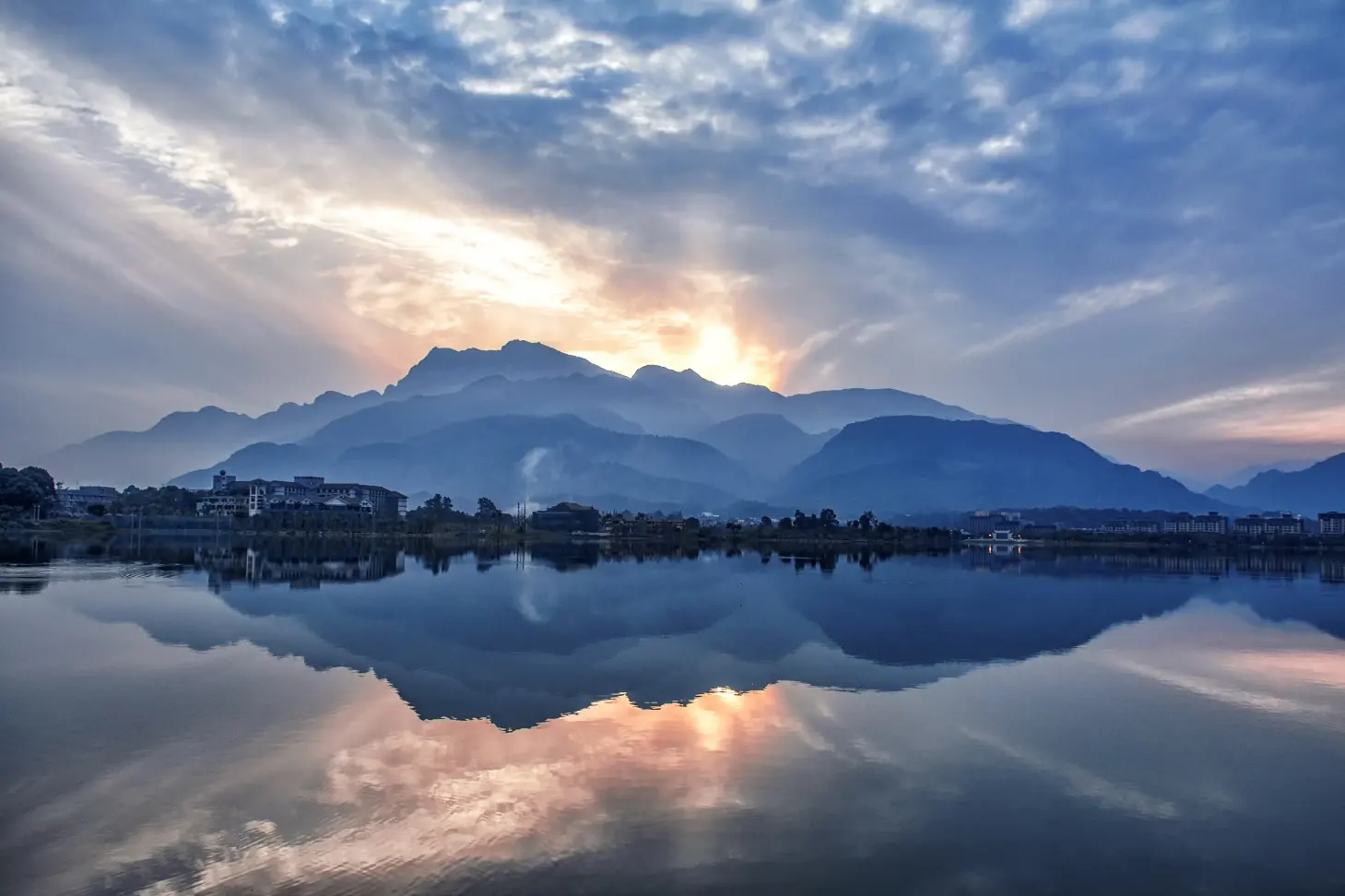
The sunrise viewed from the Golden Summit is the mountain's culminating gift. Pilgrims and tourists gather at the railing before dawn, wrapped in rented coats against the cold, waiting for the sun to appear above a cloud sea that may extend to the horizon. When the light comes, it illuminates the Samantabhadra statue from behind, creating a silhouette of golden edges against a pink and orange sky.
The full hiking pilgrimage from Baoguo Temple to the Golden Summit takes two to three days. Temple guesthouses along the route provide simple rooms and vegetarian meals. Book in advance during peak season. The cable car from the mid-mountain to the Golden Summit reduces the ascent to one day but skips the contemplative middle section. Buses run from the base to various mid-mountain points. Start each day's hiking early to reach the next temple before dark.
Carry rain gear regardless of forecast.
Context and lineage
In Chinese Buddhist tradition, a monk or Indian merchant arrived at the mountain during the Eastern Han Dynasty and was struck by its resemblance to the sacred mountains of India. He established a hermitage, making Emei the first Buddhist site in China. Later, Samantabhadra was seen riding his six-tusked white elephant through the clouds above the summit, confirming the mountain as his sacred dwelling.
Whether the traditional 1st-century dating is exact matters less than what the claim expresses: that Chinese Buddhists understand Emei as where their tradition began.
Before Buddhism, the mountain was associated with Taoist cultivation. The name Emei, meaning moth eyebrows, describes the mountain's two gently curved ridges, an image from Taoist celestial geography where mountains are features of the earth's face. Taoist hermits practiced on the mountain from at least the Han Dynasty.
Emei's religious lineage spans the entire history of Chinese Buddhism. The mountain has hosted multiple Buddhist schools, including Chan and Pure Land, across nearly two millennia. The Samantabhadra association gave it a specific identity within the Four Sacred Mountains system, each mountain dedicated to a particular bodhisattva. The Emei martial arts tradition, one of the three great schools alongside Shaolin and Wudang, adds a martial dimension to the mountain's spiritual heritage, though its Taoist origins predate the Buddhist dominance.
The UNESCO inscription recognizes this deep temporal layering, citing Emei as the place where Buddhism first became established on Chinese soil.
Samantabhadra (Puxian Pusa)
The bodhisattva of universal virtue, practice, and compassion, whose ten great vows summarize the entire Buddhist path. Emei is his earthly bodhimanda, the place where his presence is most directly accessible. The 62-ton bronze statue at Wannian Temple (980 CE) and the 48-meter gold-plated statue at the Golden Summit (2006) are among the most significant physical representations of the bodhisattva in the world.
The Song Dynasty bronze casters
The artisans who created the 62-ton bronze Samantabhadra at Wannian Temple in 980 CE achieved a technical feat that has not been surpassed at Emei. The statue, depicting Samantabhadra seated on a six-tusked white elephant, has survived over a millennium of earthquakes, fires, and political upheaval.
Xu Xiake
The Ming Dynasty travel writer whose 1616 account of Emei contributed to the mountain's literary reputation. Xu Xiake's detailed observations of the mountain's temples, trails, and natural phenomena established a tradition of documentary pilgrimage that continues in contemporary travel writing.
Traditions and practice
The traditional practice at Emei is the multi-day pilgrimage ascent, visiting temples sequentially in a journey that functions as a physical enactment of the bodhisattva path. At each temple, pilgrims participate in morning chanting, make offerings of incense and candles, and eat vegetarian meals. Prostrations before Samantabhadra images mark the journey's devotional rhythm. At Wannian Temple, the most important temple on the mountain, pilgrims pay special respect to the 62-ton Song Dynasty bronze Samantabhadra.
Samantabhadra's birthday on the sixth day of the sixth lunar month draws tens of thousands of pilgrims. Summit dawn vigils to witness the sunrise and the Buddha's Halo complete the pilgrimage cycle.
Temple services continue at all major temples. The hiking pilgrimage tradition remains strong, though many visitors now take the cable car to the Golden Summit. The temple guesthouse system still operates, offering vegetarian meals and simple accommodation along the route. Major festivals draw large crowds. Some temples offer short-term monastic experience programs. The Emei Martial Arts School near the base offers demonstrations and classes that connect to the mountain's martial tradition.
Walk the full trail if your body allows it. The cable car delivers you to the summit, but it skips the transformation. The mountain's teaching is incremental, delivered through the body's effort, the temples' rhythms, and the landscape's gradual simplification as altitude increases.
At each temple, pause. Enter the main hall, let the incense register, and sit if there is a place. The temples are not checkpoints but resting places, and what they offer is not information but atmosphere: the particular quality of silence that centuries of chanting produce in a space.
At the Golden Summit, arrive before dawn if possible. The sunrise viewed from this elevation, with the Samantabhadra statue silhouetted against the sky, is the mountain's culminating experience. If the Buddha's Halo appears, your own shadow ringed by rainbow in the clouds below, allow the strangeness of it. No explanation, scientific or spiritual, fully accounts for what it feels like to see yourself from outside yourself, haloed.
Chinese Buddhism (Samantabhadra tradition)
ActiveMount Emei is one of the Four Sacred Buddhist Mountains of China and the bodhimanda of Samantabhadra, the bodhisattva of universal virtue and practice. The mountain claims to be the first Buddhist site in China and has maintained a continuous monastic presence for nearly two millennia. Over thirty temples remain active. The 48-meter Golden Summit Samantabhadra is the largest gold-plated Buddhist statue at that elevation.
Multi-day pilgrimage ascent visiting temples sequentially. Morning and evening chanting at each temple. Offerings at Wannian Temple before the Song Dynasty bronze Samantabhadra. Vegetarian meals at temple guesthouses. Samantabhadra's birthday celebration. Summit dawn vigils for sunrise and the Buddha's Halo.
Taoism
HistoricalBefore Buddhism's dominance, the mountain was associated with Taoist cultivation. Taoist hermits practiced from at least the Han Dynasty. The Emei martial arts tradition has Taoist origins. Some Taoist architectural elements and practices were incorporated into the Buddhist temples during the centuries-long transition.
No active Taoist institutions on the mountain. The Emei martial arts tradition preserves some Taoist-influenced movement practices. Elements of Taoist feng shui are visible in temple siting and landscape design.
Natural phenomena traditions
ActiveFour natural phenomena at Emei have been interpreted as spiritual manifestations for centuries: the Buddha's Halo, the Sea of Clouds, the Sacred Lamp, and the Sunrise. The Buddha's Halo was historically understood as Samantabhadra's radiance, and its appearance prompted some pilgrims to leap from the cliff believing they were being received by the bodhisattva.
Pre-dawn gathering at the Golden Summit for sunrise viewing. Contemplation of the Sea of Clouds. Night vigils to observe the Sacred Lamp. Watching for the Buddha's Halo when conditions align.
Perspectives and open questions
Emei can be understood as a Buddhist pilgrimage route, a natural reserve of exceptional biodiversity, a history of Chinese art and architecture, or a physical teaching about what sustained effort reveals. The mountain holds all of these simultaneously.
Scholarly perspective
Scholars view Emei as the most important of the Four Sacred Buddhist Mountains for understanding the development of Chinese Buddhism. The mountain's claim to be the first Buddhist site in China, even if the exact dating is uncertain, reflects the importance that Chinese Buddhist tradition places on establishing a Chinese homeland for the Dharma.
The evolution of architectural styles from early cave hermitages to the monumental Golden Summit complex charts the trajectory of Chinese Buddhism from modest beginnings to imperial grandeur. The UNESCO designation recognizes both the cultural and natural significance, as the mountain's biodiversity, with over 3,200 plant species and 2,300 animal species, is exceptional.
Living and traditional perspectives
For Chinese Buddhists, Emei is Samantabhadra's home on earth. To climb the mountain is to enter the bodhisattva's mandala and walk in his footsteps. The difficulty of the ascent is not an obstacle but a teaching: Samantabhadra's ten vows require effort, persistence, and dedication, and the mountain demands the same. The Sea of Clouds at the summit is a living metaphor for the emptiness that underlies all phenomena.
Alternative interpretations
Some practitioners consider Emei's extraordinary biodiversity to be evidence of concentrated life-force energy flowing through the mountain. The mountain's position at the western edge of the Sichuan Basin, where the plains meet the Tibetan Plateau, is viewed as an energetic boundary zone. The Emei martial arts tradition has preserved internal energy cultivation practices that draw on the mountain's reputed power.
Open questions
The exact date and circumstances of Buddhism's first arrival at the mountain remain genuinely uncertain. The nature of the Sacred Lamp phenomenon, mysterious lights seen from the summit at night, has no consensus scientific explanation. Whether pre-Buddhist Taoist or shamanic practices influenced the development of local Buddhist traditions has not been established. The complete lineage of martial arts masters who developed the Emei school and its relationship to the Buddhist tradition remains only partially documented.
Plan your visit
Access and arrival
Approximately 150 km from Chengdu. High-speed rail from Chengdu to Emeishan station takes about 1.5 hours. Local buses from the station to the mountain base at Baoguo Temple. Mountain scenic area ticket approximately 160 CNY in peak season, 110 CNY off season. Golden Summit cable car approximately 65 CNY up, 55 CNY down. Wannian Temple cable car approximately 65 CNY up, 45 CNY down. Mobile phone signal is available at most temples and along the main trail.
Temple guesthouses along the hiking route provide simple rooms, shared facilities, and vegetarian meals. Hotels at the base area near Baoguo Temple and near the Golden Summit range from budget to mid-range. Summit-area accommodation is limited and books out during peak season. The base town offers the widest selection.
Respectful visit
Comfortable hiking clothing and sturdy shoes for the trail. Layers are essential as temperature drops significantly with altitude. Rain gear recommended at all times. Modest dress when entering temple halls, with shoulders and knees covered.
Permitted in most outdoor areas. Interior photography in temple halls may require a fee or be prohibited. Ask before photographing monks. Keep cameras secured against the macaques.
Incense and candles can be purchased at temple shops. Small monetary donations at temple altars are customary. Vegetarian meals at temple guesthouses are offered at modest prices and support the monastic community.
Do not feed the monkeys human food. Keep bags closed and food hidden in monkey-inhabited zones. Do not touch Buddhist statues or climb on temple structures. Walk clockwise around religious structures and stupas. Do not litter on the mountain trails.
The Tibetan macaques in the mid-mountain zone are bold and can be aggressive. Keep bags closed, food hidden, and cameras secured. Do not feed them human food despite vendors selling monkey food. Altitude change from base to summit is significant, producing temperature drops from 30 degrees Celsius to near freezing. Carry layers. The summit is cold, windy, and often shrouded in cloud. Rain gear is essential at all elevations.
Current practical details
Address
Emei Mountain, Emeishan City, Leshan, China, 614203
Hours, fees, and access can change — verify on the official source before you travel. Practical details last checked Jun 2026.
Location
Map loads as you approach this section.
Pilgrim reflections
A portrait of encounter, not a score
Pilgrims describe what they felt, how present they could become, and whether the place would shape a journey. There are no stars and no ranking of traditions.
No reviewed reflections yet
The first pilgrims can help describe the character of being here.
Share a reflection
Available after an account-backed “Been there.” Every reflection is reviewed before publication.
Nearby sacred places
Explore other sacred places in the region. Proximity does not establish access or travel time; check each place’s guidance.



Pilgrim glossary
- Bodhisattva
- An enlightened being who postpones full nirvana to help others toward awakening.
- Mandala
- A symbolic diagram of the cosmos used in meditation and ritual.
- Dharma
- The teachings of the Buddha; also the universal law underlying them.
- Pure Land
- A Buddhist tradition focused on rebirth in Amida Buddha's western paradise through devotional practice.
Share a photo
Help visitors recognize Mt. Emei Shan. Every submission is reviewed before publication.