Mt. Blanc
The white crown of the Alps — feared as a cursed mountain, revered as the Romantic sublime, climbed as a pilgrimage
Understand sacred places, explore living traditions, and learn how to engage respectfully with Pilgrim Map.
Access has not been verified. Check current local guidance before planning a visit.
Saint-Gervais-les-Bains, Haute-Savoie, France
Read the sources
Visit essentials
A quick read before you go
- Duration
- A guided summit climb is typically 2-3 days, including acclimatization and hut nights; the…
- Access
- Chamonix in France and Courmayeur in Italy are the gateway towns.
Overview
Mont Blanc—Monte Bianco on its Italian side—rises about 4,808 meters as the Alps' and western Europe's highest summit, an ice-capped granite-and-gneiss massif on the disputed French-Italian border. It has never held a single religious cult, yet layered sacred meanings gather around its scale.
Before the first ascent in 1786, La Montagne Maudite—the cursed mountain—was feared and largely shunned. Legend placed a fairy queen or 'White Goddess,' dragons, and ice-devils there, while advancing glaciers terrified the Chamonix valley. On 8 August 1786 Jacques Balmat and Michel-Gabriel Paccard reached the summit, encouraged and rewarded by scientist Horace-Bénédict de Saussure, launching modern mountaineering.
Shelley's 1816 poem 'Mont Blanc' later made the peak a symbol of the Romantic sublime: awe, terror, and nature's mysterious power confronting the human mind.
Devotion also gathers at the Marian sanctuary of Notre-Dame de Guérison ('Our Lady the Healer') near Courmayeur. Its Madonna is said to have miraculously survived the Brenva glacier's 1816 advance, and votive-covered walls hold alpinists' prayers for safe return. Tens of thousands now climb each year in a secular pilgrimage to the summit.
Why this place is sacred
Mont Blanc's sacredness is the sacredness of the sublime made literal — the highest, most overwhelming summit in western Europe, where scale, danger, and beauty meet. It is a boundary place, shared and disputed between France and Italy, and an elemental one, with glaciers and rapidly shifting alpine weather giving it a liminal atmosphere.
Onto this natural overwhelm centuries of meaning have settled: the folk dread of the cursed mountain, the Marian healing-devotion of the flanking sanctuaries, the Romantic reverence of Shelley's verse, and the rite of the climb itself. To stand before or upon it is to confront the power and mystery of nature directly.
A natural mountain, not a built sanctuary; its sacredness is folkloric, devotional, literary and mountaineering rather than centered on a temple.
First recorded ascent on 8 August 1786 by Balmat and Paccard, launching modern alpinism; the flanking sanctuary of Notre-Dame de Guérison has been a pilgrimage site since the seventeenth century, its present building dating to 1867; Shelley's 'Mont Blanc' of 1816 fixed it as the emblem of the Romantic sublime.
Experience and orientation
Climbers describe the gruelling Goûter route, the danger and adrenaline of the rockfall couloir, the thin air and cold, and overwhelming summit panoramas across the Alps. The ascent is serious and not to be attempted without experience or a guide. Those who do not climb still report awe — from Chamonix, from the Aiguille du Midi cable car, and at the Notre-Dame de Guérison sanctuary, whose walls are covered in votive offerings and which looks out over the glacier.
The recurring note, whether on the summit or in the valley, is the sublime: a confrontation with scale, danger and beauty that leaves many with a profound sense of perspective and human smallness.
There is no single sacred summit ritual; the mountain is met in several ways. The normal climbing route ascends via the Nid d'Aigle and the Goûter, and must not be attempted without proper experience or a qualified guide. For most visitors, the contemplative encounter is from the valley, the Aiguille du Midi viewpoint, or the votive-filled sanctuary of Notre-Dame de Guérison near Courmayeur.
Context and lineage
For centuries the people of the Chamonix valley feared the peak as La Montagne Maudite, an enchanted, cursed mountain whose creeping glaciers — the descending Mer de Glace — were imagined as ice-devils, and whose summit kingdom belonged in legend to a fairy White Goddess. The mountain was shunned until 1786, when Jacques Balmat and Michel-Gabriel Paccard, spurred by Horace-Bénédict de Saussure's standing reward, made the first recorded ascent and inaugurated modern mountaineering.
In 1816 the Brenva glacier advanced on the chapel of Notre-Dame de Guérison and destroyed it, but the Madonna statue was found unharmed — read as miraculous and deepening the Marian devotion on the mountain's flanks. The same era saw Shelley's 'Mont Blanc' cast the peak as the emblem of nature's sublime, inaccessible power.
Layered: Alpine folk belief, Roman Catholic Marian devotion at the flanking sanctuaries, and Romantic-aesthetic reverence for the sublime.
Jacques Balmat
First ascensionist (1786)
Michel-Gabriel Paccard
First ascensionist (1786)
Horace-Bénédict de Saussure
Scientist and patron
Percy Bysshe Shelley
Poet
Traditions and practice
Historically, the avoidance and folk propitiation of a feared mountain, and Marian devotion at the flanking sanctuaries — above all pilgrimage and the leaving of ex-votos at Notre-Dame de Guérison, with prayers for healing and for safe return.
Pilgrimage and votive offerings continue at Notre-Dame de Guérison; the secular ritual of summiting draws tens of thousands; many simply behold the peak from the valley and viewpoints.
If you are not an experienced alpinist, meet the mountain from below: visit the votive-covered sanctuary, ride to a high viewpoint, and let the scale work on you. For climbers, the ascent itself can be approached as a pilgrimage of effort and exposure — undertaken with proper preparation and a guide.
Alpine folk belief
HistoricalBefore its 1786 ascent the peak was 'La Montagne Maudite', the cursed mountain — home in legend to a fairy queen or 'White Goddess', to dragons, and to ice-devils whose advance terrified the Chamonix valley.
Avoidance and propitiation; the mountain was feared and largely shunned.
Roman Catholic Marian devotion
ActiveSanctuaries at the foot of the massif, above all Notre-Dame de Guérison ('Our Lady the Healer') near Courmayeur, draw pilgrims; the Madonna statue famously survived the Brenva glacier's 1816 advance, deemed miraculous. The sanctuary became a spiritual stop for alpinists.
Pilgrimage, prayers for healing and safe return, and the leaving of votive offerings and ex-votos.
Romantic sublime / aesthetic reverence
ActiveShelley's 1816 'Mont Blanc' and its place in the world of 'Frankenstein' made the peak the supreme emblem of the sublime — awe, terror and the mystery of nature's power confronting the human mind.
Contemplative pilgrimage to behold the mountain; a touchstone of Romantic and modern nature-reverence.
Perspectives and open questions
Mont Blanc is read as a once-cursed mountain, the cradle of alpinism, the icon of the sublime, and a Marian devotional landscape.
Scholarly perspective
The highest peak of the Alps (about 4,808 m), first climbed in 1786 in a feat that launched modern mountaineering; a granite-and-ice massif on the disputed France-Italy border, never holding a single religious cult but woven into folklore, Marian devotion, and Romantic aesthetics.
Living and traditional perspectives
Alpine folk tradition cast the peak as the cursed, enchanted abode of the White Goddess and of dragons; valley Catholics venerate the Virgin at the flanking sanctuaries.
Alternative interpretations
The Romantic-sublime reading, above all Shelley's, treats the mountain as a symbol of nature's inaccessible, vivifying and destructive mystery — a secular form of the sacred.
Open questions
The mountain's exact summit height shifts with its snow cap, its border remains legally unsettled, and the line between its folkloric 'curse' and the lived alpine fear of the glaciers is hard to disentangle.
Plan your visit
Access and arrival
Chamonix in France and Courmayeur in Italy are the gateway towns. The normal Goûter route starts via the Nid d'Aigle; Notre-Dame de Guérison sits along the Val Veny road near Courmayeur. No formal climbing permit is required, but overnight stays at the Tête Rousse, Goûter or Nid d'Aigle huts require advance reservation and numbers on the Goûter route are limited.
Chamonix and Courmayeur offer the full range of accommodation; the mountain huts on the climbing route require advance booking.
Respectful visit
No religious dress code on the mountain; serious cold-weather, high-altitude gear is essential. Modest dress inside the flanking sanctuaries.
Freely permitted outdoors; respect signage and worshippers inside the sanctuaries.
Ex-voto and votive offerings are traditional at Notre-Dame de Guérison; on the mountain itself, carry out all waste.
Do not attempt the summit without proper experience or a qualified guide. Reserve mountain huts in advance, respect rockfall timing and weather windows, and pack out all rubbish.
Do not attempt the summit without proper experience or a qualified guide; this is a serious high-altitude climb with significant objective hazard. Reserve mountain huts in advance, respect rockfall timing and weather windows, and pack out all waste — litter is a serious problem on the fragile glacial environment.
Current practical details
Address
Mont Blanc de Courmayeur
Hours, fees, and access can change — verify on the official source before you travel. Practical details last checked Jun 2026.
Location
Map loads as you approach this section.
Pilgrim reflections
A portrait of encounter, not a score
Pilgrims describe what they felt, how present they could become, and whether the place would shape a journey. There are no stars and no ranking of traditions.
No reviewed reflections yet
The first pilgrims can help describe the character of being here.
Share a reflection
Available after an account-backed “Been there.” Every reflection is reviewed before publication.
Nearby sacred places
Explore other sacred places in the region. Proximity does not establish access or travel time; check each place’s guidance.

Great St Bernard Hospice
Bourg-Saint-Pierre, Bourg-Saint-Pierre, Valais, Switzerland
23.9 km away
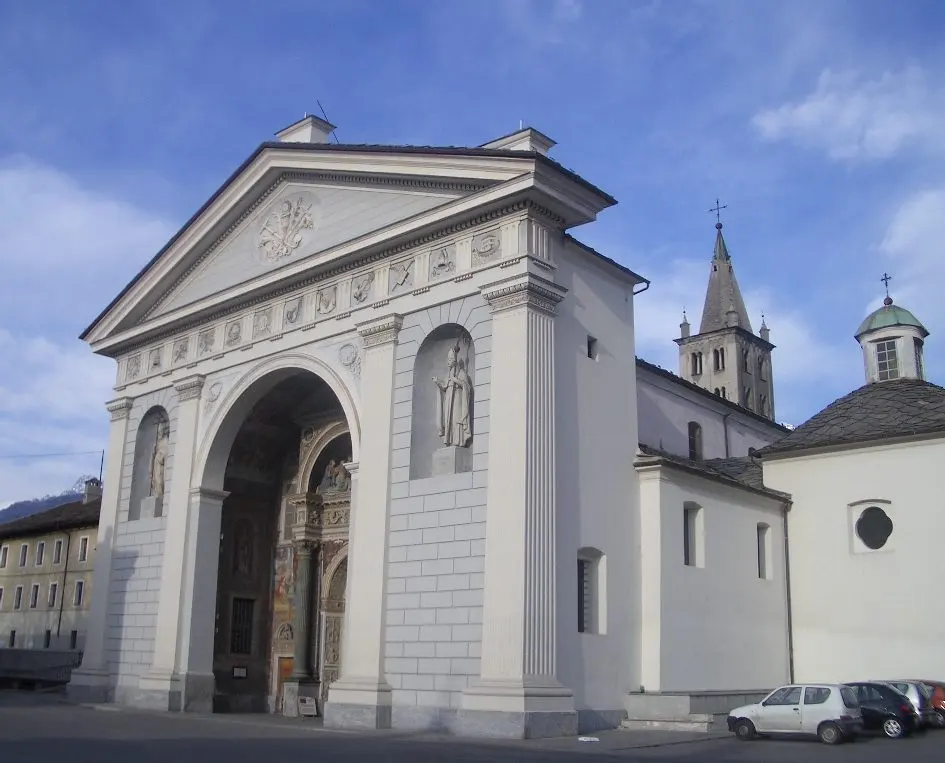
Aosta Cathedral (Cattedrale di Santa Maria Assunta e San Giovanni Battista)
Aosta, Aosta Valley, Italy
36.6 km away

Abbey of Saint-Maurice
Saint-Maurice, Saint-Maurice, Valais, Switzerland
44.3 km away

Basilica of Notre-Dame of Geneva
Geneva, Geneva, Geneva, Switzerland
69.8 km away
References
Sources consulted for this page. Source categories describe the publication, not a guarantee that every claim is verified. Traditional accounts and outside interpretations may differ.
- 01Mont Blanc — Wikipedia — Wikipedia contributorsacademicConfirms ~4,808 m elevation, highest in western Europe/EU, France-Italy border dispute, first ascent 1786 by Balmat and Paccard, Saussure's role.
- 02Mont Blanc | Romanticism, Nature, Sublime (Shelley poem) — Britannica — Encyclopaedia BritannicaacademicContext for Shelley's 1816 poem 'Mont Blanc' and the mountain as an emblem of the Romantic sublime and the mystery/power of nature.
- 03Notre Dame de Guérison sanctuary — Wikipedia — Wikipedia contributorsacademicMarian pilgrimage sanctuary at the foot of Mont Blanc (Courmayeur, Val Veny); Madonna statue spared by the Brenva glacier's 1816 advance; pilgrimage since the 17th century; rebuilt 1867.
- 04Sanctuary (Notre-Dame de Guérison) — Courmayeur Mont Blanc — Courmayeur Mont Blanc TourismofficialOfficial tourism page on the Marian sanctuary as a spiritual stop for alpinists below Mont Blanc; walls covered in votive offerings.
- 05How to climb Mont Blanc — British Mountaineering Council — British Mountaineering Council (BMC)Source contextReputable safety/logistics: hut-reservation requirement on the Goûter route, the rockfall 'Grand Couloir', and conservation/litter concerns.
- 06August 8, 1786: the story of the first ascent of Mont Blanc — 1786.travelSource contextDetailed account of the 1786 Balmat/Paccard ascent, the 'cursed mountain' reputation beforehand, and the birth of alpinism.
- 07When to climb Mont Blanc – a guide to the climbing season — Chamonix Mountain Guides — Vertical Frontiers / Chamonix Mountain GuidesSource contextBest-season guidance (June-September), Goûter route, rockfall hazard, guide recommendations.
- 08Tales of Mont Blanc: From Forbidden Heights to Human Triumph — French MomentsSource contextEpistemic marker for folklore: the 'Montagne Maudite' (cursed mountain), the White Goddess/fairy queen, dragon and glacier legends.
Share a photo
Help visitors recognize Mt. Blanc. Every submission is reviewed before publication.