Mt. Amnye Machen
Grandfather mountain of the Golok Tibetans, where the Yellow River bends around an ancestor deity
Understand sacred places, explore living traditions, and learn how to engage respectfully with Pilgrim Map.
Access has not been verified. Check current local guidance before planning a visit.
Maqên, Qinghai, China
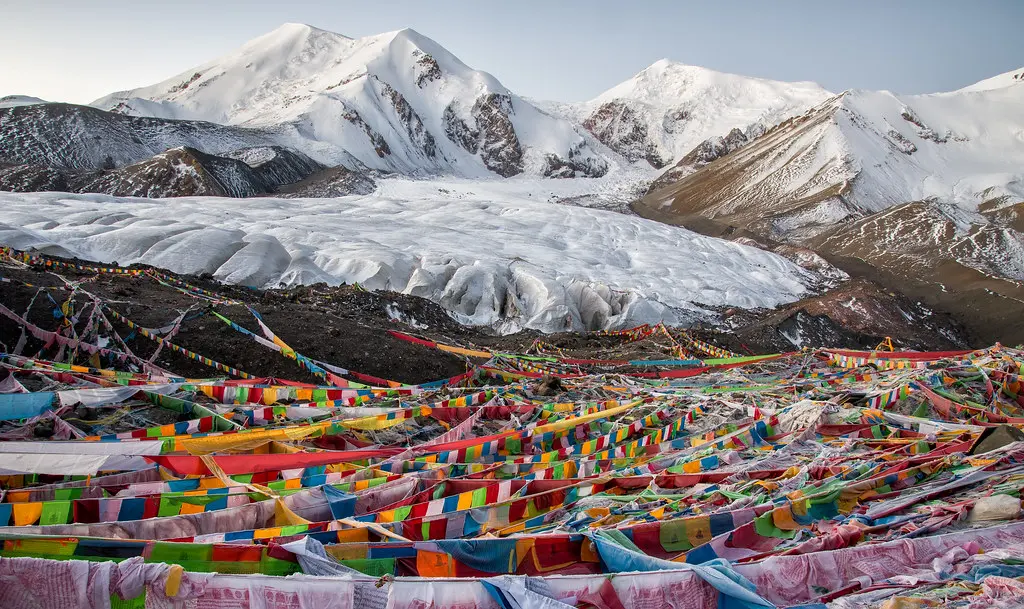
Image of Mt. Amnye Machen. Image source
Visit essentials
A quick read before you go
- Duration
- The full kora takes eight to ten days of trekking.
- Access
- Maqen (Dawu) town is the main gateway, approximately 580 km from Xining.
Overview
Amnye means “grandfather.” For Golok Tibetans, Machen Pomra is the mountain itself: their ancestor, the warrior defending their territory, and the father watching their herds. Retreating glaciers signal a world out of balance; storms are his speech.
The range extends roughly 80 km through Golok grasslands averaging 4,000 metres, while Machen Kangri reaches 6,282 metres. The Yellow River, China's great mother river, bends around it as a natural mandala of water and stone. Snow leopards, blue sheep, and Tibetan gazelle inhabit one of the Tibetan Plateau's last large-scale intact ecosystems.
The kora follows that bend for 120–180 kilometres, depending on the route, over eight to ten days through country where nomadic Golok herders have lived for centuries. There is no phone signal, internet, or permanent infrastructure beyond an occasional herder's tent. Buddhist pilgrims walk clockwise and Bon practitioners counter-clockwise, honoring the same mountain from opposite directions. Every twelve-year Year of the Horse draws tens of thousands, and tradition says the kora's merit is multiplied twelvefold.
Why this place is sacred
To speak of Amnye Machen as a thin place is almost to miss the point. Thin places are locations where the boundary between the ordinary world and something greater becomes permeable. At Amnye Machen, according to the Golok tradition, there is no boundary to thin. The mountain is the grandfather. The grandfather is the mountain.
The deity Machen Pomra, described as a warrior on a white horse wearing armor and carrying a spear, accompanied by 360 lesser deities corresponding to each day of the Tibetan year, does not peer through a veil between worlds. He stands in full view, 6,282 meters of him, glaciated and immovable.
This sense of the mountain as a person rather than a place pervades the experience for those attuned to it. The weather is not weather but communication. The animals that live on the slopes are not simply wildlife but members of the deity's household.
The grasslands around the base, where nomadic Golok families live in black yak-hair tents tending their herds, are not a buffer zone between the sacred and the profane but the deity's territory, all of it sacred, all of it Amnye's.
The Yellow River's great bend adds a geographical dimension that amplifies the mountain's presence. Water and mountain describe a circle together, the river wrapping itself around the range as though embracing or being held. This natural mandala has been interpreted in different ways by different traditions: as the protective coils of a cosmic serpent in Bon understanding, as a geographical embrace between water and stone that mirrors the embrace between ancestor and descendants.
The remoteness of the place preserves its power. There are no cable cars at Amnye Machen, no paved paths to the high passes, no gift shops at the kora trailhead. Reaching the mountain requires days of travel from any major city. The grasslands surrounding it feel unchanged by modernity. In a world where access tends to erode sacredness, Amnye Machen remains what it has been: a grandfather, waiting for his children to visit.
Sacred veneration of Amnye Machen predates all written records. The mountain has been a pilgrimage site for at least 1,500 years and likely far longer. In the oldest layer of tradition, the mountain is understood as a soul mountain of Tibet, one of the great peaks that anchors the vitality and fate of the Tibetan people to the physical landscape.
The Golok tribal identification with the mountain as their ancestral deity represents a tradition older than organized Buddhism in the region.
The Buddhist incorporation of Machen Pomra as a dharma protector layered a new framework onto existing mountain worship without replacing it. The kora tradition, with its Buddhist clockwise and Bon counter-clockwise directions, formalized a practice of circumambulation that may have existed in some form before either tradition provided its theological justification. Joseph Rock's explorations in the 1920s and 1930s brought the mountain to Western attention and produced crucial baseline documentation.
A brief period in the mid-20th century saw the mountain's elevation controversially overestimated, briefly thought higher than Everest, before accurate measurements corrected the record. The first ascent in 1981 by a Sino-Japanese expedition established the mountain's climbing history. The Year of the Horse pilgrimage continues to draw tens of thousands, with the most recent in 2026.
Experience and orientation
Reaching Amnye Machen requires a commitment that begins long before the kora itself. From Xining, the capital of Qinghai Province, the journey to Maqen town takes twelve to fourteen hours by bus through a landscape that gradually empties of everything except grass, sky, and the occasional cluster of tents. The last towns feel provisional, outnumbered by the land. By the time you reach the mountain's vicinity, the modern world has become the distant thing, not the mountain.
The kora begins from near Maqen and follows a route that skirts the mountain range at altitudes consistently above 4,000 meters, crossing passes that reach 4,800 to 5,000 meters. The landscape is grassland of an immensity that is itself disorienting. The sky occupies most of the visual field. Yak herds move slowly across the plains.
Nomadic Golok families in black tents may invite passing trekkers for butter tea, an act of hospitality that is also an act of welcome to the grandfather's territory.
Each day on the kora brings a new face of the mountain. The peaks emerge and disappear behind weather systems that move across the plateau with theatrical speed. The prayer flags at passes speak their own language in the wind, a constant tearing sound that becomes the kora's soundtrack. At cairns and la-tse, Tibetan pilgrims throw printed lung-ta papers into the air, where the wind catches them and carries printed prayers across the grassland in all directions.
The physical demands are real and unforgiving. Altitude sickness is a genuine risk at these sustained elevations, particularly for those arriving from sea level without adequate acclimatization. The cold penetrates gear. Water sources require treatment. There are no rescue services. The mountain does not accommodate weakness, which is part of what the Golok understand as its teaching: the grandfather does not coddle. He tests.
Encounters with Golok pilgrims provide the kora's deepest dimension. Their devotion is physical: in their pace, their prostrations at holy sites, their quiet intensity at the passes. Watching a Golok pilgrim throw lung-ta at a high pass, shouting prayers as the printed papers scatter across the sky with the mountain behind them, is to witness a relationship between person and place that no outsider can fully share but that no observer can fail to respect.
The kora starts and ends near Maqen (Dawu) town in Golok Tibetan Autonomous Prefecture. A local guide is essential and may be required. Pack animals can be hired for gear transport. Bring all food, fuel, and camping equipment. Allow at least two to three days for acclimatization in Maqen before starting. Carry altitude medication. The route has no permanent facilities. Some nomad families may offer tea or shelter but do not depend on this.
Context and lineage
The Golok tradition holds that Machen Pomra was a great warrior deity who chose to manifest as a mountain to protect the Golok people forever. His white peak is his helmet, the glaciers are his armor, and the storms that lash the mountain are his battle cries. The 360 lesser peaks surrounding the main summit are his army of attendant deities, one for each day of the year.
The Tibetan Buddhist tradition recounts that Guru Rinpoche visited the mountain during his journey through eastern Tibet and bound Machen Pomra as a protector of the Dharma. The deity agreed to use his warrior power in service of the Buddhist teachings rather than against them. The kora route was established as the path by which devotees honor this covenant.
The Bon tradition holds that the mountain is one of the great soul mountains that anchor the Tibetan world. When the mountain stands strong, Tibet is strong. When glaciers recede or storms rage, it is a sign that the world's balance is disturbed. The Yellow River's bend around the mountain traces the protective coils of a cosmic serpent.
The religious lineage at Amnye Machen is distinctively layered. The oldest layer is the Golok tribal identification with the mountain as their ancestral deity, a tradition that predates organized religion. The Bon tradition, which venerates the mountain as one of Tibet's great soul mountains, adds a second layer with its own cosmology and its distinctive counter-clockwise circumambulation.
The Buddhist layer, attributed to Guru Rinpoche's binding of the mountain deity as a dharma protector, provides the framework within which most contemporary pilgrims understand their kora. Small monasteries around the mountain's base maintain various Buddhist lineages. These three traditions coexist at the mountain without resolution into a single narrative.
Machen Pomra
The warrior deity manifested as the mountain itself. Described as riding a white horse, wearing armor, and carrying a spear, accompanied by 360 lesser deities. He is simultaneously the Golok people's ancestor, a protector of the Buddhist Dharma, and the sovereign of the eastern Tibetan Plateau's greatest mountain range.
Joseph F. Rock
Austrian-American explorer whose expeditions between 1926 and 1929 produced the first extensive Western documentation of Amnye Machen and the Golok people. His 1956 monograph on the mountain and surrounding region remains a foundational reference. Rock's work also inadvertently contributed to the brief 1930s controversy when early elevation estimates suggested the mountain might be taller than Everest.
The Golok people
The Tibetan tribal community for whom Amnye Machen is not merely sacred but ancestral. Historically the most independent and martial of Tibetan tribes, the Golok's fierce resistance to both Chinese and central Tibetan authority is understood as inseparable from their devotion to their grandfather mountain.
Guru Rinpoche (Padmasambhava)
The 8th-century Indian master credited with binding Machen Pomra as a protector of the Dharma during his journey through eastern Tibet, incorporating the pre-Buddhist mountain deity into the Buddhist cosmological framework.
Traditions and practice
The full kora circumambulation of the mountain range takes eight to ten days on foot, following the Yellow River's great bend. Buddhist pilgrims walk clockwise, reciting mantras, particularly Om Mani Padme Hum. Bon practitioners walk counter-clockwise. At each pass and designated holy site, pilgrims hang prayer flags, burn juniper incense, throw printed lung-ta papers into the wind, and make prostrations. Horse festivals and archery competitions are held in the grasslands around the mountain.
Community offerings are made before the kora season. The Year of the Horse grand pilgrimage, occurring every twelve years, is considered to multiply the kora's merit twelvefold and draws tens of thousands of pilgrims.
Tibetan pilgrims continue the kora, increasingly supplemented by vehicular sections on improved roads. Monks at small monasteries around the base maintain daily prayers. Golok communities continue horse festivals and ancestral ceremonies. The Year of the Horse pilgrimage remains the mountain's most significant event. Young Golok men still undertake the kora as a rite of passage. Foreign trekkers occasionally complete the route with local guides.
If you undertake the kora, enter it with the understanding that you are circling a person, not a peak. The Golok do not see this as metaphor. Carry prayer flags to offer at each pass. Accept hospitality from nomad families graciously if offered, and carry small gifts of tea or sweets in reciprocity.
At the high passes, pause before descending. Throw lung-ta if you have them, or simply stand in the wind and attend to the mountain's presence. The passes are where the kora's physical demands peak and where the mountain is closest. The combination of altitude, exertion, and proximity to the sacred tends to strip away distraction.
The kora's rhythm is its teaching. One step, one breath. Day after day for over a week, the practice simplifies until walking itself becomes meditation. By the final days, many trekkers find that the distinction between pilgrimage and hiking has dissolved. The mountain does not insist on any particular theology. It insists on presence.
Tibetan Buddhism
ActiveAmnye Machen is one of the four most sacred mountains in the Tibetan world. In Buddhist cosmology, the mountain is considered the eastern Tibetan equivalent of Mount Kailash: a cosmic axis where the human and divine worlds intersect. The kora circumambulation generates enormous merit, said to be equivalent to reading the entire Kangyur. The Year of the Horse kora multiplies merit twelvefold.
Clockwise kora circumambulation of the mountain range, eight to ten days on foot. Prayer flag offering at passes. Juniper incense burning. Prostrations at holy sites. Lung-ta throwing at high passes. Recitation of mantras, particularly Om Mani Padme Hum.
Bon
ActiveThe Bon tradition considers Amnye Machen one of the great soul mountains of Tibet, directly linked to the vitality and fate of the Tibetan people. The Bon circumambulation goes counter-clockwise, reflecting a cosmological system that predates and differs from the Buddhist one.
Counter-clockwise kora circumambulation. Offerings of incense and barley flour. Rituals to propitiate the mountain spirit and the water spirits of the mountain's rivers and lakes. Bon prayer flag offerings with symbols distinct from Buddhist flags.
Golok Tribal Tradition
ActiveFor the Golok Tibetans, Amnye Machen is literally their ancestral grandfather. The mountain is inseparable from Golok identity in a way that goes beyond religious devotion to ethnic and cultural survival. The deity Machen Pomra is the progenitor who gave the Golok their identity, their territory, and their fierce independence.
Community gatherings and festivals at the mountain's base. Offerings before major community decisions. Young men undertake the kora as a rite of passage. Horse races and archery competitions in the surrounding grasslands. Prayer flag renewal ceremonies at the start of the new year.
Perspectives and open questions
Amnye Machen can be read as a geological formation, a conservation landscape, or a tribal ancestor deity. The Golok reading, in which the mountain IS the grandfather, is not the scholarly consensus but it is the deepest truth available about what the mountain means to those who live with it.
Scholarly perspective
Scholars study Amnye Machen as a case where mountain deity worship, tribal identity, and Buddhist pilgrimage traditions intersect. Joseph Rock's mid-20th-century documentation provides crucial baseline data. The mountain is significant for understanding Golok Tibetan distinctiveness within the broader Tibetan cultural world, as the Golok's fierce independence and their identification with this particular mountain form a case study in landscape-based ethnic identity.
The 1930s elevation controversy, when the mountain was briefly thought higher than Everest, is studied as an example of how Western exploration narratives interacted with Tibetan sacred geography.
Living and traditional perspectives
For the Golok, Amnye Machen is not a sacred site in the way outsiders understand the term. It is the foundation of reality for their people. The mountain's health is the people's health. When glaciers retreat, the Golok read this as a sign of cosmic imbalance. Pilgrimage is not recreation or even purely religious practice. It is the essential activity that maintains the relationship between the people and their protector. The kora is as necessary as breathing.
Alternative interpretations
Some practitioners consider the Yellow River's great bend around Amnye Machen to trace a ley line of exceptional power, linking the mountain's energy to the broader energetic system of China via the river. The mountain's position in the remote eastern Tibetan Plateau is seen as a node that anchors the roof of the world energetically.
Open questions
The pre-Buddhist origins of the Machen Pomra warrior deity, and whether the figure derives from an earlier Central Asian tradition, remain unresolved. Whether the mountain was a site of significant Bon temple construction before the Buddhist period is not established through archaeological evidence. The full extent of wildlife populations in the mountain's ecosystem and their role in local spiritual traditions have not been comprehensively documented.
How the kora tradition has changed over centuries as roads have reached the area is a question that oral histories may still illuminate.
Plan your visit
Access and arrival
Maqen (Dawu) town is the main gateway, approximately 580 km from Xining. Buses from Xining take approximately 12 to 14 hours. Some travelers fly to Xining from major Chinese cities and then take ground transport. Qinghai Province generally does not require special permits for foreign travelers, unlike the Tibet Autonomous Region, but check current regulations as they change frequently. A local guide is essential for the kora and may be required. Pack animals can be hired in Maqen.
No permanent facilities exist on the kora route. Bring all food, fuel, and camping equipment. Mobile phone signal is absent on the route. The nearest hospital is in Maqen.
Maqen town offers basic guesthouses and a few hotels. Standards are modest but adequate for a base during acclimatization. On the kora route, there are no permanent accommodations. Bring a tent rated for cold conditions. Some nomad families may offer shelter in their tents, but this cannot be counted upon.
Respectful visit
Full mountain trekking and camping gear is required for the kora. Warm layers, rain gear, and sturdy boots are essential. Sun and wind protection is critical at altitude. Dress modestly when visiting monasteries.
Generally welcomed, but always ask before photographing people, especially at close range. Do not photograph military installations. Respect privacy at nomad camps. Landscape photography is unrestricted.
Prayer flags, juniper incense, lung-ta papers, and khatags are appropriate at passes and shrines. Small gifts of tea, candy, or fruit are appreciated by nomad hosts. Do not offer money to nomad families unless specifically asked for a service.
Walk clockwise around all religious structures and the mountain itself (unless following Bon tradition). Do not sit on mani stone piles or la-tse cairns. Do not hunt, fish, or disturb wildlife. Do not pollute water sources. Show deep respect for the nomadic community and their way of life.
The entire kora takes place above 4,000 meters, with passes reaching 4,800 to 5,000 meters. Acute mountain sickness, high-altitude cerebral edema, and high-altitude pulmonary edema are genuine dangers. Spend at least two to three days acclimatizing in Maqen (approximately 3,700 meters) before starting. Carry altitude medication. Bring all food, fuel, and camping equipment. There are no rescue services. Evacuation from the route would take days. Go with a local guide who knows the route and the weather patterns.
Do not underestimate the cold, even in summer.
Current practical details
Address
Dradullungshog, Maqên County, Golog Tibetan Autonomous Prefecture, China
Hours, fees, and access can change — verify on the official source before you travel. Practical details last checked Jun 2026.
Location
Map loads as you approach this section.
Pilgrim reflections
A portrait of encounter, not a score
Pilgrims describe what they felt, how present they could become, and whether the place would shape a journey. There are no stars and no ranking of traditions.
No reviewed reflections yet
The first pilgrims can help describe the character of being here.
Share a reflection
Available after an account-backed “Been there.” Every reflection is reviewed before publication.
Nearby sacred places
Explore other sacred places in the region. Proximity does not establish access or travel time; check each place’s guidance.



Pilgrim glossary
- Mandala
- A symbolic diagram of the cosmos used in meditation and ritual.
- Dharma
- The teachings of the Buddha; also the universal law underlying them.
Share a photo
Help visitors recognize Mt. Amnye Machen. Every submission is reviewed before publication.