Mosque of Cristo de la Luz
Toledo's oldest standing monument: ten centuries of prayer layered in brick and stone
Understand sacred places, explore living traditions, and learn how to engage respectfully with Pilgrim Map.
Access has not been verified. Check current local guidance before planning a visit.
Toledo, Toledo, Spain
Read the sources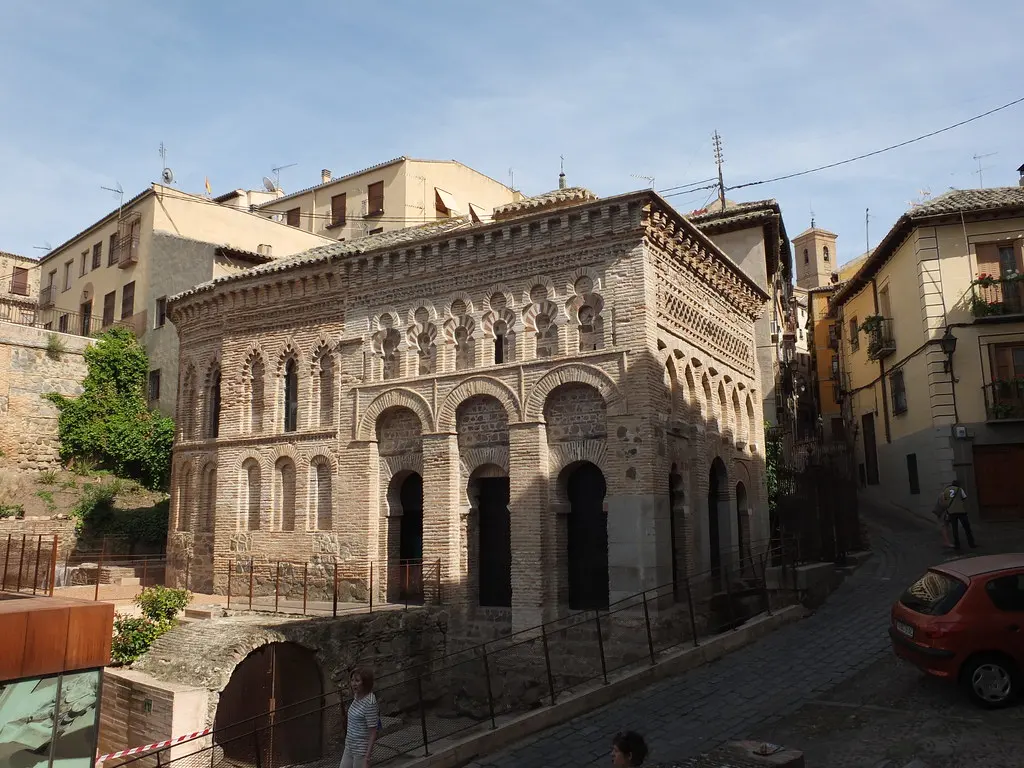
Image of Mosque of Cristo de la Luz. Image source
Visit essentials
A quick read before you go
- Duration
- 30 to 60 minutes for a thorough visit of the interior and exterior.
- Etiquette
- The site is both a heritage monument and an active chapel; visitors are expected to engage it…
Overview
On a rise near the old Bab al-Mardum gate, at the edge of Toledo's former Muslim quarter, stands the city's smallest and most layered sacred structure. Toledan Muslim nobleman Ahmad Ibn Hadidi raised it in 999 CE as a neighborhood oratory for Friday and daily prayer. Architect Musa ibn Ali's nine-bay hall has a different ribbed-vault pattern in each bay, recalling the Great Mosque of Córdoba in miniature; salvaged Visigothic columns and capitals carry its arches.
After Alfonso VI took Toledo from its taifa rulers in 1085, the building passed into Christian hands. From 1182 to 1186 the Knights Hospitaller added an eastern Mudéjar apse whose curved interior shows Christ Pantocrator with tetramorphs and angels, among Spain's southernmost surviving Romanesque frescoes.
Its name, Cristo de la Luz, comes from the legend that at the conquest a Visigothic crucifix and oil lamp were found behind the mosque wall, the lamp still burning unattended after three centuries of Islamic rule.
Archaeology in 2006 found a Roman road and earlier construction beneath the altar. Toledo's oldest standing monument thus carries an uninterrupted sequence from Roman civic infrastructure through Visigothic reuse and Islamic worship to Christian devotion.
Why this place is sacred
What gives the Mosque of Cristo de la Luz its particular quality is not size — the interior measures roughly eight meters on a side — but accumulation. Beneath the altar stones, the 2006 excavations encountered a Roman road dating the site's use to the pre-Islamic city. The columns inside are Visigothic, quarried from an earlier sacred or civic structure and set into new work by Muslim builders who prized good stone over ideological consistency.
The nine ribbed vaults overhead were cut in brick by craftsmen working within the aesthetic of Córdoba, a city then at the apex of European civilization. Each vault bay displays a different rib configuration — a formal variety in so small a space that reads less as structural experiment than as a kind of devotional attention, as though the builders wanted no two bays to repeat the same form of praise.
When the apse was attached to the eastern wall in the 12th century, the builders did not demolish what they found: the mosque's original structure remained largely intact and the new Christian addition was joined to it without erasing it. This has always been the site's peculiarity. Unlike the great mosque-cathedral at Córdoba, where Christian builders replaced the qibla wall, here the original Islamic fabric survives almost complete.
Standing inside, you can read the building's religious history in sequence without needing documentation: the Roman stone underfoot, the Visigothic capitals at eye level, the Andalusian vaults above, and through the arch, the frescoed apse of a very different civilization.
For traditions that seek thin places — locations where the boundary between the everyday world and something older, more concentrated, feels permeable — this layering is the condition. It is not that any single religion hallowed this ground more than another; it is that the ground has been held sacred, by different people, for long enough that the interruptions between traditions feel shorter than the continuities.
A masjid (neighborhood oratory) for congregational prayer, built with pious intent by Ahmad Ibn Hadidi and dedicated through a Kufic inscription as an act of worship. The inscribed dedication records the patron's name, the architect's name, and the date — Muharram 390 AH — making it a precisely documented act of communal Islamic foundation.
The Kufic inscription was bricked over after 1085 and not rediscovered until 1899, when a concealing wall was demolished. The building served as a chapel under the Knights Hospitaller, then fell into varying states of use and disuse. By the 19th century it had been partially used as a stable before restoration efforts began. The 1986 UNESCO designation as part of Toledo's Historic City stabilized its conservation. Today it operates as a heritage monument with an active Catholic chapel function.
Experience and orientation
Approach from Calle Cristo de la Luz and pause at the southwest corner before entering. The Kufic brick inscription occupies the façade at roughly head height — not carved stone but built from the same common brick as the rest of the wall, an unusual technique for Islamic epigraphy in al-Andalus. In low-angle morning light the letters resolve more easily.
Read from right to left if you can; even without Arabic, the formal regularity of the Kufic script makes the inscription legible as intention: this line was cut with deliberate care, and whatever it says, it was meant to last.
Inside, allow a moment for your eyes to adjust. The nine bays press close above you, each ribbed differently — a detail that photographs compress into pattern but that reads in person as rhythm. The Visigothic capitals on the columns are worth pausing over: their carved acanthus or geometric ornament predates the mosque by centuries, salvaged and repurposed so that the building's own materials carry a history older than its construction date.
The qibla wall — the original wall indicating the direction of Mecca — was removed when the Mudéjar apse was grafted on, but the surviving walls are intact enough that the mosque's original orientation can still be sensed.
The apse draws the eye from the moment you enter. The frescoes are faded but not lost: a Christ Pantocrator in the half-dome, surrounded by the four evangelists' symbols and rows of angels, painted in the same decades that saw Romanesque art spread north across the Pyrenees. That these particular frescoes survive at the southernmost edge of Romanesque painting's range, inside a repurposed Andalusian mosque, gives them a quality they would not have in isolation.
The small crucifix displayed in the chapel is identified in Catholic tradition as the Cristo de la Luz itself — the figure around which the legend of the undying lamp gathered.
The building faces the street directly with no atrium or forecourt. Enter through the main door on the southwest side. The garden surrounding the monument offers views toward the Puerta del Sol and the city walls — worth a circumnavigation before or after the interior visit. The interior is a single undivided space; the apse is straight ahead as you enter. Allow your eyes time to adjust from Toledo's strong exterior light.
Audioguide rental is available at the ticket desk and covers both the Islamic and Christian phases of the building's history.
Context and lineage
In Muharram of 390 AH — corresponding to 999 CE in the Gregorian calendar — Ahmad Ibn Hadidi, a prominent Muslim nobleman of Toledo, commissioned a neighborhood mosque near the Bab al-Mardum gate. The architect Musa ibn Ali designed a square hall of nine ribbed vaults supported on Visigothic columns and capitals salvaged from earlier structures on the site, a practice common in al-Andalus where builders incorporated earlier stonework as both practical economy and symbolic continuity.
A Kufic inscription recording the patron's name, the architect's name, and the date of completion was set into the southwest façade in common brick — an unusual material for such inscriptions, and unique in the surviving record of Andalusian Islamic epigraphy.
The mosque was built when Toledo was a semi-independent taifa city within the orbit of the Caliphate of Córdoba, and it reflects the architectural language of that caliphate: the nine-bay plan echoes the structural logic of the Great Mosque of Córdoba, translated into a neighborhood scale. Toledo held ten mosques at this period; of these, the Bab al-Mardum mosque is the only one to survive above ground.
After Alfonso VI of León and Castile took Toledo in 1085, the building was converted to a Christian chapel. The precise sequence is not entirely clear from surviving documents: the mosque was likely used informally as a chapel from the moment of conquest, but a formal ecclesiastical transfer to the Knights of the Order of St John (Knights Hospitaller) occurred around 1182 to 1186.
The Hospitaller addition of a Mudéjar apse to the mosque's eastern end introduced the Romanesque frescoes that now give the building its second major artistic layer. The Kufic inscription on the façade was covered by a later wall at some point after Christianization and remained concealed until 1899, when the covering was demolished during a restoration and the inscription was rediscovered.
The building sits at the intersection of four distinct architectural and cultural lineages. It stands on Roman-era infrastructure. It incorporates Visigothic structural elements. Its primary fabric is Umayyad Andalusian Islamic. Its apse is Mudéjar — the hybrid Christian-Islamic style that emerged from post-Reconquista Castile. The term 'Three Cultures' (Tres Culturas), applied to Toledo and used by the Spanish state as a heritage concept, refers precisely to this layering of Islamic, Christian, and Jewish cultural production in the same urban space.
The mosque-hermitage is one of the most compressed physical illustrations of that layering in the city.
Ahmad Ibn Hadidi
Patron
Musa ibn Ali
Architect
Alfonso VI of León and Castile
Christian conqueror
Knights Hospitaller (Order of St John)
Ecclesiastical owners
Traditions and practice
The mosque was built for the Islamic practice of salat — congregational prayer performed five times daily, with special emphasis on the Friday midday prayer (Jumu'ah). The Kufic inscription invoking divine blessing framed each prayer within the language of Quranic piety. After Christianization, the chapel hosted Catholic Mass under the Knights Hospitaller, who held the building as a hospital-chapel in the tradition of their order.
The chapel's function as a site of devotion to the Cristo de la Luz figure — the Visigothic crucifix at the center of the founding legend — anchored a local Catholic practice around the image of an unextinguished divine light.
Occasional Catholic devotional services continue in the chapel; the schedule is not publicly fixed and varies by liturgical occasion. The dominant contemporary use is heritage tourism and contemplative visiting by individuals of diverse backgrounds. Visitors of Muslim heritage often come to the site as one of the very few surviving physical witnesses to Islamic civilization in Castile. The site does not function as an active mosque and no Islamic prayer services are held there.
Enter slowly and allow the scale to register before moving to details. Walk the perimeter of the interior before approaching the apse; the different vault patterns are most legible from the center of the hall, looking up.
At the exterior, stand before the Kufic inscription on the southwest façade and consider what it meant for that text to be built in brick — a humble material chosen for an act of lasting dedication — and then to be bricked over and lost for nine centuries before rediscovery. In the apse, let the frescoes' imperfect survival work on you: what remains is enough to show the image while showing also its age.
Sunni Islam (Al-Andalus period)
HistoricalThe mosque was commissioned in 999 CE as a neighborhood oratory at the political height of the Umayyad Caliphate in al-Andalus. It reflects the architectural and spiritual culture of Islamic Toledo, one of ten mosques the city held at the time. Its nine-bay plan and Kufic brick inscription embody the aesthetic values of Córdoba-influenced Andalusian Islam. For Muslim heritage communities today, the surviving fabric of the mosque is one of the most intact physical witnesses to Islamic civilization in Castile.
Congregational prayer (salat) five times daily, Quranic recitation, Friday Jumu'ah prayer. The Kufic inscription dedicating the mosque invokes piety and divine purpose, framing the building itself as an act of worship. These practices ceased after the Christian reconquest of Toledo in 1085.
Catholic Christianity
ActiveAfter 1085 the building became a Christian chapel, formally granted to the Knights Hospitaller around 1182 to 1186. The Mudéjar apse they added, with its Romanesque frescoes of Christ Pantocrator, tetramorphs, and angels, is among the southernmost surviving examples of Romanesque painting in Spain. The chapel remains active today and houses a crucifix identified in Catholic tradition as the Cristo de la Luz discovered at the moment of reconquest.
Occasional Catholic Mass, devotional visits to the Cristo de la Luz crucifix, contemplative prayer. The site is not a regular parish church; services occur on liturgical occasions and the building functions primarily as a heritage chapel.
Perspectives and open questions
The Mosque of Cristo de la Luz invites readings from multiple frameworks without resolving neatly into any one. It is simultaneously a historical document, a devotional space, and a symbol — and the richness of its interpretive life reflects the contested histories it was built within.
Scholarly perspective
The scholarly consensus treats the building as a precisely dated monument of the Umayyad period in al-Andalus, notable for the architectural sophistication of its nine-bay vaulted plan, the epigraphic value of its Kufic inscription, and its subsequent transformation into a Mudéjar chapel.
The 2006 archaeological excavations, which revealed a Roman road beneath the altar and traces of pre-Islamic construction, extended the site's documented history to include Roman-period infrastructure, though the character of any Visigothic sacred use of the site prior to the mosque remains incompletely documented. Art historians identify the Romanesque frescoes in the apse as among the southernmost surviving examples of the style in Spain, giving them significance beyond the local monument.
The building is routinely cited in scholarship on the architecture of the Caliphate of Córdoba and on the cultural dynamics of the Castilian Reconquista.
Living and traditional perspectives
For Muslim heritage communities, the Bab al-Mardum mosque is one of the few physical survivors of the Islamic civilization that shaped Castile for nearly four centuries. The Kufic inscription is not merely an architectural ornament — it is a founding document, recording in brick the pious intention of a named patron and the labor of a named craftsman. That this inscription was covered for nine centuries and survived to be read again carries its own weight of meaning.
For Spanish Catholic tradition, the building is the site of the miracle of the undying lamp — a theological sign that Christ's light persisted through Islamic rule and was rediscovered at the moment of Reconquista, the crucifix and the flame together making visible what faith had maintained invisible.
Alternative interpretations
Toledo's long reputation as a city of hidden knowledge — as the medieval center of translation of Arabic, Hebrew, and Greek scientific and philosophical texts, and later as a city associated in popular tradition with magical learning — attaches loosely to the Cristo de la Luz site through the image of the hidden, undying lamp.
Writers working in Sufi, Hermetic, and Kabbalistic registers have noted that the flame burning unseen for three centuries echoes the perennial-tradition theme of esoteric knowledge maintained through periods of suppression, transmitted from keeper to keeper outside official structures. These associations are speculative and not supported by academic scholarship, but they reflect the depth of symbolic resonance the site carries in Toledo's wider imaginative life.
Open questions
Several dimensions of the site's history remain genuinely open. The nature of any Visigothic sacred or civic building that may have occupied the site before the mosque is not documented — the 2006 excavations found Roman-era infrastructure but did not resolve the Visigothic-to-Islamic transition layer. The original qibla wall and mihrab were removed when the Mudéjar apse was constructed; their form is unknown. The precise date of the Romanesque frescoes and their artist attribution remain incompletely established.
Whether the legend of the undying lamp reflects any physical artefact — a lamp or sealed chamber — that may have been found during Alfonso VI's occupation of the building, or is a later devotional invention, cannot be determined from the current evidence.
Plan your visit
Access and arrival
Toledo is a day-trip destination from Madrid for most visitors, given the 30-minute rail connection. Overnight accommodation within the historic center includes several paradores and boutique hotels housed in converted historic buildings. Staying overnight allows early morning and evening access to the monuments before and after tour group hours.
Respectful visit
No strict dress code is posted, but as the building includes an active Catholic chapel, modest attire covering shoulders and knees is expected as a courtesy. This is consistent with general practice at Toledo's religious monuments.
Photography is permitted throughout the building. Flash photography is discouraged inside the chapel and near the Romanesque frescoes, where it can accelerate fading of fragile pigments. Staff may enforce a no-flash rule in the apse. Photography of the exterior and garden is unrestricted.
There is no established offering tradition at the site. The building operates as a ticketed heritage monument; the entry fee supports conservation. No donation boxes or offering arrangements were noted at time of research.
Maintain quiet inside the chapel space. Follow staff guidance on access to specific areas, particularly near the frescoed apse where close approach may be restricted. Mobile phone use for calls is not appropriate inside. The site does not permit guided groups to enter simultaneously in large numbers; your guide's instructions on timing and spacing should be followed.
The chapel remains an active devotional space for Catholic visitors. Conversations and phone calls inside are discouraged. Flash photography is not appropriate near the Romanesque frescoes and may be prohibited by staff. The building is small and tour groups can make focused attention difficult; early morning visits avoid the peak tour window.
Location
Map loads as you approach this section.
Pilgrim reflections
A portrait of encounter, not a score
Pilgrims describe what they felt, how present they could become, and whether the place would shape a journey. There are no stars and no ranking of traditions.
No reviewed reflections yet
The first pilgrims can help describe the character of being here.
Share a reflection
Available after an account-backed “Been there.” Every reflection is reviewed before publication.
Nearby sacred places
Explore other sacred places in the region. Proximity does not establish access or travel time; check each place’s guidance.


References
Sources consulted for this page. Source categories describe the publication, not a guarantee that every claim is verified. Traditional accounts and outside interpretations may differ.
- 01Mosque of Cristo de la Luz — Wikipedia — Wikipedia contributorsacademicComprehensive overview of history, architecture, builders, dates, Kufic inscription, and current status
- 02Mosque of Cristo de la Luz — Discover Islamic Art, Museum With No Frontiers — Museum With No Frontiers (MWNF)academicScholarly database entry with precise dimensions, architectural analysis, patronage details, and caliphate-period context
- 03Mosque of Cristo de la Luz — Toledo Monumental — Toledo MonumentalofficialOfficial monument management site with current opening hours, ticket prices, and visitor information
- 04Mosque of Cristo de la Luz — Spain.info — Spain Tourism (Turespaña)officialOfficial Spanish national tourism authority entry; confirms heritage status and legend of Alfonso VI
- 05Visit Cristo de la Luz Mosque — Turismo Castilla-La Mancha — Regional Government of Castile-La ManchaofficialRegional official tourism body page with heritage classification and site description
- 06Cristo de la Luz Mosque, the Oldest Standing Monument in Toledo — Toledo Monumental — Toledo MonumentalofficialEstablishes the building as Toledo's oldest surviving structure and covers the 2006 excavation findings
- 07Mosque of Cristo de la Luz — Madain Project — Madain ProjectacademicDetailed archaeological and architectural reference compiling academic sources on Roman and Visigothic substrata
- 08The Christ of the Light Mosque in Toledo — Itinerartis — Itinerartis editorial teamSource contextDetailed visitor and cultural analysis with good synthesis of the multi-faith layering and legend accounts
Share a photo
Help visitors recognize Mosque of Cristo de la Luz. Every submission is reviewed before publication.