Royal Basilica of San Francisco el Grande
A Franciscan parish beneath one of Europe's largest domes
Understand sacred places, explore living traditions, and learn how to engage respectfully with Pilgrim Map.
Access has not been verified. Check current local guidance before planning a visit.
Madrid, Madrid, Spain
Read the sources
Visit essentials
A quick read before you go
- Duration
- Approximately one to two hours for a guided tour of the church and museum together; self-paced…
- Access
- Central Madrid, Palacio/La Latina neighborhood, at Gran Vía de San Francisco / Plaza de San…
Overview
In Madrid's Palacio district, San Francisco el Grande first declares its scale through a circular dome whose exact place among Europe's largest remains disputed—just behind or alongside the Pantheon, St. Peter's, and Florence Cathedral. Charles III inaugurated it on 6 December 1784, more than two decades after Franciscan friar-architect Francisco Cabezas laid the cornerstone in 1761.
The basilica joins parish life and state custody. Franciscan Friars of the Immaculate maintain weekly Mass and solemnly observe Saint Francis of Assisi's October 4 feast in a building rededicated in 1962 also to Our Lady of the Angels. Spain's Ministry of Foreign Affairs separately runs a paid museum encompassing the cloister, sacristy, one of Francisco Goya's earliest known paintings, and works by Zurbarán and Alonso Cano.
Pious tradition says Saint Francis passed through Madrid around 1214 en route to Compostela and founded a hermitage here in 1217; reputable sources explicitly label this legend, not documented fact. A Franciscan convent certainly stood here for centuries before Charles III demolished it in 1760 for the present neoclassical basilica.
Why this place is sacred
Unlike sites where sacredness is read from geography or accumulated pilgrimage, San Francisco el Grande's weight comes largely from what its builders chose to put inside a circle of stone. The dome was conceived, according to scholarly and heritage consensus, explicitly to rival Rome's Pantheon and St. Peter's Basilica — an ambition unusual for a parish church rather than a cathedral, and one that gives the interior a scale disproportionate to the building's modest footprint in the surrounding streets.
Radiating from that central rotunda, a ring of chapels holds paintings by Francisco Goya, Francisco de Zurbarán, and Alonso Cano, alongside nineteenth-century frescoes that visitors regularly single out as a highlight distinct from the architecture itself. The concentration of major Spanish Golden Age and Enlightenment-era art inside a single, relatively lesser-visited building is part of what gives the basilica its particular character: awe encountered without crowds, in a city where crowds usually attach to awe.
The Franciscan foundation legend — that Francis of Assisi himself established a hermitage here in 1217 while on pilgrimage toward Santiago de Compostela — belongs to a genre common across medieval Europe, in which later Franciscan houses trace their founding directly to the order's own saint. Multiple sources treat it explicitly as unverified tradition.
What is documented is more modest and, in its own way, still remarkable: a medieval Franciscan convent did occupy this site, and it stood long enough to be demolished only in 1760 to make room for the building that exists now.
The demolished medieval convent's original purpose is not well documented archaeologically, but as a Franciscan house it would have served the order's mendicant mission within Madrid. Its eighteenth-century successor was built with an explicitly ambitious purpose: a basilica whose dome could stand alongside Rome's greatest domed churches, commissioned under royal patronage as a statement of Bourbon-era Catholic Spain's architectural confidence.
The site's history after 1784 turns out to be less straightforward than 'basilica, then museum.' In the nineteenth century it briefly served as a National Pantheon, housing temporary interments of notable historical figures, and as the headquarters of the Obra Pía de los Santos Lugares, a state-linked Catholic foundation tied to protecting Holy Land shrines and to military-religious orders such as the Order of the Holy Sepulchre.
During the Napoleonic occupation and again amid the mid-nineteenth-century Mendizábal disentailment, the building was pressed into use as barracks and stables — a jarring interval for a space built to rival St. Peter's. Religious use resumed under the Franciscans after 1939, and the museum reopened to visitors in 2001, giving the basilica its current dual identity as parish and state-run gallery.
Experience and orientation
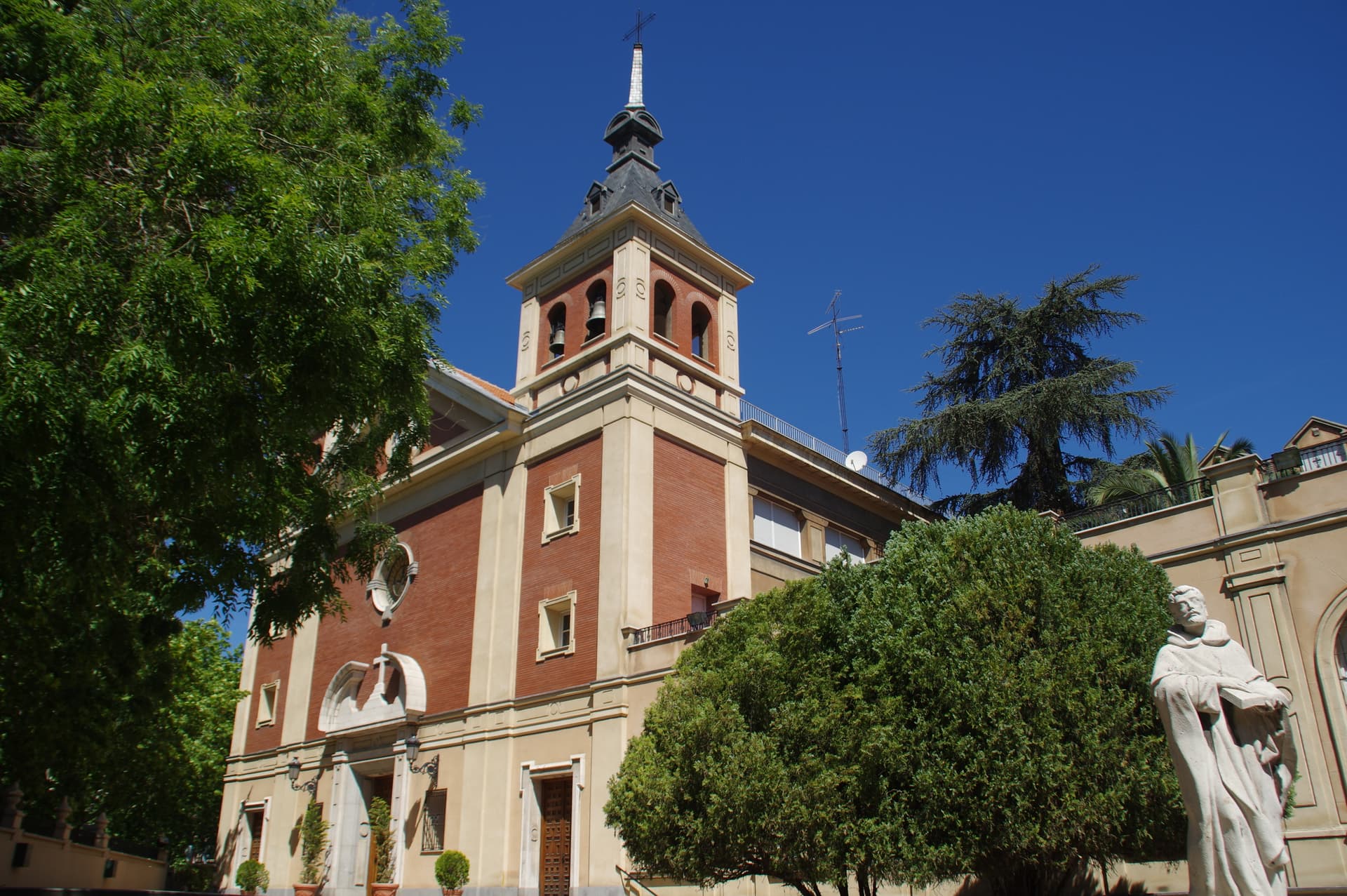
From the street, San Francisco el Grande does not compete for attention with the Royal Palace or the cathedral nearby. Inside, the dome changes the register immediately: light pours down from a height that visitors, by consistent report, do not expect from the exterior, and the comparison to the Pantheon in Rome comes up so often in accounts that it functions almost as the building's informal introduction.
Moving around the rotunda, the ring of chapels rewards a slower pace than the dome alone invites. The nineteenth-century frescoes and the Golden Age paintings are frequently described as a highlight distinct from the architecture — a reason to return with more time than a first, awe-struck circuit tends to allow. Because the basilica draws fewer visitors than Madrid's larger monuments, several accounts specifically note a quieter, more contemplative atmosphere than comparable sites nearby.
For visitors attending Mass rather than touring the museum, the experience is naturally different in kind: participation in an active Franciscan parish rather than an encounter staged by exhibition panels, governed by the church's own hours rather than the museum's.
Check which hours you are visiting under before arriving, since church (Mass) hours and museum (paid gallery) hours run separately and do not fully overlap. If the art is the draw, aim for the museum's guided tours, offered Tuesday through Friday, which give context the dome alone does not.
If the dome and the space itself are the draw, arriving during open Mass hours costs nothing and lets you experience the basilica functioning as it was built to function — as an active parish, not only a museum.
Context and lineage
Catholic and local tradition holds that Francis of Assisi passed through Madrid around 1214, traveling on pilgrimage toward the tomb of Saint James at Santiago de Compostela, and founded a modest hermitage on this site in 1217.
English and Spanish encyclopedic sources, along with Spain's own tourism authorities, explicitly flag this as tradition rather than documented history — there is no independent archaeological or documentary confirmation that Francis himself established the original chapel, and the story follows a pattern common to many medieval Franciscan foundation legends across Europe.
What is documented is that a Franciscan convent stood on the site through the medieval period, and that Charles III had it demolished in 1760 to build the present neoclassical basilica, whose cornerstone was laid in 1761 and which was inaugurated in 1784.
The basilica passed through the hands of the Franciscan order, the state-linked Obra Pía de los Santos Lugares, and periods of secular requisition (National Pantheon, military barracks) before settling into its present arrangement: an active parish under the Franciscan Friars of the Immaculate, administered jointly with a museum run by Spain's Ministry of Foreign Affairs since religious life resumed in 1939 and the galleries reopened in 2001.
Saint Francis of Assisi
saint
Founder of the Franciscan Order; tradition, not documented history, credits him with founding a hermitage on this site around 1217 during a pilgrimage toward Santiago de Compostela.
Charles III of Spain
patron
King who ordered the demolition of the medieval convent in 1760 and inaugurated the completed basilica on 6 December 1784.
Francisco Cabezas
architect
Franciscan friar-architect who began the present basilica's design in 1761, though he struggled to resolve the dome's engineering.
Antonio Pló
architect
Completed the dome's construction around 1770 after Cabezas's design proved difficult to execute.
Francesco Sabatini
architect
Oversaw the facade, towers, and overall completion of the project, with Miguel Fernández also credited in the final phase.
Traditions and practice
Historically the basilica hosted royal Bourbon ceremonies and weddings and served as the seat of the Obra Pía de los Santos Lugares de Jerusalén, a Catholic foundation tied to the protection of Holy Land shrines, along with associated military-religious orders such as the Order of the Holy Sepulchre — a civic-religious role layered onto ordinary parish life.
The Franciscan Friars of the Immaculate hold daily and Sunday Mass on a published schedule, with a special liturgical celebration each October 4 for the feast of Saint Francis of Assisi. These are living observances rather than reconstructed ones, continuing a parish identity that predates the current building.
Attending an ordinary weekday or Sunday Mass, rather than only the museum tour, is the most direct way to encounter the basilica as the Franciscan community understands it — as a working parish first, landmark second. Pairing that with a guided museum visit on a separate occasion lets each register of the building register on its own terms rather than blurring together.
Catholic (Franciscan)
ActiveDedicated to Saint Francis of Assisi and, since a 1962 rededication, also to Our Lady of the Angels. Administered historically by the Franciscan Order and today served by the Franciscan Friars of the Immaculate, the basilica is tied to Franciscan identity in Madrid and to the Obra Pía de los Santos Lugares de Jerusalén.
Daily and Sunday Mass; annual Feast of Saint Francis of Assisi on October 4 with special liturgies; historical role as headquarters for orders connected to the Holy Sepulchre; veneration of an extensive collection of devotional art depicting the life of Saint Francis.
Perspectives and open questions
San Francisco el Grande sits at the intersection of two readings that do not conflict so much as operate on different registers: an architectural-historical view focused on the dome's Enlightenment-era ambition, and a devotional view centered on Franciscan founding legend and ongoing parish life.
Scholarly perspective
Architectural and art historians treat the basilica as a landmark of Spanish Enlightenment-era neoclassicism under Charles III, notable chiefly for its ambitious Pantheon-inspired dome — among the largest circular domes in Europe, though sources differ on its exact ranking — and for its role as a repository of major Spanish Baroque and nineteenth-century religious art.
Scholars generally treat the claim that Saint Francis personally founded a hermitage here in 1217 as an unverified foundation legend rather than established history, consistent with similar origin stories attached to other medieval Franciscan houses across the Iberian Peninsula and along pilgrim roads to Santiago de Compostela.
Living and traditional perspectives
Within Franciscan and Catholic devotional tradition, the 1217 founding narrative is honored as sacred memory linking the basilica directly to the order's founder and to the broader Camino de Santiago pilgrimage tradition. This continues to shape the basilica's devotional identity and its popular framing as spiritually founded by Francis himself, even where the institution's own heritage literature carefully labels the story as tradition rather than fact.
Open questions
The precise physical form and exact foundation date of the medieval hermitage or convent reportedly standing here before its 1760 demolition are not well documented archaeologically in available sources; how much of the site's earlier medieval fabric, if any, might still lie beneath the current basilica remains historically uncertain.
Plan your visit
Access and arrival
Central Madrid, Palacio/La Latina neighborhood, at Gran Vía de San Francisco / Plaza de San Francisco, 28005 Madrid. Nearest Metro stations are La Latina and Puerta de Toledo (both Line 5); multiple bus routes and BiciMAD bike-share stations also serve the area. Museum admission is approximately €6 standard / €3.50 reduced, free on Thursdays. Confirming hours by phone (+34 91 365 38 00) is advised given seasonal and liturgical variation.
The basilica sits within central Madrid, where accommodation of every category is available within easy walking or metro distance; no site-specific lodging exists at the basilica itself.
Respectful visit
No basilica-specific dress code is documented, but general modest dress expected of an active Catholic church in Spain applies — shoulders and knees ideally covered, especially during Mass.
Not explicitly restricted for general visiting in available sources, but photography during active Mass or other liturgical services should be avoided; museum-gallery areas may have separate posted policies not detailed in research and worth checking on-site.
No specific offering or votive custom beyond standard Catholic practice — lighting a candle, offering a quiet prayer — common to Spanish parish churches generally.
Photography during active Mass or any liturgical service should be avoided out of respect, even where general photography is not restricted; museum-gallery sections may carry their own posted photography policies that visitors should check on-site rather than assume.
Location
Map loads as you approach this section.
Pilgrim reflections
A portrait of encounter, not a score
Pilgrims describe what they felt, how present they could become, and whether the place would shape a journey. There are no stars and no ranking of traditions.
No reviewed reflections yet
The first pilgrims can help describe the character of being here.
Share a reflection
Available after an account-backed “Been there.” Every reflection is reviewed before publication.
Nearby sacred places
Explore other sacred places in the region. Proximity does not establish access or travel time; check each place’s guidance.


References
Sources consulted for this page. Source categories describe the publication, not a guarantee that every claim is verified. Traditional accounts and outside interpretations may differ.
- 01Royal Basilica of Saint Francis the Great — Wikipedia — Wikipedia contributorsacademicPrimary English-language reference; covers history, architects, dome dimensions, basilica elevation (1963), heritage designation (1980), and notes the founding legend as unverified tradition.
- 02Real basílica de San Francisco el Grande — Wikipedia (Spanish) — Wikipedia contributorsacademicSpanish-language reference with more granular detail: construction timeline 1761-1784, architects by phase, rededication to Nuestra Señora de los Ángeles (1962), Obra Pía de los Santos Lugares administration, museum reopening in 2001.
- 03Historia — Museo Basílica San Francisco el Grande — Ministerio de Asuntos Exteriores, Unión Europea y Cooperación (Spain)officialOfficial Spanish government (Ministry of Foreign Affairs) historical account; the ministry administers the site as museum. Confirms construction dates, inauguration by Charles III on 6 December 1784, and post-1939 religious resumption under the Obra Pía de los Santos Lugares.
- 04Basilica of San Francisco El Grande | Tourism Madrid — esmadrid.com (Madrid City Council tourism board)officialOfficial Madrid tourism board listing with opening hours, admission prices, transit access, and contact details.
- 05San Francisco el Grande Basilica in Madrid — spain.info (Turespaña / Spanish national tourism board)officialNational tourism board overview confirming architectural summary and practical visiting details.
- 06San Francisco el Grande de Madrid en su historia reciente (1835-2015) — Archivo Ibero-Americano (Franciscan historical journal)academicAcademic Franciscan-order journal article on the basilica's modern history (identified via search; not fully fetched in this research pass, listed for future deeper research).
- 07Royal Basilica of St. Francis the Great, Madrid, Spain — Catholic Shrine & Basilica (catholicshrinebasilica.com)spiritualDevotional/pastoral-focused source confirming feast day (October 4, Saint Francis of Assisi), current Mass schedule, and framing as active pilgrimage/worship site alongside museum function.
- 08San Francisco el Grande - Spain's Largest Dome — Historias de MadridSource contextLocal history blog with detailed account of dome construction difficulties (Francisco Cabezas struggling with the design, Antonio Pló completing it), young Goya's early painting there, and use as French military stables during Napoleonic occupation.
Share a photo
Help visitors recognize Royal Basilica of San Francisco el Grande. Every submission is reviewed before publication.