Monastery of Mar Behnam, Iraq
A medieval Syriac martyr-shrine in the Nineveh Plains, razed by ISIS and rebuilt, shared by Christians, Muslims, Yazidis
Understand sacred places, explore living traditions, and learn how to engage respectfully with Pilgrim Map.
Access has not been verified. Check current local guidance before planning a visit.
خدرئیلیاس, Nineveh, Iraq
Read the sources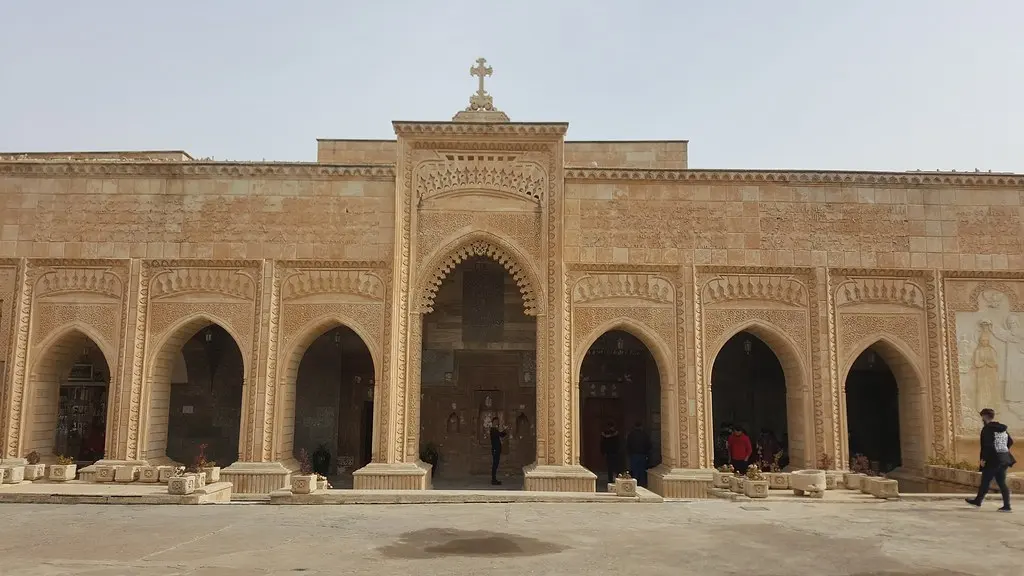
Image of Monastery of Mar Behnam, Iraq. Image source
Visit essentials
A quick read before you go
- Duration
- 1-2 hours.
- Access
- In Khidr Ilyas near Beth Khdeda (Qaraqosh/Baghdede), southeast of Mosul in the Nineveh Plains;…
Overview
Near the village of Khidr Ilyas, Mar Behnam Monastery is a fortified stone complex enclosing one of Mesopotamia's most celebrated medieval mausoleums. It honors fourth-century martyrs Saint Behnam, his sister Saint Sarah, and forty companions killed after converting to Christianity. Legend says their father, a king, ordered their deaths and then founded the monastery over their tomb in penance.
Scholars date surviving fabric to the twelfth and thirteenth centuries, while the martyr legend survives in a manuscript no earlier than 1197—faith and story held in tension with stone and inscription.
The octagonal domed mausoleum stands over a pit in Tell al-Khidr, a low hill identified with al-Khidr, the Qur'anic 'green one' of fertility and renewal. Generations of Muslims and Yazidis, especially women seeking children, harvest, or their flocks' wellbeing, have come beside Syriac Christian pilgrims, making this rare living shared sacred space. Famous carvings accompany Syriac, Arabic, Armenian, and rare Uyghur inscriptions, the last tied to a Mongol-era episode in 1295.
The tomb was deliberately destroyed in March 2015. Restored by December 2018, it again hosted the feast of Mar Behnam and now carries the weight of survival and return alongside its older meanings.
Why this place is sacred
Mar Behnam's pull comes from layering. At its core is the tomb of early Christian martyrs, enshrined in a mausoleum admired for its carving and its multilingual inscriptions. Around that core gathered the cult of al-Khidr, the green prophet, drawing Muslims and Yazidis into a shared circuit of devotion and healing — a coexistence that itself feels sacred to those who witness it. A nearby spring, where tradition says Mar Mattai healed Sarah, added a place of miraculous healing.
And in our own time the deliberate destruction of the tomb and its painstaking restoration have made the site a witness to both violence and recovery, so that resilience is now part of what it means to stand here.
A Syriac monastery and martyr-shrine built around the tomb of Saints Behnam and Sarah, a center of pilgrimage and intercession.
Traditionally founded in the fourth century; the surviving structures date to the twelfth and thirteenth centuries, with Mongol/Ilkhanid-era additions around 1295. The Syriac Catholic Church took possession in 1839. The tomb was destroyed by ISIS on 19 March 2015 and restored by December 2018.
Experience and orientation
Visitors describe approaching what looks more like a fortress than a church — heavy stone walls enclosing courtyards and the celebrated mausoleum at the heart. Inside, the octagonal domed tomb-chamber is densely carved, its restored twelfth- and thirteenth-century mural reliefs and multilingual inscriptions repaying slow attention.
Knowing that the tomb was blown apart in 2015 and rebuilt by 2018 changes the quality of the visit: the carving you see is at once ancient and newly recovered, and the sense of return is part of the atmosphere. The hill behind the tomb, Tell al-Khidr, and the nearby healing spring extend the visit outward into the older, shared layers of devotion.
Begin in the courtyard to take in the fortified scale, then enter the octagonal mausoleum for the carved decoration and inscriptions. The tomb-chamber is the devotional center; the hill of al-Khidr behind it and the healing spring nearby complete the circuit that pilgrims of three traditions have followed for centuries.
Context and lineage
By tradition, Behnam — son of a king of the Assyrian or Persian era — and his sister Sarah converted to Christianity after Sarah was miraculously healed, an act attributed to the hermit Mar Mattai. Their father had them martyred, and afterward, in penance, built the monastery over their tomb.
The surviving complex is medieval rather than ancient, raised by Syriac patrons and craftsmen who left inscriptions in several languages, including a rare Uyghur text linked to a Mongol episode of 1295. The Syriac Catholic Church repossessed the monastery in 1839. In 2015 ISIS destroyed the tomb; an international effort restored it, and worship resumed in 2018.
Syriac Catholic Christianity, formerly Syriac Orthodox, with layered Muslim and Yazidi folk veneration through the cult of al-Khidr.
Saint Behnam
Fourth-century martyr
Saint Sarah
Fourth-century martyr
King Senchareb (Sennacherib)
Legendary founder
Restoration partners (Fraternité en Irak, Mesopotamia, ALIPH Foundation)
Post-2015 conservators
Traditions and practice
Syriac Christian liturgy and the feast of Mar Behnam, veneration at the tomb, and prayers for intercession. Alongside these, Muslim and Yazidi pilgrims — especially women — have long come to seek the saint's and al-Khidr's intercession for children, harvest, and livestock, making petitions at the tomb and the healing spring.
Worship and the feast of Mar Behnam (early December) resumed after the 2018 restoration; pilgrimage continues across the three traditions.
Move through the space slowly and with attention to its shared character. Reading the inscriptions, sitting with the restored carvings, and reflecting on coexistence, loss, and renewal fit the place for visitors of any background.
Syriac Catholic Christianity
ActiveShrine of the fourth-century martyrs Behnam and Sarah, a major Syriac monastery and pilgrimage center with a renowned octagonal mausoleum and twelfth- to thirteenth-century carved decoration.
Liturgy, the feast of Mar Behnam, veneration at the tomb, and prayers for intercession.
Local Muslim and Yazidi folk veneration
ActiveThe hill behind the tomb, Tell al-Khidr, is associated with al-Khidr, the Qur'anic figure of fertility and renewal. Muslims and Yazidis, especially women, visit to seek intercession for fertility, harvest, livestock and children, making the monastery a shared interfaith sanctuary.
Pilgrimage to the tomb and the nearby healing spring; petitions for fertility and abundance; veneration tied to al-Khidr.
Perspectives and open questions
Mar Behnam is read through several lenses at once — as architecture and inscription, as Christian shrine, and as shared interfaith sanctuary.
Scholarly perspective
Scholars describe a significant medieval Syriac monastic complex, its surviving fabric of the twelfth and thirteenth centuries, built around the cult of the martyrs Behnam and Sarah and notable for its multilingual inscriptions, including rare Uyghur text. The fourth-century founding is legendary. The complex was deliberately damaged by ISIS in 2015 and restored by 2018.
Living and traditional perspectives
Syriac Christians venerate the monastery as the tomb of their martyr saints; local Muslims and Yazidis revere the site through the cult of al-Khidr and seek healing and fertility there.
Alternative interpretations
Folk traditions hold to miraculous healing at the tomb and the nearby spring, and to the protective, fertility-giving power of al-Khidr, the green prophet.
Open questions
The historical kernel behind the martyr legend, the precise date and circumstances of the original tomb, and the full meaning of the Uyghur inscriptions all remain uncertain.
Plan your visit
Access and arrival
In Khidr Ilyas near Beth Khdeda (Qaraqosh/Baghdede), southeast of Mosul in the Nineveh Plains; reached by road from Mosul or Erbil. Check current access and security conditions before visiting.
Mosul and Erbil are the practical bases; Erbil offers the widest range of accommodation and the most settled access for travelers to the Nineveh Plains.
Respectful visit
Modest dress appropriate to a Christian sacred site; cover shoulders and knees.
Generally permitted; be respectful of worshippers and of the restored carvings and murals, and avoid touching the reliefs.
Candles, prayers and donations toward upkeep; petitions for intercession.
Treat the tomb and restored artworks with care and follow the monastery's guidance.
This is a shared interfaith sanctuary that suffered deliberate destruction; treat the Christian, Muslim and Yazidi devotions here with equal respect and take no side among them.
Current practical details
Address
Iraqi Republic Railways, Nineveh Governorate, Iraq
Phone
Hours
Hours, fees, and access can change — verify on the official source before you travel. Practical details last checked Jun 2026.
Location
Map loads as you approach this section.
Pilgrim reflections
A portrait of encounter, not a score
Pilgrims describe what they felt, how present they could become, and whether the place would shape a journey. There are no stars and no ranking of traditions.
No reviewed reflections yet
The first pilgrims can help describe the character of being here.
Share a reflection
Available after an account-backed “Been there.” Every reflection is reviewed before publication.
Nearby sacred places
Explore other sacred places in the region. Proximity does not establish access or travel time; check each place’s guidance.

St. Matthew’s Monastey, Mosul, Kurdistan, Iraq
Faf, Nineveh, Iraq
39.4 km away

Tomb of Sheikh Adi ibn Musafir (Yazidi Temple), Lalish
Lalsh, Nineveh, Iraq
71.1 km away

Tomb of the Prophet Nahum, Alqosh, Kurdistan, Iraq
Alqosh, Nineveh, Iraq
72.3 km away

Mausoleums of 10th Imam Ali Alhadi and 11th Imam Hasan Alaskari, Samarra
Samarra, Saladin Governorate, Iraq
219.7 km away
References
Sources consulted for this page. Source categories describe the publication, not a guarantee that every claim is verified. Traditional accounts and outside interpretations may differ.
- 01Monastery of the Martyrs Mar Behnam and Mart Sarah — Archnet — Archnet (MIT/Aga Khan)academicArchitectural detail: fortress-like complex, octagonal domed mausoleum above a pit in Tell al-Khidr, multilingual inscriptions (Syriac, Arabic, Armenian, Uyghur), Mongol/Ilkhanid 1295 episode.
- 02Mar Behnam and Sarah's Convent — Mesopotamia Heritage — Mesopotamia (mesopotamiaheritage.org)academicHealing spring tradition, al-Khidr association, visitation by Muslims and Yazidi women for fertility/abundance, mural reliefs.
- 03Rehabilitation of the Mar Behnam Monastery — ALIPH Foundation — ALIPH FoundationofficialPost-ISIS rehabilitation funding and project documentation.
- 04Mar Behnam, More Than a Sanctuary — Fraternite en Irak — Fraternite en IrakofficialRestoration work; shared pilgrimage of Christians, Muslims and Yazidis; healing and fertility intercession traditions.
- 05The Uighur Inscription in the Mausoleum of Mar Behnam (Iraq) — De Gruyter / Gorgias PressacademicScholarly study of the Uyghur inscription invoking Khidr Elias, linked to the 1295 Ilkhanid episode.
- 06Mar Behnam Monastery — Wikipedia — Wikipedia contributorsacademicSyriac Catholic monastery near Khidr Ilyas/Beth Khdeda; 4th-c. legend, 12th-13th c. fabric, Syriac Catholic repossession 1839; ISIS destruction of the tomb 19 March 2015; restoration completed Dec 2018.
- 07Behnam, Sarah, and the Forty Martyrs — Wikipedia — Wikipedia contributorsacademicHagiography of the 4th-c. martyrs under Shapur II; veneration in Oriental Orthodox and Syriac Catholic churches.
Photo gallery
3 curated photos
Share a photo
Help visitors recognize Monastery of Mar Behnam, Iraq. Every submission is reviewed before publication.