Tomb of the Prophet Nahum, Alqosh, Kurdistan, Iraq
A Jewish prophet's shrine kept alive by the Christian town that surrounds it
Understand sacred places, explore living traditions, and learn how to engage respectfully with Pilgrim Map.
Access has not been verified. Check current local guidance before planning a visit.
Alqosh, Nineveh, Iraq
Read the sources
Visit essentials
A quick read before you go
- Duration
- About 30 to 60 minutes at the shrine itself, or half a day if combined with the Rabban Hormizd…
- Access
- Alqosh lies roughly 75 km (about 1.5 hours) north of Erbil, or around 40 km north of Mosul, with…
Overview
Nahum prophesied the fall of Nineveh, whose ruins lie some forty kilometers south near Mosul. Long tradition locates his grave here in the town Jewish memory called Elkosh, beneath a mountain once climbed by pilgrims. For more than two thousand years, a Jewish community tended the tomb on the Nineveh Plains; thousands gathered at Shavuot. Almost all left for Israel between 1948 and 1951, and by the early 2010s the synagogue's roof was collapsing.
Alqosh's Assyrian Christian families guarded the Jewish shrine through war and the nearby ISIS advance until conservation completed in 2021 secured its survival. Inside the freshly stabilized stone building, Hebrew verses from the Book of Nahum mark the pillars around the quiet, railed tomb. Almost none of the people for whom it was built remain.
More witness than destination, the shrine holds the memory of a community that flourished here for two millennia before its departure and of neighbors who protected its sacred place.
Why this place is sacred
The resonance of this place comes from absence as much as presence. For most of recorded history this was the single most important Jewish pilgrimage site in Mesopotamia, the focus of an annual gathering that filled the town. Today the synagogue is nearly silent, its community scattered across the world for three-quarters of a century.
The mountain above still stands where pilgrims once climbed before dawn; the tomb still bears its rails; the Book of Nahum is still carved into the pillars in the language of those who are no longer here. What gives the shrine its weight is this layering of vitality and loss, and the unlikely fact that it survives at all.
It was not preserved by its own people but by neighbors of a different faith, in a region scarred by recent violence. To enter is to feel the elegiac quality of a fragment that outlived the whole, and to confront questions of memory, exile, and what one community owes the sacred places of another.
Experience and orientation
The approach reads first as ordinary: a stone town spread below a dry mountain at the edge of the Nineveh Plains, reached along roads punctuated by military checkpoints. The shrine sits at Alqosh's northern edge. Inside, the scale is intimate rather than grand. The restored interior is pale stone, recently stabilized, with the central tomb set behind a low rail at the heart of the room.
Around it, pillars carry Hebrew inscriptions drawn from the Book of Nahum, and a smaller tomb in the inner courtyard is shown as that of Nahum's sister, Sara. Visitors most often report a doubled feeling: the calm of a small, well-kept sanctuary, and a sharp poignancy at finding a Jewish site so carefully preserved in a town with essentially no Jews left. The silence is part of the experience.
There is no congregation, no liturgy in progress, only the held quiet of a place kept ready for worshippers who rarely come. Many describe the encounter with interfaith custodianship, the Christian families who guarded it, as the most affecting part of the visit.
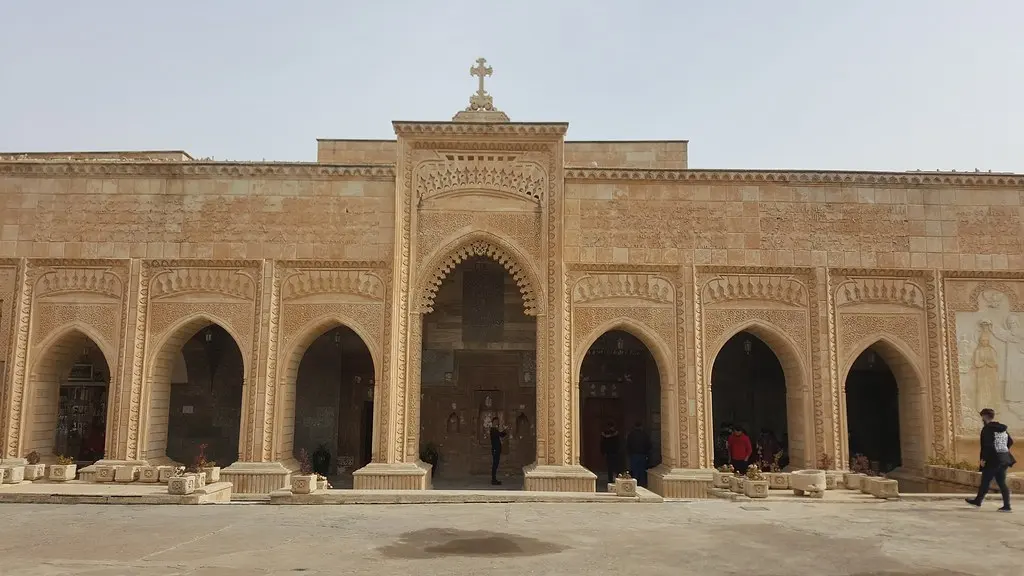
The shrine stands at the northern edge of Alqosh below the mountain. The railed tomb of Nahum is at the center of the synagogue hall; Hebrew inscriptions run along the surrounding pillars, and Sara's tomb lies in the inner courtyard. Above the town is Rabban Hormizd Monastery.
Context and lineage
Nahum the Elkoshite is one of the minor prophets of the Hebrew Bible; his short book is an oracle on the fall of Nineveh, the Assyrian capital destroyed in 612 BCE, and a message of comfort to Judah. His name itself means 'comfort'. Local and rabbinic tradition identifies this Alqosh as the biblical Elkosh, Nahum's hometown and place of burial, a tradition recorded as early as the 12th century by the traveler Benjamin of Tudela.
A synagogue grew up around the tomb. The standing structure is traditionally dated to 1173 CE, far later than the 7th-century-BCE prophet himself, so it is the burial tradition rather than the building that reaches into antiquity. The Jewish community that maintained the shrine departed almost entirely between 1948 and 1951. The building deteriorated badly over the following decades, drawing attention by 2015 as a monument in danger of collapse.
A conservation effort led by ARCH International, with work carried out by GEMA ART International and funding that included support from the United States government, ran from roughly 2018 to 2021, stabilizing the vaults and columns through photogrammetry and careful repair, and the shrine reopened to visitors in 2022.
The shrine belongs to the long history of Iraqi and Kurdish Jewry, one of the oldest diaspora communities in the world. It was the pre-eminent Jewish pilgrimage destination in Mesopotamia until the community's mid-20th-century departure. Custodianship now rests with the Assyrian and Chaldean Christian town of Alqosh, which also keeps the nearby Rabban Hormizd Monastery.
Nahum the Elkoshite
The 7th-century-BCE minor prophet whose oracle foretold Nineveh's fall; traditional occupant of the tomb
Benjamin of Tudela
12th-century Jewish traveler whose account records the identification of Alqosh as Nahum's burial place
Austen Henry Layard and George Percy Badger
19th-century explorers who documented the shrine and the surrounding region
ARCH International
Heritage organization that led the 2018-2021 restoration that saved the collapsing shrine
GEMA ART International
Conservation contractor responsible for stabilizing the vaults and columns
Traditions and practice
The defining ritual was the Shavuot pilgrimage, known locally as Eid al-Ziyara, the festival of the visit. It drew Jews from across the region for what was the central pilgrimage event of Mesopotamian Jewry, last held at full scale in 1951. The observances included a dawn service and a roughly three-hour climb to a nearby peak the pilgrims called Mount Sinai, where the giving of the Ten Commandments was commemorated.
At the tomb itself, men circled seven times in alphabetical order, singing a refrain rejoicing in the prophet Nahum, while women joined the celebration with song and dance in Arabic and Kurdish. Torah processions accompanied the gathering.
Since the 2022 reopening, practice is far quieter: individual prayer and visitation by Iraqi Jewish families and by travelers. The elaborate communal Shavuot rites are historical and are not currently re-staged at any comparable scale.
Allow for stillness rather than activity. Reading a few verses of the Book of Nahum, the inscriptions carved into the pillars come from it, gives the visit its bearings. If you come near Shavuot in late spring, the season carries the deepest historical resonance even though the old mass pilgrimage no longer occurs.
Judaism
ActiveThe traditional burial place of the minor prophet Nahum the Elkoshite, identified as such by the Jews of the region for centuries and recorded by Benjamin of Tudela in the 12th century. A synagogue was built around the tomb, and the inner courtyard also holds the tomb of Nahum's sister, Sara.
Historically the great Shavuot pilgrimage with Torah processions, sevenfold circumambulation of the tomb, and a re-enactment of the giving of the Ten Commandments on a nearby peak; today quieter individual visits and prayer.
Eastern Christianity (Assyrian / Chaldean)
ActiveNahum is venerated as a saint in Eastern Christianity, with an Orthodox feast day on December 1. Alqosh is an ancient Assyrian Christian town, and its Christian families have safeguarded the Jewish shrine for generations.
No specific liturgy is held at the tomb itself, but the town's Christians act as custodians; the wider Christian devotional life of Alqosh centers on the nearby Rabban Hormizd Monastery.
Perspectives and open questions
The shrine sits at the meeting of firm religious tradition, cautious scholarship, and a recent story of interfaith rescue.
Scholarly perspective
Scholars accept that Alqosh has been venerated as Nahum's tomb for at least a millennium, but caution that the identification of this Alqosh as the biblical Elkosh is uncertain and contested, with rival sites in Galilee and elsewhere. The standing structure is medieval, traditionally dated to 1173 CE, not from the prophet's era.
Living and traditional perspectives
Iraqi Jewish tradition firmly held this as Nahum's grave and the focus of the Mesopotamian Shavuot pilgrimage. The Assyrian and Chaldean Christians of Alqosh honor Nahum as a saint, his Orthodox feast falling on December 1, and have acted as the shrine's protectors.
Alternative interpretations
Popular accounts often frame the shrine as a 'last Jewish site' in Iraq and a symbol of interfaith coexistence. These framings are commemorative rather than scholarly claims, but they capture something real about how the place survives.
Open questions
Whether an actual burial lies beneath the shrine cannot be verified, and the precise location of the biblical Elkosh remains an open historical question.
Plan your visit
Access and arrival
Alqosh lies roughly 75 km (about 1.5 hours) north of Erbil, or around 40 km north of Mosul, with the shrine at the town's northern edge below the mountain. A hired car with a local driver is recommended; expect multiple military checkpoints, and note that the site is guarded by Kurdish Peshmerga. Most nationalities require a Kurdistan Region e-visa. Entry to the synagogue interior may require coordinating with a local guardian in advance.
Mobile signal is generally available in the town. Confirm current access conditions before traveling, as the wider region remains politically sensitive.
Alqosh itself has limited tourist accommodation; most visitors base in Erbil or Dohuk and travel out for the day with a driver.
Respectful visit
Dress modestly as for a religious shrine, covering shoulders and knees. A head covering for men is customary inside a synagogue.
Photography of the restored interior is generally permitted, but ask the guardian first and be discreet if any worshippers are present.
There is no formal offering system; donations toward the upkeep of the shrine may be appreciated.
Respect the instructions of any local custodian and the Peshmerga security presence, and keep the conduct appropriate to a place of worship.
Behave throughout as you would in an active synagogue, even when no one else is present. Follow any guardian's instructions and respect the security presence around the site.
Location
Map loads as you approach this section.
Pilgrim reflections
A portrait of encounter, not a score
Pilgrims describe what they felt, how present they could become, and whether the place would shape a journey. There are no stars and no ranking of traditions.
No reviewed reflections yet
The first pilgrims can help describe the character of being here.
Share a reflection
Available after an account-backed “Been there.” Every reflection is reviewed before publication.
Nearby sacred places
Explore other sacred places in the region. Proximity does not establish access or travel time; check each place’s guidance.



References
Sources consulted for this page. Source categories describe the publication, not a guarantee that every claim is verified. Traditional accounts and outside interpretations may differ.
- 01The Tomb of Prophet Nahum — Mesopotamia HeritageofficialCoordinates, architectural description, 12th-century traveler Benjamin of Tudela reference, 19th-century explorers Layard and Badger
- 02Salvation of the Prophet Nahum Shrine, Iraq — GEMA ART InternationalofficialConservation contractor; restoration phases 2018-2021, photogrammetry, vault and column stabilization
- 03Book of Nahum — Encyclopaedia BritannicaencyclopediaOracle concerning Nineveh; destruction of Nineveh 612 BCE; message of comfort to Judah
- 04Is This the Tomb of a Biblical Prophet—and Will It Survive? — National GeographicnewsPre-restoration state of collapse, ISIS-era threat, structural deterioration
- 05Saving Iraq's Tomb of Nahum, a secret mission resurrects Kurdistan's Jewish past — Times of IsraelnewsRestoration narrative, ARCH International, departure of Jewish community in 1948
- 06In Iraq, restored tomb of biblical prophet Nahum quietly attracts Jewish pilgrimage — Times of IsraelnewsReopening in 2022, current pilgrimage activity by Iraqi Jewish families
- 07Nahum's Tomb: A Shavuot Like No Other — My Jewish LearningguideDetailed Shavuot pilgrimage rituals ('Eid al-Ziyara'), last major pilgrimage 1951, sevenfold circumambulation, Mount Sinai ascent
- 08Nahum — WikipediaencyclopediaProphet biography, meaning of name ('comfort'), Orthodox feast Dec 1, contested Elkosh identification
- 09Alqosh travel guide — WikivoyageguidePractical access, proximity to Rabban Hormizd monastery
- 10Rabban Hormizd Monastery — WikipediaencyclopediaNearby 7th-century Chaldean monastery, second sacred site at Alqosh
Share a photo
Help visitors recognize Tomb of the Prophet Nahum, Alqosh, Kurdistan, Iraq. Every submission is reviewed before publication.