Llech-y-tribedd
A Neolithic threshold between worlds, still standing in the Welsh hills after five millennia
Understand sacred places, explore living traditions, and learn how to engage respectfully with Pilgrim Map.
Access has not been verified. Check current local guidance before planning a visit.
Moylgrove, Wales, United Kingdom
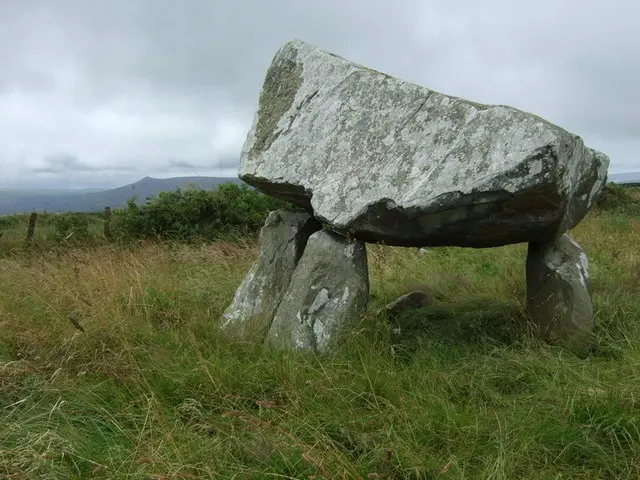
Image of Llech-y-tribedd. Image source · CC-BY-SA-2.0
Visit essentials
A quick read before you go
- Duration
- Allow thirty to sixty minutes for a focused visit, including the walk from the road.
- Etiquette
- Llech-y-tribedd requires respectful behavior toward both the archaeological monument and the…
Overview
The name means either 'Stone of the Three Graves' or 'Tripod Stone,' depending on the interpretation; both fit a place where communities gathered their dead into stone. Three rock legs have held its massive capstone aloft for over five thousand years.
Llech-y-tribedd rises on a Pembrokeshire hillside in the Nevern Valley, one of at least eight megalithic tombs in this small part of Wales. Its Neolithic builders placed ancestors where views reach the Preseli Hills, sacred source of Stonehenge's bluestones, and Carningli, later called the 'Mount of Angels.' Their understanding of landscape and death can now only be approximated.
No one performs rituals here anymore. The covering mound has eroded away, leaving the skeleton of its architecture. Silence, alignment with distant peaks, and surviving human intention remain; people who climb the stile and cross the field to stand beneath the capstone often describe an unnamed sense of deep time made tangible.
Why this place is sacred
Portal dolmens are threshold architecture. The Neolithic builders who raised Llech-y-tribedd were not simply disposing of the dead; they were creating permanent points of contact between the living community and those who had crossed over. The two tall portal stones frame an entrance, a doorway leading into the chamber beneath the capstone where ancestral bones were gathered.
Archaeologists describe these sites as ossuaries, places where the disarticulated bones of community members accumulated across generations, possibly after initial burial or exposure elsewhere. But to the communities who built and used them, these structures were something more than repositories. The ancestors housed within became mediators, connecting the living with powers beyond ordinary reach. The chambered tombs functioned, in the interpretation of some scholars, as 'multipurpose shrines' where the boundary between human and divine could be negotiated.
The site's placement intensifies this threshold quality. Llech-y-tribedd stands in visual relationship with Carningli Mountain, the peak where, fifteen centuries after the dolmen's construction, the Celtic saint Brynach would claim to commune with angels. Local legend says a giant named Samson hurled the capstone from that mountaintop. This story, scholars suggest, may preserve ancient memory of a ritual connection between burial site and sacred mountain, a relationship built into the landscape itself.
The Nevern Valley holds one of the densest concentrations of Neolithic ritual monuments in Wales. Within walking distance stand Pentre Ifan, the largest portal dolmen in Wales; Trellyffaint with its rock art; Carreg Coetan Arthur; and others. This was a landscape deliberately shaped for sacred purposes, a geography of the dead that linked individual sites into a network of meaning.
Five thousand years later, the mound that once covered Llech-y-tribedd has eroded away. No bones remain within, if any were ever found or recorded. The rituals that once took place here are beyond recovery. Yet the threshold architecture persists, still framing an entrance, still marking a passage between states. Visitors who stand before it today encounter what the Neolithic builders intended: a door.
Archaeological evidence indicates Llech-y-tribedd was constructed as a portal dolmen during the Neolithic period, likely between 4400 and 2900 BCE. It served as a communal burial chamber where the disarticulated bones of community members were deposited over generations. Portal dolmens are characterized by their entrance framed by two tall portal stones, creating an architectural threshold. The original structure would have been covered by a mound of earth and stones, now completely eroded.
These sites functioned not merely as tombs but as places of ongoing relationship between living communities and their ancestors, maintaining continuity across generations and connecting the human world with sacred powers.
The rituals that animated Llech-y-tribedd ceased thousands of years ago, their specific nature passing beyond the reach of historical record or archaeological reconstruction. The covering mound eroded over millennia, leaving only the stone skeleton that visitors encounter today. Early 18th-century records note that one of the recumbent stones was 'still standing,' suggesting some movement in the structure over time.
In the Christian era, the Nevern Valley gained new sacred significance through St Brynach's 6th-century church and the later pilgrimage route to St Davids. The dolmen itself received no documented religious attention, slipping into the category of ancient curiosity rather than active sacred site. Local folklore preserved the Samson legend, linking the stone to Carningli Mountain through supernatural narrative.
F.M. Lynch documented the portal dolmens of the Nevern Valley in 1972, establishing the scholarly framework through which the site is now understood. Today, Llech-y-tribedd is a Scheduled Ancient Monument protected by Cadw, receiving visitors interested in prehistory, Welsh heritage, and the accumulated weight of human presence across deep time.
Experience and orientation
The approach to Llech-y-tribedd requires commitment. There is no car park, no visitor center, no interpretive signage beyond a small green marker at the stile. You walk up a farm track, past Penlan Farm, until you reach a field where the dolmen stands alone against the Welsh sky.
This isolation is part of the experience. Llech-y-tribedd has not been packaged for easy consumption. It asks you to find it, to cross the stile, to walk across uneven ground toward something that could be mistaken, from a distance, for a natural rock formation. The moment of recognition, when the structure resolves from landscape feature into human architecture, carries its own quiet power.
Up close, the scale becomes apparent. The capstone, roughly three meters by two and a half, tilts dramatically, supported by three uprights and a fallen slab. Visitors often find themselves drawn to touch the stone, though this should be resisted, as significant cracking in both capstone and uprights indicates structural fragility. The experience is better held at a slight distance, allowing the architecture to speak on its own terms.
The views from the site reward the climb. To the south and east, the Preseli Hills form a rumpled horizon, the sacred range from which the Stonehenge bluestones were quarried. Carningli rises closer, the mountain whose later association with St Brynach overlays whatever significance it held for the Neolithic builders. On clear days, the visual dialogue between dolmen and distant peaks becomes almost conversational.
Visitors frequently describe a sense of awe at the structure's dramatic form against this landscape, and a feeling of connection to deep antiquity. The atmosphere of timelessness in this rural Welsh setting allows for contemplation that busier heritage sites rarely permit. Those who come seeking more than a photograph often speak of sitting quietly near the stones, watching light change across the hills, and sensing the accumulated presence of all the generations who placed their dead here.
Llech-y-tribedd offers itself to those who approach slowly. The best visits begin with the walk, allowing the modern world to recede with each step up the farm track. Arrive without an agenda beyond presence.
Consider the threshold. You stand before an entrance built five thousand years ago to frame a passage between worlds. The doorway still functions, in its way, even if what lies beyond has shifted from the realm of ancestors to the realm of time itself.
The fallen stone that once stood upright, the cracking in the capstone, the erosion of the mound, all speak to impermanence operating at scales we rarely contemplate. Yet here the structure stands. Five millennia of weather, of passing seasons, of human generations rising and falling, and these stones still hold their positions.
Sit, if you can, with your back to the modern and your face toward the ancient view. Let the Preseli Hills do what they will. Let Carningli watch. The ancestors placed here are long beyond naming, but something of human intention remains in these arranged stones. That is worth attending to.
Context and lineage
The Neolithic farmers who settled the Nevern Valley around six thousand years ago transformed the landscape according to a cosmology we can only partially reconstruct. They raised stone monuments across the hillsides, creating a network of sacred sites connected by lines of sight and shared purpose.
Local legend offers a different origin. The giant Samson, standing atop Carningli Mountain, hurled the capstone to its present position. Some versions identify this Samson with the biblical figure; others with St Samson of Dol, a 6th-century Welsh saint associated with supernatural feats at other megalithic sites in Pembrokeshire.
Barber and Williams, documenting Pembrokeshire folklore in 1989, suggested this legend might preserve folk memory of a deliberate orientation on Carningli, some ritual connection between mountain and burial site encoded in story after the original meaning was lost.
The scholarly account and the legendary account need not compete. Both acknowledge that the capstone's placement was significant, that its relationship with the mountain mattered, that something about this arrangement warranted remembrance across millennia, even if the details shifted from cosmology to legend.
For centuries, perhaps a millennium, Neolithic communities brought their dead to this hillside. The specific practices, the words spoken, the meanings held, are beyond recovery. When the tradition ceased, and why, we do not know.
The site passed into the care of time. The mound covering the chamber eroded, leaving only the stone skeleton. Farmers worked the surrounding land, their ancestors having no memory of who had built this strange structure or why. Folklore stepped in where history fell silent, attributing the capstone to giants.
In the 18th century, antiquarians began recording the monument. F.M. Lynch's 1972 study placed it within scholarly understanding of portal dolmens. Today, Cadw protects it as a Scheduled Ancient Monument, and the Royal Commission on Ancient and Historical Monuments of Wales maintains detailed records.
No formal excavation has been conducted. What lies beneath, if anything, remains unknown. The site's significance is determined by its architecture, its landscape position, and its relationship to the wider complex of Nevern Valley monuments.
The Ancestors
spiritual
The unnamed dead whose bones were deposited within the chamber across generations. In Neolithic understanding, these ancestors became mediators between the living community and sacred powers. Their presence in the landscape maintained continuity and connection.
Samson
legendary
The giant said to have hurled the capstone from Carningli Mountain. Possibly a folk memory of St Samson of Dol, a 6th-century Welsh-born saint associated with superhuman strength at other megalithic sites. The legend may encode an ancient understanding of ritual connection between dolmen and mountain.
St Brynach
historical/spiritual
6th-century Irish-Welsh saint who founded the church at Nevern and was said to commune with angels on the summit of Carningli, the 'Mount of Angels.' Though not directly associated with the dolmen, his presence in the landscape adds a layer to the valley's sacred geography.
Traditions and practice
Neolithic mortuary practices at portal dolmens likely included the deposition of disarticulated bones within the chamber, possibly after excarnation or initial burial elsewhere. This created collective ancestral presences over generations, the bones of many individuals mingling in the common house of the dead.
Archaeologists suggest these sites functioned as places of veneration where rituals connected living communities with their ancestors. Access may have been limited to spiritual leaders who maintained the relationship between worlds. The ancestors housed within served as mediators, and ceremonies at the threshold maintained the reciprocal bonds on which community welfare depended.
Specific rituals are unrecoverable. No written records exist. Comparison with mortuary practices at other Neolithic sites provides context but not certainty. What we know is form, not content.
No organized spiritual practice occurs at Llech-y-tribedd. The site does not draw formal pilgrimage or ceremony. Visitors come for heritage, for archaeology, for an encounter with deep time.
Those seeking something more contemplative may sit quietly near the stones, allowing the landscape and the structure to work at their own pace. Photography, when practiced mindfully, becomes a form of attention. Walking from Moylgrove rather than driving the lane turns the approach into a small pilgrimage of its own.
The Nevern Valley's wider sacred geography offers context. St Brynach's Church, a few miles south, is an active place of worship on the pilgrimage route to St Davids. Carningli Mountain, visible from the dolmen, can be climbed. Pentre Ifan, better known and more visited, provides a counterpoint that may deepen appreciation for Llech-y-tribedd's quieter presence.
No one can recreate what the Neolithic builders performed here. But those seeking more than a heritage checkbox might consider these approaches:
Arrive on foot if possible. The walk from Moylgrove takes about forty minutes and transforms a visit into a minor journey. Let the approach be part of the practice.
Stand before the threshold and acknowledge what it is: a doorway built to frame passage between states. You need not believe in ancestors as mediating powers to recognize that the builders believed, and that their belief shaped stone into meaning.
Sit quietly with the view. The Preseli Hills held significance for Neolithic people across Britain, their bluestones transported to Stonehenge. Carningli became the Mount of Angels for Celtic Christians. Let the landscape speak what it will.
Before leaving, offer silent acknowledgment to those unnamed dead whose bones once rested here. The form is yours to determine. What matters is the recognition that you stand where others stood, seeking connection across the ultimate boundary.
Neolithic Mortuary Practice
HistoricalLlech-y-tribedd was constructed as a portal dolmen during the Neolithic period, serving as a communal burial chamber where ancestral remains were deposited across generations. These sites functioned as thresholds between the worlds of living and dead, places where the ancestors became mediators connecting their descendants with sacred powers. The concentration of such monuments in the Nevern Valley indicates a landscape deliberately shaped for ritual purposes, with each site forming part of a network of sacred significance.
Practices likely included the deposition of disarticulated bones within the chamber, possibly after excarnation or initial burial elsewhere. Rituals of ancestor veneration maintained the reciprocal bonds between living communities and their dead. Access to the chamber may have been restricted to spiritual leaders who mediated between worlds. Ceremonies probably occurred at significant moments, though the specific occasions and forms are beyond recovery.
Welsh Folklore
HistoricalLocal legend attributes the capstone's placement to a giant named Samson, who hurled it from the summit of Carn Ingli. This may reference the biblical Samson, St Samson of Dol, or a more primordial figure. The legend preserves memory of the stone's unusual nature and its relationship with the sacred mountain, encoding in narrative what may once have been understood cosmologically.
The tradition persisted through oral transmission, with the story passing down through generations who had lost direct understanding of the site's original purpose. The legend answered the question that the monument poses: how did this massive stone come to rest here, balanced on three uprights?
Celtic Christianity (Regional Context)
ActiveWhile not directly associated with the dolmen, the site lies within the parish of Nevern, which holds profound significance for Celtic Christianity. St Brynach founded his church in Nevern in the 6th century and was said to commune with angels on Carningli, the mountain visible from the dolmen and source of the Samson legend. Nevern lies on the pilgrimage route from Holywell to St Davids, and the church contains a famous 10th-century Celtic cross and the 'Bleeding Yew.' This layering of prehistoric and Celtic Christian sacred geography creates a landscape where multiple traditions overlap.
Pilgrimage along routes connecting Holywell to St Davids via Nevern continues today. St Brynach's Church is an active place of worship. While no Christian practice occurs at the dolmen itself, visitors may incorporate it into a broader engagement with the valley's sacred geography.
Perspectives and open questions
Llech-y-tribedd invites interpretation from multiple angles: the archaeological, the folkloric, the contemplative. Each offers genuine insight while acknowledging uncertainty. The site has not been excavated; much remains unknown. Holding these perspectives together, without forcing resolution, is the most honest approach to a monument that has outlasted all the belief systems brought to it.
Scholarly perspective
Archaeological consensus classifies Llech-y-tribedd as a portal dolmen, a type of chambered tomb characteristic of western Britain and Ireland with construction dates typically placed between 3800 and 2800 BCE. The site retains significant archaeological potential, with a strong probability of intact burial or ritual deposits, environmental evidence, and a buried prehistoric land surface that could illuminate Neolithic lifeways.
F.M. Lynch documented the Nevern Valley portal dolmens in 1972, establishing their classification and regional significance. The site forms part of a group of at least eight extant stone chambered monuments in the valley, giving it 'group value' as an element of a prehistoric funerary and ritual landscape.
No formal excavation has been conducted at Llech-y-tribedd. Dating remains approximate, inferred from architectural style rather than direct evidence. The Royal Commission on the Ancient and Historical Monuments of Wales maintains detailed records, and the site is protected as a Scheduled Ancient Monument under Cadw's stewardship.
Living and traditional perspectives
Welsh folklore preserved knowledge of the site through the name 'Llech-y-tribedd,' which may translate as 'Stone of the Three Graves,' suggesting memory of multiple burials, or 'Tripod Stone,' describing its form. The persistence of a mortuary association in the name across millennia indicates that local understanding never entirely forgot the dolmen's function.
The Samson legend transforms the stones' placement into supernatural narrative. Whether the giant was the biblical Samson, St Samson of Dol, or a more primordial figure, the story acknowledges that something required explanation: how did this massive stone come to rest here? The answer encoded in folklore may preserve, as Barber and Williams suggest, 'folk-memory indicating that there was some deliberate orientation on Carningli, or some other ritual connection between the two sites.'
St Samson of Dol was a 6th-century Welsh-born saint associated with miraculous strength at other megalithic sites, including Carreg Samson in Pembrokeshire, whose capstone he supposedly placed with his little finger. The attribution to Samson may represent early Christian efforts to claim or explain prehistoric monuments.
Alternative interpretations
The visual alignment between Llech-y-tribedd and Carningli Mountain has attracted interest from those seeking to understand ancient sacred geography beyond conventional archaeology. Some suggest the monument's placement was chosen to create visual and energetic dialogue with the mountain, connecting the threshold of the dead with the heights where, centuries later, angels would appear.
The Preseli Hills visible from the site are the source of Stonehenge's bluestones, suggesting this region held significance in Neolithic cosmology that extended far beyond local communities. Alternative interpretations sometimes frame the Nevern Valley as a zone of intensified spiritual activity, where the concentration of monuments indicates a landscape deliberately charged with sacred purpose.
No formal studies have examined potential astronomical alignments at this specific site. Such interpretations, while not supported by current evidence, often emerge from genuine attempts to understand why ancient people placed such effort in locations that continue to feel significant.
Open questions
Genuine mysteries remain at Llech-y-tribedd, and honest engagement requires acknowledging them.
No excavation has been conducted. Whether burial deposits survive beneath the structure, and if so, from what periods and containing what remains, is unknown. The dating of the monument rests on typological comparison rather than direct evidence.
The exact relationship between the dolmen and Carningli Mountain has not been formally studied. Whether orientation was deliberate, and if so, what it signified, remains speculative.
The original appearance of the covering mound is entirely lost to erosion. How large it was, whether it was marked or decorated, and how it related to the landscape are questions without answers.
The meaning encoded in the name variation, 'Three Graves' versus 'Tripod Stone,' cannot be definitively resolved. Whether three distinct burials existed, and how the folk memory diverged into competing interpretations, is unknown.
The structural damage visible today, significant cracking in the capstone and uprights, cannot be dated. Whether this is recent deterioration or has developed over centuries remains unclear.
These uncertainties are not failures of knowledge but invitations to humility. The monument has outlasted every culture that sought to explain it. It may outlast ours as well.
Plan your visit
Access and arrival
Newport, Pembrokeshire, offers the nearest range of lodging options, from B&Bs to small hotels. The coastal town has good amenities and easy access to Nevern Valley sites. For those seeking longer stays, the area has self-catering cottages. No accommodation specifically oriented toward pilgrimage or spiritual retreat exists in the immediate area, though the Pembrokeshire Coast Path brings walking-oriented visitors who may appreciate the landscape's contemplative dimensions.
Respectful visit
No formal dress requirements. Wear sturdy walking shoes with good grip, as the approach involves farm tracks and uneven ground. Be prepared for Welsh weather, which can change quickly.
Photography is permitted and welcome. The dramatic form of the dolmen against the landscape makes for compelling images. Practice mindful photography, being present before composing shots. No restrictions on personal photography; professional shoots should seek permission from the landowner.
No formal offerings are expected or appropriate. Do not leave objects, flowers, or other items at the site. If you wish to offer something, let it be internal: attention, acknowledgment, respect. The monument needs nothing you can leave behind except preservation.
Located on private farmland. Access via public footpath only, do not stray beyond the path and immediate monument area. Do not drive up the private farm track. Keep dogs on leads around livestock. The site is not wheelchair accessible due to stile and uneven ground.
The structure shows significant cracking in both capstone and uprights. Do not touch, climb, or lean against the stones. What has stood for five thousand years remains vulnerable to accumulated pressure.
The site is on private farmland. Respect the agricultural setting, keep dogs under control, close gates, and leave no trace of your visit. The experience of future visitors depends on current care.
Do not leave offerings or items at the site. Whatever spiritual significance the gesture might hold, physical objects are inappropriate at an archaeological monument and may be removed.
Location
Map loads as you approach this section.
Pilgrim reflections
A portrait of encounter, not a score
Pilgrims describe what they felt, how present they could become, and whether the place would shape a journey. There are no stars and no ranking of traditions.
No reviewed reflections yet
The first pilgrims can help describe the character of being here.
Share a reflection
Available after an account-backed “Been there.” Every reflection is reviewed before publication.
Nearby sacred places
Explore other sacred places in the region. Proximity does not establish access or travel time; check each place’s guidance.
Share a photo
Help visitors recognize Llech-y-tribedd. Every submission is reviewed before publication.